


















Listen To Our Podcast🎧
Why does invoice fraud look routine?
Most invoice fraud doesn't look like fraud. It looks like a supplier changing bank details.
Invoice fraud detection is the set of checks a finance team runs to catch fake, altered, duplicated or redirected invoices before the payment run releases money. The checks that work compare each invoice and each change request with records the fraudster can't touch, such as the purchase order, the goods receipt, the vendor master history and a phone number you already had. This guide is for CFOs and finance leaders. It sets out the fraud types, a red-flag matrix by fraud type, the detection methods and their limits, and where AI agents help and where a person still has to decide. Last updated 23 November 2026.
- What invoice fraud is, and the eight forms finance teams meet most.
- A red-flag matrix that maps each fraud type to its signs, the check to run and who decides.
- Which detection methods catch what, and where each one is blind.
- What AI agents add to invoice fraud detection, and why a person still releases payment.
- The controls and rules a finance team is judged against when a payment goes wrong.
Request the invoice fraud red-flag matrix
Invoice fraud detection is the set of checks a finance team runs to catch fake, altered, duplicated or redirected invoices before payment, comparing each invoice and change request with records the fraudster cannot touch.
What is invoice fraud?
Invoice fraud is any scheme that gets a business to pay an invoice it doesn't owe, or to pay a real invoice to the wrong account. It comes from outside and from inside.
From outside, the commonest form is payment redirection. UK Finance describes it as a victim trying to pay a legitimate payee while a criminal convinces them to send the money elsewhere, often by posing as a supplier whose bank details have changed. The UK's Action Fraud treats mandate fraud, payment diversion fraud and business email compromise as the same crime. The FBI defines business email compromise as a scam aimed at businesses that work with suppliers or pay by wire, run through compromised email and other channels such as phone numbers and video meeting apps.
From inside, the Association of Certified Fraud Examiners (ACFE) calls it a billing scheme, where someone causes the employer to pay for fictitious goods or services, inflated invoices or personal purchases, for example through a shell company they control.
This guide covers the buyer's side, the accounts payable (AP) team.
How big is the invoice fraud problem?
The losses are large, and the trend depends on where you look.
| Market | Latest figure | Source |
|---|---|---|
| United States | 24,768 business email compromise complaints and about $3.05 billion reported lost in 2025 | FBI IC3 |
| United States | 74% of organisations affected by business email compromise in 2025 | AFP survey |
| United Kingdom | £41.3 million lost to invoice and mandate scams in 2025 across 2,305 cases | UK Finance |
| Australia | A$166.8 million lost to payment redirection scams in 2025, up 9.3% | National Anti-Scam Centre |
| Singapore | S$35.3 million lost to business email compromise in 2025, down 60.1% | Singapore Police Force |
The FBI's Internet Crime Complaint Center (IC3) logged 24,768 business email compromise complaints in 2025 with $3,046,598,558 in reported losses, up from 21,442 complaints and $2.77 billion in 2024, according to its 2025 annual report. In the Association for Financial Professionals (AFP) 2026 survey, 74% of organisations were affected by business email compromise, and the survey's 465 corporate respondents show only 17% using AI against payments fraud. Among organisations that faced payments fraud, 26% named invoice fraud as a source and 33% named manipulated ACH or wire instructions.
UK invoice and mandate scam losses fell 4% to £41.3 million in 2025, the lowest UK Finance has reported, but 68% of that loss hit business accounts, because businesses make large genuine payments often enough that a fraudulent one is hard to spot. The UK government's Economic Crime Survey found fake invoices were the most common fraud against UK businesses, hitting 11%. Australia's payment redirection losses rose 9.3% to A$166.8 million in 2025, according to the National Anti-Scam Centre. Singapore's business email compromise losses fell 60.1% to S$35.3 million, yet between 1 January and 20 May 2026 police counted at least 66 cases of requests to change vendors' payment details, with at least S$19 million lost.
Insider billing fraud lasts. In the ACFE's 2026 study, billing schemes appeared in 21% of cases with a median loss of $90,000 and ran a median 14 months before anyone caught them. Across all its cases, 43% of frauds were found through a tip, not a control.
The invoice fraud red-flag matrix by fraud type
Most AP teams check every invoice the same way. The matrix sorts eight common fraud types by where the signs show up and which check catches them, drawing on the UK National Crime Agency, the NHS Counter Fraud Authority, the FBI, the ACFE and state auditors.
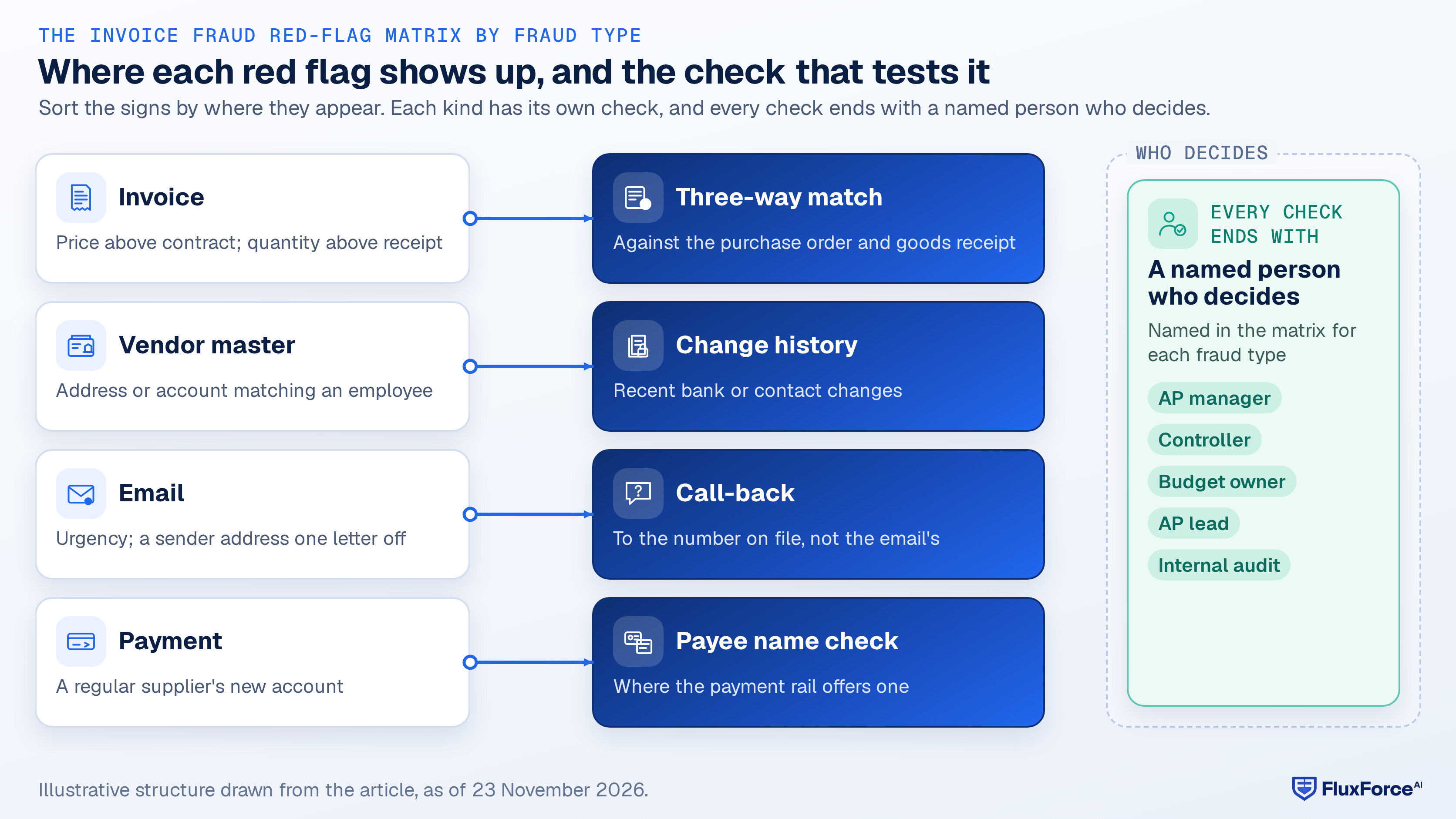
- Signs on the invoice itself go to the three-way match. Signs in the vendor master go to its change history. Signs in the email go to a call-back to the number on file. Signs at payment go to the payee name check.
| Fraud type | Red flags to look for | Check before judgment | Who decides |
|---|---|---|---|
| Bank-detail change (vendor impersonation) | Email says a regular supplier's account changed; urgency or "late payment" claims; a sender address one letter off | Call the supplier on a number from records older than the request; check the vendor master for recent contact changes; run a payee name check | A second person who didn't receive the request |
| Real supplier, hijacked mailbox | Genuine invoice, right amounts, new account; a pretext such as an audit of the usual account | Same call-back; compare the account with the last paid invoice; ask the supplier to confirm its last three payments | AP manager, with the call-back result |
| Fictitious or shell vendor | No street address or a mail-box address; non-business email; foreign account for a domestic firm; address or account matching an employee | Match vendor master to HR records; confirm the company exists; require onboarding outside AP | Procurement head or controller |
| Duplicate invoice | Same amount and date under a slightly different invoice number or a second vendor record | Duplicate test across every vendor ID, including second records for one supplier | AP lead |
| Inflated or overbilled invoice | Price above contract; hidden fees; quantity above goods received | Three-way match plus contract price check | Budget owner |
| Split invoices | Several invoices from one vendor just under an approval limit | Sum invoices by vendor over a window against the limit | Approver one level up |
| Kickback or collusion | Steady rise in one supplier's share; inflated purchase orders; close ties between a buyer and a supplier | Review purchase order changes by user; rotate buyers; compare prices across suppliers | Internal audit or compliance |
| Fake or AI-made document | Arithmetic that doesn't add up; metadata that doesn't fit; no matching purchase order or receipt | Recompute totals; check the document against the purchase order and vendor history, not its look | AP manager |
The second figure shows how the matrix routes each kind of sign. Signs on the invoice itself go to the three-way match. Signs in the vendor master go to its change history. Signs in the email go to a call-back to the number on file. Signs at payment go to the payee name check. Every check ends with a named person who decides.
The signs in the first two rows come from the UK National Crime Agency's list, which flags urgency, messages saying a regular supplier's bank details have changed, invoice details that don't match earlier genuine invoices and small changes to the supplier's email address. The NHS Counter Fraud Authority tells staff to verify bank changes using contact details already on file, to check those details haven't recently changed themselves, and to take the contact from existing records rather than the request. It also suggests asking the supplier to confirm the amount and date of its last three transactions. Calling back the number in the email doesn't count. A spoofed vendor email sent to Bernalillo County, New Mexico, carried a phone number the fraudster controlled, and the county paid $447,372.89 over several months.
For shell vendors, fraud auditors match vendor master records to HR records by address and bank account, and look for missing addresses, mail-box services, non-business email and a foreign account for a domestic company. For kickbacks, the inspector general of the US General Services Administration lists overly friendly relationships with contractors and unexplained increases of business with one contractor among its red flags. The duplicate row matters because, as the Washington State Auditor puts it, most software flags a repeated invoice number only within the same vendor number, so a second vendor record slips past.
The third column follows a rule we call checks before judgment. The agent runs the defined checks and gathers the evidence, then a person judges whether to pay.
Treat every bank-detail change as unverified until someone has called the supplier on a number you held before the request arrived. Nothing in the email counts as proof, including the phone number in its signature.
How invoice fraud detection works: checks before judgment
Detection works when every invoice and every change passes the same checks in the same order, written down before anyone approves. Capture the invoice and its purchase order. Match price and quantity against the purchase order and goods receipt. Check the vendor master for recent changes to bank details, contacts or address. If anything changed, verify by calling a number from records older than the change. Run a payee name check where the payment rail offers one. Send anything that fails to a person with the evidence. Release payment only after that person approves.
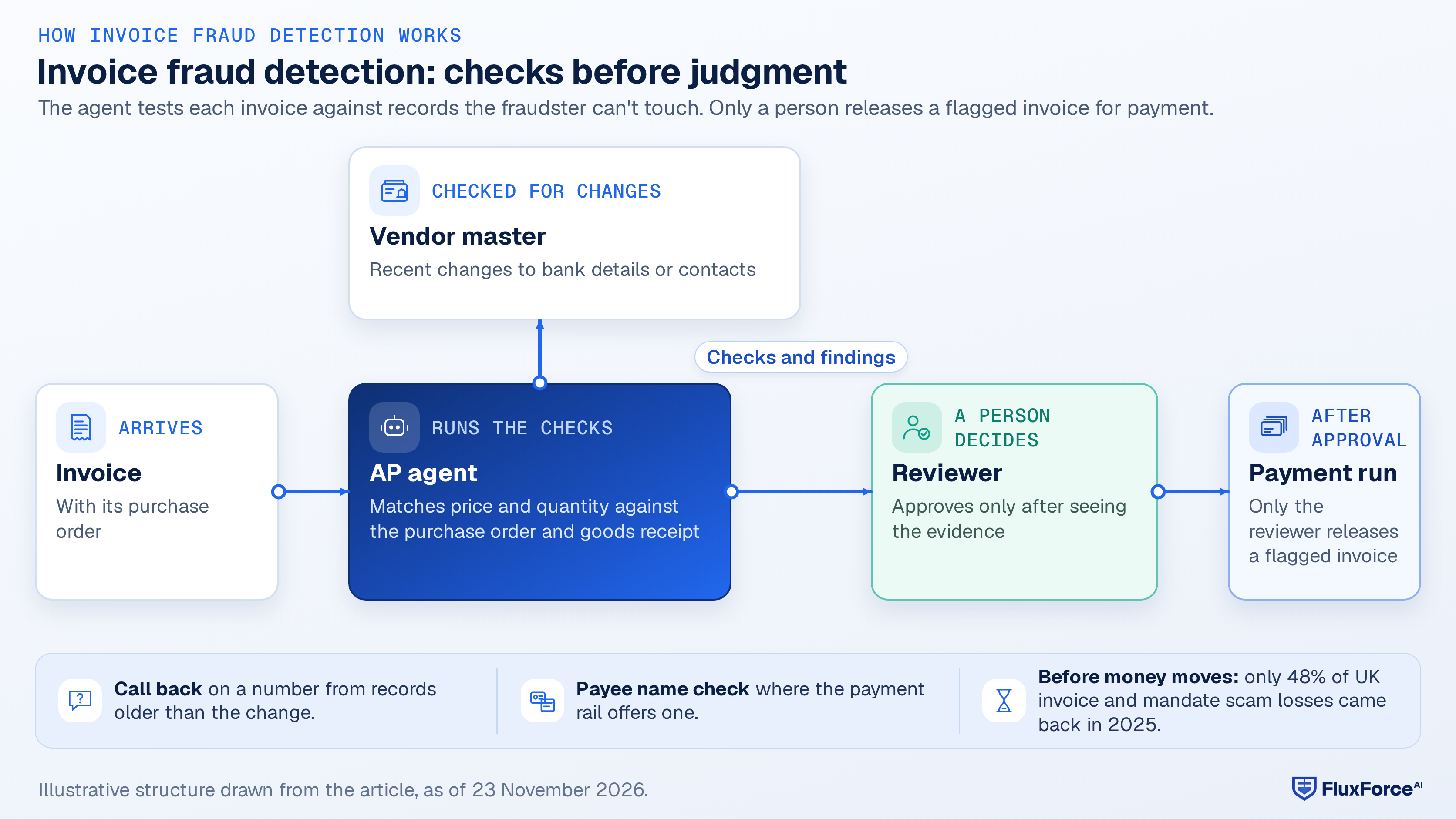
- The invoice and its purchase order reach the AP agent. The AP agent checks the vendor master for recent changes to bank details or contacts. The AP agent sends each flagged invoice to the reviewer with the checks it ran and what it found. Only the reviewer can release a flagged invoice to the payment run.
The first figure shows that order as a flow. The invoice and its purchase order reach the AP agent. The AP agent checks the vendor master for recent changes to bank details or contacts. The AP agent sends each flagged invoice to the reviewer with the checks it ran and what it found. Only the reviewer can release a flagged invoice to the payment run.
The call-back has to use official records. In the AFP's 2026 survey, calling an authorised contact at the payee on a phone number from official records, not from email, was rated very effective by 63% of organisations, the highest of the business email compromise controls it measured. The check must also happen before the money moves, because recovery is poor. Only 48% of UK invoice and mandate scam losses were returned to victims in 2025.
Invoice anomaly detection: the methods and their limits
Invoice anomaly detection finds invoices or payments that don't fit the normal pattern. Each method sees one kind of oddity.
| Method | What it catches | Where it's blind |
|---|---|---|
| Three-way match | Price or quantity above the purchase order or goods received | Bank-detail changes; inflated purchase orders; faked receipts |
| Duplicate testing | Repeat invoices, including across vendor records | Well-disguised fake vendors |
| Benford's law digit tests | Amounts that cluster oddly, such as just under limits | Small datasets; deviations with innocent causes |
| Split-invoice rules | Several invoices under a single-invoice limit | Splits spread across vendors |
| Vendor-to-employee matching | Shell vendors sharing an employee's address or account | Fronts using third-party details; fuzzy matches create false alarms |
| Machine-learning models | Unusual combinations across many fields | Fraud types missing from training data; inflated test scores |
The Washington State Auditor's AP guide calls the three-way match, comparing quantities and prices on the purchase order, receiving document and invoice, a standard best practice that shouldn't be dropped to save time. It can't see a bank change, though. In a federal case sentenced in 2024, a ferry builder paid a $3,316,730 engine invoice to a fraudster's account after emails said the engine maker's usual account was "undergoing an audit". It can also be beaten from inside. A Missouri employee altered 152 purchase orders and issued 82 fictitious ones, $3.82 million in all, in a deal with suppliers for kickbacks. When the purchase order is the fraud, a match against it proves nothing.
Duplicate testing has to look across vendor numbers. Mark Nigrini's tests find the same invoice number and amount paid to different vendor numbers. In a 2022 post, the Washington State Auditor cites industry estimates that duplicate payments run from 0.8% to 2% of total payments, an estimate rather than a measured rate.
Benford's law compares the leading digits of amounts with their expected frequency. ISACA warns it suits only large datasets and that fewer than 1,000 records can produce too many false positives. Nigrini notes that deviations can have innocent causes, such as processing inefficiencies or per diem amounts. Treat a Benford spike as a reason to look, never as proof.
Split-invoice rules sum small invoices by vendor and flag the vendor if the total passes a set limit, as one ERP vendor's documented method does. Vendor-to-employee matching finds shell companies, but fuzzy name matching tends to create false positives.
Machine learning helps most when it's tested honestly. A 2026 benchmark on ERP data, published as a preprint, found that leakage-safe testing cut previously inflated accuracy figures, and that three-way match discrepancies were the most informative predictors.
AI invoice fraud detection: what agents add and where they fall short
AI invoice fraud detection means one of two things. A model scores each invoice for risk, or an AI agent does the investigation around the score. It pulls the purchase order and receipt, reads the vendor master history, recomputes the totals and writes up what it found for a person to judge.
The second matters because fraud is moving faster than document checks. The FBI says businesses reported more than $30 million in 2025 losses to business email compromise scams involving AI, and that voice cloning can be used to request wire payments. Europol's 2026 threat assessment reports more realistic business email compromise and CEO fraud linked to generative AI. A lawyer quoted by ICAEW, the accountancy body, warns that AI-generated invoices can carry genuine-looking logos and layouts, and that a matching email thread can be faked within 10 minutes.
Visual checks alone won't hold. In a 2026 benchmark of AI-inpainted numbers on receipts and forms, the published tamper detector DocTamper scored an AUC of 0.563 against 0.98 on its usual test data, and a GPT-4o judge scored 0.509, close to chance. A separate 2026 study found the main sign of AI-made receipts was arithmetic errors that people can't see but a language model can check in milliseconds. Recomputing and cross-checking against records is work an agent can do on every invoice.
Where agents fall short is judgment and accountability. An agent can't take responsibility for releasing a large payment. The ICAEW article advises an additional layer of review before money leaves the organisation. The right design has the agent prepare and the person decide, with every check written to a record an auditor can follow later.
Invoice fraud detection software: what to ask before you buy
Invoice fraud detection software is easy to buy on a label. These questions separate tools that prepare evidence from tools that only raise a flag.
- Does it check the vendor master history, or only the invoice in front of it?
- Does it verify bank changes against records older than the request, never contact details in the request?
- Does it test duplicates across every vendor record, including second records for one supplier?
- Does every flag come with the checks run, the evidence and a plain reason?
- Can your team set the thresholds for pass, review and hold, and change them?
- Does a person release every flagged payment, and is that release recorded with a name?
- Can it run in shadow mode beside your current process before it changes anything?
- Does it cover bulk payment runs and cross-border suppliers?
The bulk-run question matters more than it looks. The UK's 2022 Confirmation of Payee direction exempts some bulk payments where the customer isn't present, and payments to accounts outside the UK. Under the EU's Instant Payments Regulation, business payers sending payments as a package can opt out of Verification of Payee, and the bank must warn them the money may reach an account not held by the intended payee. An AP payment file can therefore leave with no name check at all.
Invoice fraud prevention controls that stop the payment
The COSO Internal Control framework lists authorisations, approvals, verifications and reconciliations as control activities that can prevent or detect, and says segregation of duties is typically built into them. Its Principle 8 says an organisation considers the potential for fraud when assessing risks.
Five controls carry most of the weight for AP.
- Only named people can change vendor bank details, and never the person who pays. Action Fraud advises letting only designated employees change payment arrangements.
- Every bank change gets a call-back to a number on file, plus a check that the contact details didn't change recently, as the NHS Counter Fraud Authority advises.
- Dual approval above a threshold, and a small test payment before a large first payment to a new account.
- Email authentication on your own domains. The UK National Cyber Security Centre says a DMARC policy of "reject" on all of your domains is the best way to stop spoofing of your email. DMARC protects your domain only, so it does nothing against a lookalike domain or a supplier's hijacked mailbox.
- Extra care in busy periods. The NHS Counter Fraud Authority notes that change requests often arrive during busy periods with an urgent need for payment.
Payee name checks help, with limits. The EU's Verification of Payee has applied in euro-area member states since 9 October 2025, returning "match", "close match", "no match" or "other" before payment. A match proves only that the name fits the account. In a case that ended with a five-year sentence in 2019, Evaldas Rimasauskas registered a Latvian company with the same name as an Asian hardware maker and induced two US internet companies to wire over $120 million.
What do the rules expect from a finance team?
No single law tells a private company how to check invoices, but several make weak controls expensive.
In the US, the SEC's 2018 report on cyber-related frauds looked at nine public companies that lost nearly $100 million to spoofed executive and vendor emails. One paid eight invoices totalling $1.5 million over several months, and only found out when the real vendor complained about past-due invoices. The SEC said issuers subject to Section 13(b)(2)(B) of the Exchange Act must calibrate internal accounting controls to the current risk environment.
Since 19 June 2026, Nacha's ACH rules require every non-consumer originator, which includes many corporate AP teams, to have risk-based processes reasonably intended to identify ACH entries initiated due to fraud, reviewed at least annually.
In the UK, the failure to prevent fraud offence came into force on 1 September 2025 for large organisations. It covers fraud by an associated person intended to benefit the organisation, and an organisation isn't liable where it is the victim. That means it doesn't apply to supplier fraud against your AP team. Mandatory APP reimbursement covers only individuals, micro-enterprises and charities, capped at £85,000. A mid-size company usually carries its own invoice fraud losses unless the bank recalls the money in time.
In the EU, the AI Act's high-risk category for credit scoring expressly excludes AI systems used to detect financial fraud.
Retail and manufacturing: one bank-detail change, traced
Manufacturers and retailers pay many suppliers, often in bursts around quarter end. Between 2023 and 2024, the safety manager at an Alabama cellulose plant approved payments to a friend's shell company more than 20 times, nearly $1.3 million in all. Toyota Boshoku said in 2019 that fraudulent payment directions from a third party had caused its European subsidiary an expected loss of up to about 4 billion yen.
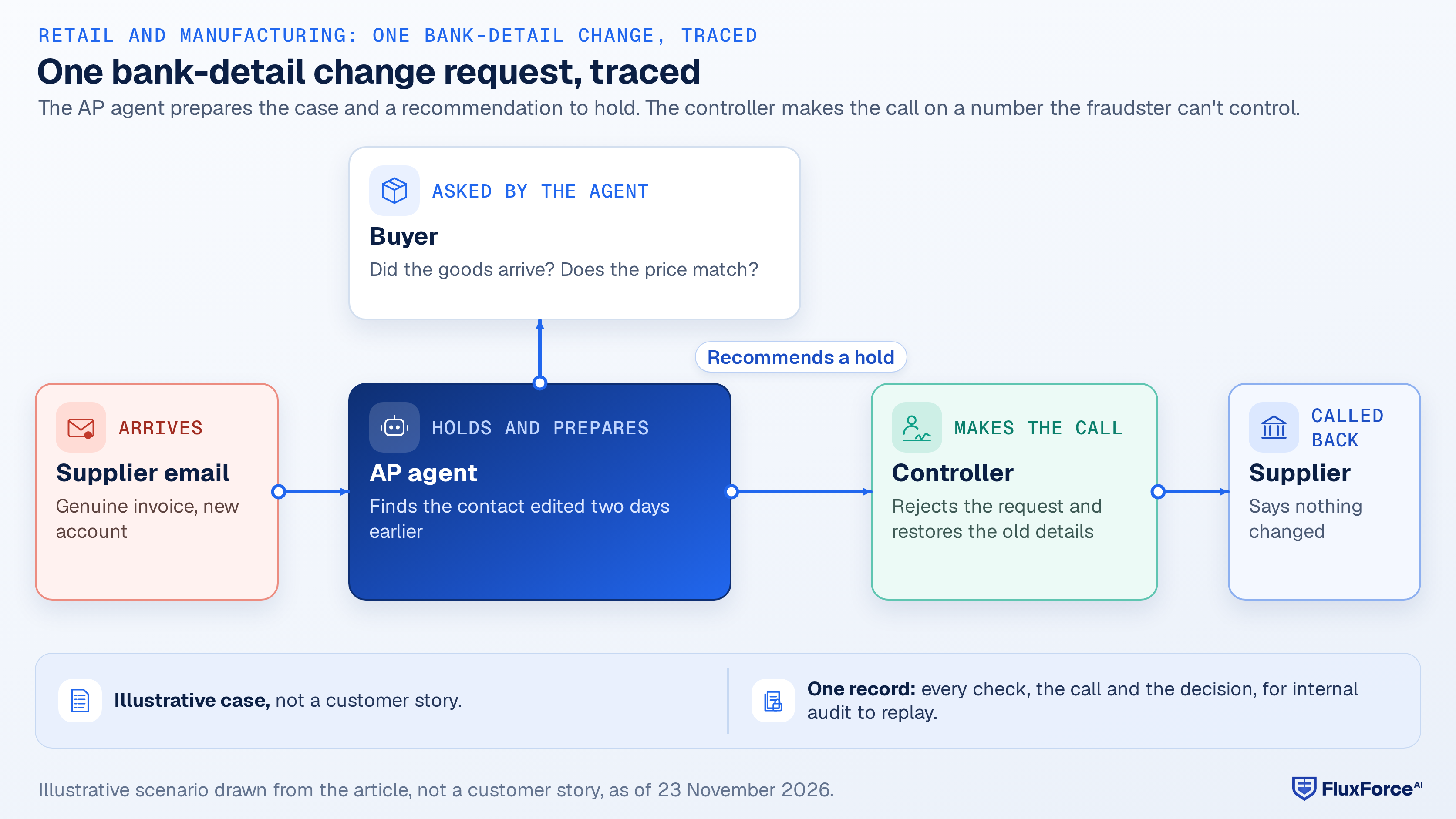
- The supplier email and its attached invoice go to the AP agent. The AP agent asks the buyer in procurement whether the goods arrived and the price matches the contract. The AP agent sends the case to the controller with the old and new account, the call-back number and its recommendation to hold. The controller calls the supplier on the number from the original contract.
Illustrative scenario: a component supplier "changes banks" before quarter end
This is an illustrative case, not a customer story. A mid-size manufacturer's AP inbox receives an email from a long-standing component supplier with a genuine invoice and a matching purchase order. The email says the supplier's usual account is under audit and asks for payment to a new account this week.
- The AP agent finds the invoice passes the three-way match, so price and quantity are fine.
- It sees the request changes bank details, which no clean match covers, and holds the invoice.
- It finds the vendor master contact was edited two days earlier, by a request from the same email thread.
- It pulls the supplier's phone number from the original contract, two years older than the request.
- It writes up the case with the old and new accounts, the edit history, the audit pretext and a recommendation to hold.
The third figure shows the same case as a flow. The supplier email and its attached invoice go to the AP agent. The AP agent asks the buyer in procurement whether the goods arrived and the price matches the contract. The AP agent sends the case to the controller with the old and new account, the call-back number and its recommendation to hold. The controller calls the supplier on the number from the original contract.
The supplier says nothing changed. The controller rejects the request, restores the old contact details and reports the attempt, and the invoice is paid to the old account on time. Every check, the call and the decision sit in one record internal audit can replay later.
What should you do when the money has already gone?
Move within hours. The FBI says time is of the essence. Contact your bank immediately to request a recall, and file an IC3 complaint whatever the amount. In 2025 the FBI's Financial Fraud Kill Chain handled 3,900 incidents with $1.16 billion in attempted theft and froze $679 million, a 58% success rate.
How FluxForce approaches invoice fraud detection
FluxForce is the platform your departments run AI agents on. The agents investigate and prepare the work, a person makes the call, and every step leaves evidence an examiner can replay. The industry calls that record a decision trace, and our term for the way it's built is checks before judgment.
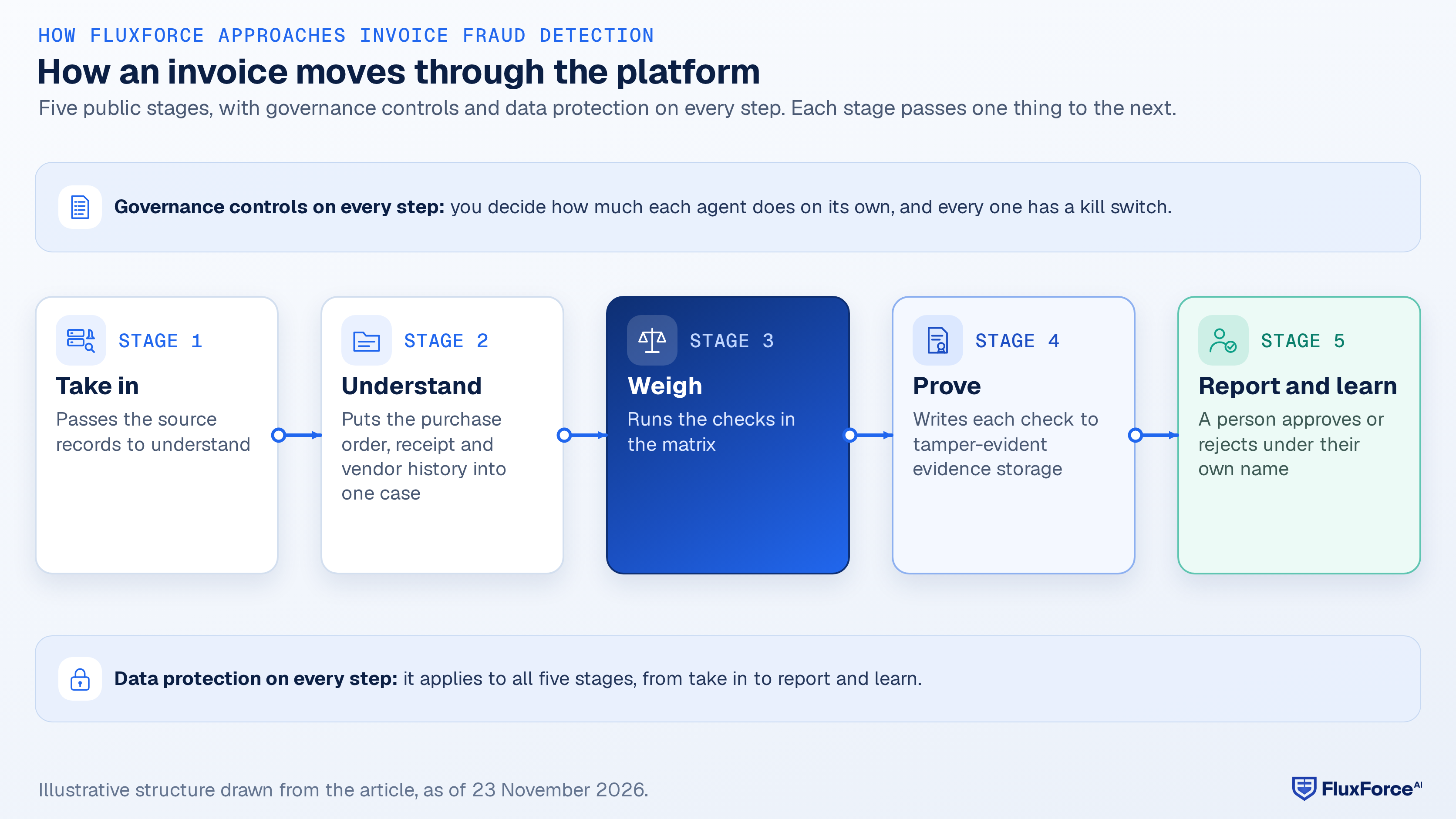
- Take in passes the source records to understand. Understand passes one assembled view of the case to weigh. Weigh passes the checked recommendation and its reasons to prove. Prove passes the evidence record to report and learn.
The platform works in five public stages, take in, understand, weigh, prove, and report and learn, with governance controls and data protection on every step. The fourth figure shows how an invoice moves through them. Take in passes the source records to understand. Understand passes one assembled view of the case to weigh. Weigh passes the checked recommendation and its reasons to prove. Prove passes the evidence record to report and learn.
For an invoice, understand assembles the purchase order, receipt and vendor master history into one case before anything is scored, which we call context before decision. Weigh runs the checks in the matrix, prove writes each one to tamper-evident evidence storage, and in report and learn a person approves or rejects under their own name.
The closest of our solutions is Fraud Prevention. Its page says "You set the score bands for pass, review and hold." and "High-risk payments always go to a person." "Every score lists the signals that drove it", and it "Starts in shadow mode, scoring beside your current rules." See how Fraud Prevention works.
On fit, our first app line is financial crime and compliance. AI agents that investigate AML, sanctions, fraud and KYC alerts and prepare the case. Your analyst makes the call, with evidence an examiner can replay. You decide how much each agent does on its own, and every one has a kill switch. Fraud Prevention's page is written for banks and fintechs scoring payments, so an AP team gets the same agent pattern with fewer ready-made templates, and we can't point you to customer results yet. If your AP volume is small and your suppliers rarely change, a strict call-back rule and dual approval may be all you need.
How do you start with invoice fraud detection?
Start with bank-detail changes, because they cause the largest losses and need the fewest data sources. Pull the last 12 months of vendor master edits and check each one against the matrix. Then run an agent in shadow mode, preparing each change request beside your team without acting, and compare its write-ups with what your team did.
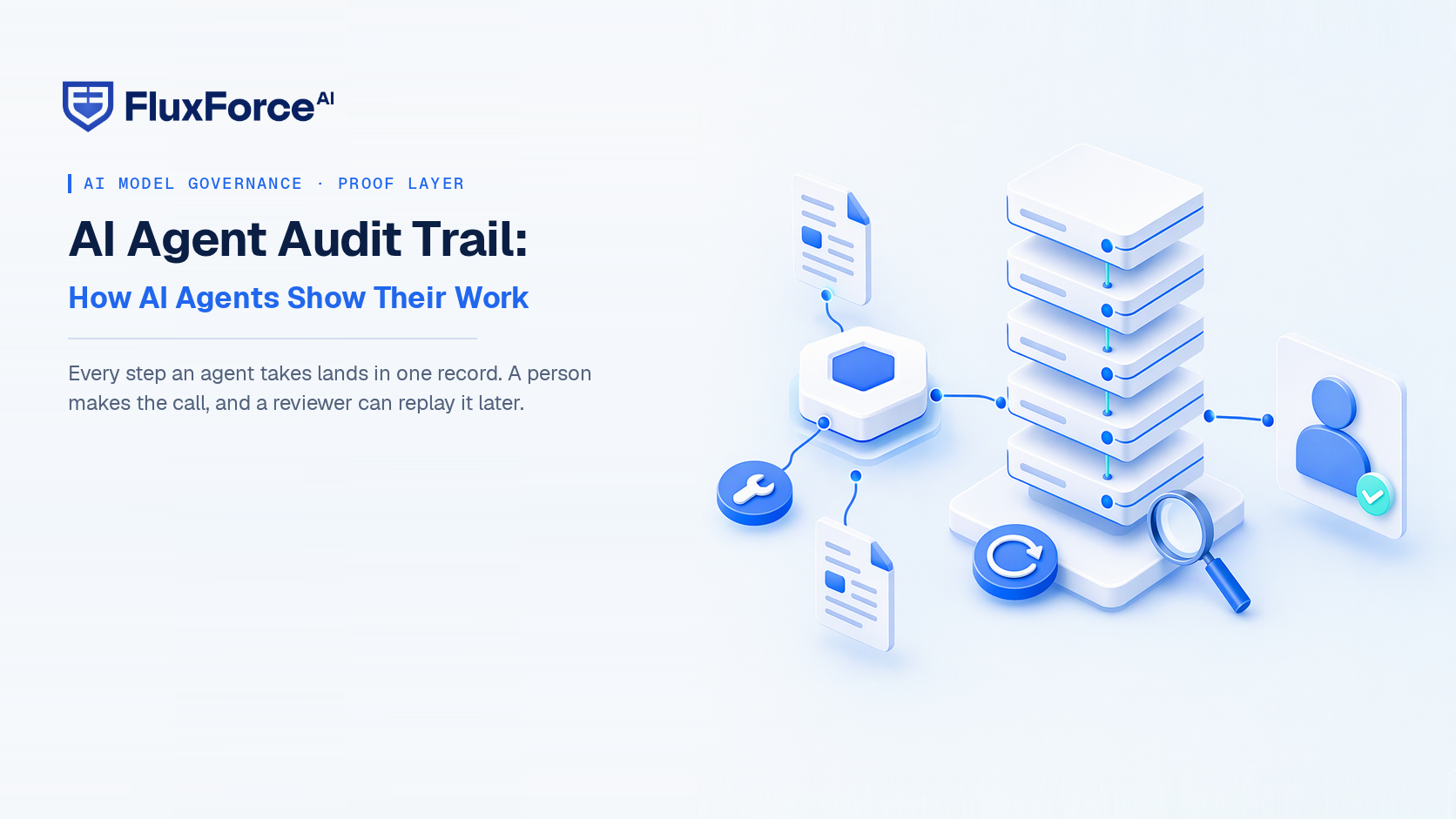
Our human-in-the-loop review control covers what a real review looks like, and AI-enhanced core audit trails for retail banking shows how each decision stays traceable. See also how AI agents show their work in an audit trail, our business email compromise glossary entry, shell company definition, Confirmation of Payee explainer and fraud typology library.
- Most invoice fraud looks like a routine supplier bank-detail change.
- Verify every change by calling a number from records older than the request.
- Three-way match can't see bank changes, inflated purchase orders or faked receipts.
- A payee name match proves the name fits the account, not that the request is real.
- Agents run the checks and prepare the case; a person releases the payment.
Conclusion
Pick the last ten bank-detail changes in your vendor master and ask who verified each one, how, and where that's written down. If the answer is an email chain, your controls depend on the one channel fraudsters control. Fix that first, then add the duplicate, split-invoice and vendor-to-employee tests.
Request the invoice fraud red-flag matrix
Frequently Asked Questions
About the author

Sahil Kataria
Founder and CEO of FluxForce

Share this article