




Identify
The agent checks ID documents and traces company ownership through to the people who control it.




28 specialized agents
See an agent work your alert queue
AI agents investigate and prepare the case. Your analysts decide, with evidence an examiner can replay.View All Solutions

Rhea LedgerSenior AI KYC/AML Compliance DirectorKYC/AML & Sanctions Screening
Iris VermaSenior AI Identity Verification SpecialistIdentity Verification & KYC
Nova SentinelLead AI Zero Trust Security ArchitectZero Trust Access Security
Cian GatekeeperLead AI Customer Identity DirectorIdentity Management & Account Takeover
Zara TrustwellDirector AI Regulatory ComplianceSTR / SAR Reporting & Regulatory Evidence
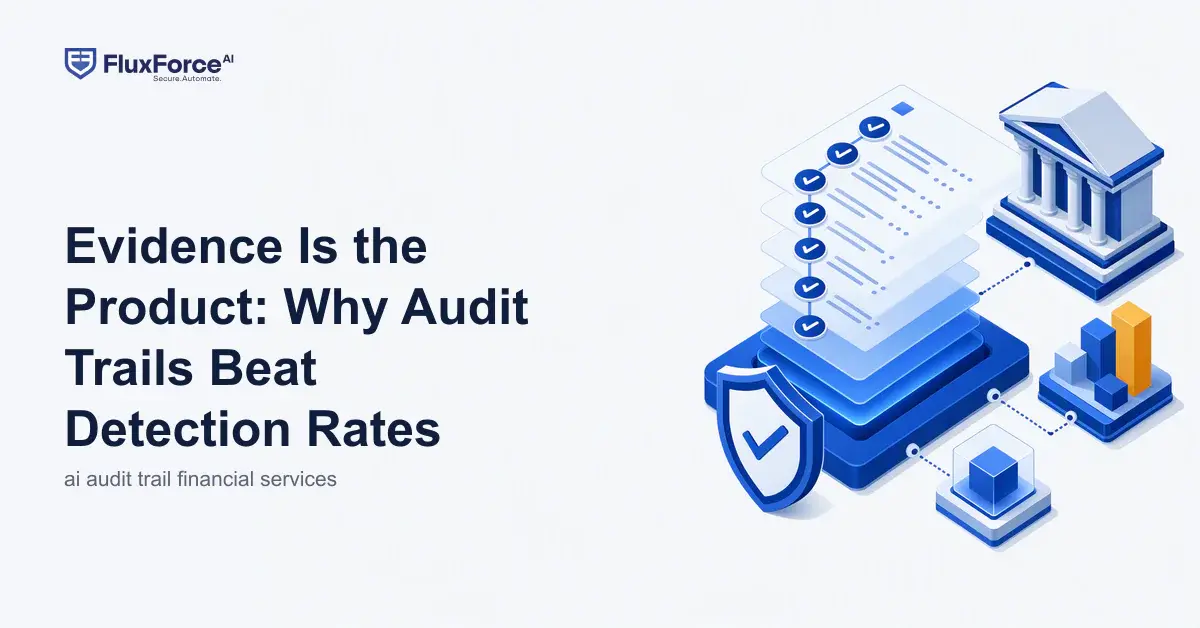
Arin NarrateSenior AI Audit Trail SpecialistAudit Trail & Evidence Management
Riya IntelDirector AI Governance & Model RiskModel Governance & Model Risk
Nolan BriefwellSenior AI Incident Response NarratorCase Management & Investigations


28 specialized agents
See an agent work your alert queue
AI agents investigate and prepare the case. Your analysts decide, with evidence an examiner can replay.View All AI Agents


28 specialized agents
See an agent work your alert queue
AI agents investigate and prepare the case. Your analysts decide, with evidence an examiner can replay.View All IndustriesBank-grade AML duties, usually one Compliance Officer. Real estate brokers, gold dealers, corporate service providers, accountants and lawyers all carry CDD, screening and reporting obligations.
FluxForce AI agents identify the real owner behind each client, screen every party and draft the suspicious transaction report from the case file. Your Compliance Officer reviews and decides, with evidence an inspector can replay.
Most DNFBP risk comes down to two questions: who is really paying, and who really owns the buyer? The agents answer both before the deal closes and keep the file ready for your supervisor.
The agent checks ID documents and traces company ownership through to the people who control it.
Every person on the file is screened against sanctions, PEP and adverse media, and the client gets a risk rating built from your own risk assessment.
Your Compliance Officer approves the client, asks for more or turns the case into an STR draft. Every step is stored tamper-evident for inspection.
DNFBPs face supervisor inspections on a fraction of a bank's compliance budget. The agents take the file-building off that one person's desk, and leave the decisions on it.

Cash deposits, buyers hidden behind companies and payments from people who aren't on the contract. Agents trace each buyer to its real owner, check where the funds come from and flag third-party payments before the deal completes.

Large cash purchases, repeat buys that stay just under a reporting limit and scrap gold with no clear origin. Agents link transactions across a customer's visits and draft cash and suspicious transaction reports for your sign-off.

You form the companies others hide behind. Agents verify every director, shareholder and beneficial owner at formation, then watch for ownership changes and adverse media for as long as you act for the company.

Your duties apply when you handle client money, property deals or company structures. Agents run CDD and screening for those engagements and keep a file you can hand to your supervisor or professional body.
Start with client onboarding and screening, then add reporting. Each solution runs on the same agents, case file and evidence trail, so the second one builds on the first.
Speed is easy to sell. What your examiner asks is why an alert was closed, who closed it and what they looked at. Every part of FluxForce is built to answer that.
Medium risk goes to an analyst by default. High risk always does. You set the bands for each agent.
Transactions, customer profile, screening results and match reasoning sit in one file, so nobody copies between systems.
Stored tamper-evident, so a supervisor or examiner can replay how any case was handled, months later.
Agents draft STRs and cash transaction reports from the case evidence. Nothing goes to the FIU until your Compliance Officer approves it. Who decides at each risk level is your call:
Run it where your data residency rules say it has to run. Built on Microsoft Azure.
Your CISO will ask what an AI agent can touch. Only what you've permissioned, and you can switch any agent off.
FluxForce takes an alert in and hands your team a case it can decide on, with every step on record.
Written for the people who sign off on financial crime decisions.
It's built for teams where compliance is one or two people. You don't need analysts to run it. The agents build the client file and your Compliance Officer reviews it.
No. They draft the report from the case evidence in the format your FIU expects, such as goAML in the UAE. Your Compliance Officer reviews, edits and files it.
The agent traces ownership through each company layer to the people who own or control it, using the documents you collect and the registries available in your market. Gaps are flagged as gaps, so you know what to ask the client for.
You show them the file. Each client record has the documents checked, the screening results, the risk rating with the factors behind it and every decision with who made it and when, stored tamper-evident.
With your current client list. The agents re-screen and risk-rate existing clients first, in shadow mode, so your Compliance Officer sees what they'd flag before any new deal depends on it.
We'll show you the ownership the agent traces, the screening behind it and the report it drafts for your sign-off.
Share a few details and we'll email the deck straight to your inbox.