


















Listen To Our Podcast🎧
Where do AI agents for business work best?
AI agents for business work best where the work is high volume and every decision gets questioned later. Start there, in one department, with a person approving every call until the agent has earned more.
Most firms pick their first department by enthusiasm or by vendor pitch. A better way is to score each department on three things, which are how many repeat decisions it makes, what a wrong call costs, and how often an auditor, regulator, customer or court questions those decisions afterwards. The top scorer is usually the best place to start.
This guide gives COOs at firms of 100 to 1,500 people the scoring grid, the evidence behind it, the controls to set first and a 90-day plan. Last updated 19 November 2026.
- What AI agents in business do, and how they differ from assistants and scripts.
- How to score your departments on volume, risk and how often decisions get questioned.
- Why finance, procurement and claims usually score first, and why HR and customer operations need more care.
- What a department mandate is, and how risk bands decide what an agent may do alone.
- Who decides what, and what to do in the first 90 days.
Request the department scoring grid
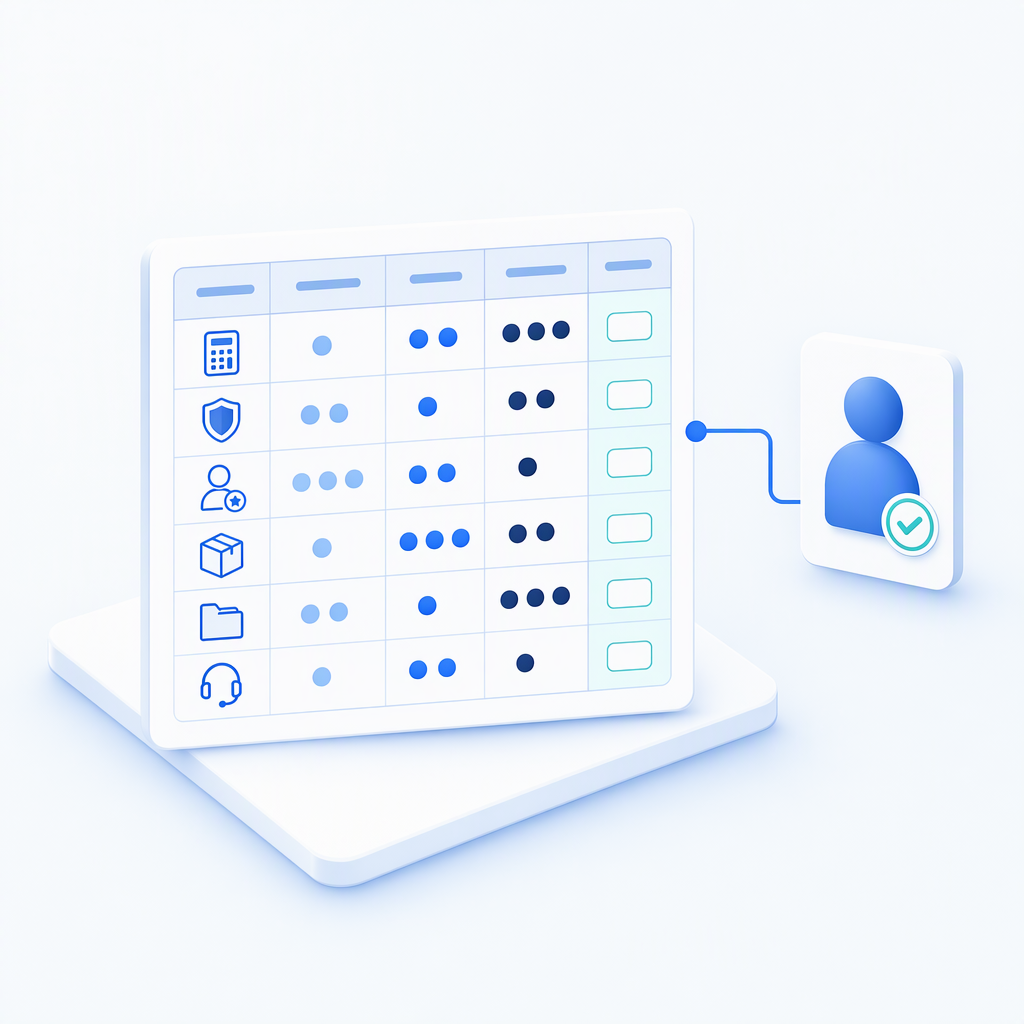
AI agents for business work best where the work is high volume and every decision gets questioned later. Score each department on how many repeat decisions it makes, what a wrong call costs and how often an auditor, regulator, customer or court questions those decisions, then start with the top scorer, with a person approving every call until the agent has earned more.
What are AI agents in business, and what changed in 2026?
An AI agent is software that takes a goal, gathers the information it needs, works through the steps and prepares an outcome for a person to act on. Gartner's advice is to use AI agents where decisions are needed, automation for routine workflows and assistants for simple retrieval.
Adoption is real but uneven. In McKinsey's 2026 survey, 40% of respondents from organizations with more than $1 billion in revenue reported scaling AI agents, up from 27% a year earlier, while smaller organizations stayed flat at 22%. The US Census Bureau found that 32% of firms with 100 to 249 employees used AI in the period ending 3 May 2026, against 19.8% of all firms. Across the OECD, 52.0% of large firms use AI, compared with 17.4% of small firms.
Deployment is still early. Stanford's 2026 AI Index found that AI agent deployment was in the single digits across nearly all business functions. Gartner expects over 40% of agentic AI projects to be canceled by the end of 2027, citing escalating costs, unclear business value or inadequate risk controls.
The firms getting results work differently. McKinsey's high performers redesign workflows that are enabled by AI rather than insert AI into existing ones. Stanford's index reports that productivity gains are largest in structured, measurable work where outputs are easy to monitor.
Where should AI agents for business start first?
Start in the department with the most repeat decisions that someone will later ask you to explain. The grid scores ten departments at a typical mid-market firm from 1 (low) to 3 (high) on each factor. The scores are our recommendation, built from the evidence in the last column, so treat them as a first draft of your own grid.
| Department | Repeat decisions (volume) | Cost of a wrong call (risk) | How often decisions get questioned | Total | Who questions them, and the evidence |
|---|---|---|---|---|---|
| Finance and accounts payable | 3 | 3 | 3 | 9 | External auditors under Sarbanes-Oxley section 404; payment fraud hit 79% of organizations in 2024 |
| Compliance (financial crime) | 3 | 3 | 3 | 9 | Regulators and examiners, who expect a replayable reason for every closed alert |
| HR and recruiting | 2 | 3 | 3 | 8 | Candidates, courts and, from December 2027, EU AI Act high-risk duties |
| Procurement and vendor onboarding | 2 | 3 | 2 | 7 | Auditors and AP; vendor imposter fraud was cited by 45% of organizations |
| Insurance claims | 3 | 2 | 2 | 7 | State insurance regulators under the NAIC AI bulletin, and claimants |
| Customer operations | 3 | 2 | 2 | 7 | Customers, consumer regulators and tribunals |
| IT and security operations | 3 | 2 | 2 | 7 | Internal audit and incident reviews; third parties were involved in 48% of breaches |
| Risk | 2 | 3 | 2 | 7 | Model risk reviews and internal audit |
| Internal audit | 1 | 2 | 2 | 5 | The audit committee |
| Marketing | 2 | 1 | 1 | 4 | Rarely, outside regulated claims |
HR scores 8, yet we don't recommend it first. The EU AI Act treats hiring decisions as high-risk, and that's hard to contain while a team is still learning how agents behave. Finance and compliance score 9 because the volume is high and an auditor or examiner already expects the record. The breach figure comes from Verizon's 2026 Data Breach Investigations Report.
How do you score a department for AI agents?
Score each department on the same questions, with the people who run it in the room. Singapore's IMDA framework for agentic AI puts the logic plainly. Risk is a function of likelihood and impact, and not all use cases are suitable for agents. The NIST AI Risk Management Framework asks you to identify the likelihood and magnitude of each impact before you deploy.
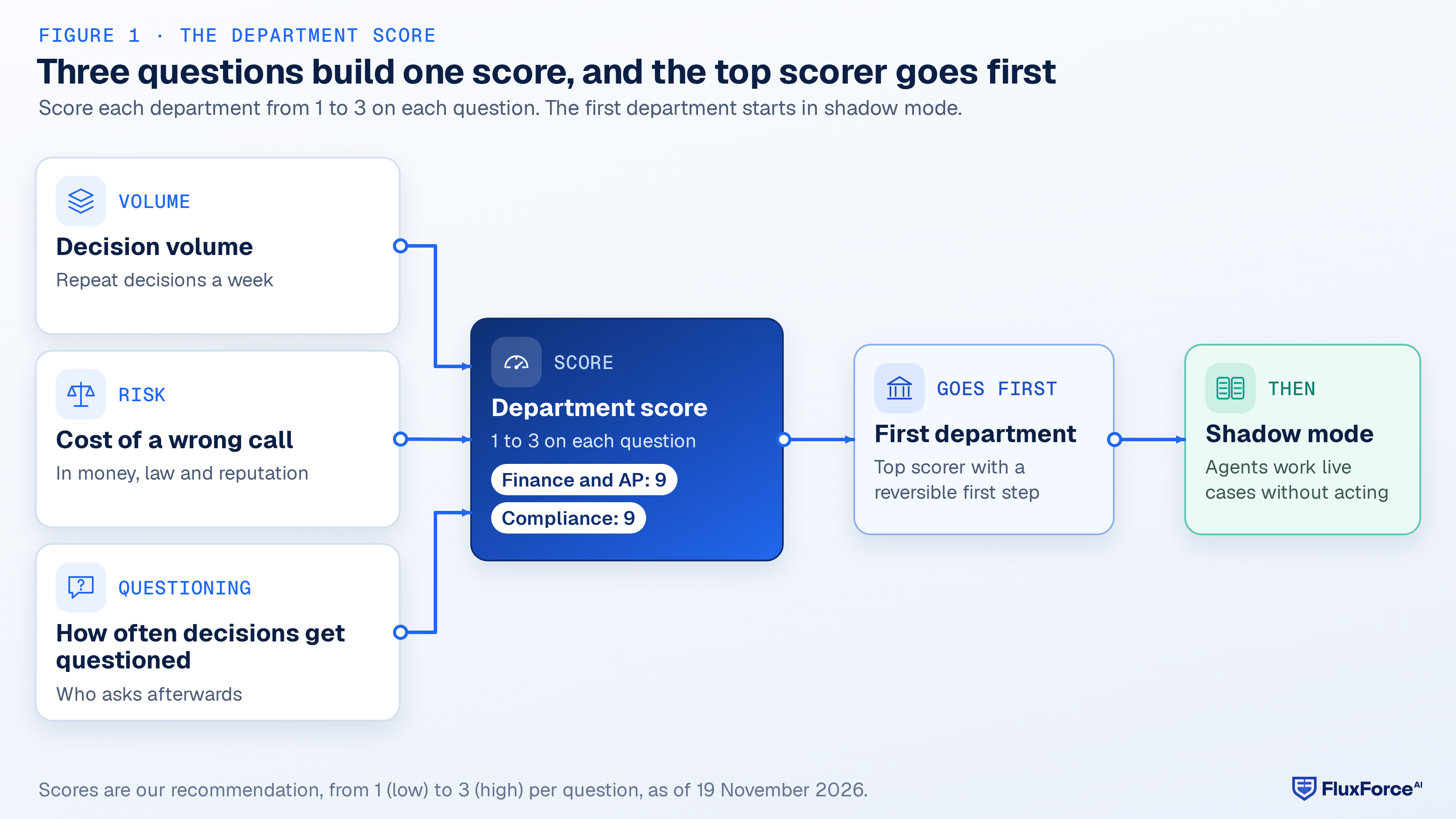
- Decision volume feeds the department score. The cost of a wrong call feeds the department score. How often decisions get questioned feeds the department score. The highest department score picks the first department. The first department runs its agents in shadow mode before anything goes live.
- Volume. Pick one decision type per department, such as invoice exceptions, supplier bank-detail changes or claim triage, and count how many a week. Give the busiest third of departments a 3 and the quietest third a 1.
- Risk. Price a wrong call in money, law and reputation. Give a 3 where a wrong call can't be undone or triggers a legal duty, a 2 where it costs money but can be reversed, and a 1 where it's an inconvenience.
- Questioning. List who asks about these decisions afterwards. Give a 3 where an auditor, regulator or court reviews them as a matter of course, a 2 where customers or internal audit raise them now and then, and a 1 where hardly anyone asks.
- Reversibility. IMDA links agent risk to the scope of actions the agent can take, the reversibility of those actions and the agent's level of autonomy. Check that the first step you hand the agent can be undone.
- Choice. Pick the top scorer with a reversible first step.
IMDA notes that actions may not be easily reversed if they trigger downstream obligations, such as entering into a contract or sale. A paid invoice or a settled claim is hard to pull back. A prepared recommendation isn't, which is why the first step should end with a recommendation.
The first figure shows how the score is built. Decision volume feeds the department score. The cost of a wrong call feeds the department score. How often decisions get questioned feeds the department score. The highest department score picks the first department. The first department runs its agents in shadow mode before anything goes live.
AI agents for business operations: finance, procurement and claims
Finance and accounts payable
Ardent Partners' State of ePayables 2025 puts the average cost to process an invoice at $9.84 and average processing time at 8.2 days. The same research finds that 18.4% of invoices hit an exception, and that exceptions are typically the biggest single reason the cost benchmarks aren't lower. Those exceptions, such as a mismatched purchase order or a missing receipt, are the work an agent can prepare.
In the 2025 AFP Payments Fraud and Control Survey, 79% of organizations were victims of attempted or actual payments fraud in 2024. Section 404 of the Sarbanes-Oxley Act requires each annual report a US-listed company files to contain management's assessment of its internal control over financial reporting. For accelerated filers, the external auditor attests to that assessment. So the controls around AP decisions get tested at least once a year.
Procurement and vendor onboarding
The AFP survey found vendor imposter fraud cited by 45% of respondents, up 11 percentage points from the previous survey. For a supplier's request to change bank details, an agent can compare the request with past changes and prepare the call-back checklist, while a person approves the change.
Insurance claims
In the US, 30 jurisdictions have adopted the NAIC model bulletin on insurers' use of AI systems, according to the NAIC's map dated 13 November 2026. The NAIC says the bulletin reminds insurers that decisions or actions made or supported by AI must comply with all applicable insurance laws. The EU AI Act lists AI for risk assessment and pricing in life and health insurance as high-risk. Its Annex III doesn't list claims handling.
AI agents for business automation: where agents fit and where they don't
IMDA says some use cases may be better served by deterministic workflows. If the rule never changes and the inputs are clean, a script is cheaper and easier to audit.
Agents earn their place when each case needs information from several systems and a judgment about what it means. That's why invoice exceptions suit an agent and clean three-way matches don't, and it's the split Gartner draws between agents for decisions and automation for routine work.
Why HR is a harder first move
The EU AI Act lists AI used to analyse and filter job applications and to evaluate candidates as high-risk. It also covers AI used for decisions on promotion or termination, task allocation and performance monitoring. Regulation (EU) 2026/1744 moved the start of those high-risk duties to 2 December 2027. In the US, a federal court in Mobley v. Workday granted preliminary certification of a nationwide age-discrimination collective in May 2025. The claim rests on a unified policy of using an AI recommendation system to score and sort applicants. HR agents can still prepare interview logistics or policy answers, but screening people out is a poor first project.
Why customer operations needs a named owner
In a June 2023 report, the US Consumer Financial Protection Bureau said chatbots must comply with all applicable federal consumer financial laws, like the processes they replace. In the 2024 case Moffatt v. Air Canada, a British Columbia tribunal called the airline's argument that its chatbot was a separate legal entity "a remarkable submission". The tribunal found that Air Canada didn't take reasonable care to ensure its chatbot was accurate, and ordered it to pay C$812.02. The amount was small, but the company answers for what its agent tells a customer.
What is a department mandate?
A department mandate is the agent mandate set for a whole department. It says what that department's agents may see and do in each risk band. The industry calls the same idea guardrails or decision boundaries.
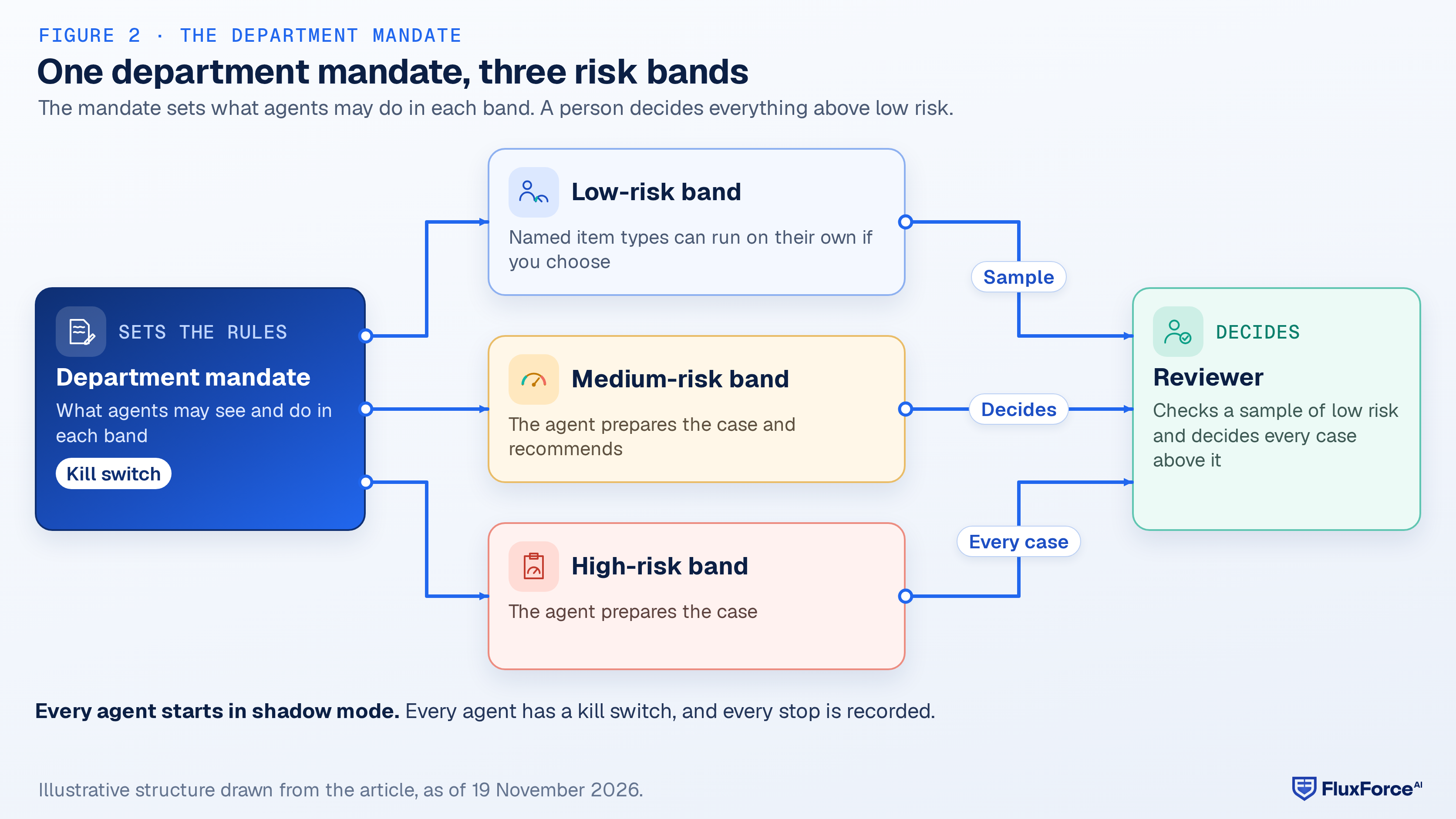
- The department mandate sets what agents may do in the low-risk band. The department mandate sets what agents may do in the medium-risk band. The department mandate sets what agents may do in the high-risk band. In the low-risk band, named item types can run on their own if you choose, and the reviewer checks a sample. In the medium-risk band, the agent prepares the case and the reviewer decides. In the high-risk band, every case goes to the reviewer.
Firms are already drawing these lines. KPMG's Q3 2026 pulse survey found that 49% of leaders have defined high-risk use cases where they don't allow autonomous decision-making by agents.
| Risk band | What the agent does | What a person does |
|---|---|---|
| Low | Prepares the case and, only for item types you name, can proceed on its own | Checks a sample and can switch that permission off at any time |
| Medium | Prepares the case and recommends | Decides every case |
| High | Prepares the case | Decides every case, with a second approver where your policy asks for one |
The second figure shows the department mandate by risk band. The department mandate sets what agents may do in the low-risk band. The department mandate sets what agents may do in the medium-risk band. The department mandate sets what agents may do in the high-risk band. In the low-risk band, named item types can run on their own if you choose, and the reviewer checks a sample. In the medium-risk band, the agent prepares the case and the reviewer decides. In the high-risk band, every case goes to the reviewer.
Every agent starts in shadow mode, working live cases without acting so the team can compare its calls with their own. Every agent has a kill switch, and every stop is recorded.
Key insight: the department mandate is written before the agent runs, by the person who answers for the department's decisions. A vendor can suggest risk bands, but only the department head can sign them.
What does this look like in practice?
The scenario below follows one department through the grid, the mandate and shadow mode. It uses accounts payable because AP scores 9 on the grid and its evidence is the strongest.
Who decides what when AI agents run in a department?
AI agents investigate and prepare the work, and the reviewer makes the call. The department head owns the mandate, and internal audit can replay any decision from the record.
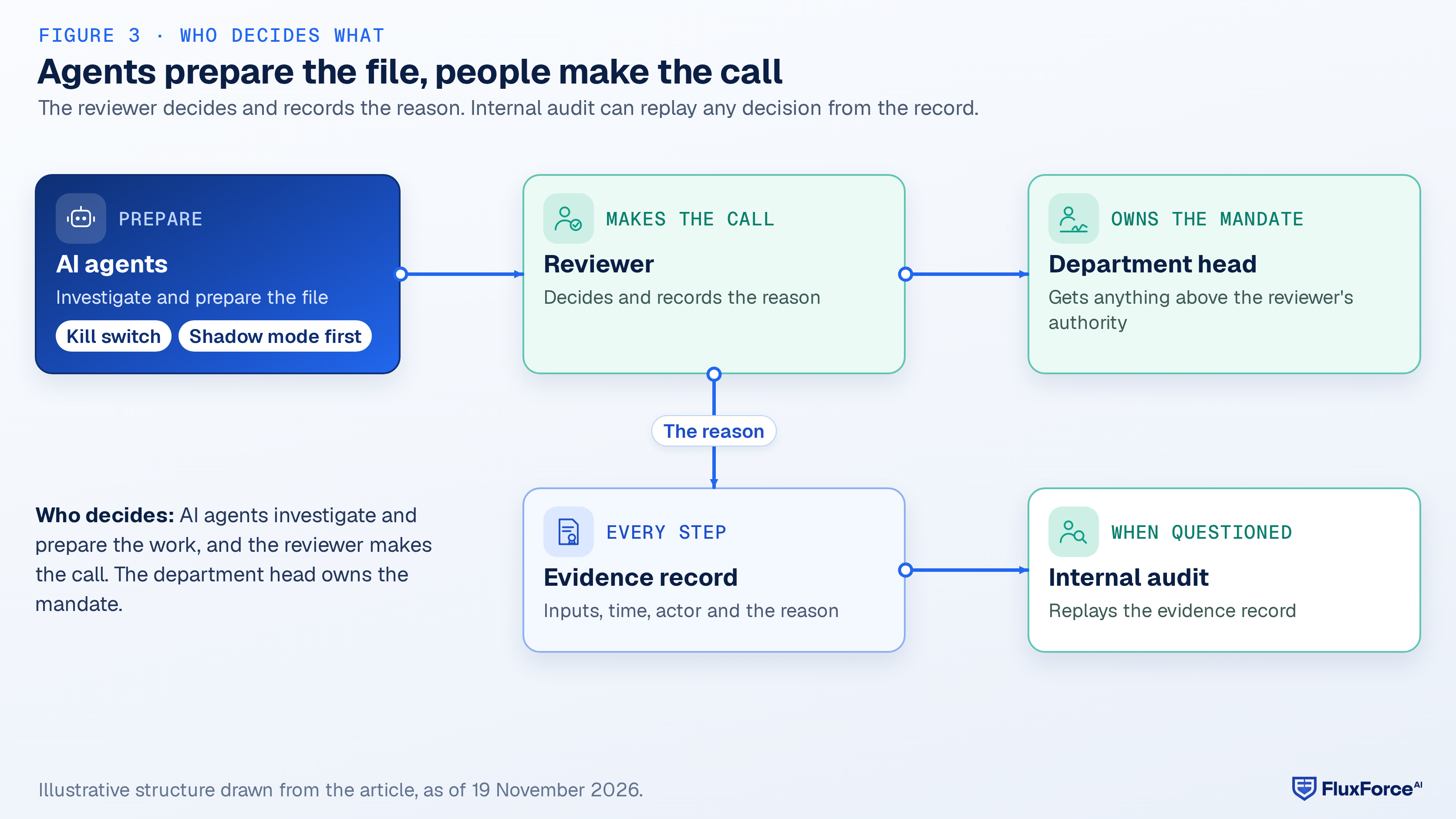
- AI agents investigate the case and pass the prepared file to the reviewer. The reviewer makes the call and records the reason in the evidence record. The reviewer sends anything above their authority to the department head. Internal audit replays the evidence record when a decision is questioned.
The third figure shows the sign-off chain. AI agents investigate the case and pass the prepared file to the reviewer. The reviewer makes the call and records the reason in the evidence record. The reviewer sends anything above their authority to the department head. Internal audit replays the evidence record when a decision is questioned.
AI agents for business leaders: what to ask before you sign
Governance is lagging behind plans. In Deloitte's 2026 State of AI in the Enterprise research, close to three-quarters of companies planned to deploy agentic AI within two years, yet only 21% of those companies reported a mature model for agent governance. When PwC asked 308 US executives in April 2025 which tasks they trusted AI agents to handle, 38% named data analysis but only 20% named financial transactions. Deloitte's advice is the plain one: start with lower-risk use cases, build governance capabilities and scale deliberately.
Before you sign with any vendor, ask these questions.
| Question for the vendor | Why it matters |
|---|---|
| Can a person replay any decision the agent prepared, with the inputs, time and rules of that day? | Auditors and examiners ask for the record, not the outcome |
| Is there a kill switch for each agent, and is every stop recorded? | You need to stop one agent without stopping the department |
| Will the agent run in shadow mode on your own cases before it acts? | Shadow mode shows whether its calls match your reviewers' |
| Which of your departments does the vendor support today, and which are plans? | It separates real agents from rebranded assistants |
The last question protects you from what Gartner calls agent washing, the rebranding of assistants, robotic process automation and chatbots as agents. Gartner estimates that only about 130 of the thousands of agentic AI vendors are real.
How does FluxForce approach AI agents for departments?
FluxForce is the platform your departments run AI agents on. The agents investigate and prepare the work, a person makes the call, and every step leaves evidence an examiner can replay.
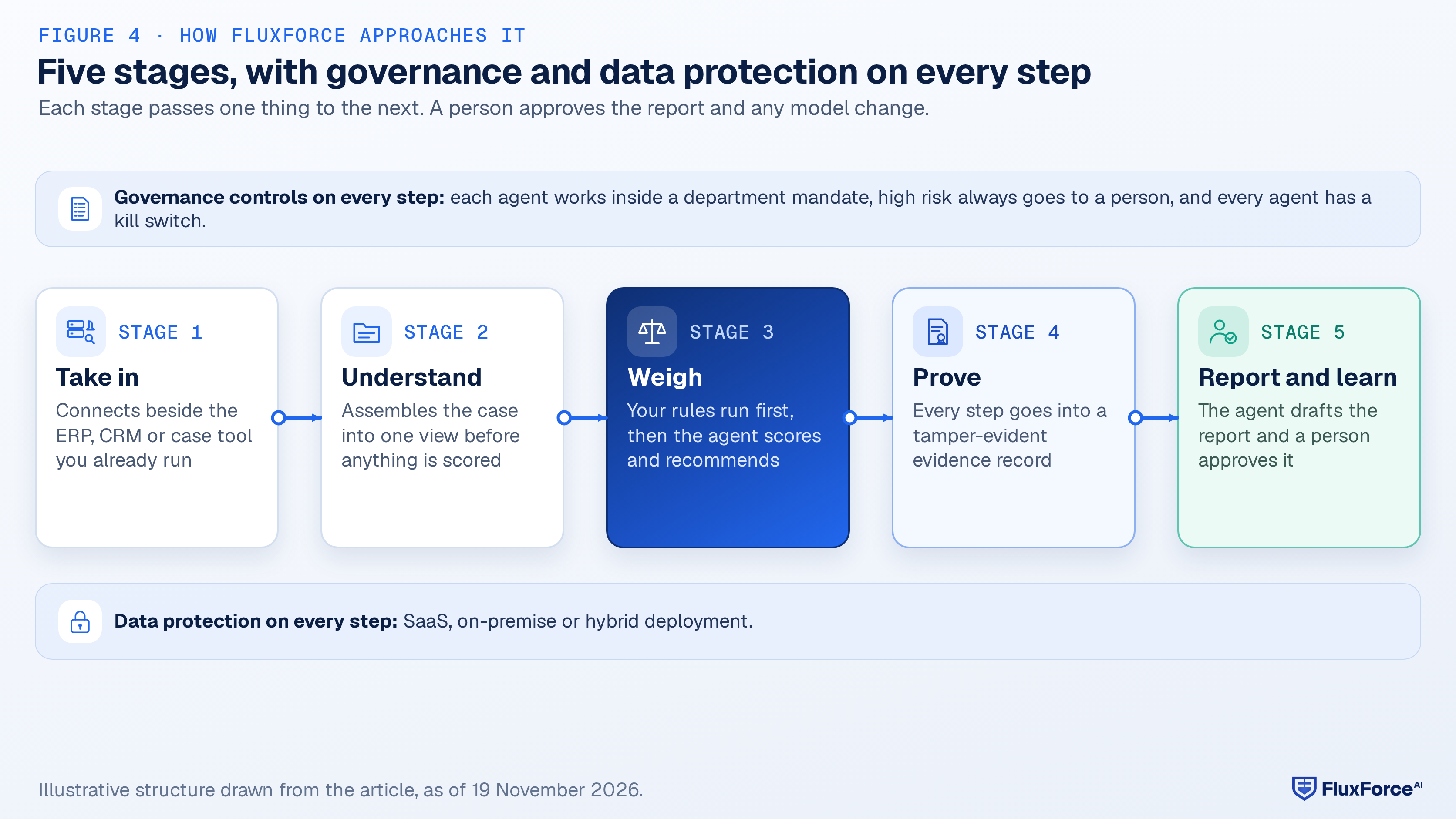
- Take in passes the department's records to understand. Understand passes one assembled view of the case to weigh. Weigh passes the checked and scored recommendation to prove. Prove passes the evidence record to report and learn.
| Public stage | What happens |
|---|---|
| Take in | Agents connect beside the ERP, CRM or case tool you already run, and nothing is migrated |
| Understand | The agent assembles the supplier, claim or application into one view before anything is scored |
| Weigh | Your rules run first as hard checks, then the agent scores the case and recommends, with an explanation |
| Prove | Every step goes into a tamper-evident evidence record with its inputs, time, actor and the rules of that day |
| Report and learn | The agent drafts the report, a person approves it, and models change only after a person approves |
Governance controls apply on every step. Each agent works inside a department mandate, high risk always goes to a person, and every agent has a kill switch. Data protection applies on every step, with SaaS, on-premise or hybrid deployment.
The fourth figure shows the five stages. Take in passes the department's records to understand. Understand passes one assembled view of the case to weigh. Weigh passes the checked and scored recommendation to prove. Prove passes the evidence record to report and learn.
Financial crime and compliance is the first app line on the platform: AI agents that investigate AML, sanctions, fraud and KYC alerts and prepare the case. Your analyst makes the call, with evidence an examiner can replay. You decide how much each agent does on its own, and every one has a kill switch.
Once agents run in more than one department, someone has to know which model version made each call and who approved it. That's the job of FluxForce AI Model Governance, which keeps one inventory covering our agents' models and your own.
To see which agents run on the platform today, start with our AI agents page. Our guide to AI agents in finance and where they fail covers where autonomy stops inside a regulated firm.
- Score each department on repeat decisions, the cost of a wrong call and how often decisions get questioned later.
- Finance and accounts payable and financial-crime compliance usually score highest; HR scores high but carries the most legal risk.
- Write a department mandate by risk band before any agent runs: low risk can run on its own if you choose, high risk always goes to a person.
- Run every agent in shadow mode on live cases, and widen autonomy one item type at a time.
- Gartner expects over 40% of agentic AI projects to be canceled by the end of 2027, and names unclear business value and weak risk controls among the reasons.
Conclusion
The best first department isn't the one with the most hype. It's the one where decisions repeat every day and get questioned every year, so a better record is worth as much as a faster answer. For most mid-market firms that's accounts payable or compliance.
Write the department mandate before the agent runs, and keep a person on every accountable call until shadow mode has shown the agent deserves more. Unclear value and weak risk controls are two of the reasons Gartner gives for the projects it expects to be canceled, and a scored first department with a written mandate answers both.
Request the department scoring grid
Frequently Asked Questions
About the author

Sahil Kataria
Founder and CEO of FluxForce
Share this article