


















Listen To Our Podcast🎧
What makes an AI decision defensible?
Every decision an AI agent prepares will be questioned one day, by an auditor, a regulator, a court or the person it affected. Defensible AI decisions are the ones you can answer for on that day. You can name who decided, show what was known and which rules applied, explain the outcome to each reader, and let someone else replay it and challenge it.
In February 2025 the EU's highest court ruled on a refused phone contract that would have cost €10 a month. The court said the person was owed a description of the procedure and principles applied, and that handing over the algorithm wasn't enough. If a €10 decision has to be explained that way, so does every decision your agents prepare.
This piece is for General Counsel and Chief Risk Officers. It gives you a five-question test to run on one decision this week. Last updated 19 November 2026, it reflects the rules as they stood on that date and isn't legal advice.
- What makes a decision defensible.
- A five-question defensibility test for one decision.
- Which EU, UK, US and Singapore rules sit behind each question.
- Why AI decision support fails when nobody checks the reviewer.
- How to explain one decision to three readers and test it for bias.
Request the five-question defensibility test

Defensible AI decisions are decisions an AI system prepared or made that can be explained and replayed for whoever questions them. To test one, pick a finished decision and answer five questions from the record alone: who decided, what it knew, which rules applied that day, why this outcome, and whether someone else can replay and challenge it.
What are defensible AI decisions?
Defensible AI decisions are decisions an AI system prepared or made that can be explained and replayed for whoever questions them. At FluxForce we call this outcome defensible decisions. The industry terms for parts of it are explainable AI and AI accountability.
Defensibility lives in the record more than in the model. The Organisation for Economic Co-operation and Development (OECD) says in its AI Principles that AI actors should ensure traceability, including in relation to datasets, processes and decisions made during the AI system lifecycle. The US National Institute of Standards and Technology (NIST) put it more bluntly in its 2023 AI Risk Management Framework. Trustworthy AI depends upon accountability, and accountability presupposes transparency.
A defensible decision also has a person behind it. Singapore's Infocomm Media Development Authority (IMDA) says in its 2026 framework for agentic AI that organisations and humans remain accountable for the decisions and actions of agents. The UK Financial Conduct Authority (FCA) wrote in October 2026 that firms are responsible for AI systems they develop, procure and deploy, including their outputs and outcomes. Buying the agent from someone else doesn't move the accountability.
What is the five-question defensibility test?
The five-question defensibility test is a review you run on one finished decision. Pick a decision an AI agent prepared last month, pull everything recorded about it, and ask five questions. The decision passes only if you can answer all five from the record alone, without asking the people who were there.
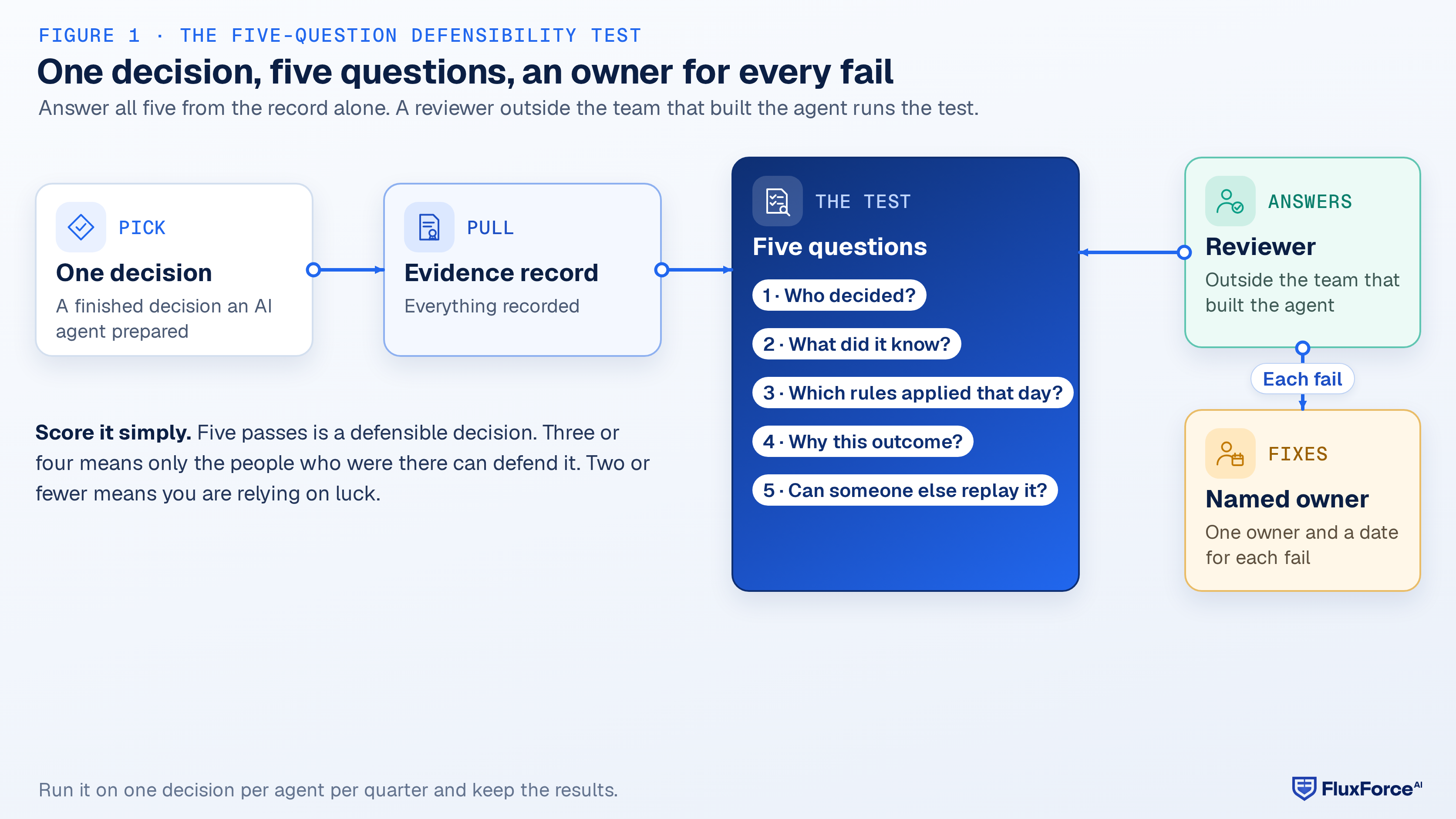
- You pick one decision and pull its evidence record. The evidence record goes to the five questions. A reviewer outside the team that built the agent answers the five questions. Every question the reviewer marks as a fail goes to a named owner with a date.
| # | Question | What a pass looks like | Typical fail |
|---|---|---|---|
| 1 | Who decided? | A named person made the call, or a setting someone approved let a low-risk item proceed, and you can show who approved it | "The system decided", or a reviewer who clicked approve in four seconds |
| 2 | What did it know? | Every input is listed with its source and time, including data the agent fetched from outside | Inputs that were overwritten or never stored |
| 3 | Which rules applied that day? | The policy version, model version, thresholds and agent permissions in force on that date | Only today's settings exist |
| 4 | Why this outcome? | Reasons that match the factors used, written for each person who will read them | A score with no reasons, or reasons written after the fact |
| 5 | Can someone else replay it and challenge it? | A reviewer outside the team can follow every step in order, and the affected person had a route to contest it | Rebuilding the story from emails and memory |
The first figure shows how to run the test. You pick one decision and pull its evidence record. The evidence record goes to the five questions. A reviewer outside the team that built the agent answers the five questions. Every question the reviewer marks as a fail goes to a named owner with a date.
Score it simply. Five passes is a defensible decision. Three or four means it can be defended only by the people who were there, and they won't always be there. Two or fewer means you're relying on luck. Run it on one decision per agent per quarter and keep the results, because the trend tells you more than any single score.
Key insight: the test is run by someone outside the team that owns the agent, on a decision that already happened. If only the builders can answer the five questions, the decision isn't defensible yet.
Why are defensible AI decisions now a legal question?
Defensible AI decisions are a legal question because rules in the EU, the UK, the US and Colorado now ask for parts of the record behind them. The wording differs, but the demands line up with the five questions.
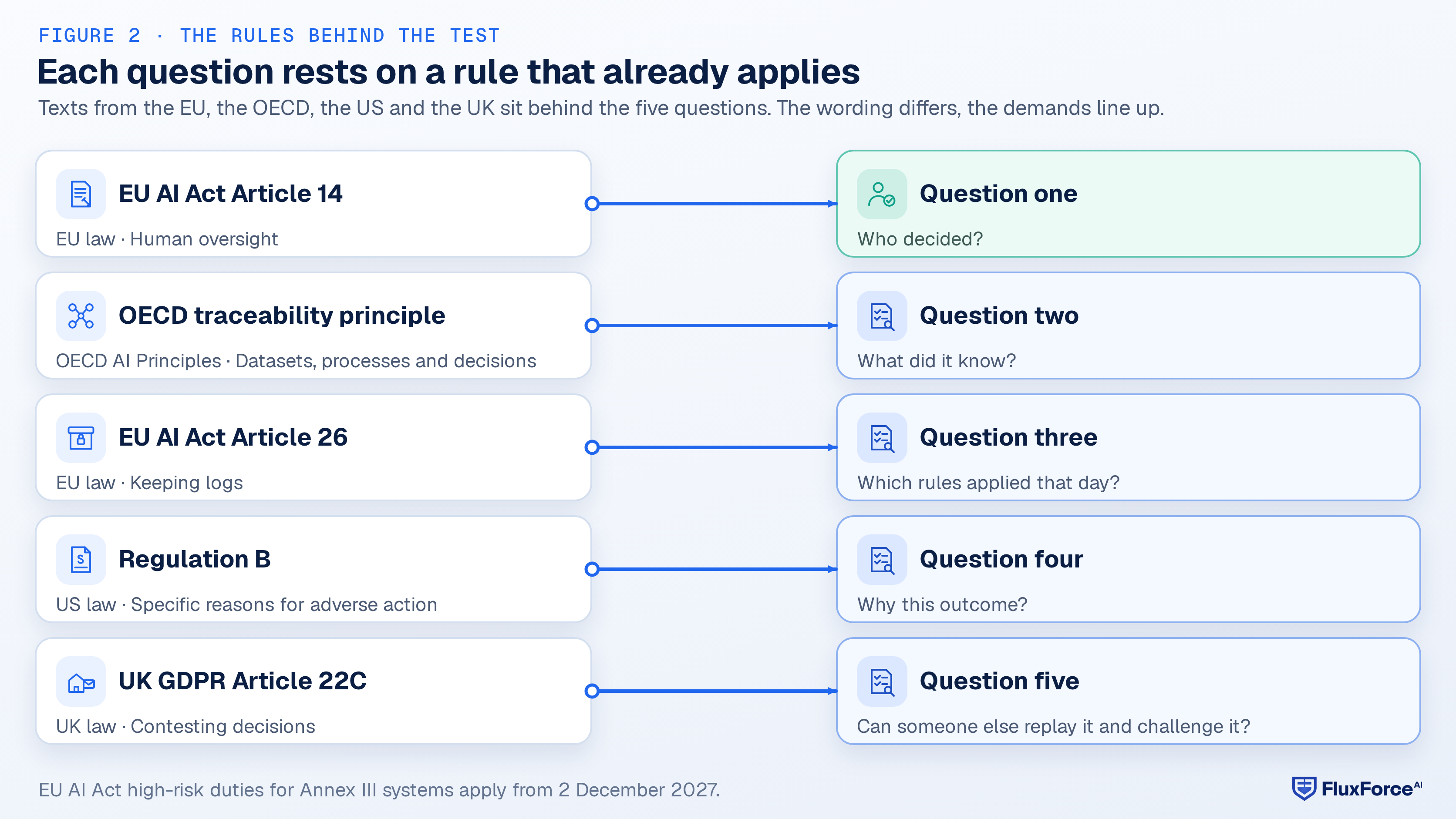
- EU AI Act Article 14 on human oversight feeds question one, who decided. The OECD traceability principle feeds question two, what it knew. EU AI Act Article 26 on keeping logs feeds question three, which rules applied. Regulation B's specific-reasons rule feeds question four, why this outcome. UK GDPR Article 22C on contesting decisions feeds question five, replay and challenge.
| Market | Rule | What it asks for | Label | Question |
|---|---|---|---|---|
| EU | AI Act, Regulation (EU) 2024/1689, Articles 14, 26 and 86 | Oversight aware of automation bias; logs kept at least six months; an explanation of the system's role (Annex III high-risk duties from 2 December 2027) | LAW | 1, 3, 5 |
| EU | GDPR Article 22 and Case C-203/22 | Human intervention, a right to contest, and the procedure and principles applied | LAW | 4, 5 |
| UK | UK GDPR Article 22C (Data (Use and Access) Act 2025) | Representations, human intervention and a right to contest | LAW | 5 |
| US | Regulation B, 12 CFR 1002.9 | Specific reasons for adverse credit action that match the factors considered | LAW | 4 |
| US (Colorado) | SB 26-189 | Human review and reconsideration on request after an adverse outcome; records kept at least 3 years | LAW | 1, 5 |
| Singapore | MAS Guidelines on AI Risk Management | Firms stay accountable for AI, including third-party AI | GUIDANCE | 1 |
The EU AI Act is the most specific. Article 14 asks that people overseeing a high-risk system remain aware of automation bias, naming systems used to provide information or recommendations for decisions to be taken by natural persons. Deployers must assign human oversight to people who have the necessary competence, training and authority. They must keep the system's automatically generated logs for at least six months, unless other law says otherwise. A person affected by a decision based on a listed high-risk system can obtain clear and meaningful explanations of the role of the AI system in the decision-making procedure and the main elements of the decision taken. The Digital Omnibus on AI, Regulation (EU) 2026/1744, moved the high-risk duties for Annex III systems to 2 December 2027.
Under GDPR Article 22, where solely automated decisions with significant effects are allowed, the controller must offer at least the right to obtain human intervention, to express a point of view and to contest the decision. UK GDPR Article 22C, rewritten by the Data (Use and Access) Act 2025, requires safeguards that let the person make representations, obtain human intervention and contest the decision.
In the US, Regulation B requires creditors to give a statement of specific reasons for adverse action. Its official interpretation says those reasons must relate to and accurately describe the factors the creditor considered or scored. Colorado's SB 26-189, signed in May 2026, gives consumers the right to request meaningful human review and reconsideration after automated decision-making technology makes a consequential decision with an adverse outcome. Developers and deployers must keep compliance records for at least 3 years.
Some rules leave gaps you still own. The Federal Reserve's revised model risk guidance, SR 26-2, says generative AI and agentic AI models are novel and rapidly evolving, and as such aren't within its scope. The Monetary Authority of Singapore (MAS) says its Guidelines on AI Risk Management take effect on 7 October 2027 and that firms remain accountable for AI used in the services they deliver, including AI from third parties.
The second figure maps the rules to the test. EU AI Act Article 14 on human oversight feeds question one, who decided. The OECD traceability principle feeds question two, what it knew. EU AI Act Article 26 on keeping logs feeds question three, which rules applied. Regulation B's specific-reasons rule feeds question four, why this outcome. UK GDPR Article 22C on contesting decisions feeds question five, replay and challenge.
Where does AI decision making go wrong?
In our view, AI decision making goes wrong in the record around the model at least as often as in the model itself. Gartner predicts at least 15% of day-to-day work decisions will be made autonomously through agentic AI by 2028, up from 0% in 2024. It also expects over 40% of agentic AI projects to be canceled by the end of 2027, due to escalating costs, unclear business value or inadequate risk controls.
Incidents are rising with adoption. Stanford's 2026 AI Index reports that the AI Incident Database recorded 362 incidents in 2025, up from 233 in 2024. In IBM's 2025 Cost of a Data Breach study of 600 breached organizations, 63% either didn't have an AI governance policy or were still developing one.
A well-scoring model can still produce an indefensible decision. It happens when nobody stored the inputs, when the policy changed and the old version wasn't kept, or when the approver can't say why. NIST notes that human-AI configurations can span from fully autonomous to fully manual, and that human roles in decision making need to be clearly defined and differentiated.
Is AI decision support safer than AI decision making?
AI decision support isn't automatically safer than AI decision making. A person at the end of the chain helps only if that person reviews the case. A reviewer who accepts every recommendation turns decision support into automated decision making with a signature on it. The EU's highest court took a similar line in the 2023 SCHUFA case, holding that a credit score must be regarded as an automated individual decision where banks give it a determining role in granting credit.
IMDA warns that automation bias, the tendency to over-trust an automated system, especially when it has performed reliably in the past, becomes a bigger concern as humans supervise increasingly capable agents. The better an agent performs, the less closely people check it, and the weaker your answer to question one becomes.
So measure the reviewer as well as the agent, and design the human-in-the-loop review step so it leaves evidence of what the person checked. IMDA's framework points to auditing the effectiveness of human approvals. Track how often reviewers change the recommendation and how long they spend per case. An override rate near zero can be a sign of automation bias rather than a good agent. IMDA says organisations should define significant checkpoints or action boundaries that require human approval, especially before sensitive actions are executed.
FluxForce calls that limit the autonomy budget, which is how much each agent may do on its own in each risk band, set by your institution the way a spending limit is set. High risk always goes to a person. Low-risk items proceed on their own only where you've allowed it, and the setting that allowed it is part of the record. Write each agent's permissions and risk bands down and version them, as an AI governance control your auditors can test.
How do you get AI decisions explained for three different readers?
You get AI decisions explained by writing three explanations from one record, because three different people will ask. The model risk team needs the technical account, the reviewer needs the operational account, and the examiner or affected person needs plain language. We call this the three-reader explanation.
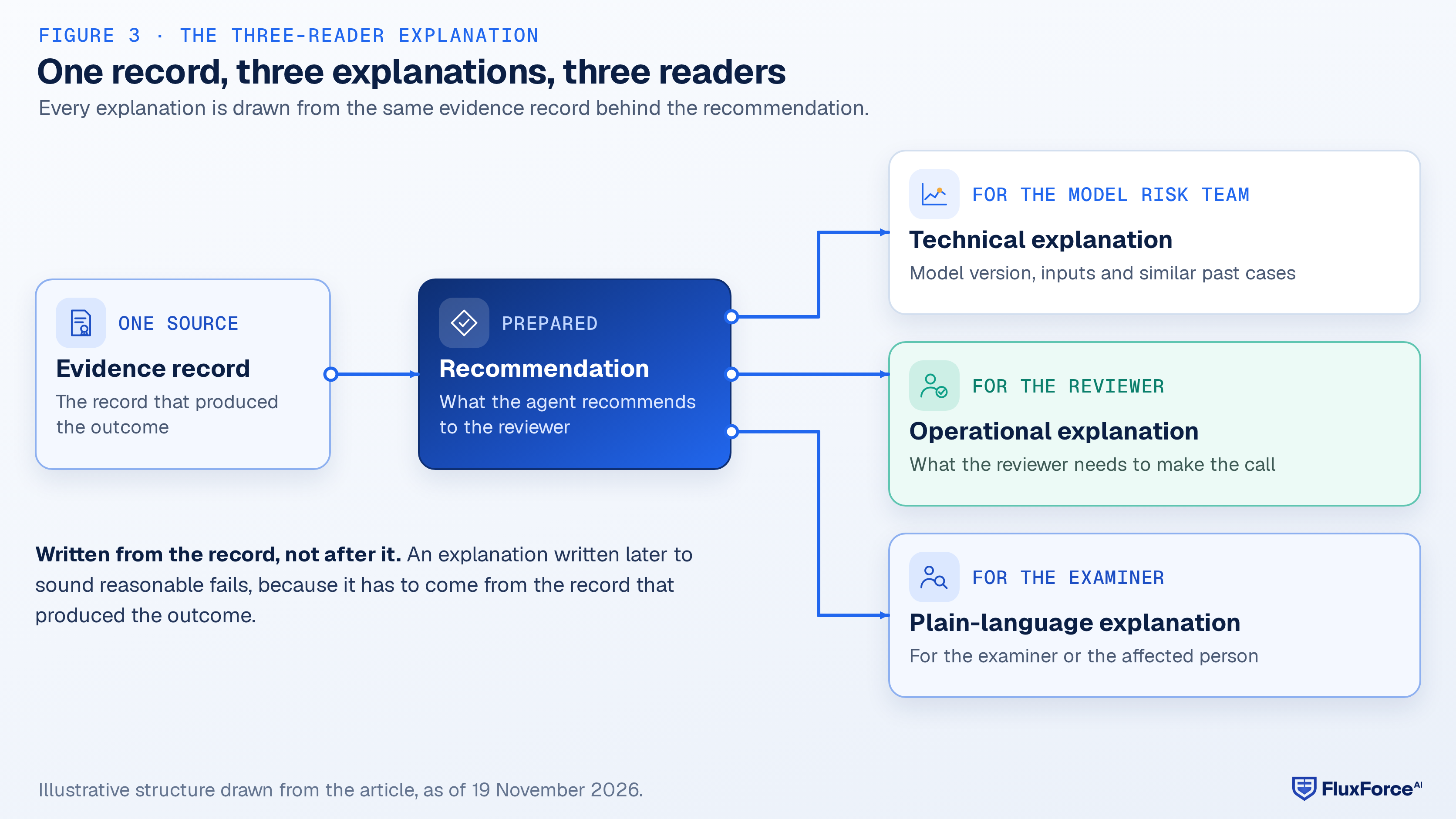
- All three explanations are drawn from the same evidence record behind the recommendation. One recommendation yields a technical explanation for the model risk team. The same recommendation yields an operational explanation for the reviewer. The same recommendation yields a plain-language explanation for the examiner.
The third figure shows how one record serves all three. All three explanations are drawn from the same evidence record behind the recommendation. One recommendation yields a technical explanation for the model risk team. The same recommendation yields an operational explanation for the reviewer. The same recommendation yields a plain-language explanation for the examiner.
In Case C-203/22, the Court of Justice said the controller must describe the procedure and principles applied, and that the mere communication of an algorithm isn't enough. In US credit, the reasons must accurately describe the factors the creditor considered or scored. An explanation written later to sound reasonable fails both tests, because it has to come from the record that produced the outcome.
The technical reader also needs the model version, the inputs and how this case compares with similar past cases. FluxForce calls that last part decision precedent, which means pulling similar past cases and how they were decided into the new case, so like cases get like outcomes. Our guide to explainable AI for governance, risk and controls covers how each reader's explanation is built.
How do you test for AI decision bias?
You test for AI decision bias by comparing outcomes across groups on real decisions, on a schedule, and keeping the results with the rest of the record.
New York City's Local Law 144 is a working example. It prohibits employers from using an automated employment decision tool unless the tool has been subject to a bias audit within one year of its use, the audit information is public, and the required notices have gone to candidates or employees. The city's guidance says the audit must at least calculate selection or scoring rates and impact ratios across sex, race and ethnicity, and intersectional categories. You can borrow the method anywhere.
- Define the groups you'll compare, using the categories your applicable rules name.
- Measure approval or selection rates for each group on real decisions.
- Set a tolerance for the gap between groups, and decide who acts when it's breached.
- Record who reviewed the result and what they did, next to the rest of the decision record.
What does a defensible decision look like in practice?
In every department, the agent prepares, a named person decides, and the record holds what both of them did. The scenario below is invented to show the process. A supplier's email asks the payables team at a mid-sized insurer to change the bank account for an invoice due in two days.
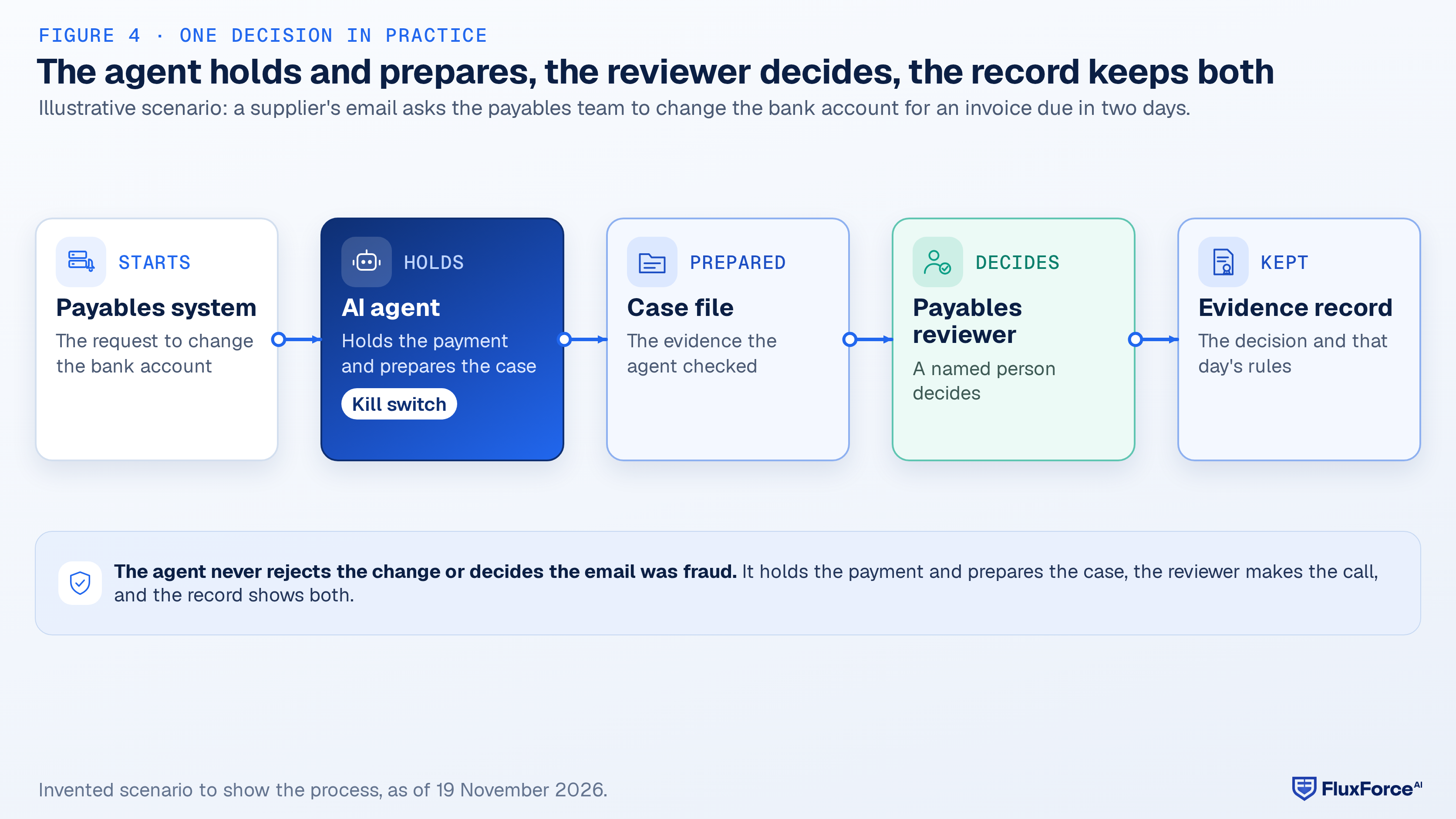
- The payment request reaches the AI agent from the payables system. The AI agent prepares the case file with the evidence it checked. The case file goes to the payables reviewer, who makes the call. The payables reviewer's decision goes to the evidence record with the rules that applied that day.
The fourth figure shows the decision chain in the scenario. The payment request reaches the AI agent from the payables system. The AI agent prepares the case file with the evidence it checked. The case file goes to the payables reviewer, who makes the call. The payables reviewer's decision goes to the evidence record with the rules that applied that day.
In the scenario the agent never rejects the change or decides the email was fraud. It holds the payment and prepares the case, the reviewer makes the call, and the record shows both.
How does FluxForce approach defensible decisions?
FluxForce is the platform your departments run AI agents on. The agents investigate and prepare the work, a person makes the call, and every step leaves evidence an examiner can replay. Every agent follows five public stages, with governance controls and data protection on every step.
- Take in. Agents connect beside the systems you already run.
- Understand. Before anything is scored, the agent assembles the customer, supplier, claim or application into one view, which we call context before decision.
- Weigh. Your policies run first as hard checks, then the agent scores and recommends.
- Prove. Every step goes into an evidence record in tamper-evident evidence storage, with inputs, time, who acted and the rules that applied that day. This is the proof layer.
- Report and learn. The agent drafts the report and a person approves it, and models only change after a person approves.
On financial-crime work, our first app line, the same promise reads this way. AI agents that investigate AML, sanctions, fraud and KYC alerts and prepare the case. Your analyst makes the call, with evidence an examiner can replay. You decide how much each agent does on its own, and every one has a kill switch.
Questions three and four depend on knowing which model version produced a recommendation and why. That's the job of FluxForce AI Model Governance, which keeps a record of every model your agents and your own teams run.
FluxForce doesn't make a decision defensible by itself. It records what happened and makes it replayable, but your people still decide, your policies still set the rules, and your legal team still judges what your regulator expects. You can run the agents in shadow mode first, where they work live items without acting so your team can compare their recommendations with its own.
- A decision is defensible when you can answer five questions from the record alone: who decided, what it knew, which rules applied, why, and whether someone else can replay it.
- The EU AI Act, GDPR and UK GDPR, Regulation B and Colorado SB 26-189 already ask for parts of that record.
- AI decision support is only as safe as the reviewer, so track override rates and review times per agent.
- Write one record and three explanations from it: technical, operational and plain language.
- Run the test on one decision per agent per quarter and fix the first fail you find.
Conclusion
We think defensibility should be the test an AI agent passes before it touches a live decision. A regulator, a court or a board won't ask how accurate your model was on average. They'll ask about one decision, the one that went wrong, and they'll want the record.
We'd go further than the rules do. A firm that can't replay one decision shouldn't widen any agent's autonomy budget, however good the accuracy figures look, because a complaint is always about one case. None of the rules covered here asks you to stop using AI agents. Each asks for some part of the record, and the record has to exist before anyone asks.
Pick one agent and one decision, run the five questions, and fix the first fail you find.
Request the five-question defensibility test
Frequently Asked Questions
About the author

Sahil Kataria
Founder and CEO of FluxForce
Share this article