.webp)




.webp)



Listen To Our Podcast🎧
.jpeg)
Introduction
Today, Agentic AI decisions are shaping high-stakes environments such as trading in financial markets, routing in logistics, and risk assessments in insurance. With this rise, businesses face a critical question: “How do we trust what we cannot see?”
According to Gartner research, a majority of enterprise executives cite lack of AI decision transparency as a key barrier to trust in AI systems. In other words, leaders want to understand not just outcomes, but the reasoning behind them.
Why Explainability Can’t Be Optional ?
“The risks from AI systems largely come from a lack of accountability surrounding how they are developed and deployed.” Margaret Mitchell, a leading researcher in responsible AI. This is where the concept of an Explainability dashboard becomes prevalent. It acts as a visibility layer, providing decision traces, model reasoning, and performance metrics in real time.
The Foundation of AI Accountability
Industry regulators are increasingly introducing frameworks that place responsibility on enterprises deploying autonomous systems. An AI accountability framework supports compliance and helps build market confidence in AI-driven decisions. Companies that invest early in interpretability will enjoy a competitive edge, as trust becomes a market differentiator.
This first step sets the stage: the necessity of Human-centered AI explainability as the backbone of enterprise adoption. In the next part, we will look at how traditional business dashboards fall short and why agent-driven systems need a new approach to explainability.
Why Traditional BI Falls Short in the Age of Agentic AI ?
.webp?width=1200&height=800&name=Why%20Traditional%20BI%20Falls%20Short%20in%20the%20Age%20of%20Agentic%20AI%20(2).webp)
Traditional BI Shows the Past
Traditional BI dashboards are designed to summarize historical data, highlighting trends and performance metrics. However, they are limited when it comes to Agentic AI decisions, which operate autonomously and make choices in real time. These systems require dashboards that can explain not just what happened, but why the system acted in a particular way. Historical snapshots alone cannot provide the context needed to trust or validate AI-driven decisions.
Static Dashboards Lack Transparency
Static dashboards focus on reporting outcomes rather than the reasoning behind them. When AI is making decisions, executives and stakeholders often lack visibility into decision pathways, leading to gaps in AI decision transparency. Without an AI accountability framework, these rapid decisions can introduce operational, ethical, and compliance risks.
Real-Time AI Decisions Create New Risks
Real time decisioning processing introduces complexity that static dashboards are not equipped to handle. In fast-moving sectors like finance, healthcare, and logistics, AI can act in milliseconds based on multiple competing inputs. Without an AI accountability framework, these rapid decisions carry operational, ethical, and compliance risks. Enterprises need visibility into the inputs, rationale, and confidence of AI systems to manage these risks effectively.
Components of an Explainability Dashboard for Agentic AI
Data Inputs and Sources
A robust Explainability dashboard relies on comprehensive, high-quality data. It must consolidate structured databases, system logs, and unstructured sources such as text or sensor data. For Agentic AI decisions, every input that influences a model should be traceable. This enables executives to evaluate not only outputs but also the underlying rationale, which is critical for audits and strategic decision-making.
Decision Path Tracking
Enterprise stakeholders need visibility into the decision-making sequence. Explainable AI (XAI) tools allow teams to map how the system prioritized inputs, what trade-offs it considered, and why it selected specific actions. Understanding how AI makes decisions enables better risk assessment and supports internal governance policies.
Metrics and Performance Indicators
Effective dashboards present Explainability metrics for agentic AI, including confidence scores, sensitivity to input changes, and scenario-based simulations. These metrics align with an AI accountability framework, helping organizations assess whether AI behavior meets corporate and regulatory expectations.
Human Oversight and Controls
Despite autonomous operation, human oversight in Agentic AI systems remains essential. A well-designed dashboard incorporates human-centered AI explainability, enabling compliance teams and managers to review, validate, or intervene in critical decisions. This helps maintain alignment between AI outputs and organizational objectives while mitigating operational and ethical risks.
Visualizations and Reporting
The dashboard must present information in clear, actionable ways. Interactive flow diagrams, decision outcome charts, and scenario simulations enable leadership to interpret AI reasoning quickly. Visualizing agentic AI models and outputs ensures transparency, strengthens trust, and facilitates communication between technical teams and business executives.
How can an Explainability Dashboard interpret Agentic AI decisions
A well-designed Explainability dashboard for AI decision-making allows enterprises to interpret Agentic AI decisions by mapping each action to its key inputs, decision path, and outcomes. Unlike traditional reporting tools, it helps answer how AI makes decisions in complex environments, showing which factors influenced outcomes and where trade-offs occurred.
The dashboard includes Explainability metrics for agentic AI, such as confidence scores, feature importance rankings, scenario simulations, and deviation analysis. These metrics provide measurable assurance, enabling teams to assess reliability, identify potential risks, and meet requirements under an AI accountability framework. Features built for human-centered AI explainability allow managers or compliance teams to review and intervene when necessary, preserving oversight without significantly slowing real time decisioning processing.
Beyond interpretation, the dashboard turns insights into action. Stakeholders can simulate alternative scenarios, compare outcomes, and prioritize responses based on risk or strategic impact. This makes autonomous outputs more interpretable, auditable, and operationally relevant, helping build trust in AI systems while enabling enterprises to leverage agentic AI more confidently and responsibly.

How Do Explainability Dashboards Integrate Agentic AI into Enterprise Strategy
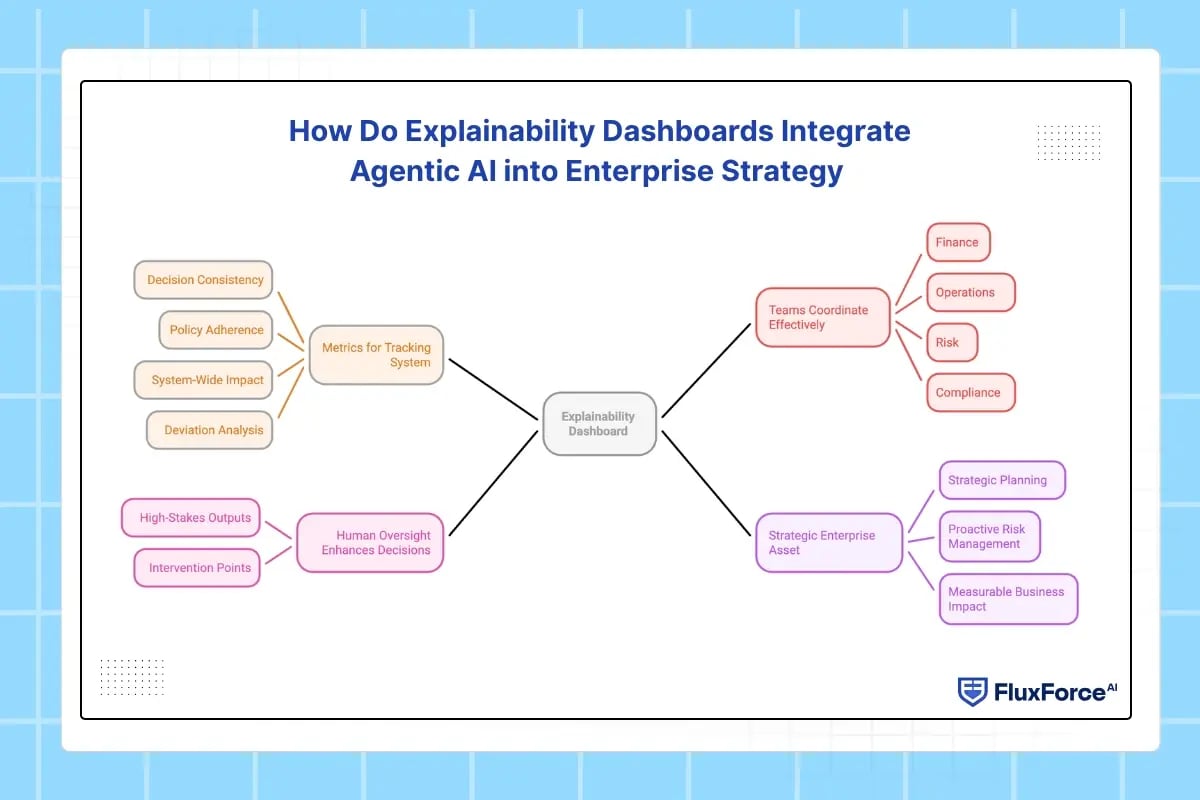
The Dashboard aligns Agentic AI with business strategy
An Explainability dashboard for AI decision-making acts as the bridge between Agentic AI decisions and enterprise strategy. By consolidating multiple AI outputs into a unified interface, the dashboard enables leaders to align autonomous operations with organizational goals, monitor emerging patterns, and identify potential risks early.
Metrics for Tracking System
The dashboard leverages Explainability metrics for agentic AI such as decision consistency, policy adherence, system-wide impact, and deviation analysis. These metrics provide actionable insight into where AI decisions can be automated safely, where human oversight is necessary, and how autonomous behavior affects business outcomes across departments.
Teams coordinate effectively using Dashboard Insights
By centralizing insights, the dashboard enables cross-functional orchestration across finance, operations, risk, and compliance teams. Stakeholders can observe patterns in autonomous decisions, detect bottlenecks, and synchronize interventions, ensuring that agentic AI actions support enterprise objectives holistically rather than in isolated silos.
Human oversight enhances Autonomous Decisions
Integrating human-centered AI explainability helps ensure that critical decisions remain under human supervision without significantly slowing real time decisioning processing. The dashboard highlights high-stakes outputs and provides intervention points, enabling teams to guide AI behavior, validate critical choices, and maintain accountability.
The Dashboard Becomes a Strategic Enterprise Asset
Ultimately, the dashboard transforms agentic AI from an isolated automation system into a decision intelligence tool. By making autonomous decisions interpretable, auditable, and actionable, it empowers enterprises to leverage AI for strategic planning, proactive risk management, and measurable business impact, building Trust in AI systems and reinforcing AI accountability frameworks.
Onboard Customers in Seconds

A dashboard is one surface for this evidence. See the wider treatment of explainable AI in finance for how the same principles apply across lending, fraud, AML, and market risk.
Conclusion
A well-designed Explainability dashboard for AI decision-making provides transparency into complex decision pathways, highlights influential factors, and quantifies confidence and trade-offs. By integrating Explainability metrics for agentic AI and enabling Human-centered AI explainability, these dashboards turn opaque AI actions into auditable, actionable, and strategically relevant intelligence.
Beyond interpretation, the dashboards drive enterprise value. They allow teams to simulate scenarios, anticipate risks, and link AI outputs directly to operational decisions and business strategy. This combination of visibility, metrics, and actionable insight builds Trust in AI systems, enforces accountability under an AI accountability framework, and ensures alignment with corporate goals and compliance requirements.



Share this article