.webp)







Listen To Our Podcast🎧
%20%20(1).png)
Introduction
The GRC platform market reached $51.4 billion in 2025 and is projected to grow to $84.7 billion by 2030, according to PECB's 2025 AI-GRC infrastructure analysis. That investment reflects one consistent operational reality: governance, risk, and compliance programs have outgrown what manual processes can manage. AI now scans policies, maps controls, flags risks, and monitors compliance across frameworks simultaneously. The governance challenge that follows is not whether AI works. It is whether GRC leaders can explain why the AI flagged one risk and ignored another when auditors, regulators, and executive leadership ask.
That idea sits at the core of governance, risk, and compliance. GRC teams are not judged only on outcomes. They are judged on how those outcomes were reached. This is where explainable AI becomes critical.
AI already scans policies, maps controls, flags risks, and monitors compliance in real time. But when AI outputs cannot be explained, they introduce a new layer of risk. In GRC, unexplained automation is often worse than manual work.
So, the real question is not can AI help GRC
It is: can AI justify its decisions to auditors, regulators, and leadership?
Explainable AI exists to answer that question.
What is explainable AI in GRC?
Explainable AI in GRC is the capability that allows governance, risk, and compliance teams to see why the AI produced a specific output — which policy provisions triggered a flag, which control weakness generated an alert, which data pattern elevated a risk score. This is operationally distinct from AI that produces accurate results. A risk monitoring system that accurately identifies 95% of control failures provides no audit value if the compliance team cannot explain why each specific failure was flagged when a regulator or auditor requests justification.
This matters because GRC decisions are reviewed long after they are made. During audits, investigations, or regulatory reviews, teams must reconstruct decision logic. Explainable AI makes that possible.
A 2025 research paper on GenAI in GRC cited a PwC case study finding that GenAI tools identified regulatory changes with 90% accuracy and helped reduce compliance-related mistakes by 75%, according to StrikeGraph's analysis of the research. The performance improvement was directly linked to the explainability layer: when compliance teams could see why the AI flagged specific regulatory changes, they validated and acted on alerts rather than routing them for manual verification.
Why is AI explainability important for governance ?
Governance is about accountability. Boards and executives remain responsible even when AI supports decisions.
Many organizations already use AI to:
- Summarize board discussions
- Compare new regulations against internal policies
- Highlight governance gaps in codes of conduct
But here is the problem:
If leadership cannot explain why AI highlighted one issue and ignored another, governance weakens instead of improving.
Explainable AI fixes this by exposing decision logic. It allows leaders to see which policies, controls, or data patterns influenced recommendations. This supports responsible AI governance, where humans approve decisions with confidence instead of blind trust.
How explainable AI improves risk management decisions ?
Risk teams deal with volume. Logs, transactions, vendor data, user activity, and external signals arrive faster than humans can review.
AI helps by prioritizing risks. But traditional AI often hides its reasoning. That creates tension during reviews.
Explainable AI changes how AI risk management works:
- It links risk alerts to specific behaviors or control gaps
- It shows why a pattern was considered risky
- It allows risk owners to validate or override findings
In real-world deployments cited in banking and enterprise risk programs, AI systems that surfaced explainable risk signals helped teams detect issues earlier and act faster. Mastercard, for example, significantly accelerated fraud signal detection by focusing on patterns AI could clearly explain to analysts.
This is the difference between automated risk assessment tools and trusted risk systems.
Why compliance GRC cannot rely on black-box AI ?
Compliance teams live under scrutiny. Every action must be defensible.
Black-box AI creates serious problems:
- Auditors ask for reasoning that cannot be provided
- Regulators challenge decisions with no explanation trail
- Internal teams struggle to validate outcomes
Explainable AI supports regulatory compliance automation by creating clear audit trails. It explains how a policy change, access update, or control failure triggered a compliance action.
This directly enables continuous compliance monitoring. Instead of checking controls once a quarter, teams can monitor them daily and still explain every alert. The same PwC case study cited above found that AI identifying regulatory changes at 90% accuracy also reduced compliance mistakes by 75% — but only in deployments where explainability was embedded. Deployments without explainability showed lower compliance improvement rates because teams could not validate AI-identified changes with sufficient confidence to act without manual re-verification. The performance benefit of AI in GRC is contingent on explainability enabling trust in the AI's outputs.
The real shift explainable AI brings to GRC
Explainable AI does not replace people. It supports them.
It allows GRC teams to:
- Trust AI outputs without losing control
- Defend decisions during audits
- Move from reactive reviews to proactive oversight
Most importantly, it aligns AI with the core principle of GRC:
If you cannot explain a decision, you should not automate it.
That is why explainable AI is not optional in modern governance, risk, and compliance. It is the foundation that makes AI usable, defensible, and safe in regulated environments.

Explainable AI frameworks for governance and risk ?
Here, we dive into how explainable AI (XAI) is being applied across governance, risk, and controls (GRC) programs. Organizations today face an overwhelming volume of policies, audits, and regulatory frameworks. XAI frameworks help GRC teams make sense of complex data and enforce AI governance consistently.
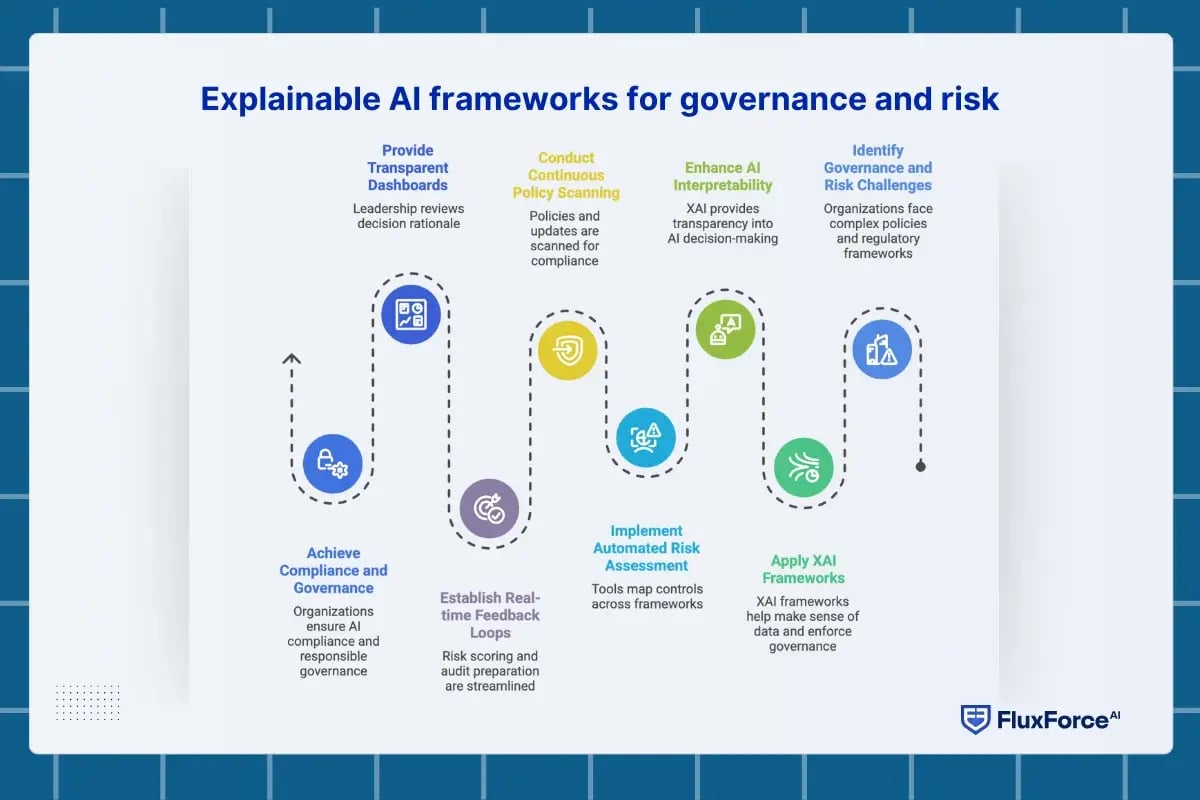
Why does this matter? Traditional AI systems often operate as “black boxes,” leaving compliance officers unsure about how risk assessments were generated. With AI interpretability and model explainability techniques, explainable AI surfaces the reasoning behind every recommendation, making decisions traceable and defensible.
Clear impact on risk detection
- Automated risk assessment tools that map controls across multiple frameworks.
- Continuous scanning of internal policies and regulatory updates.
- Real-time feedback loops for risk scoring and audit preparation.
- Transparent dashboards for leadership to review decision rationale.
Example in practice:
A leading enterprise used a continuous compliance monitoring platform powered by XAI to cross-check internal security policies against ISO 27001 and SOC 2 frameworks. This reduced manual review times by 70% while improving alignment with regulatory expectations.
Key takeaway: Using structured XAI frameworks ensures that organizations are not only AI compliant but also maintain responsible AI governance, allowing human experts to focus on high-stakes judgment instead of repetitive audits.
Explainability in AI risk controls
How does explainable AI improve compliance and risk management?
Explainable AI also improves the quality of validation challenge. Instead of vague concerns, validators point to specific drivers and decision thresholds that increase risk. Model owners respond faster because issues are clear and measurable.
When explainability becomes standard practice, institutions see shorter validation cycles, fewer follow-up findings, and stronger AI model governance. Most importantly, explainable AI turns validation into a control that proves value and builds regulator confidence.
Applications include:
- Risk assessment automation for financial, cybersecurity, and operational risks.
- Predictive alerts for unusual patterns in employee behavior or transaction flows.
- Visual traceability of each AI-generated recommendation for auditors.
Primary benefits highlighted:
- Transparent reasoning supports compliance GRC objectives.
- Continuous monitoring allows proactive risk mitigation.
- Human oversight remains central, creating a responsible AI governance environment.
Explainable AI best practices for compliance
For organizations adopting AI compliance tools, following best practices ensures effective integration of explainable AI in daily operations.
Recommended steps include:
- Embed explainability in every model used for risk assessment automation.
- Conduct regular bias detection and fairness testing to ensure decisions are equitable.
- Align AI decision logic with internal policies and regulatory compliance automation frameworks.
- Maintain version control and detailed audit trails for accountability.
Why this matters:
With evolving regulations like the EU AI Act and standards such as ISO/IEC 42001, explainable AI provides a documented path showing that AI-driven decisions are consistent, auditable, and defendable. Teams using these best practices experience faster audits, fewer errors, and a measurable increase in compliance confidence.
Why explainable AI matters for GRC ?
What makes explainable AI critical for governance, risk, and controls?
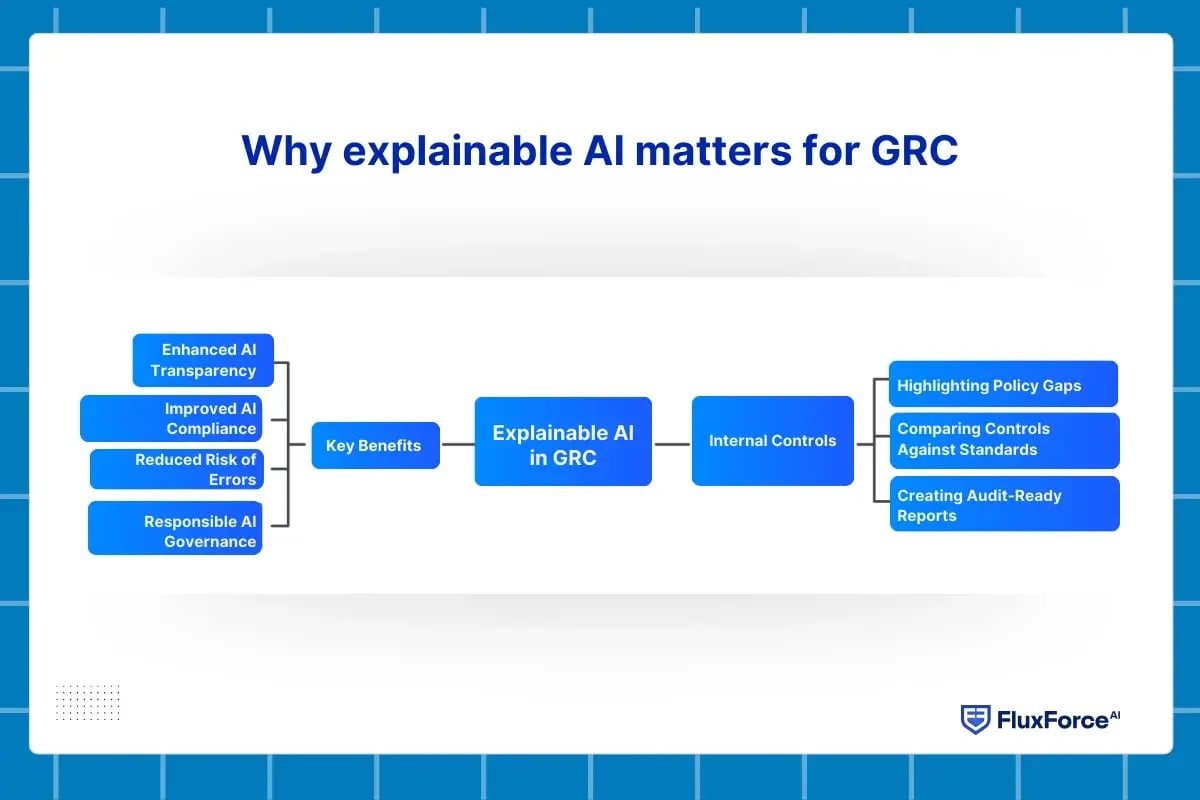
As GRC programs grow more complex, traditional AI can’t always provide clear reasoning behind risk scores, control recommendations, or compliance alerts. Explainable AI (XAI) addresses this by making every AI decision transparent and understandable for humans. This is essential for organizations that need to defend decisions to auditors, regulators, or internal leadership.
Key benefits of XAI in GRC:
- Enhanced AI transparency ensures teams can trace recommendations step by step.
- Improved confidence in AI compliance tools.
- Reduced risk of errors in automated risk assessment tools.
- Enables responsible AI governance by keeping humans in the decision loop.
Stat to highlight:
A 2025 study by PwC found that organizations using XAI for risk management reduced compliance errors by 75% and improved decision-making speed by 60%.
Example:
A large financial institution used continuous compliance monitoring with XAI to flag unusual account activity. Analysts could see why transactions were flagged, which prevented false alarms and improved operational efficiency.
Explainable AI for internal controls
Internal controls are the backbone of compliance, but manually reviewing them across multiple departments or frameworks is time-consuming. XAI enables regulatory compliance automation by:
- Highlighting gaps in internal policies.
- Comparing controls against multiple standards like ISO 27001, SOC 2, or HIPAA.
- Creating audit-ready reports automatically.
Practical use case:
JPMorgan implemented an XAI-powered tool to review loan documents for control compliance. It reduced review time from hundreds of hours to just a few hours per week while maintaining full traceability of decisions.
Primary advantage:
By combining AI interpretability with model explainability techniques, internal audit teams can focus on judgment calls, rather than repetitive tasks.
Benefits of explainable AI in risk management
How does explainable AI transform risk management ?
Traditional AI risk management produces risk scores that risk managers must act on without seeing the reasoning. The result is a consistent operational failure pattern: risk teams override high-confidence alerts because they cannot evaluate the reasoning, or escalate low-confidence alerts because they cannot rule out genuine risk without investigation. According to the Association of Certified Fraud Examiners' 2024 Report, organizations implementing continuous controls monitoring with explainable AI achieved 40 to 60% reductions in median fraud losses. The improvement traces directly to confident action: when risk managers can see why a specific behavioral pattern was flagged, they investigate the right cases immediately rather than applying uniform caution to all alerts.
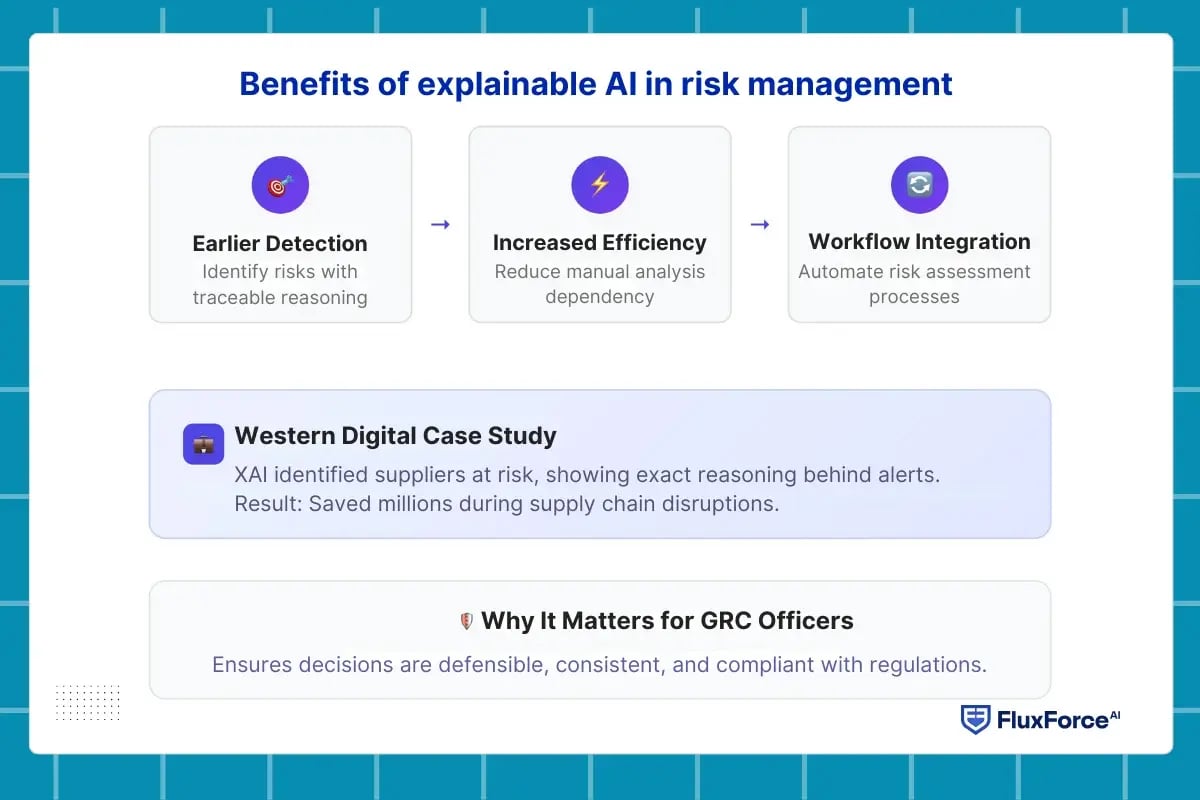
Benefits include:
- Earlier detection of potential risks with traceable reasoning.
- Reduced dependency on manual analysis, increasing efficiency.
- Ability to integrate insights into risk assessment automation workflows.
Example:
Western Digital leveraged XAI for supply chain risk. AI highlighted suppliers at risk of delays, and risk managers could see the exact reasoning behind each alert. This proactive approach saved the company millions during global supply chain disruptions.
Why it matters for GRC officers:
Using explainable AI tools for GRC officers ensures that all risk-related decisions are defensible, consistent, and compliant with both internal standards and external regulations.
What Model Risk Rules Actually Require
Under SR 11-7, model risk management requires that decisions be traceable to the inputs and the logic that produced them. The Federal Reserve expects firms to validate models continuously and to document their limitations, not certify them once at approval and move on.
What changed recently is the status of that expectation. SR 11-7, Article 13 of the EU AI Act, and DORA's operational resilience requirements now name explainability as a documentation standard rather than a best practice. The difference shows up at examination. A best practice invites a conversation. A documentation standard invites a finding.
DORA adds a specific obligation to test and document how AI systems behave under stress. That is a different question from whether a model is accurate in normal conditions, and it needs evidence generated before the stress event rather than reconstructed afterward.
GRC is where these controls get governed. See the wider treatment of explainable AI in finance for how the same principles apply across lending, fraud, AML, and market risk.
Why Aggregate Metrics Hide the Problem
A model can hold a stable 94% detection rate and still be missing an entire fraud typology. The aggregate stays flat because the typology it stopped catching is a small share of total volume, so the number that gets reported to the risk committee never moves. Statistical correctness at validation is not the same thing as operational reliability in production, and only one of those is measured monthly.
Scale makes the gap wider. A bank processing 500,000 card transactions a day makes 3.5 million automated decisions in a week. If model review runs quarterly, that is tens of millions of decisions between one look and the next. Explainability is what makes that interval auditable after the fact, because the reasoning for each decision was recorded when it was made rather than reconstructed from a log afterwards.
Conclusion
The GRC platform market at $51.4 billion in 2025 and growing to $84.7 billion by 2030 reflects organizations making AI infrastructure investment at scale. The governance challenge that comes with that investment is explainability: 43% of GRC professionals cite regulatory uncertainty around AI explainability as their leading challenge, according to MetricStream's 2025 GRC Practitioner Survey. Organizations that resolve this challenge build something more valuable than audit efficiency — they build the regulatory confidence that comes from demonstrating, every time an auditor or regulator asks, exactly why the AI produced a specific output for a specific decision.
The key is to implement responsible AI governance, focus on AI interpretability, and follow best practices for compliance. When done right, explainable AI saves time, reduces errors, and builds trust across the business.
In short, AI transparency and model explainability techniques make governance, risk, and compliance simpler, safer, and more efficient.

Share this article