.webp)








Listen To Our Podcast🎧

Introduction
The OCC's 2025 supervisory feedback documented a 35% rejection rate for AI models lacking adequate explainability documentation across community and regional banks. Federal Reserve examiners apply the same standard under SR 11-7, with regulators now raising expectations around explainability, bias mitigation, and transparency for AI, machine learning, and generative AI systems alike. For model validation teams at financial institutions, this is no longer a documentation preference. It is the threshold between model approval and regulatory rejection.
Are we validating performance or understanding behavior?
Regulatory examinations consistently identify gaps in AI model validation: incomplete model inventories missing shadow AI deployments, insufficient validation of conceptual soundness for black-box models, and inadequate monitoring for model drift and bias. These are explainability gaps, not accuracy failures. A model that performs well at the population level while producing unexplainable individual decisions creates exactly the supervisory risk that SR 11-7's conceptual soundness requirement is designed to address. Performance metrics answer the wrong question during validation. The question regulators ask is whether the model's behavior can be understood, defended, and monitored over time.
Model validation in banking is not limited to testing outcomes. Validators must assess whether a model behaves logically across scenarios and changing market conditions.
The growing validation gap in complex AI models
As models grow more complex, understanding why a prediction was made becomes harder. This gap directly weakens AI model risk management, increasing the likelihood of undetected bias, unstable behavior, and regulatory challenge.
How explainable AI changes the validation equation ?
Explainable AI introduces transparency into complex models by revealing key decision drivers and their relative influence. Explainable AI in finance allows validation teams to test assumptions, verify fairness, and assess whether model behavior aligns with business and regulatory expectations.
Without explainability, how can validators confidently answer:
- Why a borrower was approved or rejected?
- Which features are driving risk scores?
- Whether model decisions remain consistent over time?
Unanswered questions like these undermine effective AI model validation.
Explainability as a governance and risk control
SR 11-7 requires that developers assess the model's sensitivity to key assumptions and demonstrate an understanding of the model's capabilities and limitations — a standard that black-box models structurally cannot meet without explainability. Explainable AI converts this requirement from a documentation challenge into an operational capability. Validators produce SHAP explanation records that satisfy the sensitivity assessment requirement. Model owners maintain feature attribution logs that demonstrate understanding of capability limits. Risk teams use explanation drift monitoring to identify when model behavior is changing before it produces downstream harm. Federal Reserve examiners are applying the SR 11-7 standard with particular scrutiny on models used for credit decisions where ECOA adverse action notices are required. In practice, explainability transforms model validation into an audit-ready process instead of a post-hoc justification.

How Explainable AI Improves Model Validation ?
Model validation teams do not approve models based on results alone. They approve models when the logic makes sense. Explainable AI plays a direct role.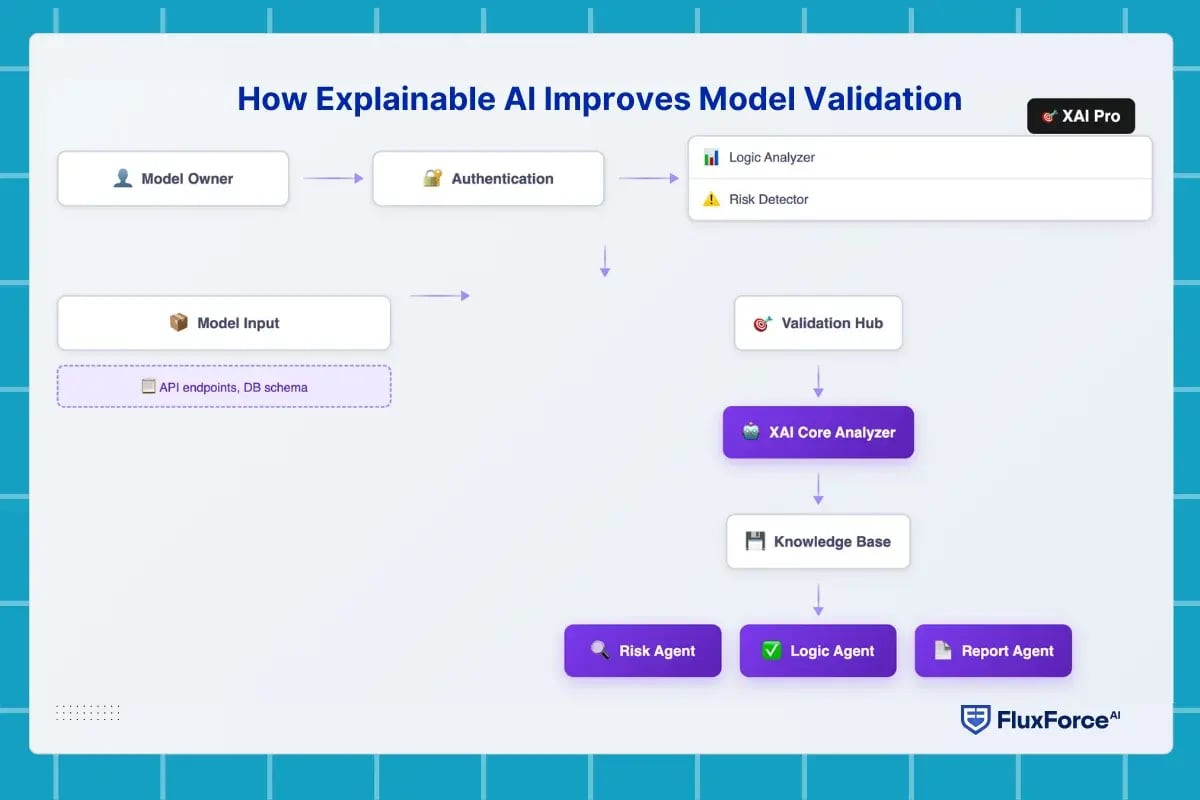
Explainability as part of day-to-day validation work
In financial institutions, explainable AI sits inside the core AI model validation workflow. Validation teams review explanation outputs along with back-testing and stress results. This allows them to see how a model behaves across approvals, rejections, and edge cases.
By reviewing key drivers for different outcomes, validators confirm whether decisions match documented assumptions. This approach strengthens AI model risk management because logic issues surface early, not after deployment.
Clear impact on risk detection
Explainability reveals issues that accuracy checks often miss. Examples include sudden dominance of one variable, use of weak proxy signals, or unstable decision patterns. These insights allow teams to correct models without full rebuilds, which saves time and reduces regulatory risk.
Stronger validation tests with practical explanations
In explainable AI in finance, validation teams use explanations to improve standard tests. Feature impact reviews support sensitivity checks by confirming that outputs change in a reasonable way. Scenario-based explanations show whether decisions flip under realistic conditions.
This method gives validators stronger evidence for fairness and stability and improves machine learning model validation without slowing approvals.
Better challenge, faster approval, real results
Explainable AI also improves the quality of validation challenge. Instead of vague concerns, validators point to specific drivers and decision thresholds that increase risk. Model owners respond faster because issues are clear and measurable.
When explainability becomes standard practice, institutions see shorter validation cycles, fewer follow-up findings, and stronger AI model governance. Most importantly, explainable AI turns validation into a control that proves value and builds regulator confidence.
XAI for Model Risk Management in Banks
Banks manage dozens, sometimes hundreds, of AI and machine learning models across credit, fraud, AML, and risk functions. While AI model risk management frameworks exist, many struggle when models become complex and opaque. Risk teams can see outcomes, but not always the logic behind them.
This creates gaps in control. When risk teams cannot explain how a model behaves, it becomes difficult to assess whether risks are understood, monitored, and kept within limits—especially during audits or supervisory reviews.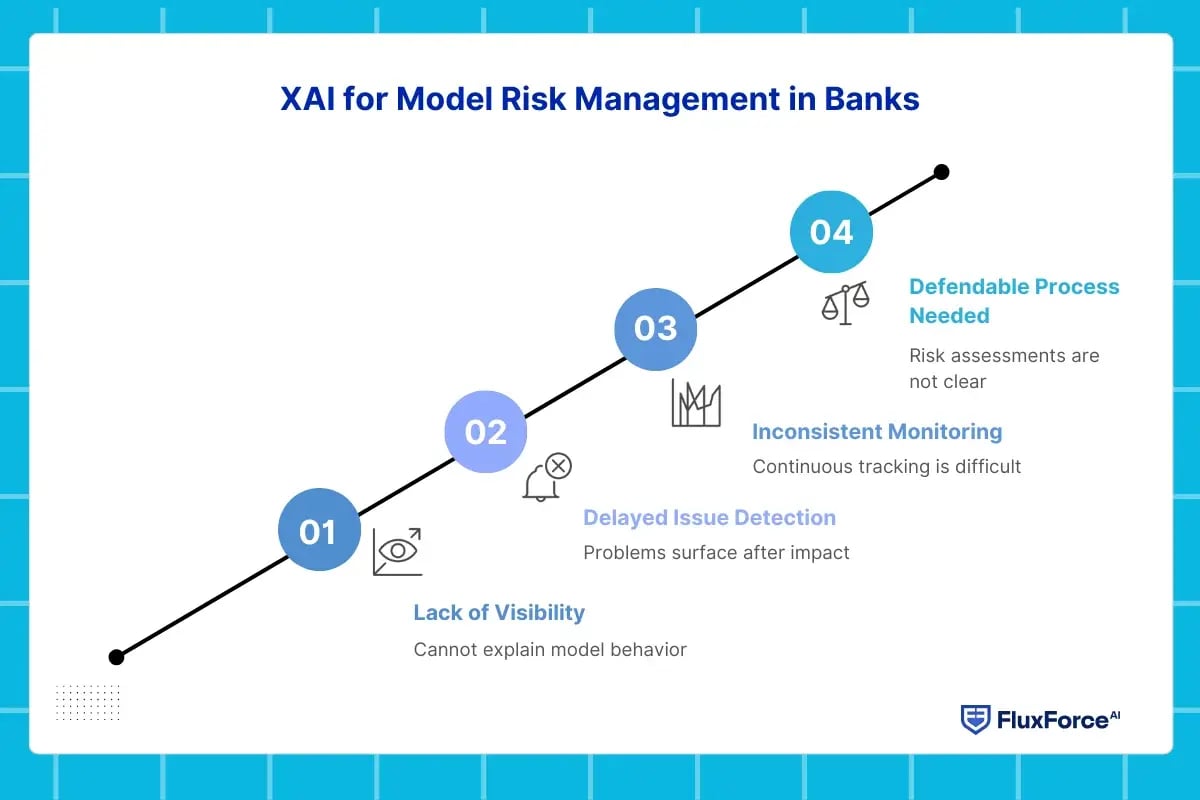
How XAI strengthens risk identification and assessment
Explainable AI gives risk teams direct visibility into model behavior. By showing which inputs drive decisions and how sensitive outputs are to change, XAI helps banks identify risk patterns early.
In explainable AI in finance, risk teams use this visibility to:
- Detect unstable or dominant risk drivers
- Identify hidden bias before it escalates
- Spot early signs of model drift
- Validate that model behavior matches risk appetite
Clear signals instead of late surprises
Without explainability, many issues surface only after customer impact or regulatory challenge. XAI allows banks to catch problems while models are still under review, which reduces remediation effort and reputational exposure.
Supporting ongoing monitoring and governance
Model risk does not end after approval. Banks must monitor models continuously. Explainable AI supports this by providing consistent signals that risk teams can track over time.
Changes in feature impact or decision logic act as early warnings. These signals help teams decide when a model needs review, recalibration, or escalation under AI model governance policies.
Turning risk management into a defendable process
When risk assessments are backed by clear explanations, banks can show regulators how risks are identified, measured, and controlled. This strengthens documentation, supports audit responses, and improves confidence across risk, compliance, and validation teams.
In practice, XAI for model risk management in banks transforms risk oversight from a checkbox exercise into a structured, explainable, and regulator-ready process.
AI Model Validation for Regulatory Compliance
Regulators no longer accept AI models that work but cannot explain themselves. In banking, AI model validation must show not only strong results but also clear reasoning. Supervisors expect banks to prove how decisions are made, how risks are controlled, and how humans stay in charge.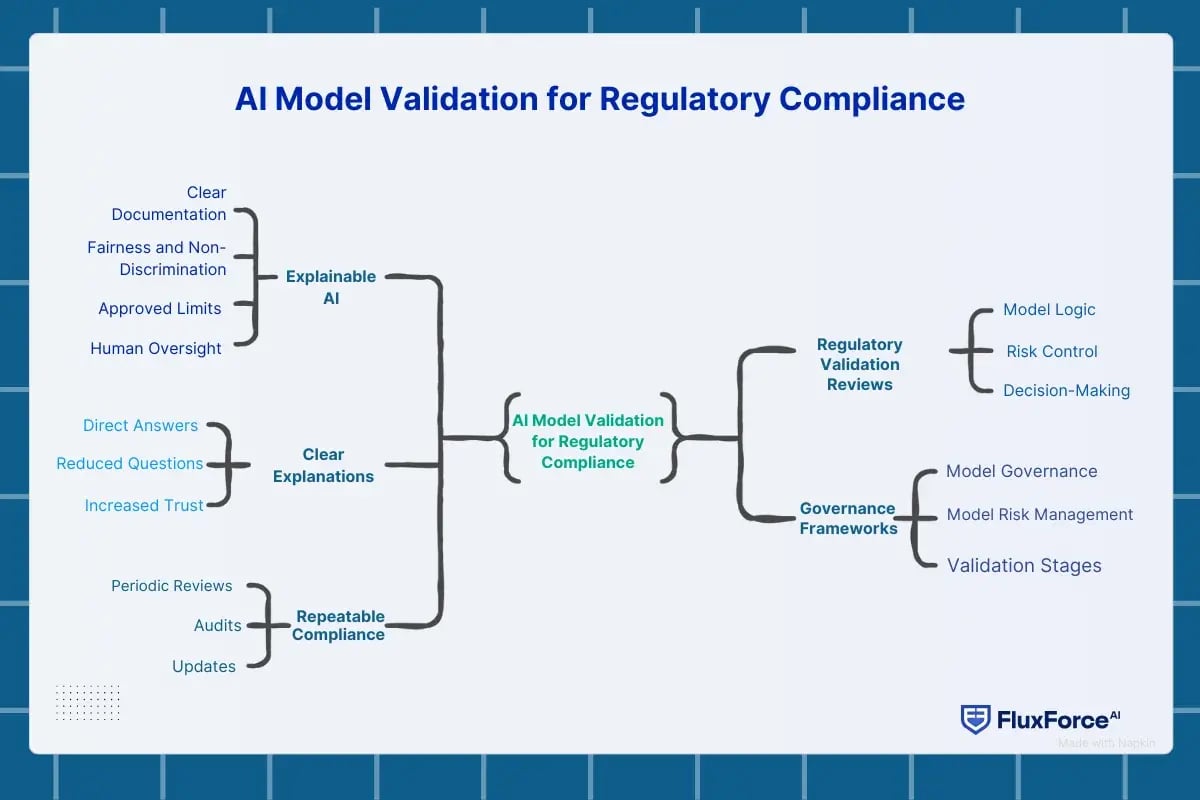
Without explainable AI, this becomes difficult. Validation teams struggle to justify approvals, and compliance teams lack the evidence regulators ask for during reviews.
Explainable AI gives validation and compliance teams clear proof of control. It shows which factors drive decisions, how much they matter, and whether outcomes follow defined rules. In explainable AI in finance, this transparency supports key regulatory checks, such as:
- Clear documentation of model logic
- Evidence of fairness and non-discrimination
- Proof that models stay within approved limits
- Human oversight for high-impact decisions
This makes regulatory validation reviews faster and more structured.
Clear explanations reduce regulatory pushback
When regulators ask why a decision occurred, explainable models provide direct answers. This reduces follow-up questions, remediation requests, and repeat findings. It also strengthens trust between institutions and supervisors.
Aligning explainability with governance frameworks
Most banks already follow AI model governance and model risk management (MRM) frameworks. Explainable AI fits naturally into these structures by supporting validation, approval, and monitoring stages.
Explainability helps institutions show:
- Who approved the model
- Why the model was approved
- How risks were assessed
- When the model should be reviewed again
Making compliance repeatable and defensible
Regulatory compliance is not a one-time exercise. Models face periodic reviews, audits, and updates. Explainable AI ensures that validation evidence remains consistent and easy to reproduce.
For financial institutions, this turns AI model validation for regulatory compliance into a repeatable, defensible process.
Model Validation Challenges Banks Cannot Solve Without XAI
Modern banks already have model validation frameworks. Policies exist. Committees review models. Yet problems keep repeating. The reason is simple: traditional validation methods cannot fully assess models that do not explain their behavior.
As AI adoption grows, several validation challenges become structural rather than procedural.
Difficulty challenging models during review
Effective validation requires challenge. Validators must question assumptions, stress logic, and test edge cases. Black-box models make this difficult.
When explanations are missing, challenges remain vague:
- “The model feels risky”
- “The behavior is unclear”
- “We need more comfort”
Explainable AI replaces these concerns with evidence. Validators can point to specific drivers, thresholds, or patterns that increase risk. This strengthens governance and leads to faster, more productive reviews.
Weak detection of hidden bias and instability
Bias and instability rarely appear in aggregate accuracy results. They surface in how individual features influence decisions across different groups or time periods.
Without model transparency, validation teams may approve models that perform well overall but behave inconsistently under certain conditions. These issues often emerge later through customer complaints or regulatory findings.
Explainable AI exposes these patterns early, allowing banks to correct issues before deployment.
Inability to validate model behavior over time
AI models evolve. Data shifts. Market conditions change. Traditional validation often treats approval as a fixed event rather than an ongoing responsibility.
Explainable AI supports continuous validation by showing how decision drivers change over time. When feature importance shifts or logic drifts, validators receive early signals that a model needs review.
This strengthens AI model governance and reduces long-term model risk.
Regulatory pressure without supporting evidence
Regulators increasingly ask banks to explain not only what a model does, but how it does it. Without explainable AI, validation teams struggle to produce clear evidence during audits and supervisory reviews.
This gap creates friction, delays, and repeat findings. Explainable AI closes that gap by turning validation evidence into something concrete, traceable, and defensible.
5. Train Members to Challenge Model Outputs Using Explanations
Explainability only improves oversight if committees know how to use it. Training should focus on recognizing when an explanation seems incomplete, when factor weights don't align with policy expectations, and when to escalate for deeper technical review. The goal is not to turn risk leaders into data scientists but to equip them with the questions that expose model weaknesses.
Conclusion
The OCC's 2025 supervisory feedback establishes that 35% of AI models are being rejected for inadequate explainability documentation, and Federal Reserve SR 11-7 examiners are applying the same standard with particular scrutiny on credit models requiring ECOA adverse action notices. For model validation teams, this is the operational context that defines the 2025 and 2026 validation environment. Performance metrics satisfy back-testing requirements. Explainability satisfies the conceptual soundness, human oversight, and documentation requirements that SR 11-7, OCC Bulletin 2025-26, and the EU AI Act collectively impose on AI models in financial services. Validators must see how decisions are made, not just whether they work. Without clear reasoning, trust breaks down. So does regulatory confidence.
Explainable AI gives validation teams that clarity. It shows what drives decisions. It reveals risk early. It makes review stronger and faster.
For banks, this changes how models are approved and monitored. Validation becomes a control, not a formality. Risk teams gain confidence. Compliance teams gain evidence. Regulators gain trust.
The future of model validation is clear, transparent, and explainable. Financial institutions that adopt XAI do not just meet expectations. They set the standard for responsible and reliable AI.

Share this article