.webp)







Listen To Our Podcast🎧

Introduction
Global compliance, in most enterprises, has become a decision problem, not a documentation problem. With automated compliance solutions in place, organizations efficiently process thousands of regulatory decisions daily. While speed has improved, decision defensibility often has not.
When auditors question why a transaction was approved, a customer was flagged, or a risk score changed, more than 70% of executive teams struggle to provide the underlying logic behind decisions.
Over the years, regulators have strengthened expectations around AI governance, demanding decisions that are transparent, interpretable, and auditable.
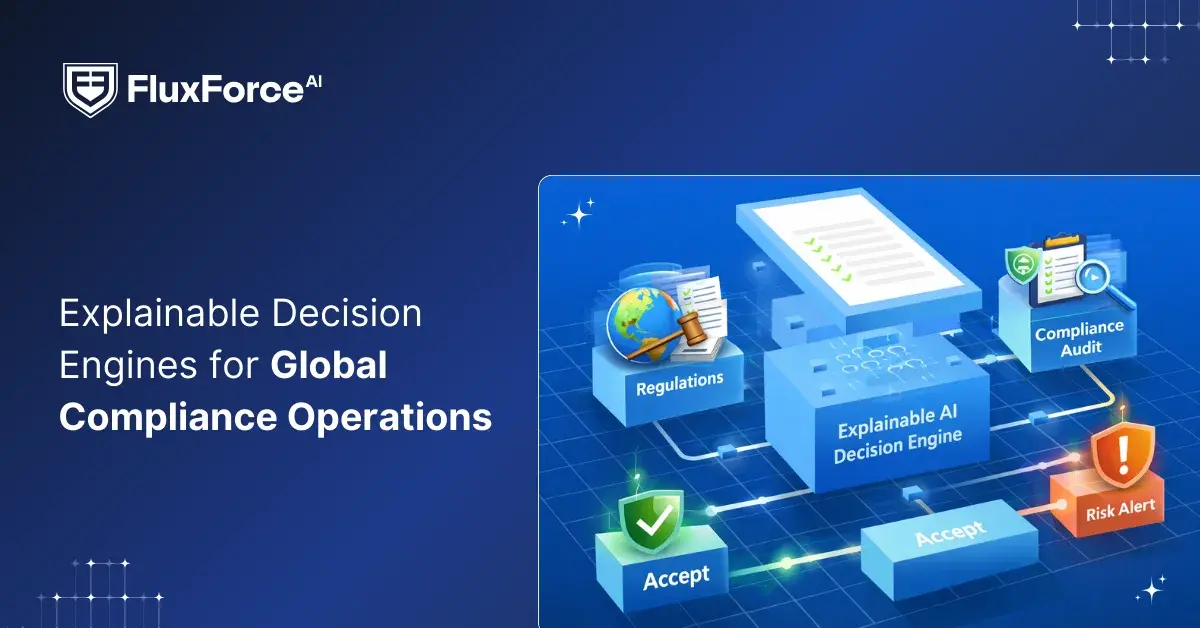
Explainable decision engines address this operational gap by providing not only decision traceability but also audit-ready evidence at scale.

The Operational Reality of Global Compliance Management in Enterprises
Across small and large enterprises, managing compliance across multiple jurisdictions has become expensive, complex, and increasingly inefficient. On average, global organizations operate five to twelve regulatory compliance automation tools with regional compliance teams for financial and risk processes.
Even with this investment, internal audits regularly show that a large portion of compliance effort is still spent on manual investigation, data checking, and audit preparation.
Below are three execution gaps that continue to consume operational budgets without delivering meaningful regulatory value:
1. Inconsistent Decision Ownership and Policy Interpretation
In multinational organizations, the same risk policy is often applied differently across regions and business units. Internal reviews frequently show noticeable variation in outcomes for similar cases across markets. This leads to repeated reviews, frequent escalations, and additional workload for compliance teams.
2. Automation Without Decision Transparency
Automated compliance solutions help process large volumes of activity, but many organizations still struggle to clearly explain why a specific decision was made. Teams often need to manually review multiple systems and reports to reconstruct decision logic.
3. Evidence Gaps in Regulatory Reporting and Audits
Regulators increasingly expect structured decision records and consistent supporting evidence. However, many enterprises still spend significant time collecting screenshots, logs, and manual notes during audits rather than demonstrating control effectiveness.
Where Traditional Compliance Management Software lacks ?
Traditional compliance management software handles alerts and case routing efficiently but often fails to clearly explain decisions. For regulators, the core priority is clear reasoning and defensibility, which most enterprise software solutions fail to provide:
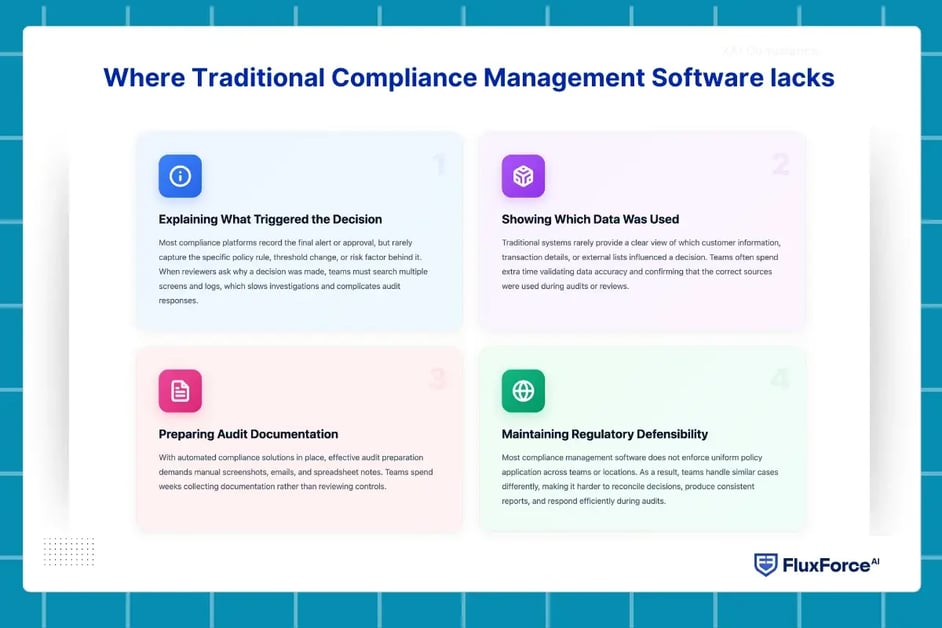
1. Explaining What Triggered the Decision- Most compliance platforms record the final alert or approval, but rarely capture the specific policy rule, threshold change, or risk factor behind it. When reviewers ask why a decision was made, teams must search multiple screens and logs, which slows investigations and complicates audit responses.
2. Showing Which Data Was Used in the Decision- Traditional systems rarely provide a clear view of which customer information, transaction details, or external lists influenced a decision. Teams often spend extra time validating data accuracy and confirming that the correct sources were used during audits or reviews.
3. Preparing Audit Documentation Independently- With automated compliance solutions in place, effective audit preparation demands manual screenshots, emails, and spreadsheet notes. Teams spend weeks collecting documentation rather than reviewing controls.
4. Maintaining Regulatory Defensibility and Cross-Border Consistency- Most compliance management software does not enforce uniform policy application across teams or locations. As a result, teams handle similar cases differently, making it harder to reconcile decisions, produce consistent reports, and respond efficiently during audits.
Explainable AI (XAI) excels at what traditional compliance software lacks. By allowing financial organizations to clearly understand how decisions are made, which data was used, and how policies were applied, it strengthens AI model’s governance and audit confidence.
How Explainable AI Supports Regulatory Compliance Across Borders ?
Explainable decision systems improve compliance by showing how rules and data drive each decision. Integrated interpretable machine learning engine enables fully AI-led compliance workflows across finance operations. Organizations can process cases faster while maintaining clear reasoning, consistent policies, and evidence that meets regulatory expectations across regions.
Consistency Across Varied Jurisdictions
Explainable decision systems ensure policies apply consistently across jurisdictions, including GDPR, EU regulations, and DORA requirements. By standardizing decision logic, teams can reduce regional discrepancies, ensure fair treatment, and maintain uniform compliance even as rules differ across countries.
System-Ready Documentation
Explainable automated systems generate structured audit documentation alongside every decision. Teams no longer need to assemble spreadsheets or screenshots manually. This saves time, supports regulatory reporting, and provides clear, organized records for audits.
Traceability of Sources
Explainable systems provide a direct link to all data used for each decision. Compliance teams can instantly show which customer information, transaction details, or external lists influenced outcomes, so that:
- Auditors can verify data integrity quickly.
- Compliance teams can report all inputs for each decision.
- Leadership gains visibility into data flow and controls.
Human-Understandable Insights
Explainable models use methods like SHAP (Shapley Additive Explanations) and LIME (Local Interpretable Model-agnostic Explanations) to convert complex model outputs into human readable insights. This helps explain decisions clearly to regulators and act on them confidently.
Decision Accountability
The system records every step and policy applied in the decision process. Organizations can assign responsibility, demonstrate oversight to regulators, and ensure that each outcome is supported by verifiable evidence, strengthening compliance governance.
Adaptive Compliance Logic
With XAI in place, decision rules update automatically when regulations, risk thresholds, or data sources change. This adaptive logic ensures consistent compliance across jurisdictions, prevents errors, and keeps audit records aligned with current regulatory requirements without manual updates.
Operational Benefits of Explainable Decision Engines for Regulated Enterprises
Regulated enterprises such as banks, insurance firms, logistics companies, and fintechs gain the most from explainable compliance risk management software: Explainable AI exposes how inputs shape decisions
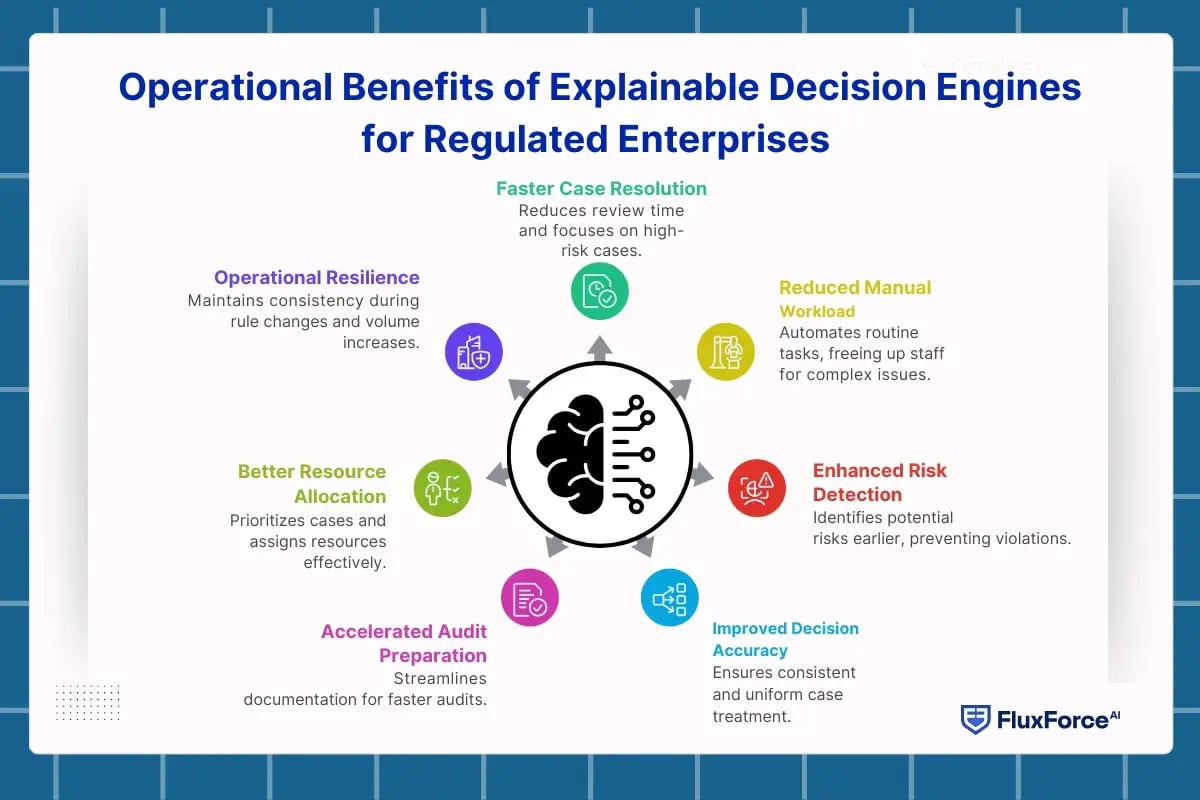
- Faster Case Resolution- Explainable engines help staff process compliance cases more quickly by providing clear decision reasoning, reducing back-and-forth reviews, and allowing teams to focus on high-risk or exceptional cases.
- Reduced Manual Workload- Automation of routine compliance tasks minimizes repetitive checks and manual documentation. Teams can redirect effort toward complex investigations and exception handling, improving overall productivity and operational efficiency.
- Enhanced Risk Detection- Decisions come with clear explanations, enabling compliance officers to identify potential risks earlier. This reduces exposure to regulatory violations and prevents operational losses due to overlooked anomalies.
- Improved Decision Accuracy- By consistently applying defined rules and showing the rationale behind each outcome, the system reduces human errors, ensures uniform treatment of cases, and improves overall operational reliability.
- Accelerated Audit Preparation- Structured, explainable records make audits faster and less resource intensive. Staff can generate complete documentation in minutes, ensuring regulators receive accurate and verifiable evidence.
- Better Resource Allocation- With clarity on decision drivers, managers can prioritize cases, assign resources effectively, and focus attention on the most critical compliance risks, reducing bottlenecks in daily operations.
- Operational Resilience- Adaptive systems reduce downtime caused by rule changes or data updates. Compliance operations remain consistent, responsive, and resilient, even during regulatory updates or sudden increases in case volumes.
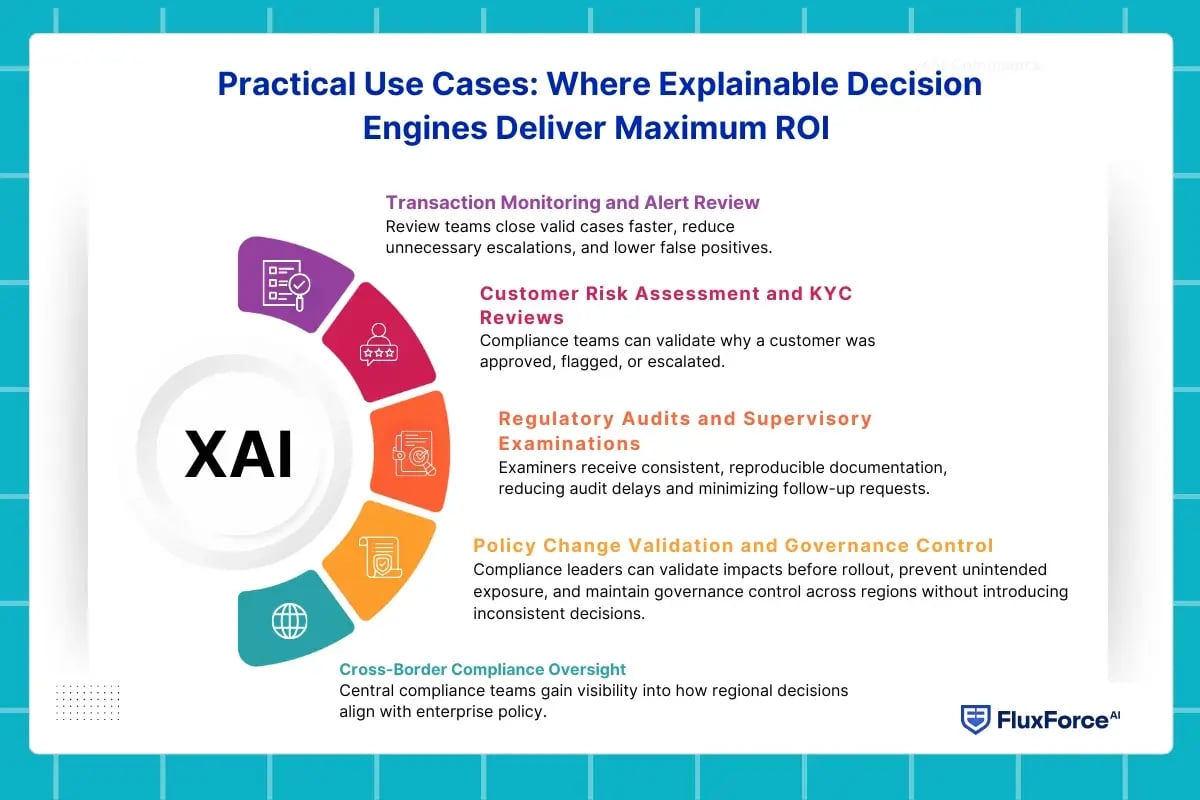
Practical Use Cases: Where Explainable Decision Engines Deliver Maximum ROI
Leveraging explainable, AI-driven decision engines allows regulated enterprises to improve compliance and boost operational revenue. Below are key areas where organizations gain measurable returns while minimizing errors, audit overhead, and risk exposure: 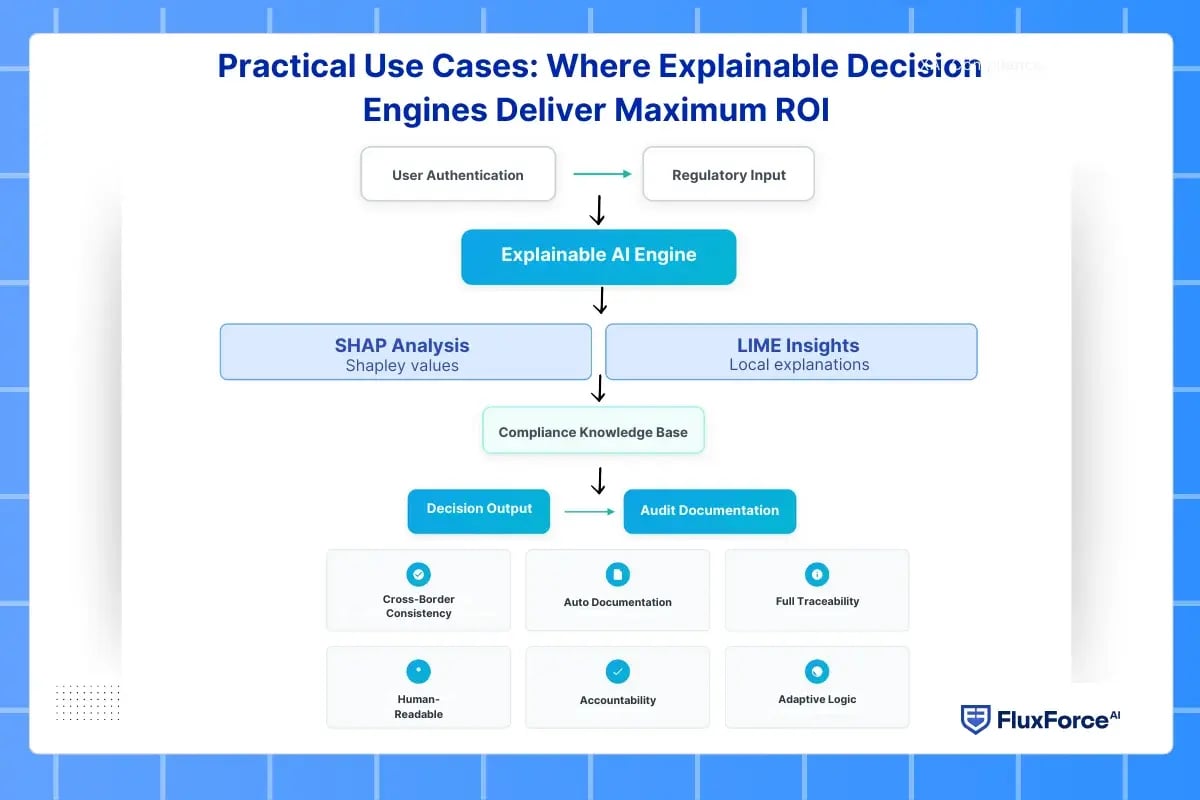
1. Transaction Monitoring and Alert Review
Explainable decision engines show which rule, threshold, and data triggered each alert. Review teams close valid cases faster, reduce unnecessary escalations, and lower false positives. Investigations complete sooner, analyst workload decreases, and operational throughput improves without compromising regulatory defensibility.
2. Customer Risk Assessment and KYC Reviews
Risk scores become transparent and fully reviewable. Compliance teams can validate why a customer was approved, flagged, or escalated. This improves accountability, supports audit readiness, and reduces rework during onboarding, periodic reviews, and regulatory inquiries.
3. Regulatory Audits and Supervisory Examinations
Audit teams access structured decision evidence directly from the system. Examiners receive consistent, reproducible documentation, reducing audit delays and minimizing follow-up requests. Operational cost and effort for regulatory inspections drop significantly.
4. Policy Change Validation and Governance Control
When policies or thresholds change, explainable engines show how decisions shift across historical cases. Compliance leaders can validate impacts before rollout, prevent unintended exposure, and maintain governance control across regions without introducing inconsistent decisions.
5. Cross-Border Compliance Oversight
Central compliance teams gain visibility into how regional decisions align with enterprise policy. Variations are measurable and reviewable, strengthening accountability, lowering regulatory risk, and enabling faster remediation without disrupting daily operations.
Enhance global compliance with explainable decision engines
—transform your compliance today!
Conclusion
According to regulatory bodies, ensuring AI governance requires transparency, accountability, and clear decision reasoning at every stage of compliance operations.
Explainable decision engines provide organizations with visibility into why and how decisions are made across multiple jurisdictions. This clarity reduces investigation delays, ensures consistent policy application, and strengthens audit readiness.
Enterprises can align global compliance programs, minimize regulatory risk, and make faster, defensible decisions. With decision logic that is both traceable and interpretable, organizations not only maintain regulatory confidence but also optimize operational efficiency.
Explainable decision engines transform compliance from a reactive task into a controlled, measurable, and scalable global operation.

Share this article