.webp)




.webp)



Listen To Our Podcast🎧

Introduction
In multi-framework compliance, accuracy depends less on detection and more on justification.
AI compliance tools can scan regulatory texts, identify overlapping obligations, and suggest mappings across frameworks at a speed that manual processes cannot approach. The accuracy problem surfaces after the mapping is generated. Compliance teams must defend every link to auditors who ask why two rules were connected, risk teams who ask what logic was applied, and regulators who ask whether the interpretation aligns with the framework's intent. When the AI system that generated the mapping cannot answer these questions, the compliance team must reconstruct the reasoning manually, which is the same effort the automation was meant to eliminate.
The real challenge appears after the mapping is created.
Compliance teams are expected to defend every decision. Auditors ask why two rules were linked. Risk teams ask what logic was applied. Regulators ask whether the decision can be explained clearly. If an AI system cannot answer these questions, trust breaks down.
Explainability addresses this at the point of mapping generation. When each mapping decision includes the reasoning behind it, the obligation concepts that were matched, the intent alignment that was assessed, and the confidence level of the connection, compliance teams can validate decisions directly rather than reconstructing them from model outputs. According to Wolters Kluwer's Q1 2026 Banking Compliance AI Trend Report, 28.4% of financial institutions now cite explainability and transparency as their most acute AI regulatory concern, which reflects how directly this gap affects operational compliance programs.
In regulated environments, this clarity is essential. Expectations around AI transparency in regulated industries continue to rise. Accuracy alone is no longer enough. Organizations are expected to show reasoning, not just results.
By using trustworthy AI with explainability, compliance teams gain confidence in automation. They can review mappings, validate logic, and respond to audit questions without redoing the work manually.
This approach also aligns with responsible AI frameworks, which emphasize accountability and interpretability. When AI can explain itself, compliance becomes easier to manage and easier to defend.
This blog explains How XAI improves accuracy in regulatory compliance by bringing clarity to multi-framework regulatory mapping. It focuses on practical understanding rather than technical complexity.

Why Traditional Regulatory Mapping Fails at Scale ?
Multi-framework regulatory mapping fails at a specific point: when the number of framework combinations exceeds what manual review can validate with consistency. A compliance team mapping obligations across GDPR, EU AI Act, PCI DSS, ISO 27001, and FATF simultaneously faces thousands of potential obligation pairs. The combinations grow exponentially with each additional framework. Traditional systems address this with keyword matching and similarity scoring, which processes volume but consistently misses regulatory intent. The result is high false positive mapping rates that compliance teams spend weeks correcting before any regulatory review begins.
To handle this complexity, many organizations turn to regulatory compliance AI and standard AI compliance tools. These tools promise faster mapping and reduced manual effort. In practice, they introduce new risks that are less visible but more damaging.
Text matching is not the same as regulatory understanding
As organizations expand across regions and regulations, regulatory mapping becomes harder to manage. Teams are no longer dealing with one framework at a time. They are aligning multiple rulebooks that were never designed to work together.
To handle this complexity, many organizations turn to regulatory compliance AI and standard AI compliance tools. These tools promise faster mapping and reduced manual effort. In practice, they introduce new risks that are less visible but more damaging.
Machine learning improves speed but hides reasoning
More advanced regulatory compliance AI systems use machine learning to understand language better. They analyze patterns and generate similarity scores. While this improves coverage, it creates a new challenge.
The system provides an answer, but not an explanation.
Without AI explainability, compliance teams cannot see how a decision was made. They cannot verify whether the logic aligns with regulatory expectations. This lack of machine learning transparency reduces trust and slows adoption.
Audits demand justification, not confidence scores
A regulatory mapping with a 94% confidence score satisfies a data scientist. It does not satisfy an auditor. Regulators and internal audit teams assess mapping decisions by asking whether the underlying regulatory intent was correctly understood and whether the link between obligations is legally and operationally defensible. A confidence score answers neither question. Organizations operating under the EU AI Act's high-risk AI provisions face this directly: Article 13 requires that AI system outputs be interpretable in terms that the user can evaluate, not just in terms of statistical confidence. Explainability converts confidence scores into reasoning chains that auditors can assess.
This is especially critical as expectations around AI transparency in regulated industries increase. Regulations are no longer focused only on outcomes. They also focus on decision logic.
Scaling without trust creates operational risk
As regulations evolve, mappings must be updated. Traditional systems struggle to adapt. Static rules break. Black-box models cannot explain changes. Teams are forced back into manual reviews.
This is why many automation initiatives stall. The technology scales, but trust does not. Accuracy becomes difficult to measure. Governance becomes harder to maintain.
These limitations explain why explainable AI is gaining attention in compliance programs. It addresses the core failure point of traditional mapping systems. It brings visibility into decisions and allows teams to review and refine mappings with confidence.
Next, we will examine how XAI works in practice and why it improves accuracy in multi-framework regulatory mapping.
XAI techniques for regulatory mapping accuracy
Regulatory mapping is only as effective as the decisions teams can validate and defend. Accuracy is not measured by the number of matches alone. It is measured by how clearly each decision can be reviewed, corrected, and repeated. Explainable AI enables compliance teams to achieve this by linking AI outputs directly to rationale and intent.
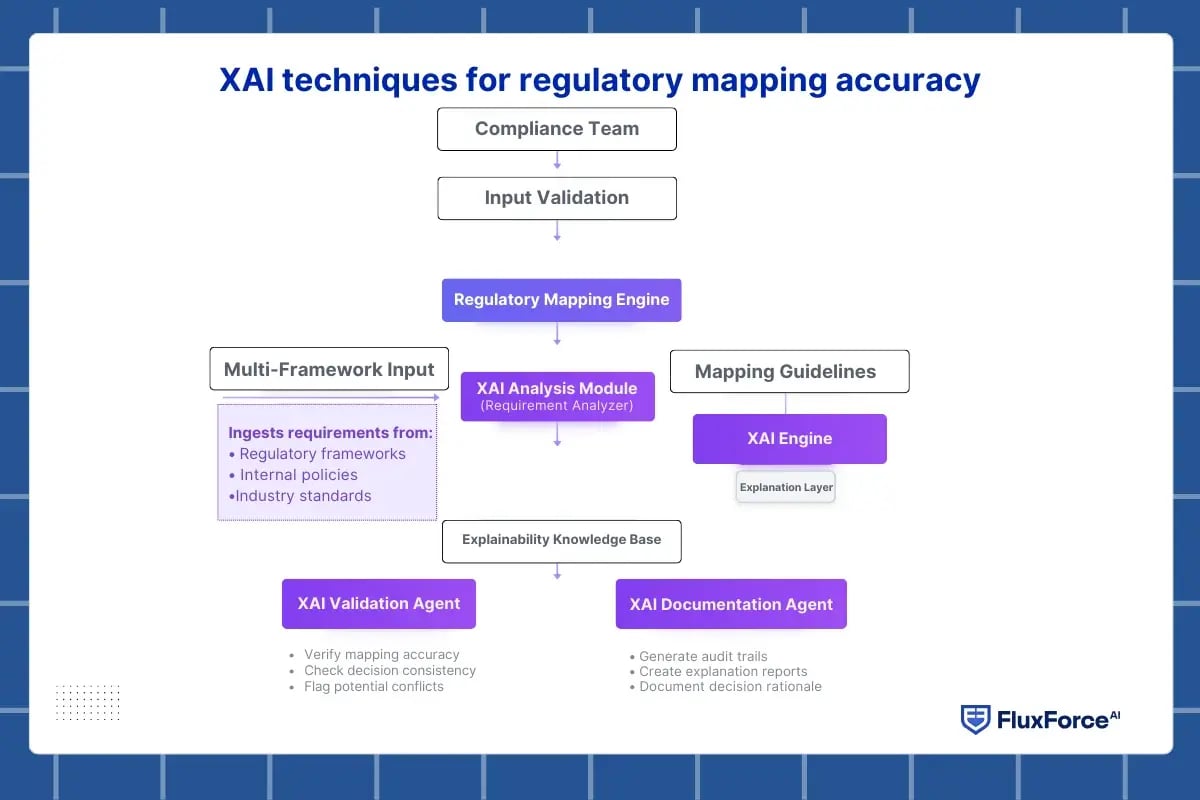
Here we outline how XAI improves accuracy during real compliance operations.
Accuracy improves when explanations drive feedback
In operational workflows, compliance teams review AI-generated mappings before approval. When reasoning is hidden, teams spend time guessing or rejecting mappings, slowing the process.
With AI explainability, each mapping includes decision logic. Teams can see which obligations were matched and why. This machine learning transparency reduces review time and allows early corrections, improving overall quality.
XAI techniques for regulatory mapping accuracy reduce false matches
Regulatory mapping errors fall into two categories with opposite compliance consequences. False matches link obligations that are not genuinely related, creating the appearance of coverage where none exists. Coverage gaps miss genuine obligation links, leaving real regulatory requirements unaddressed. Traditional mapping systems typically trade one for the other: lowering thresholds reduces false matches but increases coverage gaps. XAI addresses both by exposing the reasoning behind each mapping decision. Compliance teams remove false matches by identifying where vocabulary overlap drove the link rather than regulatory intent. They identify coverage gaps by finding obligation areas where the model's reasoning consistently underweighted relevant concepts.
XAI methods for improving AI decision accuracy support audits
Audit readiness requires traceable decisions. Auditors expect to understand why a requirement was mapped to another. Confidence scores alone are insufficient.
AI model interpretability metrics measure the consistency and reliability of explanations. Teams can confirm whether mappings are repeatable across similar cases. This is how XAI methods for improving AI decision accuracy strengthens operational compliance and aligns with audit expectations.
XAI for multi-framework regulatory mapping ensures consistency
Regulations evolve constantly. New rules, updates, and amendments create drift if mappings are not consistent.
Explainable AI for multi-framework regulatory mapping preserves decision paths. Teams can apply the same logic to new requirements and frameworks, ensuring consistent accuracy over time. Repeatable logic also builds trust with regulators and internal reviewers.
Responsible AI strengthens long-term mapping accuracy
Accuracy is not static. To maintain it, teams need transparency, monitoring, and accountability.
By following responsible AI frameworks, organizations ensure that XAI improvements are sustainable. Teams can detect biases, track performance, and maintain accuracy as regulations change. This supports trustworthy AI with explainability and positions compliance operations for long-term success.
Implementing XAI in Compliance Operations
Successfully adopting explainable AI requires more than technology. It requires operational alignment, workflow integration, and team readiness. Accuracy in regulatory mapping improves when AI supports decision-making, not replaces it.
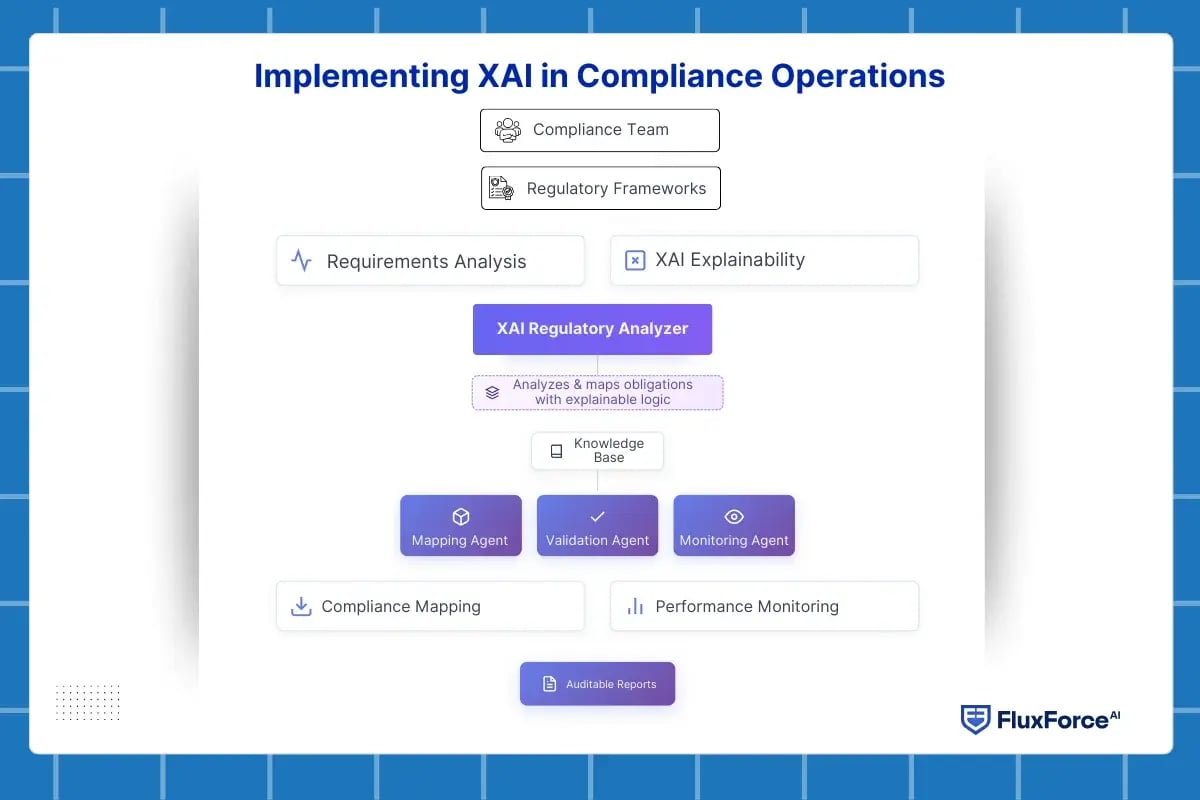
Here we will explain how fintech teams can embed XAI into daily compliance operations.
Start with understanding regulatory obligations
The first step is clarity. Compliance teams must define obligations across frameworks and capture context for each rule.
AI systems work best when obligations are structured and tagged. Using AI for regulatory compliance, teams can automate initial mapping while keeping human oversight for critical decisions.
Integrate explainability into workflows
Deploying XAI techniques for regulatory mapping accuracy requires visible AI reasoning. Teams should:
- Review AI decisions through dashboards
- See key factors that influenced mappings
- Validate alignment with intent, not just keywords
This ensures trustworthy AI with explainability and reduces operational friction during reviews.
Pilot small, refine continuously
Start with one regulatory framework or a high-priority use case. Monitor how the team interacts with AI explanations:
- Which mappings are easy to approve?
- Which require clarification or retraining?
Iterative refinement strengthens XAI methods for improving AI decision accuracy, building confidence before scaling to multiple frameworks.
Scale while maintaining transparency
Regulators want clear answers. They need to know why decisions were made. Explainable AI provides this automatically. Clear explanations reduce follow-up questions. Reviews happen faster. Audit work is easier. This lowers hidden compliance costs in financial services compliance automation.
Embed XAI in team culture
Teams should:
- Be trained to understand AI explanations
- Use AI insights to guide decisions rather than override them blindly
- Provide feedback to improve models continuously
This operational approach aligns with responsible AI frameworks and ensures long-term success.
Monitor impact and refine strategy
Measure performance through operational KPIs:
- Reduced errors in mapping
- Faster review cycles
- Consistent alignment across frameworks
This demonstrates How XAI improves accuracy in regulatory compliance while building confidence in automated workflows.
The Future of XAI in Regulatory Compliance
The compliance landscape is evolving rapidly. Organizations are handling more regulations, faster updates, and higher scrutiny from auditors. Explainable AI is no longer optional; it is central to achieving accurate, traceable, and auditable regulatory mapping.
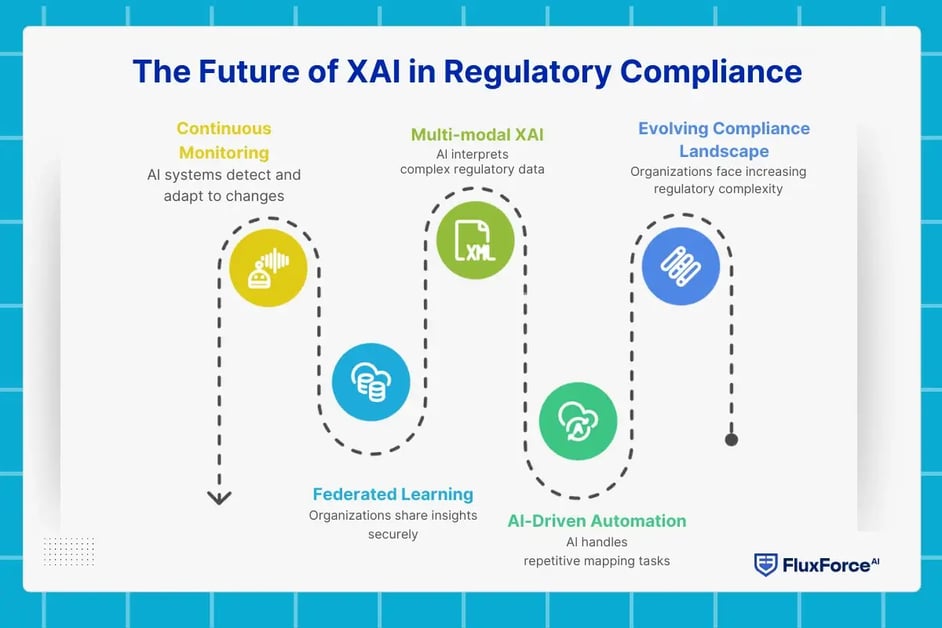
AI-driven automation for routine mapping
By 2027, the standard compliance mapping workflow will involve AI systems handling initial obligation identification, cross-framework linking, and consistency checking across all applicable regulatory pairs. Human compliance teams will focus on intent validation, exception review, and regulatory update integration. This division of labor is already emerging in organizations that have deployed XAI-enabled mapping tools: routine mapping tasks move at machine speed, while the validation layer that regulators assess remains under human oversight. XAI is the mechanism that makes this division operationally sustainable because it ensures that the AI's work product is reviewable by the humans responsible for defending it. XAI and AI model transparency for regulators ensures that even automated decisions remain fully reviewable, traceable, and auditable.
This evolution strengthens XAI techniques for regulatory mapping accuracy and reduces manual workload while maintaining control.
Multi-modal XAI interprets complex regulatory data
Regulations increasingly include tables, diagrams, and structured content. Explainable AI for compliance with regulations will interpret these multi-modal inputs, enabling more accurate and auditable mappings.
Teams can verify how AI links obligations across formats, reducing errors and ensuring alignment with regulatory intent.
Federated learning supports secure cross-organization insights
Sharing compliance intelligence without exposing sensitive data is essential. Responsible AI and regulatory mapping strategies will adopt federated learning. Organizations can collaboratively improve AI models while maintaining data confidentiality, promoting trustworthy AI with explainability.Continuous monitoring and adaptive AI
Future compliance requires AI systems that detect gaps and adapt to regulatory changes automatically. XAI methods for improving AI decision accuracy allow teams to identify weak mappings, retrain models, and maintain high precision over time.
This ensures organizations stay ahead of regulatory updates and minimize compliance risk.
Conclusion
Multi-framework regulatory mapping accuracy is a documented operational challenge: McKinsey's 2025 analysis found that institutions using manual compliance systems meet only a fraction of their obligations, while automated systems with proper documentation raise coverage above 95%. The gap between those two outcomes is not mapping speed. It is the ability to generate, review, and defend mapping decisions with enough clarity that regulators, auditors, and internal governance teams can evaluate them without additional reconstruction. Explainable AI closes that gap. Organizations that build XAI into their mapping infrastructure now are building the documentation and review capability that the EU AI Act, DORA, and successive regulatory updates will require throughout the rest of this decade.


Share this article