.webp)








Listen To Our Podcast🎧

Introduction
As per major regulators such as the Digital Operational Resilience Act (DORA), the General Data Protection Regulation (GDPR), and other broader regulations, every decision that affects customer or creates business risk must be explainable.
The regulatory shift is no longer about whether AI is permitted, but whether its decisions can be defended under scrutiny. In recent GDPR enforcement actions, over €4 billion in fines have been issued, with an increasing share linked to automated decision-making and transparency failures.
From January 2023, DORA further raised expectations by obligating institutions to demonstrate how critical systems behave during disruptions.
In this context, explainable AI directly influences whether decisions can be reviewed, traced, and defended. Without it, AI governance becomes difficult to sustain during audits, incident reviews, and regulatory inquiries.
AI enhances document forgery detection with transparent
Learn about innovative solutions and boost your security

Why is explainability important for AI compliance ?
Whether under DORA, GDPR, or broader EU regulations, explainability is essential for any decision that affects customers or creates operational risk. Regulators do not only assess the correctness of an outcome, but they also focus on whether the decision can be examined, justified, and traced.
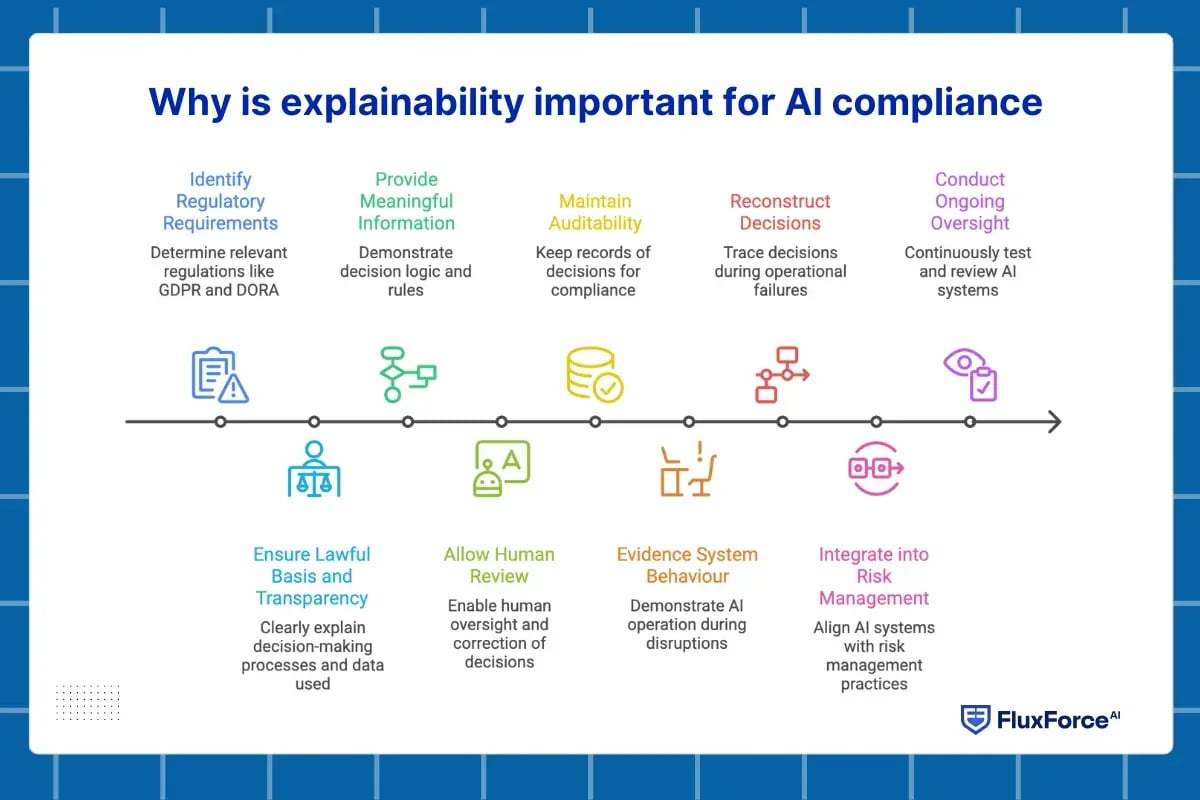
Systems without explainable outputs leave organizations unable to provide evidence during audits, incident investigations, or regulatory inquiries. Lack of explainability weakens AI governance, increases exposure to compliance penalties, and prevents institutions from demonstrating accountability. As regulatory scrutiny rises, explainability ensures that every automated decision is transparent, auditable, and aligned with meeting requirements across operational resilience, data protection, and accountability frameworks.
How GDPR regulates AI decision-making ?
GDPR explainability requirements apply to automated decisions impacting individuals.
- Lawful basis and transparency- Organizations must clearly explain how automated decisions are made, including the data and criteria used. Transparency ensures regulators and affected individuals understand the reasoning behind outcomes.
- Meaningful information about logic- The GDPR explainability requirement mandates that decision logic is interpretable. Organizations need to demonstrate the steps and rules influencing outcomes, not just provide results.
- Human review and intervention- Decisions that significantly affect individuals must allow for human oversight or correction. Explainable AI supports this process by making system reasoning accessible.
- Auditability and accountability- Institutions must maintain records of decisions to show compliance during inspections or complaints. Explainability ensures these records are meaningful and defensible.
How DORA impacts AI systems ?
DORA compliance extends explainability to operational resilience.
- System behaviour during disruptions- Under the Digital Operational Resilience Act, institutions must evidence how AI systems operate under stress or ICT incidents.
- Decision traceability during incidents- Explainability allows teams to reconstruct AI decisions during operational failures, supporting incident investigation and reporting.
- Integration into DORA ICT risk management- AI systems must align with DORA ICT risk management practices, including monitoring, escalation, and accountability frameworks.
- Ongoing oversight and testing- Continuous testing and review of critical AI systems are expected under DORA. Explainable models make it possible to identify errors, risks, or deviations promptly.
What Changes When Explainable AI is Integrated for Regulatory Compliance ?
Integrating explainable AI transforms AI systems from opaque decision engines into auditable, traceable, and accountable frameworks that meet regulatory expectations. By embedding explainability, institutions experience transformative changes:
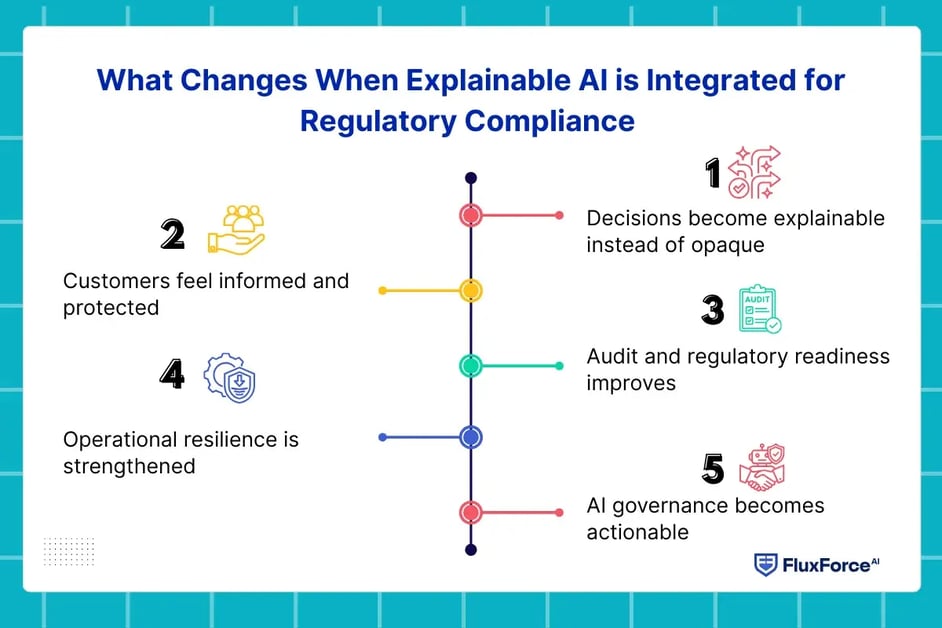
1. Decisions become explainable instead of opaque
Explainable AI systems break documents into granular features such as font consistency, spacing patterns, metadata timestamps, and digital signatures. Each feature is assigned an attribution score. When document fraud detection identifies an anomaly, the system shows exactly which features influenced the decision and their relative contribution.
2. Customers feel informed and protected
Explainable AI allows organizations to provide meaningful explanations to individuals affected by automated decisions. Customers gain confidence that decisions impacting their accounts, services, or rights are not arbitrary. This supports regulatory obligations, such as GDPR’s data subject rights, and reduces complaints or legal disputes.
3. Audit and regulatory readiness improves
Institutions can maintain detailed decision logs and evidence of system behaviour, ensuring AI governance aligns with audit expectations. Auditors and supervisors can evaluate both the processes and outputs of AI systems without relying solely on outcome verification.
4. Operational resilience is strengthened
Explainable AI enhances the ability to identify system failures or anomalies quickly. During ICT disruptions, model behaviour can be reconstructed and analysed, supporting DORA ICT risk management practices and ensuring continuity of critical services.
5. AI governance becomes actionable
Explainability makes oversight measurable. Governance processes, escalation procedures, and accountability mechanisms can be clearly demonstrated, showing alignment with regulatory expectations and meeting requirements across risk, compliance, and operational functions.
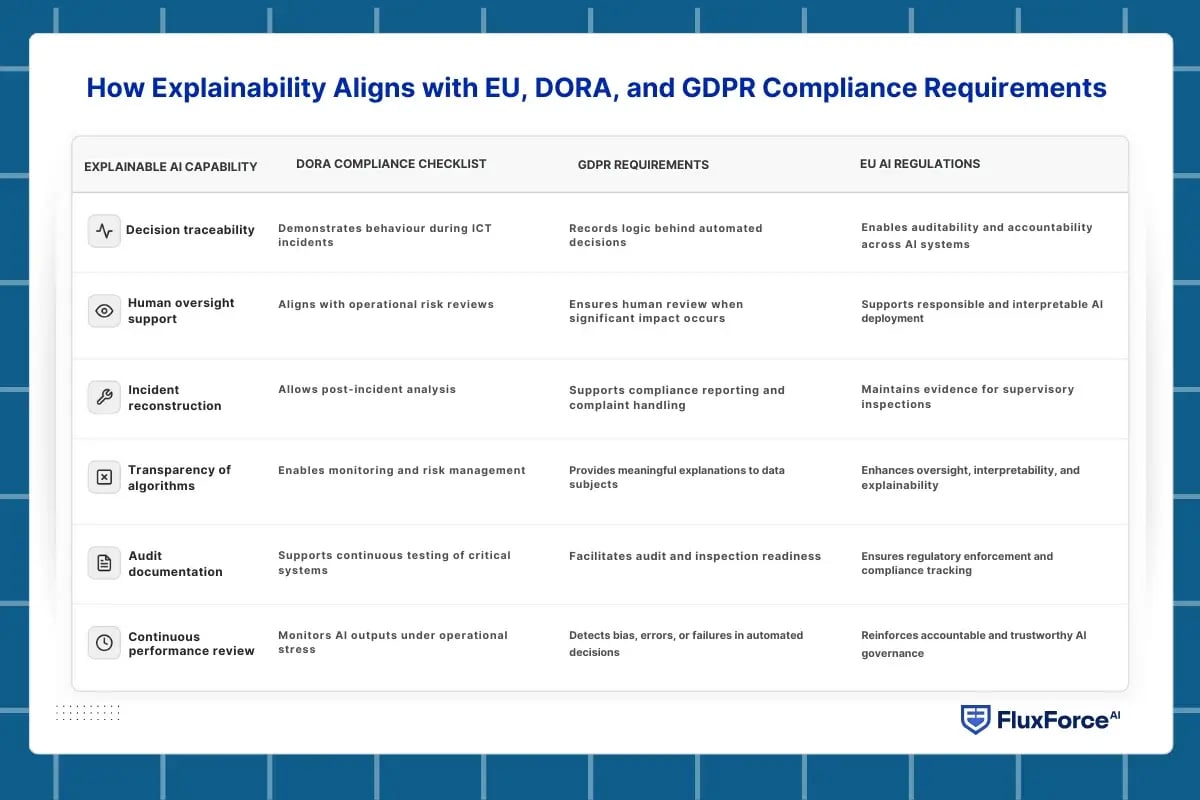
How Explainability Aligns with EU, DORA, and GDPR Compliance Requirements ?
The alignment between explainable AI and regulatory frameworks is crucial for maintaining operational resilience, transparency, and accountability. Institutions can map AI capabilities directly to compliance checkpoints under DORA, GDPR, and broader EU rules, ensuring that decision-making is defensible, auditable, and traceable.
Governance Practices Regulators Expect for Trustworthy AI
Regulators emphasize governance frameworks that integrate explainable AI into risk, compliance, and operational processes. Transparent and auditable systems are critical to demonstrate accountability, avoid regulatory penalties, and ensure consistent decision-making across AI-driven processes.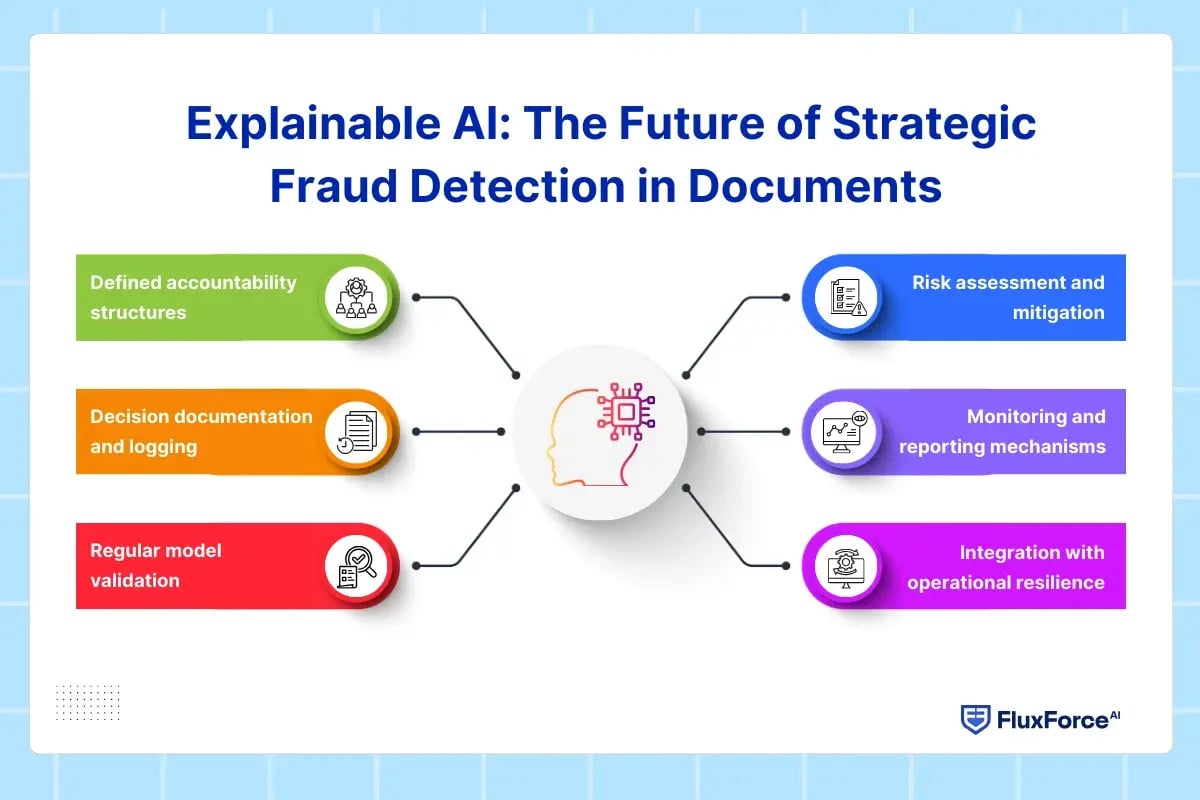
1. Defined accountability structures
Institutions must establish clear responsibilities for all AI decisions. Roles for oversight, escalation, and validation ensure that decision-making processes can be evaluated and defended in case of regulatory scrutiny.2. Decision documentation and logging
All critical decisions should be recorded with detailed reasoning, supporting evidence, and the data involved. This enables reconstruction during audits or incident reviews, fulfilling GDPR explainability requirements and DORA ICT risk management expectations.
4. Risk assessment and mitigation
Ongoing evaluation of AI system risks—including operational, compliance, and ethical risks—is essential. Explainable AI supports the identification and mitigation of risks such as bias, errors, or unanticipated outcomes.
5. Monitoring and reporting mechanisms
Institutions are expected to implement continuous monitoring of AI behaviour and report incidents in accordance with DORA compliance and GDPR frameworks. Explainable models allow organizations to detect anomalies, generate insights, and provide evidence to regulators efficiently.
6. Integration with operational resilience
Governance is strengthened when explainable AI aligns with operational controls, incident management, and ICT risk frameworks. This integration ensures that decision-making is auditable and resilient to both system and regulatory challenges.
Conclusion
DORA and GDPR do not regulate algorithms directly; they regulate accountability. When an operational disruption or a data rights complaint occurs, regulators expect institutions to explain how a system behaved, why a decision was made, and who was responsible for it. What regulators expect from AI models in 2026 is explainability and decision-level reasoning.
AI systems that cannot produce this reasoning create a compliance gap—not because they are inaccurate, but because their decisions are undefendable during audits, investigations, and post-incident reviews. While the tech world moves at speed, regulatory focus remains on meeting requirements consistently and defensibly.

Share this article