.webp)








Listen To Our Podcast🎧
.png)
Introduction
“The first step in the control of any system is to understand it.
A system that cannot be understood cannot be effectively governed.”
From an operational standpoint, this is the real problem with modern regulatory reporting automation and AI process automation has improved throughput, but they have not improved understanding.
In most automated compliance reporting environments, explanations are produced separately from the decisions they describe. An analyst writes a narrative. A reviewer reconstructs logic from audit logs. A compliance officer provides context the system never captured. This separation between automated decision and human explanation is the structural weakness that regulators and auditors increasingly target.
Explainable AI (XAI) changes this by design. With explainable artificial intelligence, AI explainability is embedded into reporting workflows, not added later. The system records how decisions were formed, which rules applied, and why outcomes were produced.
For organizations investing in regulatory technology RegTech, this is what enables sustainable AI regulatory compliance. Automation is useful. Explainable automation is governable.
Organizations building scalable governance programs often combine explainability with broader AI compliance strategies. Our guide on AI Compliance Solutions: A Complete Guide for Regulated Industries explores how regulated enterprises operationalize AI-driven compliance across reporting, monitoring, and audit workflows.
XAI streamlines automated regulatory reporting workflows
ensuring compliance and efficiency

Benefits of XAI in Automated Compliance Workflows
The operational value of XAI in compliance workflows is measured in three ways: how much it reduces the time teams spend reconstructing decisions during reviews, how consistently it produces explanation records that satisfy auditors without supplementary documentation, and how well it maintains decision logic alignment as regulations change and reporting volumes scale. Each of the workflow changes below addresses one of these measures directly.
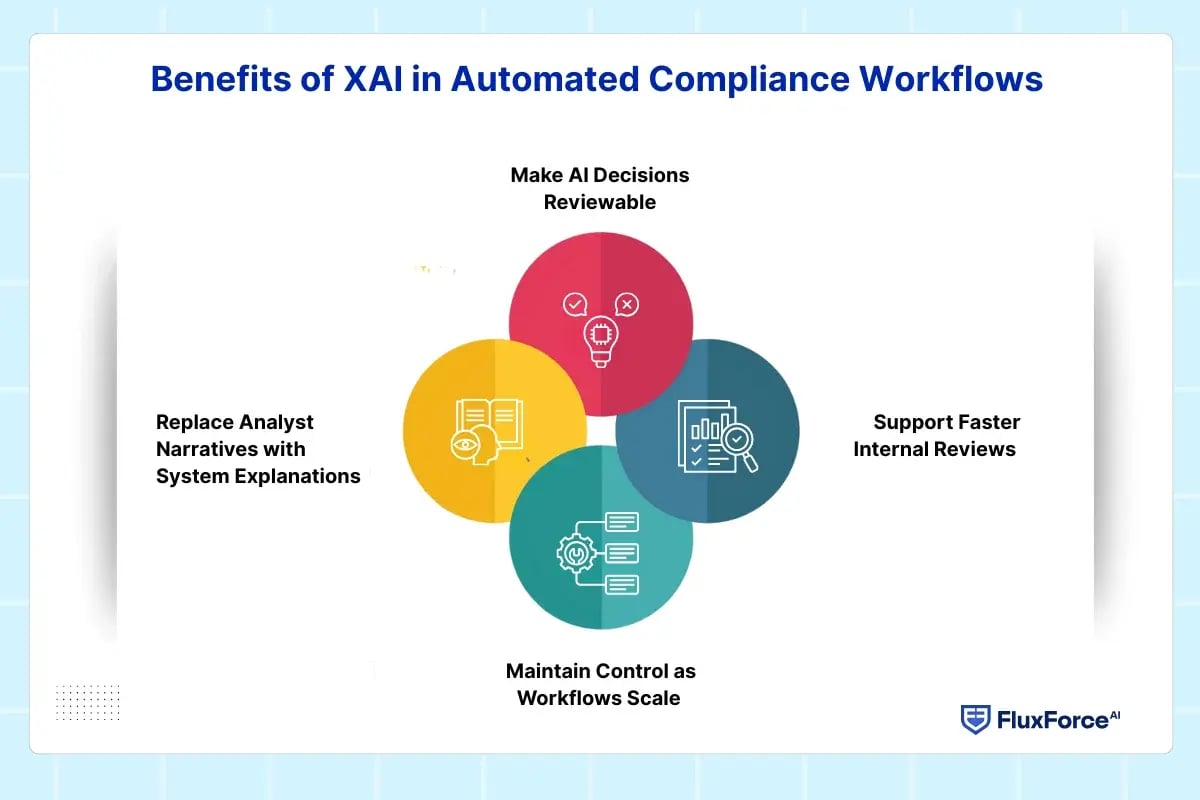
Make AI Decisions Reviewable
In many AI automation setups, a reporting decision is technically correct but operationally unclear. For example, a transaction is flagged or included in a report, but the system cannot show which conditions triggered that outcome.
With explainable AI (XAI), the workflow records the reasoning at the time of decision. A reviewer can see which inputs mattered, which rules applied, and how the outcome was reached. This removes the need for manual reconstruction during reviews.
Replace Analyst Narratives with System Explanations
Traditional automated compliance reporting still relies on analysts to write explanations when questions arise. These narratives differ from person to person and often sit outside the system.
XAI replaces this with consistent, system-generated explanations. For example, when an exception appears in a regulatory report, the workflow automatically attaches the rationale behind it. The explanation becomes part of the record, not an afterthought.
Support Faster Internal Reviews
Internal compliance reviews often slow down because reviewers need to ask follow-up questions. They want to understand how decisions were made, not just what the outcome was.
By embedding AI explainability into the workflow, XAI allows reviewers to validate decisions directly. This shortens review cycles and reduces back-and-forth between operations and compliance teams.
Maintain Control as Workflows Scale
As reporting volumes increase, maintaining consistency becomes difficult. Different teams interpret rules differently, and explanations drift over time.
XAI enforces the same logic across workflows. As part of AI compliance operations, this ensures that automated decisions remain aligned with defined policies, even as systems scale.
How Explainable AI Improves Automated Regulatory Reporting ?
Automated regulatory reporting automation workflows involve more than report generation. They cover a sequence of decisions—from data classification and rule application to exception handling and audit evidence. Explainable AI (XAI) brings transparency and accountability to each stage.
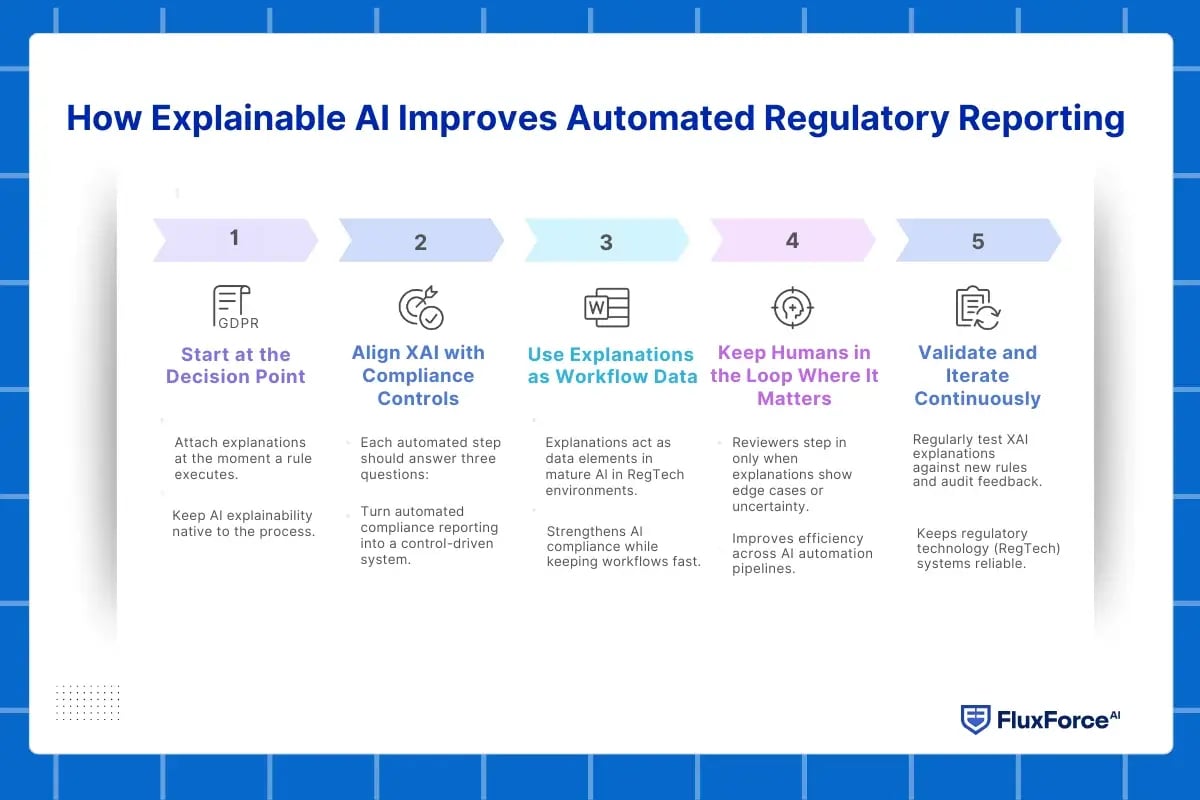
Make Reporting Decisions Transparent
In typical AI automation, decisions occur silently. Data enters or leaves the report, adjustments happen, but the reasoning stays hidden.
Explainable AI (XAI) captures the rationale behind each decision. For example, when a data item qualifies as reportable, the workflow records why it met the criteria. This ensures all decisions remain traceable and reviewable, strengthening AI compliance.
Embed Rule Interpretation into Workflows
Regulatory rules carry complexity and allow multiple interpretations. Automation may apply rules correctly but cannot show how decisions align with them.
Explainable artificial intelligence integrates interpretation directly into the workflow. When the system applies a rule, it records which conditions influence the decision. Reviewers see the “how” and “why,” supporting AI regulatory compliance.
Handle Exceptions with Built-In Explanations
Exceptions occur in every workflow. Traditionally, analysts provide separate justification after the report leaves the system.
With AI explainability, the workflow attaches an explanation automatically. Each exception shows the logic and conditions behind the decision. This removes manual narratives and strengthens automated compliance reporting.
Preserve Decision Context Over Time
Regulatory reviews often arrive after the report submission. By that time, context disappears, and teams must reconstruct logic.
Explainable AI (XAI) keeps decision context at the time of reporting. Workflows retain why and how decisions happened, allowing teams to respond quickly without redoing work, supporting modern regulatory technology RegTech environments.
How XAI Enables Audit-Ready Regulatory Reports ?
In compliance operations, audits rarely fail because numbers are wrong. They fail because no one can explain how the system reached its conclusions. Teams spend hours chasing logs, consulting analysts, and reconstructing reports. Explainable AI (XAI) removes this friction.
.webp?width=1200&height=800&name=ai%20driven%20regulatory%20workflows%20(2).webp)
Capture Decisions at the Point of Reporting
In typical AI automation, reports flag exceptions, but the “why” is buried in code or emails. Teams discover it only during audits.
XAI captures decision context at the moment each reporting rule executes — not during audit preparation. When a record qualifies as reportable, the workflow immediately records which regulatory rule triggered the classification, which data threshold was met, and what assumptions the system applied. When an auditor requests justification for a specific line item six months after submission, the compliance team retrieves a structured record rather than reconstructing logic from archived logs. This is the operational difference between audit-ready and audit-reactive.
Standardize Explanations Across Teams
Different teams often explain exceptions inconsistently. Auditors notice, creating delays.
Explainable AI in compliance enforces structured explanations for every decision. Explanations become part of automated reporting workflows, not post-process attachments. This approach reduces manual narratives and strengthens AI compliance.
Reduce Post-Audit Fire Drills
Without XAI, audits trigger a scramble. Teams spend days verifying logic and reconstructing decisions.
Embedding AI compliance automation into workflows keeps decision context at the time of reporting. Teams respond to audit queries immediately, avoiding rework and speeding review cycles.
Integrate with Compliance Systems
Most operations use RegTech platforms or internal reporting tools. XAI compliance frameworks attach explanations directly to reports. Audit-ready outputs now include results and rationale, making AI compliance reporting tools reliable partners rather than black boxes.
Implement XAI in Automated Compliance Processes
In real operations, adding explainable AI (XAI) is not a model upgrade. It is a workflow decision. Teams that succeed treat XAI as part of AI process automation, not as a reporting layer added at the end.
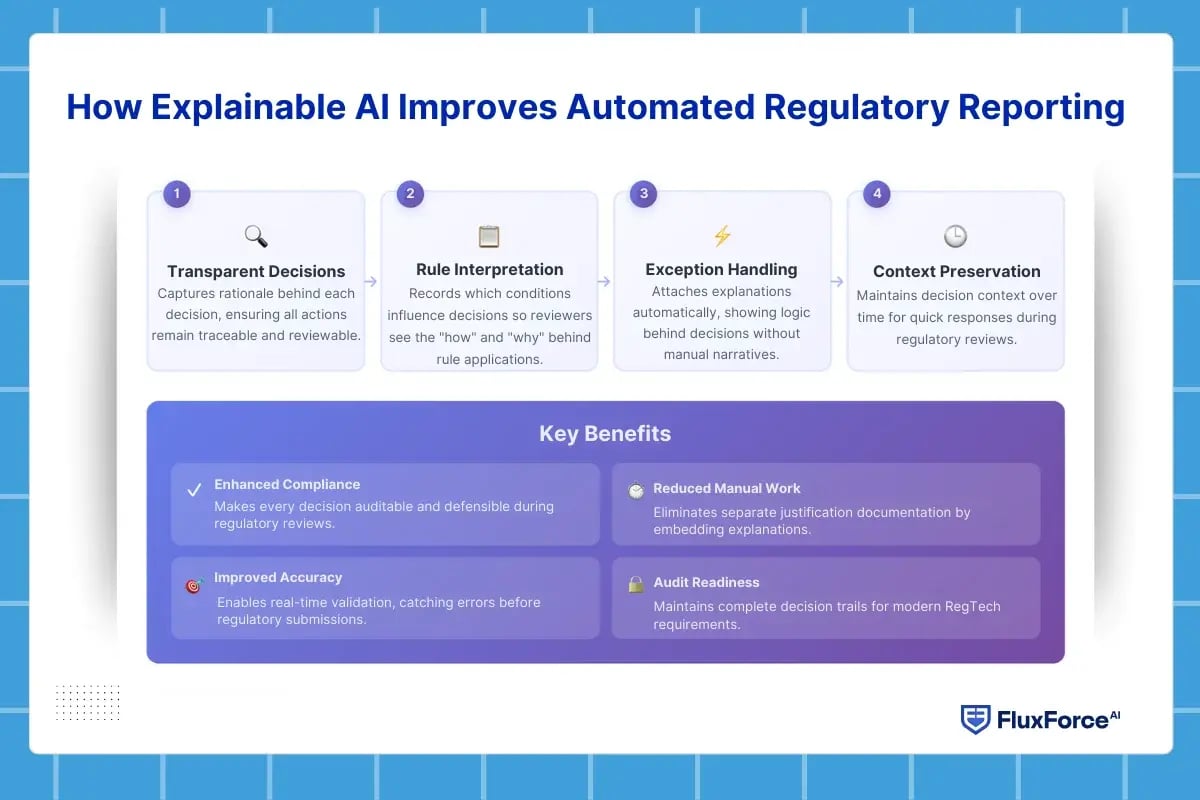
Start at the Decision Point
The most common XAI implementation failure in compliance reporting is timing: explanations are generated after reports are produced, using the outputs as a starting point. This produces explanations that describe results rather than decisions — they cannot capture the rule logic, input data, and threshold conditions that existed at the moment each classification was made. A practical XAI setup executes the explanation as part of the rule itself: when the threshold is crossed, the system simultaneously records the threshold value, the input that crossed it, and the rule reference that makes it reportable. Context is captured when it exists, not reconstructed when it is needed. This keeps AI explainability native to the process.
Align XAI with Compliance Controls
Compliance teams already operate with controls, reviews, and approvals. XAI should map directly to these controls. In AI regulatory compliance, each automated step should answer three questions:
- Which rule applied
- Which data supported the decision
- Which control validated the outcome
This alignment turns automated compliance reporting into a control-driven system rather than a black-box output.
Use Explanations as Workflow Data
Most teams treat explanations as text. That limits value. In mature AI in RegTech environments, explanations act as data elements. They trigger reviews, escalate exceptions, and route reports for approval. This approach strengthens AI compliance while keeping workflows fast.
Keep Humans in the Loop Where It Matters
XAI does not remove human oversight. It reduces unnecessary review. With explainable artificial intelligence, reviewers step in only when explanations show edge cases or uncertainty. Routine cases pass automatically, improving efficiency across AI automation pipelines.
Validate and Iterate Continuously
Regulations change. Workflows must adapt. Teams should regularly test XAI explanations against new rules and audit feedback. This keeps regulatory technology (RegTech) systems reliable and prevents drift in automated regulatory reporting workflows.
What Regulators Now Expect From an Automated Report
The EU AI Act took effect in August 2024 and requires high-risk AI systems to provide the technical capability to explain their outputs. Article 13 asks for more than a confidence score. It requires that outputs be interpretable in terms the user can actually evaluate, and a number between zero and one is not that.
In the United States the expectation is older than the technology. The Federal Reserve, OCC, and FDIC have enforced model risk management through SR 11-7 since 2011. It requires developers to assess a model's sensitivity to key assumptions and to demonstrate an understanding of its capabilities and limitations, which is a standard a black-box model structurally cannot meet without explainability layered on top of it.
Examiners are applying that standard to newer systems without softening it. Federal Reserve examiners now raise explainability, bias mitigation, and transparency expectations for machine learning and generative AI alike, with particular scrutiny on credit models where ECOA adverse action notices are required. If a model declines an application, someone still has to state the principal reasons why.
What the Data Shows
Compliance teams have already noticed. Wolters Kluwer's Q1 2026 Banking Compliance AI Trend Report found that 28.4% of financial institutions now cite explainability and transparency as their most acute AI regulatory concern. The pressure is not only regulatory. Deloitte projects that generative AI could drive US fraud losses from $12.3 billion in 2023 to $40 billion by 2027, which puts more automated decisions in front of more examiners. Verizon's 2024 Payment Security Report found that organizations with mature detection and response documentation show lower rates of repeat audit findings than those relying on opaque automated controls.
Reporting is one obligation among several. See the wider treatment of explainable AI in finance for how the same principles apply across lending, fraud, AML, and market risk.
What Enforcement Actually Costs
On 23 October 2024 the CFPB ordered Apple and Goldman Sachs to pay over $89 million over Apple Card failures: a $45 million civil penalty and $19.8 million in consumer redress from Goldman, and a $25 million penalty from Apple. The Bureau also barred Goldman from launching a new consumer credit card without first showing a credible compliance plan. That last condition is the part worth noting. The financial penalty was survivable for a bank that size. The product freeze was not priced in.
In the EU, Article 99 of the AI Act sets penalties in tiers, and the distinction matters when scoping exposure. Deploying a prohibited practice under Article 5 carries up to €35 million or 7% of worldwide annual turnover, whichever is higher. The tier that actually applies to AML monitoring, credit scoring and fraud detection is lower but still material: up to €15 million or 3% of turnover for breaching the provider and deployer obligations attached to high-risk systems. Supplying incorrect information to a regulator carries up to €7.5 million or 1%.
The operational case sits underneath the regulatory one. Consider an analyst working a flagged wire. Without an explanation they reconstruct the reasoning: pull the customer profile, check the counterparty, compare against 90-day behaviour, then decide. With the contribution scores already attached, that reconstruction step disappears and the judgement call remains. The saving is not that anyone works faster. It is that one stage of the work stops being repeated on every alert.
Conclusion
Regulatory penalties for global financial institutions reached $1.23 billion in the first half of 2025 alone — a 417% increase over the same period in 2024, according to Fenergo's enforcement actions analysis. Many of these penalties originated from reporting controls that processed data correctly but could not demonstrate to regulators why specific decisions were made. Explainable AI addresses this at the point where most reporting programs are most vulnerable: the gap between automated output and documented decision reasoning. Explainable AI (XAI) restores that trust by making AI automation accountable. It ensures every report carries context, every exception has a reason, and every decision can stand on its own without manual reconstruction. As regulatory reporting automation scales, explainability becomes a requirement, not an enhancement. Without AI explainability, automation increases speed but weakens control. With XAI, speed and governance move together.
For organizations investing in AI compliance and modern regulatory technology (RegTech), XAI acts as the stabilizing layer. It turns automated workflows into systems that can evolve, withstand scrutiny, and remain audit-ready over time.
As the RegTech market scales toward $62 billion by 2032 and regulatory scrutiny of automated compliance systems intensifies across the EU AI Act, DORA, and US agency frameworks, the organizations that build explainability into their reporting workflows now are building the governance infrastructure that the next regulatory cycle already expects. Automation with embedded explainability is not a compliance advantage — it is a compliance baseline.



Share this article