.webp)




.webp)



Listen To Our Podcast🎧
.png)
Introduction
Why trust is the missing layer in insider threat detection?
It usually starts with a simple alert.
An employee logs in late. A file is downloaded. A transaction is accessed outside routine hours. The system flags it as risky.
But the real question comes next.
Why was this action flagged, and can the team trust that decision?
Unlike external attacks that follow recognizable intrusion patterns, insider activity looks like normal work on the surface. Employees have legitimate access. Their actions occur within expected systems. Distinguishing a routine file transfer from a data exfiltration attempt — or a genuine transaction error from internal fraud — requires both behavioral context and the ability to explain why a specific action crossed the risk threshold.
This trust gap matters more than most teams realize.
When alerts arrive as risk scores without reasoning, analysts face a credibility problem. Acting on an unexplained alert risks damaging a legitimate employee relationship. Ignoring it risks missing a genuine threat. Neither outcome serves the bank, and repeated uncertainty erodes confidence in the entire insider threat program.
This trust gap matters more than most teams realize.
A Ponemon Institute study on insider threat programs found that security teams override or ignore a significant portion of alerts they cannot contextualize — a pattern that transforms detection investment into operational noise and leaves genuine risks unaddressed. When teams do not understand alerts, they stop believing in them.
Why Insider Threats Are Harder Than External Attacks ?
External threats follow recognizable patterns — unusual IP ranges, known malware signatures, credential stuffing velocity. Insider threats use legitimate credentials, familiar systems, and routine-looking actions. A customer service agent exporting account records may be handling a legitimate escalation or preparing a data sale. Traditional threat detection systems produce a risk score for both scenarios but cannot show which behavioral signals differentiate them.
This is where trust breaks down in cybersecurity in banking.
Without clarity, security teams hesitate. Business teams push back. Alerts become friction instead of protection. Over time, this weakens insider threat prevention, not strengthens it.
Trust Comes Before Prevention
Insider risk programs succeed when the people using them believe the system makes sound, contextual decisions. Accuracy metrics alone do not produce that belief — explainability does. When a security team can see why a specific employee action crossed the risk threshold, response confidence improves, false positive fatigue decreases, and the program gains the cross-functional credibility it needs to function as actual prevention rather than after-the-fact investigation.
Before banks can prevent insider threats, they must first earn trust in how those threats are identified.

Why Banks Need Explainable AI for Insider Threat Detection ?
For compliance and security leaders, the insider threat alert that arrives with a high-risk score and no context is the most operationally costly type of notification. It demands investigation time, forces judgment calls on incomplete information and creates documentation gaps that auditors later question. XAI addresses this by making the reasoning behind each alert as visible as the outcome,
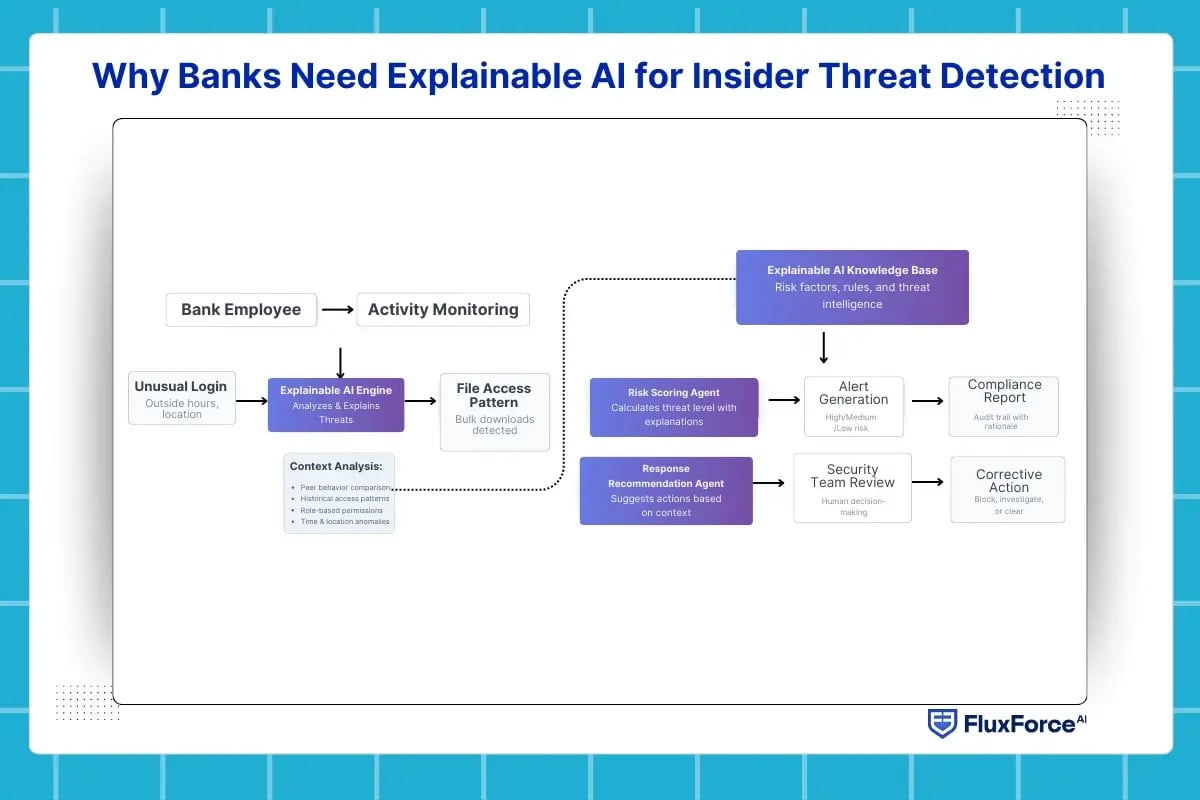
Making Complex AI Decisions Clear
Black-box AI models can spot anomalies, but without context, they create frustration. Explainable AI for fraud detection breaks down the “why” behind every alert. It can show that a login occurred outside regular hours, from an unusual location, or involved abnormal file access patterns.
This clarity allows teams to respond with confidence, transforming insider threat detection in banks from guesswork into actionable intelligence.
Reducing Noise Without Losing Security
One of the biggest headaches in banking cybersecurity is false positives generated by rigid AI security solutions. Every unnecessary alert wastes time and resources. By highlighting the exact factors driving risk, AI-powered insider risk management helps teams quickly separate genuine threats from harmless anomalies.
A teller accessing HR records once in a quarter looks different to XAI than a loan officer bulk-downloading client files at 11pm from an unfamiliar device. XAI shows the signal composition behind each, allowing analysts to apply proportionate responses — monitoring the former, escalating the latter — rather than treating both as equivalent alerts. This approach strengthens insider threat prevention while keeping operations smooth.
Strengthening Compliance and Accountability
Regulators across jurisdictions are raising the bar for insider threat documentation. The European Banking Authority's guidelines on internal governance require that risk management decisions are traceable and reviewable. The US Office of the Comptroller of the Currency's guidance on operational risk management expects banks to demonstrate that automated monitoring controls operate as intended. XAI produces the structured decision records that satisfy both — showing not just that an alert was generated, but which behavioral signals drove it and what action was taken in response.
By visualizing key drivers of insider risk, such as peer behavior deviations or abnormal access patterns, banks can not only prevent fraud but also demonstrate robust governance and control.
Empowering Human Analysts
XAI is most valuable as an analyst support tool, not an autonomous decision system. When a behavioral alert surfaces, the XAI output gives the analyst the signal breakdown, the behavioral baseline comparison, and the peer group deviation context — in a format they can evaluate, challenge, and act on. Risk managers gain the reasoning they need to validate impact. Compliance leaders gain the documentation they need to justify action. The decision remains human; XAI makes it an informed one. Combining AI insights with human judgment creates a resilient defense against insider threats, leveraging behavioral analytics security solutions effectively.
How Banks Apply Explainable AI for Insider Threat Detection ?
Most insider threat indicators are indistinguishable from legitimate work activity at the surface level. The behavioral signals that differentiate risk — access timing, volume, system scope, peer comparison — require context that only XAI can surface in real time and in a form security teams can act on without second-guessing the system. Instead of simply flagging behavior as risky, XAI shows what changed, why it matters, and how security teams should respond, helping banks move from guesswork to informed action.
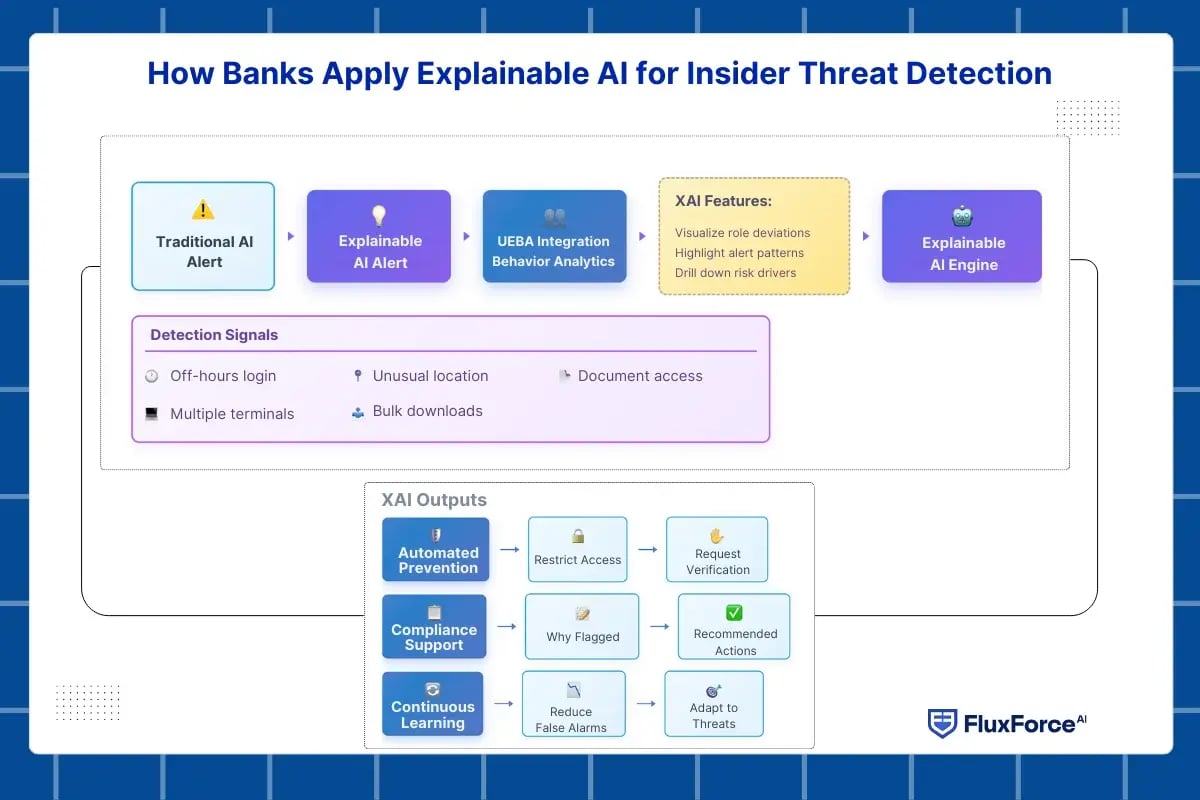
From Black-Box to Transparent Decision-Making
Traditional AI alerts often felt opaque, leaving analysts unsure why an action was flagged. Explainable AI (XAI) changes this by breaking down risk scores into understandable components. For example, when an employee accesses unusual account types or multiple terminals in a short period, XAI highlights the behaviors contributing to the alert. This helps security teams differentiate between harmless anomalies and real insider threats.
Integrating XAI With UEBA and Banking Workflows
XAI enhances UEBA by making the deviation-from-baseline visible at the feature level — showing not just that a behavior was anomalous but which specific aspect of it (document type, access volume, time-of-day pattern, system scope) crossed the risk threshold. Analysts can drill into the signal composition of any alert without leaving the UEBA dashboard, and the explanation is logged alongside the alert for audit purposes.
For instance, if a compliance officer reviews a flagged file transfer, XAI can explain that the behavior diverged from the employee’s usual workflow, making the decision clear and actionable.
Automating Insider Threat Prevention With Explainable Alerts
XAI informs automated preventive actions in banks, such as:
- Temporarily restricting access for high-risk activities until human review
- Requesting additional verification if unusual geolocation or device patterns are detected
- Sending contextual warnings to employees about a typical behavior
For example, if a teller attempts to access multiple sensitive records, XAI highlights the behaviors that triggered the risk score. The system can automatically block the action while alerting analysts for review.
Supporting Compliance and Audit Readiness
Every alert from XAI comes with an explanation showing:
- Why the activity was flagged
- Which behavioral features influenced the decision
- Recommended steps for analysts
This level of transparency strengthens AI risk management in banking, ensuring insider threat decisions are explainable, reviewable, and defensible during audits.
Refining Risk Models With Continuous Feedback
Banks use investigation outcomes to improve XAI models over time. This helps:
- Reduce false alarms
- Update behavioral baselines as work patterns change
- Adapt to evolving insider tactics, such as account sharing or remote work anomalies
By combining human insight with explainable AI, banks maintain a proactive and trustworthy insider threat detection program.
How Explainable AI Changes Insider Risk Decisions Inside Banks ?
Once explainable AI is embedded into insider threat detection, the biggest change is not technical. It is behavioral. Banks start making calmer, more confident decisions instead of reacting out of fear or uncertainty.
Explainable AI reshapes how insider risk is handled across security, compliance, and business teams.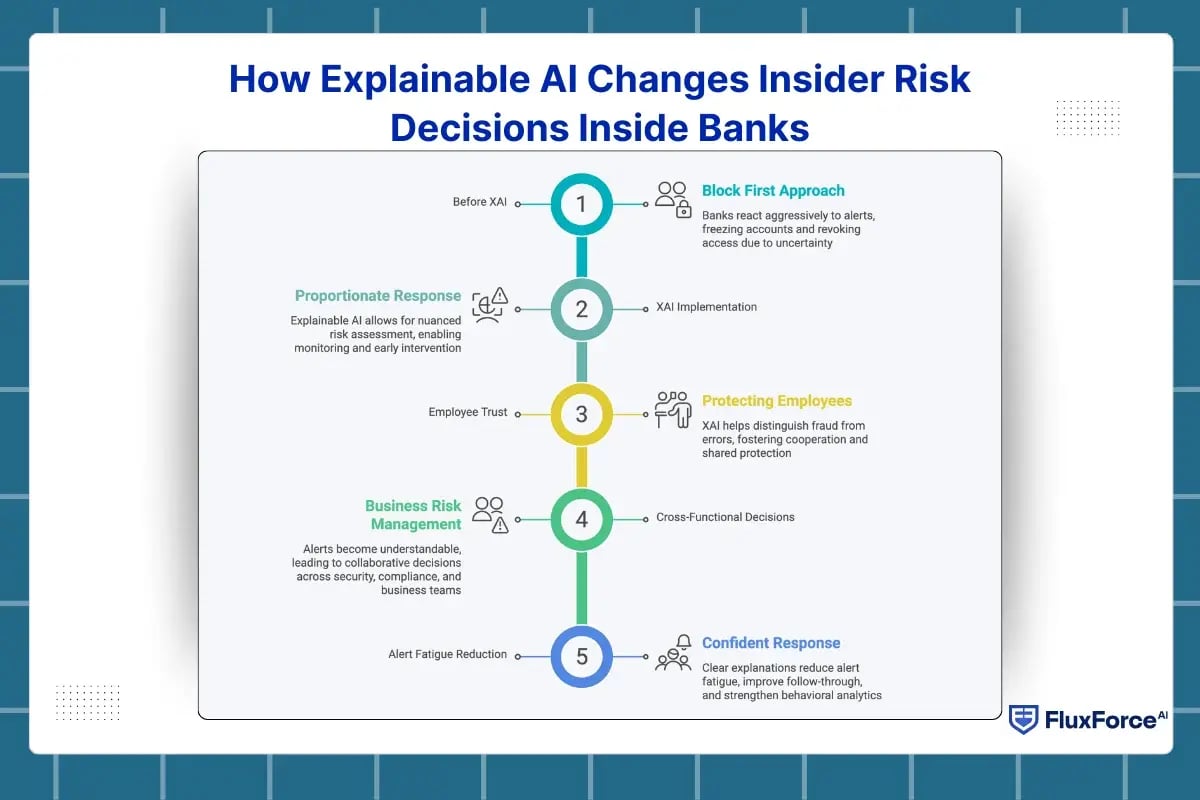
From “Block First” to Proportionate Response
Traditional threat detection systems often force banks into aggressive actions. Accounts are frozen. Access is revoked. Investigations escalate quickly because teams cannot judge intent.
With AI model explainability, banks can see what kind of risk they are dealing with.
Was the alert driven by timing, access volume, role deviation, or a one-off mistake?
This allows banks to:
- monitor low-risk behavior instead of blocking it
- intervene early without disrupting operations
- apply insider threat prevention without damaging trust
The result is stronger banking cybersecurity without unnecessary internal friction.
Protecting Employees While Preventing Internal Fraud ?
Not every insider alert points to malicious intent. Many relate to process gaps, role changes, or human error.
Explainable AI helps banks clearly separate:
- employee fraud detection cases
- accidental violations
- normal work deviations
When employees understand why an action was flagged, cooperation improves. Insider risk programs stop feeling like surveillance and start feeling like shared protection.
This balance is critical for long-term internal fraud detection and workforce trust.
Making Insider Risk a Business Decision, Not Just a Security Call
Before XAI, insider alerts lived almost entirely within security teams.
After XAI, decisions become cross-functional.
Because alerts are understandable:
- risk teams can validate impact
- compliance leaders can justify actions
- business managers can provide context
This shifts insider threat detection in banks from a siloed security function into a broader AI risk management capability.
Reducing Alert Fatigue Without Lowering Standards
One of the quiet benefits of explainable AI is confidence.
When teams understand alerts, they stop ignoring them.
Clear explanations reduce alert fatigue, improve follow-through, and strengthen behavioral analytics security programs. Over time, banks respond faster, escalate less blindly, and prevent threats earlier.
Gain actionable insights, boost security, and protect sensitive data &
Insider threat detection in banking with FluxForce's XAI solutions
Conclusion
Insider threat detection in banking is a behavioral and operational challenge as much as a technical one. The systems that work are the ones security, compliance, and business teams trust enough to act on — and that trust is built on explanability, not just accuracy. Explainable AI changes that dynamic. By revealing why employee behavior is flagged, XAI allows banks to act with clarity, fairness, and confidence.
In banking environments where access is necessary and risk is constant, explainable AI enables insider threat detection that people trust, teams can defend, and regulators can understand. It turns insider risk from a black-box judgment into a transparent, accountable process. As regulatory expectations for insider risk governance tighten — EBA internal governance guidelines, OCC operational risk standards, and the EU AI Act's high-risk AI obligations — XAI moves from a capability differentiator to a compliance baseline. Banks building explainability into their insider threat programs now are building toward the standards that are already being set.
A deeper breakdown of this concept is available in Explainable AI (XAI) – The Complete Enterprise Guide, which explores how transparency in AI systems builds trust and improves decision-making in enterprise environments.
Share this article