.webp)







Listen To Our Podcast🎧
Introduction
Every day, banks and enterprise platforms process millions of access requests — approving some, blocking others, flagging the rest for review. When those decisions are made by AI systems that no one on the security or compliance team can see inside, the consequences are predictable: legitimate users get blocked, real threats slip through, and auditors get answers no one can actually defend.
Risk-based access models address this by dynamically evaluating user behavior, device context, and environmental factors in real time. Unlike static authentication, these adaptive systems adjust decisions on the fly, reducing risk while improving user experience.
The Problem with Opaque AI in Fraud Detection
Rule-based access controls enforce known policies well — but they cannot adapt to the behavioral complexity of modern fraud, insider misuse, or evolving identity threats. AI-driven models close that gap, but only if their decision-making is visible. When risk models operate as black boxes, security teams inherit a different problem: decisions they cannot explain, audit, or improve.
The operational consequences are immediate. Security teams cannot explain why access was granted or denied. Compliance audits require justifications that the model cannot produce. False positive rates climb because no one can identify which signals are generating noise. And when regulators ask for decision documentation under frameworks like GDPR Article 22, PSD2 Strong Customer Authentication requirements, or DORA's operational resilience standards, the answer is a risk score — not an explanation.
What is risk-based authentication in cybersecurity?
Risk-based authentication (RBA) evaluates each access request in real time using a combination of behavioral signals, device health indicators, geolocation data, and session context. Rather than applying a single authentication rule to every login, RBA assigns a dynamic risk score and adjusts the authentication requirement accordingly — low-risk sessions pass with standard credentials, high-risk sessions trigger step-up verification or denial.
When integrated with Zero Trust frameworks, RBA becomes the enforcement mechanism for the "never trust, always verify" principle — continuously re-evaluating access rather than granting standing permissions.
How Explainable AI Brings Transparency
Explainable AI surfaces the reasoning behind every access decision — not just the outcome. Security teams can see exactly which signals drove a risk score: whether it was geolocation anomaly, device ID change, session velocity, or behavioral deviation from the user's established baseline.
For example, triggers such as unusual geolocation, a new device, or abnormal session behavior can be clearly traced within the decision engine. This transparency not only strengthens secure authentication but also builds confidence in AI-driven security systems, ensuring decisions are both defensible and trustworthy.
Enhance risk-based access models by increasing transparency and trust
with FluxForce AI’s explainability tools.

How Explainable AI Improves Access Control ?
Even the most advanced access control systems can frustrate users or miss threats when AI decisions are opaque. Risk scores alone tell you that a login is high-risk, but not why. Explainable AI addresses this by making the decision logic visible, turning abstract risk scores into actionable insights.
Turning Risk Signals into Clear Decisions
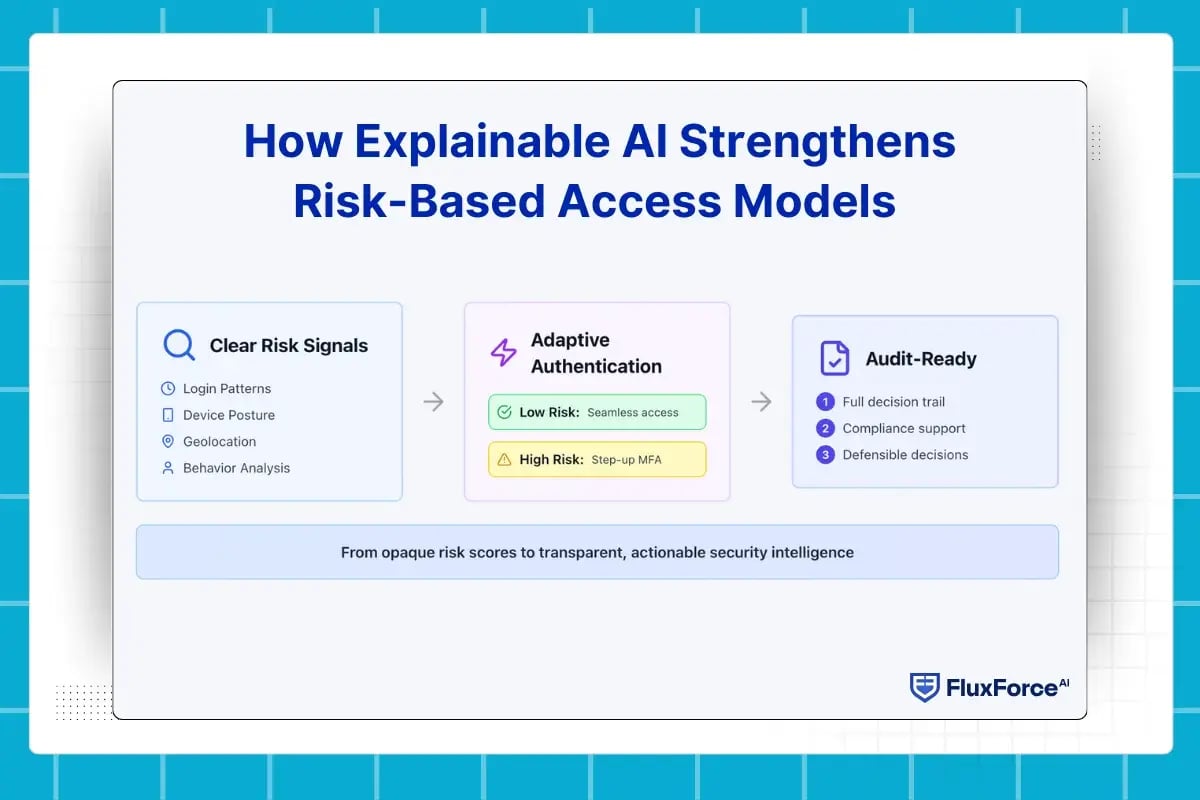
Risk-based access draws on multiple concurrent signals — login velocity, device posture, geolocation delta, session behavior, and identity baseline deviation. Without XAI, these signals collapse into a single score. With XAI, each signal's contribution is visible: a login from a known device in an unusual location carries a different risk profile than an unrecognized device with scripted session behavior. Security teams can use that distinction to calibrate responses rather than applying the same friction to both.
Adaptive Authentication Without Friction
Uniform enforcement often blocks legitimate users unnecessarily. With explainable AI, organizations can apply step-up authentication only when risk factors truly demand it. Trusted users at unusual times can pass seamlessly, while suspicious sessions trigger additional verification. This balance reduces false positives while maintaining robust security.
Defensible, Audit-Ready Decisions
Explainable AI ensures every access decision can be traced and reviewed, supporting compliance audits and governance requirements. Security teams can demonstrate why a decision was made, turning access control from an automated reaction into a defensible, intelligence-driven process.
Why Risk-Based Access Fails Without Explainability ?
Risk-based access models are inherently adaptive, assessing identity signals in real time and adjusting access dynamically. However, without explainable AI, these decisions remain opaque, creating a new type of risk.
Lack of clarity undermines trust in the access control process, causing risk-based systems to fail quietly despite their advanced design.
The Hidden Problem Inside Risk Scoring Engines
Many risk-based authentication systems condense dozens of signals into a single risk score. This score then drives the decision engine, determining whether access is granted, challenged, or denied.
When Risk Scores Lack Meaning
Without explainable AI, risk scores are just numbers—they offer no insight into why a login is considered risky. Teams cannot distinguish between genuine threat indicators and noisy data such as device drift, behavioral variance, or outdated heuristics. Explainable AI breaks down each risk score into contributing signals, transforming raw data into actionable intelligence. Security teams can then refine policies, reduce false positives, and strengthen decision-making across access control and fraud prevention using AI. For a broader understanding of how explainability is transforming financial systems, explore “Explainable AI in Finance: A Comprehensive Blog.”
When Rule-Based Controls Are Not Enough
Rule-based access controls remain essential for enforcing baseline policies and known protections. However, static rules alone cannot keep up with adaptive threats, insider misuse, or evolving identity risks that AI can detect.
Maintaining Audit Traceability and Accountability
Before regulators request evidence, explainable systems provide internal audit teams with presentation-ready explanations that trace model behavior, data usage, and approval history. Without explainability, audit reviews become slow, inconsistent, and difficult to defend.
How Explainable AI Contextualizes Rule
XAI complements rule-based controls rather than replacing them. Static rules enforce known policies — block logins from sanctioned countries, require MFA above transaction thresholds — while XAI handles the behavioral and contextual signals that rules cannot anticipate. By showing how both layers interact, XAI identifies gaps in access logic and supports policy adjustments that are evidence-based rather than reactive. This is the architecture that supports Zero Trust implementations in banking, cloud infrastructure, and enterprise IAM environments.
Risk Decisions Must Be Auditable, Not Assumed
In today’s digital environments, access decisions are subject to review by auditors, regulators, and risk leaders. Without transparency, these decisions are difficult to defend, creating access control compliance and governance challenges.
Explainability as a Governance Requirement
Opaque AI weakens cybersecurity governance. Explainable AI ensures every access decision is traceable and reviewable, aligning with model risk management and auditability requirements.
When explainability is absent, risk-based access becomes guesswork. Embedding AI transparency transforms access control into a defensible, accountable security measure, giving confidence to security, compliance, and governance teams.
How Explainable AI Improves Risk-Based Access Decisions ?
Risk-based access systems do not fail due to lack of data—they fail due to lack of clarity. Modern access platforms process identity behavior, device posture, location, session history, and anomalies in milliseconds. Without explainable AI, teams only see the decision outcome, not the reasoning behind it.
Turning Risk Signals Into Understandable Access Logic
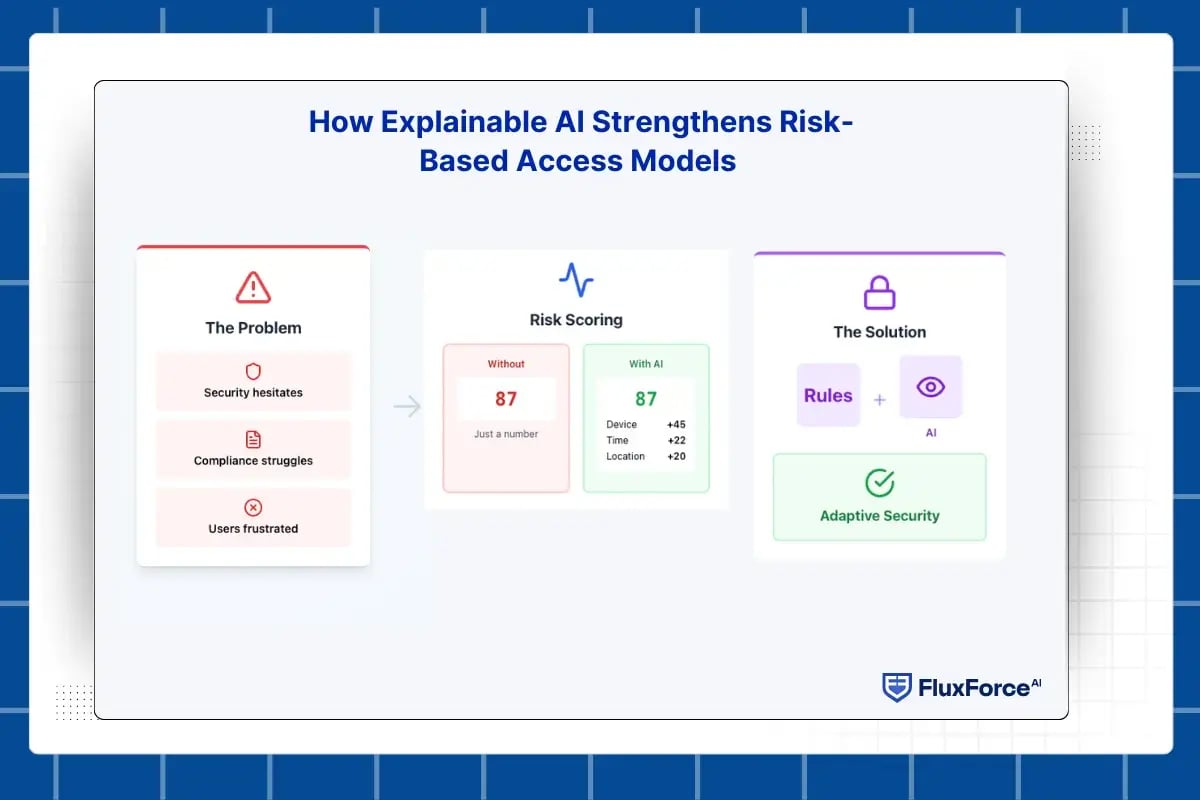
Traditional risk scores condense multiple signals into a single number, hiding which factors influenced the outcome. Explainable AI decomposes each decision into contributing signals, revealing whether an access challenge was triggered by unusual behavior, device anomalies, or identity inconsistencies. Security teams gain evidence-based intelligence instead of guessing.
Reducing False Positives Without Weakening Security
Excessive friction frustrates legitimate users when systems cannot differentiate between real risk and noise. Explainable AI helps identify consistently misleading signals, reducing false positives while preserving protection against genuine threats. This balance is crucial for enterprise platforms, cloud environments, and banking applications requiring speed and precision.
From Automated Decisions to Defensible Decisions
Risk-based access must be explainable to compliance, audit, and governance teams. Embedding AI transparency ensures every decision is traceable, reviewable, and aligned with regulatory requirements. Explainability transforms automated access enforcement into controlled, defendable security decisions.
Integrating Explainable AI Across Enterprise Security
Modern enterprise security demands more than automated decisions—it requires visibility, accountability, and control. By integrating explainable AI across enterprise security architectures, organizations can ensure that risk-based access decisions are transparent, defensible, and aligned with governance and compliance requirements. This integration transforms access control from a reactive mechanism into an intelligence-driven security capability.
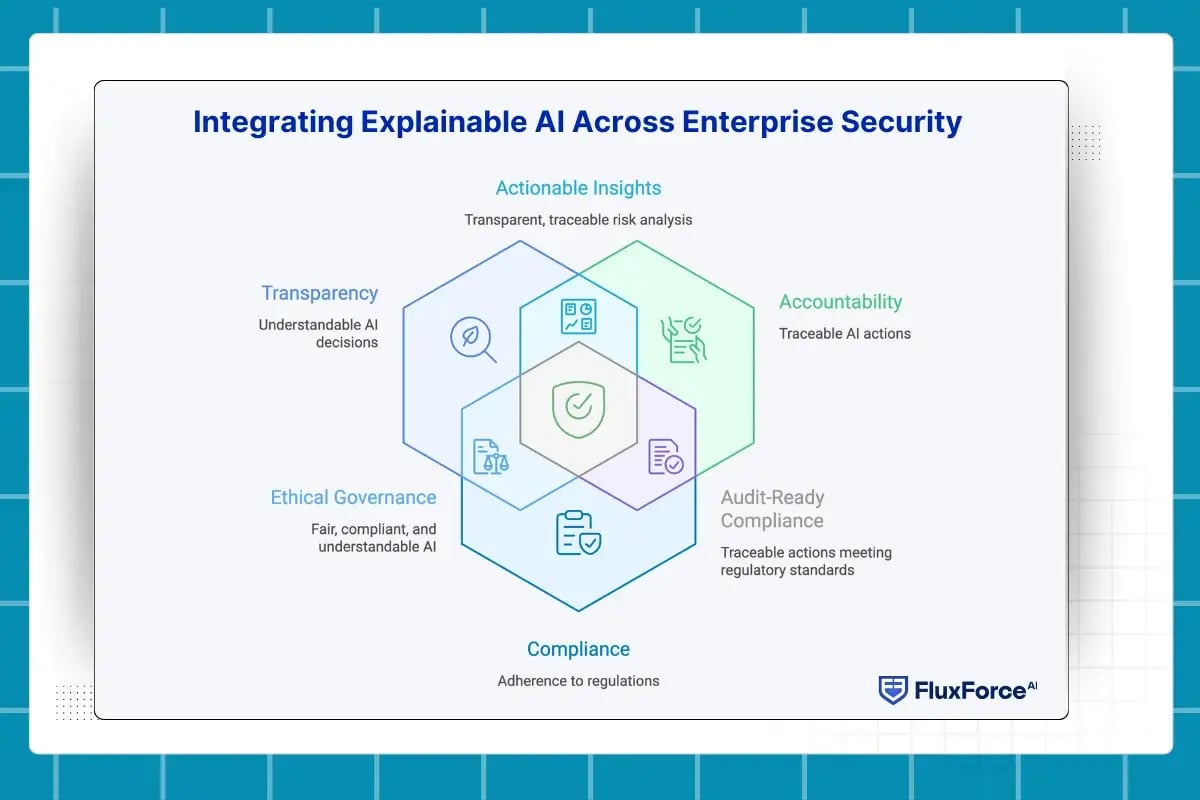
Risk-Based Access Decisions Become Actionable
Explainable AI converts risk-based access from a reactive tool into an intelligence-driven control. Instead of relying solely on risk scores, security teams can see which signals—login velocity, device posture, behavioral anomalies, or geolocation changes—triggered a decision.
This transparency transforms abstract scores into actionable insights. Organizations can fine-tune access policies, e.g., step-up authentication for logins from new devices, while trusted users with minor anomalies pass seamlessly, reducing friction without compromising security.
Detecting Insider Threats with Transparency
Interpretable AI improves detection of insider threats by revealing patterns such as unusual access hours, data exfiltration attempts, or privilege misuse in real time. Each anomaly becomes traceable, enabling security analysts to differentiate between benign behavior and malicious activity.
This approach ensures audit-ready evidence while improving operational efficiency and secure customer authentication across banking platforms.
Compliance and AI Governance Strengthened
Explainable AI ensures all access decisions are traceable, reviewable, and aligned with regulatory standards such as GDPR or PSD2. By mitigating false positives and reinforcing accountability, it builds trustworthy systems that empower security, compliance, and governance teams to confidently rely on AI-driven decisions.
Ethical and Trustworthy Enterprise Security
Access control AI can inherit bias from training data — flagging sessions from certain geographies, device types, or behavioral profiles at disproportionate rates that have nothing to do with actual fraud risk. XAI makes these patterns visible before they become discrimination findings or regulatory violations. By exposing which factors are driving disproportionate denial rates, security teams can correct threshold calibrations and ensure that access decisions are consistent across user populations — a requirement now explicit in the EU AI Act's non-discrimination provisions for high-risk AI systems.
Future-Proofing Risk-Based Access
Explainable AI allows organizations to continuously refine risk-based access. Teams can simulate policy changes, measure impacts on authentication, and anticipate emerging threats. By combining model transparency, actionable insights, and AI auditability, enterprises can scale adaptive access policies, support Zero Trust initiatives, and maintain resilience in evolving cyber threat landscapes.
Enhance risk-based access models by increasing transparency and trust
with FluxForce AI’s explainability tools.
Conclusion
Risk-based access models only succeed when decisions are interpretable. Explainable AI bridges the gap between high-speed automation and human oversight. By providing fraud model explainability, AI transparency in access control, and insight into decision engines for fraud prevention, organizations reduce risk, improve user experience, and maintain regulatory compliant AI standards. Ultimately, explainable AI converts raw data into measurable, actionable security intelligence.

Share this article