PARTIAL BUILD — Phase 1 Live

AI Payment Security That Covers Every Channel in Real Time

Leo Payden — Director AI Payment Security

Payment fraud is shifting to real-time and instant payment rails where transactions settle in seconds. Your legacy batch systems cannot keep up.Leo Payden secures every payment channel — cards, ACH, wires, and instant payments — with a zero fraud incident target. Maintains 100% PCI DSS compliance with continuous monitoring. Deploy in 30 days . No migration.


10 Leo Payden_Hero section_superhuman image (1)
profile

Leo Payden

Director AI Payment Security

coming soon

Zero

Payment Fraud Incidents

100%

PCI DSS Compliance Rate

Measurable

Chargeback Reduction YoY

All

Payment Channels Covered

30 days

Deployment Timeline

Metrics from Phase 1 production model. Cross-border compliance engine in development.
Trusted by Teams across Banking, Fintech, Insurance, and Global Trade
Logo 1 Logo 2 Logo 3 Logo 4 Logo 5 Logo 6 Logo 7 Logo 1 Logo 2 Logo 3 Logo 4 Logo 5 Logo 6 Logo 7
THE PROBLEM

The Problem Your Payment Team Faces Every Day


Your payment operations team monitors millions of transactions across multiple channels — cards, ACH, wire transfers, and increasingly, instant payments. According to Juniper Research, online payment fraud
losses are projected to exceed $48 billion globally by 2026.

Meanwhile, instant payment rails like FedNow and SEPA Instant settle
in seconds — and cannot be reversed.


Real-time fraud blind spot

Instant payment systems settle in seconds. According to the Federal Reserve, FedNow processes payments 24/7/365. Batch-based fraud detection cannot keep pace with real-time settlement.Fraudsters know this and are shifting to instant payment channels.


Cross-border compliance risk

International payments must comply with SWIFT security standards, ISO 20022 messaging, PSD2, and jurisdiction specific sanctions and currency controls. According to SWIFT, cross-border payment fraud attempts increased 23% in 2025.


PCI DSS continuous monitoring

PCI DSS 4.0 requires continuous monitoring, not annual snapshots. Non-compliance fines range from $5,000 to $100,000 per month. Manual compliance tracking cannot keep pace with the volume and velocity of modern payment operations.

JOB DESCRIPTION 

What Leo Payden Does — Job Description

Leo Payden is a Director AI Payment Security that operates inside your
payment processing infrastructure as a dedicated payment security specialist.

LEO PAYDEN 

Director AI Payment Security | FF-PAY

 Partial Build (Phase 1 Live)

Reports To

Your Head of Payments / CFO

Works With

Existing payment gateways, card processors, and banking systems 

Deployed In

30 days (shadow mode first)

KEY RESPONSIBILITIES

01

Monitor every payment transaction in real time across all channels for fraud and anomalies  

02

Maintain 100% PCI DSS compliance with continuous  monitoring and instant deviation alerts  


03

Reduce chargebacks year-over-year by catching fraud and friendly fraud before settlement

04

Secure cross-border payments against sanctions, currency control, and regulatory violations 

05

Produce audit-ready decision logs for every  payment — immutable, tamper-evident

AUTONOMY MODEL

Low risk — Acts autonomously (approve, clear) 

Medium risk — HITL by default (configurable)  

High risk —  ALWAYS human review (non-negotiable)


You configure the threshold per rule

Kill switch : Disable instantly

PERFORMANCE METRICS

Measured Performance — Not Promises

These metrics are from Leo Payden's Phase 1 production model, not a lab demo.

Zero
Payment Fraud Incidence
across all payment channels
100%
PCI DSS Compliance Rate
continuous monitoring
Measurable
Chargeback Reduction
year-over-year improvement
All channels
Payment Security Coverage
cards, ACH,wire, instant
Always ready
Regulatory Audit Readiness
with full evidence trails
Sub-second
Scoring Speed
per payment transaction
Multi- jurisdiction
Cross-Border Compliance
coverage
100%
Audit Trail
every decision logged

Model: Multi-channel payment risk engine with regulatory mapping |  Primary Layer : Payment security layer | Last validated : February 2026

HOW IT WORKS

How AI Payment Security Works with
 
Leo Payden

Leo Payden connects to your existing payment systems as a sidecar — no data migration, no core system changes. Here is how every payment transaction flows:

01

Ingest

Payment transaction data from your gateways, card processors, ACH systems, and wire transfer platforms feeds into Leo Payden via API. Data includes: payment amount, card/account details, merchant data, currency/FX data, and payment routin configurations.

02

Analyze

Every payment is scored in real time across multiple dimensions: fraud risk, PCI DSS compliance status, cross-border regulatory requirements, and merchant risk profile. Machine learning models combined with deterministic rules evaluate transaction patterns against historical baselines.
 

03

Enforce

Based on risk scores and compliance checks, Leo Payden takes action:
  • Low risk → Approves autonomously
  • Medium risk → Flags for analyst review (configurable)
  • High risk → Blocks and escalates to human team (always)

PCI DSS violations trigger immediate alerts. Cross-border transactions are validated against jurisdiction-specific rules.

04

Log

Every decision — approve, flag, or block — produces:
  • A plain-English explanation your compliance team can read
  • PCI DSS compliance mapping for the specific transaction
  • Cross-border regulatory mapping (PSD2, SWIFT, ISO 20022)
  • An immutable, tamper-evident audit trail

Your auditors get the evidence they need. Your team gets confidence.


Want to See This on Your Payment Data?

Run Leo Payden in shadow mode — 30 days, no risk, no migration. Compare his security decisions against your current system side by side.

COMPLIANCE & REGULATORY MAPPING

Regulatory Frameworks Supported

AI payment security in regulated industries requires more than fraud detection — it requires continuous compliance across every payment channel and jurisdiction. Every decision Leo Payden makes is mapped to the regulatory framework that applies.

PCI DSS 4.0

PCI DSS 4.0

Continuous compliance monitoring and control validation

PSD2

PSD2

Strong customer authentication and payment service regulation

SWIFT CSP

SWIFT CSP

Customer Security Programme compliance

ISO 20022

ISO 20022

Payment messaging standards and compliance

BSA/AML

BSA/AML

Anti-money laundering screening for payment transactions

OFAC

OFAC

Sanctions screening for cross-border payments

YOUR ANALYST'S VIEW

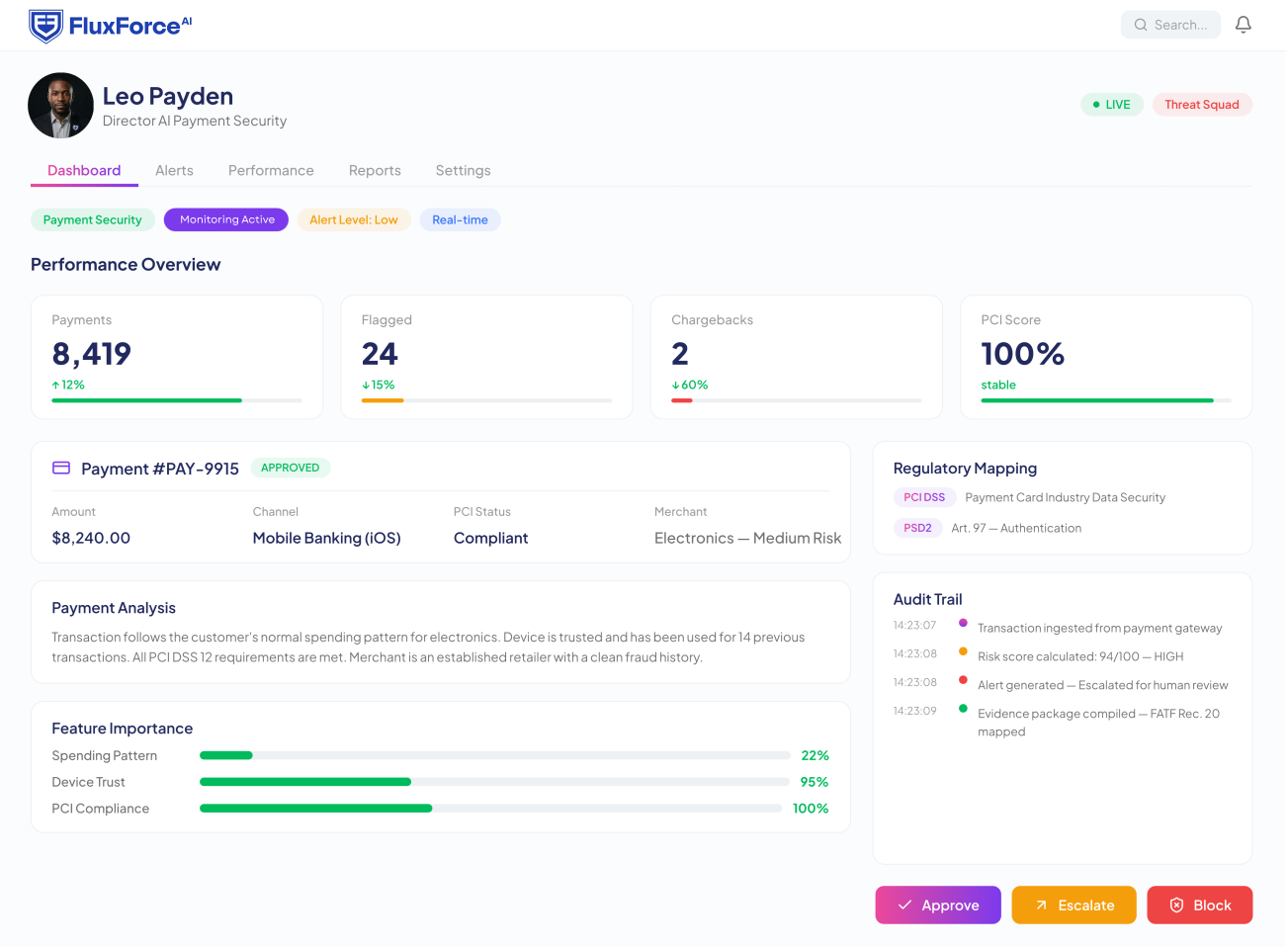
What Your Payment Operations Analyst Sees

dash board1.10

Every channel covered. Every payment explained. Continuous compliance.

BEFORE vs AFTER  

BEFORE LEO PAYDEN

  • Batch fraud checks
  • Periodic PCI audits 
  • Rising chargebacks 
  • Channel blind spots
  • Manual audit prep

 AFTER CIAN GATEKEEPER    

  • Real-time scoring 
  • 100% continuous    
  • YoY reduction  
  • All channels covered  
  • Always audit-ready 

ROI — AI PAYMENT SECURITY vs HIRING vs LEGACY TOOLS

AI Payment Security Cost Comparison — 2026

How does Leo Payden compare to hiring payment security analysts or using legacy payment fraud systems?

Criteria Hire 3 Analysts  Legacy Payment Fraud System   Leo Payden 
    Annual cost   $480K-$960K (salary + benefits  $200K-$500K (license + integration)  Custom pricing
Deployment time  6-12 months (recruit + implement) 12-18 months (full deployment) 30 days (shadow mode) 
Channel coverage  Manual, ongoing project Vendor-dependent 100% automated 
PCI DSS compliance   Manual monitoring Basic rules  ML-powered, real-time
Chargeback prevention    Custom development Vendor-dependent  Built-in, dynamic 
Explainability     WAF rules (limited)   Basic rate limiting   ML-powered, real-time
   Audit trail   Manual tracking   Partial     100% automate GDPR/CCPA  
  Scales with volume    Hire more ($$)   License tiers ($$)       Auto-scales
  Available 24/7    Manual analysis   No     Yes (continuous)
 Cross-border support    Requires specialists    Often limited     Multi-jurisdiction built-in


Key insight:According to Juniper Research, online payment fraud losses will exceed $48 billion globally by 2026. PCI DSS non-compliance fines range from $5,000 to $100,000 per month. Leo Payden provides continuous protection across every payment channel with full audit readiness. Contact our team for a tailored quote.

WORKS BEST WITH

Agents That Work Best with AI Payment Security

Leo Payden delivers maximum impact when paired with these FluxForce SuperHumans:

Aiden Flux

AI Fraud Analyst

Scores every transaction for fraud while Leo Payden handles payment-specific security

Learn now

Nova Sentinel

AI Zero Trust Security

Verifies the identity and access behind every payment request

Learn now

Piers Openfield

AI Open Banking Security

Secures open banking APIs and third-party payment integra-tions that Leo monitors 

Learn now
TRUST BUILDERS

Built for Regulated Financial Institutions

Configurable Autonomy

Low risk: Leo acts autonomously (clear payments, known merchants).
Medium risk: HITL by default (configurable). High risk: Always human
review. You set the threshold per payment channel, per transaction type, per amount tier.

Kill Switch

Disable Leo Payden instantly. No system impact. No downtime. One click.

Shadow Mode

Run Leo Payden on your live payment data for 30 days. Observation only — no blocking, no action. Validate accuracy before going live.

Explainability

Every payment decision includes plain-English reasoning explaining the risk assessment, compliance check results, and recommended action. Your auditors and regulators can read it directly.

Audit Trail

Every decision logged with immutable, tamper-evident evidence chain. Payment → risk score → compliance check → action → outcome.

No Migration

Sidecar integration. Leo Payden reads your existing payment feeds. Your core payment systems stay untouched.

Insights on AI Security,Compliance
& Financial Automation

Keep up with the latest AI trends, insights, and conversations.

Read Insights star
AI Insights star

Zero Trust banking: how CISOs secure core systems in 2026

AI Insights star

AML transaction monitoring: how AI cuts false positives by 60%

AI Insights star

Deepfake identity fraud: 5 detection gaps banks overlook

Questions? We Have Answers star

Frequently Asked
Questions

AI payment security works by monitoring every payment transaction in real time across all channels — cards, ACH, wire transfers, and instant payments. Systems like Leo Payden by FluxForce analyze payment amount, merchant data, card/account details, currency data, and routing configurations to detect fraud, enforce PCI DSS compliance, and produce audit-ready decision trails for every transaction.
PCI DSS continuous compliance monitoring means verifying that every payment transaction and system configuration meets PCI DSS requirements in real time. PCI DSS 4.0 introduces 64 new requirements, many demanding continuous monitoring rather than annual snapshots. Leo Payden maintains a 100% PCI DSS compliance rate by monitoring transaction-level security controls continuously and alerting teams instantly when any deviation is detected.
AI reduces chargebacks by identifying fraudulent transactions before settlement and detecting friendly fraud patterns. According to Juniper Research, online payment fraud losses are projected to exceed $48 billion globally by 2026. Leo Payden analyzes transaction patterns, merchant risk profiles, and historical chargeback data to flag high-risk payments for review, delivering measurable chargeback reduction year-over-year.
Yes. AI payment security is critical for instant payment systems like FedNow and SEPA Instant, where transactions settle in seconds and cannot be reversed. According to the Federal Reserve, FedNow processes payments 24/7/365. Leo Payden provides sub-second risk scoring for real-time payments, ensuring fraud checks complete before settlement.
AI payment security covers all major payment channels including card-present (POS/EMV), card-not-present (e-commerce/3D Secure), ACH/direct debit, wire transfers (SWIFT/Fedwire), instant payments (FedNow/SEPA Instant), and mobile payments. Leo Payden applies unified risk scoring across all channels so fraud cannot shift from one channel to another undetected.
Yes. Leo Payden supports cross-border compliance by mapping every transaction to applicable frameworks including PCI DSS, PSD2, SWIFT CSP, ISO 20022, and jurisdiction-specific sanctions and currency controls. According to SWIFT, cross-border payment fraud attempts increased 23% in 2025. Every cross-border decision includes full regulatory mapping and evidence trails.
FluxForce pricing is customized based on transaction volume, regulatory requirements, and deployment model. Contact our team for a tailored quote.
I Payment Security — Zero Fraud Target. 100% PCI DSS Compliance.