.webp)








Listen To Our Podcast🎧

Introduction
When a biometric authentication system denies access, users want one thing: a reason. A device change? A behavioral shift? A system that stays silent after a denial does not feel secure — it feels arbitrary. And arbitrary systems lose users fast.
Consider a professional trying to approve a critical late-night payment. The banking app performs a face scan, processes it, and then denies access. There is no explanation, no guidance—just a prompt to try again. From the user’s perspective, the system feels unreliable, not secure.
This scenario shows the fundamental tension in modern facial recognition AI. High accuracy alone cannot create confidence. When decisions remain opaque, trust quickly erodes. Organizations are recognizing that responsible AI and AI transparency are essential to ensure users and regulators can rely on biometric systems.
A 2024 Jumio Digital Identity Trends report found that nearly half of digital banking users lose confidence in a platform after two unexplained authentication failures — a signal that trust in the system matters as much as the accuracy of the underlying model.
Why Accuracy Metrics Are Not Enough ?
Many organizations focus on traditional metrics such as false acceptance rate (FAR) or false rejection rate (FRR) to evaluate biometric authentication. While these metrics measure correctness, they do not address the human or compliance perspective. Users and auditors want to understand why a decision occurred, not just how likely it was to be correct.
A trustworthy AI system must offer explainable outcomes. Without AI transparency, security teams cannot determine whether denials stemmed from poor lighting, device changes, behavioral deviations, or latent model bias. When the rationale behind decisions is unclear, even technically secure systems fail to inspire confidence.
How Explainability Converts Denials into Guidance
Explainable AI surfaces the reasoning behind a denial in terms users and analysts can act on. In the payment scenario above, the system identifies that low ambient light reduced facial match confidence and a recent device change elevated the risk score. That context changes everything — the user knows what to fix, and the analyst knows whether to escalate.
Beyond user experience, AI transparency provides organizations with actionable insights. Teams can detect bias, monitor decision patterns, and refine thresholds without compromising biometric security. Explainability allows organizations to demonstrate accountability and embed fairness in every authentication decision.
Building Predictable and Accountable Biometric Systems
Biometric authentication is successful only when it is perceived as fair, consistent, and understandable. Explainable AI converts opaque models into secure biometric systems that users trust and regulators accept. By making decisions intelligible, organizations can scale trustworthy AI from a conceptual principle into real-world adoption.
Explainability enhances biometric models' trustworthiness
build reliable, transparent biometric systems with FluxForce AI

Why Explainability Is Important in Biometric AI ?

Explainable AI for Facial Recognition
Facial recognition AI evaluates millions of data points in milliseconds — lighting angle, skin texture, facial geometry, eye distance — to determine whether a face matches a stored profile. To a user or auditor seeing only a pass or fail result, that process is invisible. Explainable AI makes it visible. Users and regulators ask: why was access denied, and can we trust this system?
Explainable AI (XAI) helps by showing which features or patterns influenced a decision. For example, a rejection may happen because the lighting on the eyes was poor or the head was slightly turned. This kind of AI transparency makes decisions clear and builds trustworthy AI.
Reducing Bias in Biometric AI Models
Facial recognition systems carry documented bias patterns. NIST's Face Recognition Vendor Testing (FRVT) program found that many commercial facial recognition algorithms produced significantly higher false match and false non-match rates for women, darker-skinned individuals, and older adults compared to lighter-skinned males. In KYC and onboarding workflows, these disparities translate directly into discriminatory denial rates. Using explainable AI in biometrics, teams can see which features the system relied on too much, like skin tone, and correct it.
This helps improve accuracy and makes responsible AI practices stronger, so biometric security works fairly for everyone.
Explainable Biometric Authentication Systems
When a high-value transaction triggers a biometric fraud alert, the difference between a good user experience and a damaging one comes down to what the system communicates. XAI identifies the specific signals that drove the alert — a typing speed deviation from the user's behavioral baseline, a gait pattern inconsistency, a facial match confidence score below threshold — and presents that reasoning in terms analysts can review and users can understand.
These explanations help users understand decisions and maintain trust. At the same time, teams can review and audit the results using AI model interpretability, keeping the system accountable and compliant.
AI Explainability in Identity Verification
During KYC onboarding, a failed biometric check can abandon a customer before the relationship begins. XAI gives onboarding teams the signal breakdown behind each failure such as a photo quality issue, liveness check anomaly, document mismatch — so they can route edge cases to human review rather than losing the user entirely. In continuous verification, the same logic applies: each re-authentication decision is traceable, reviewable, and improvable over time.
How Explainable AI Strengthens Biometric Fraud Detection ?
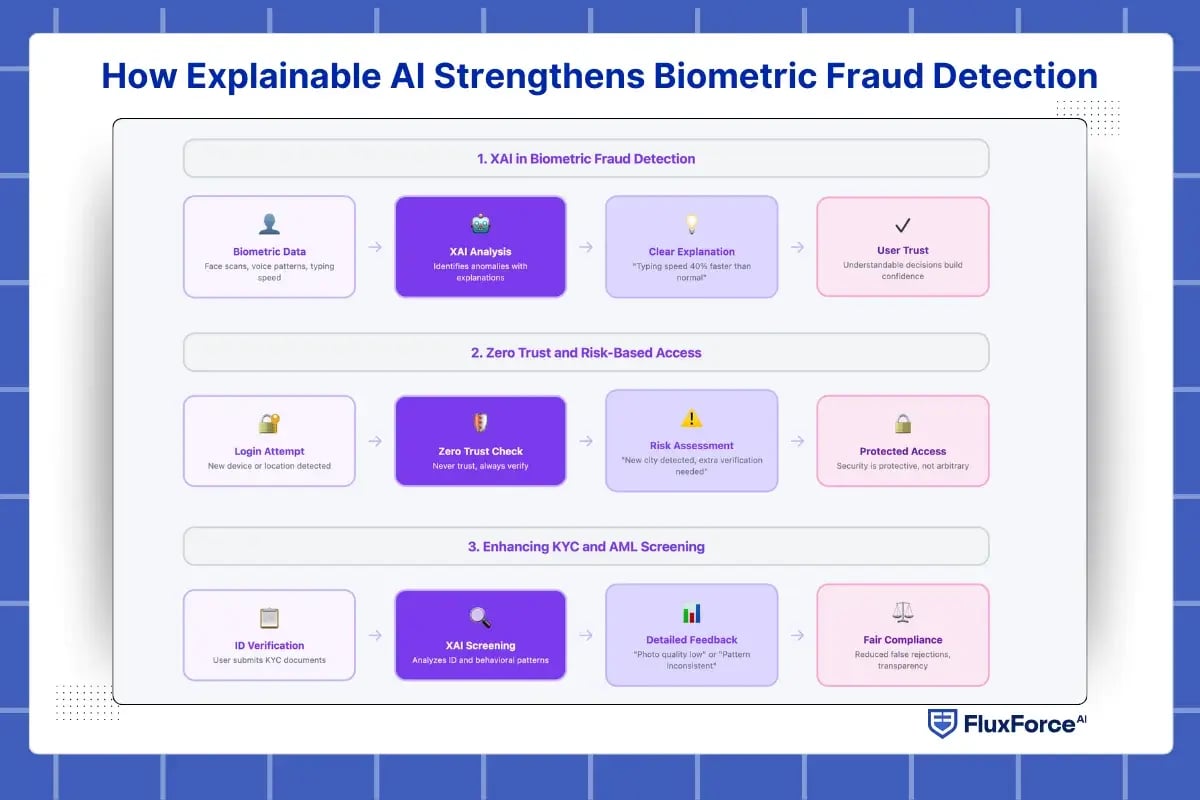
Explainable AI (XAI) in Biometric Fraud Detection
How can a bank know that a flagged transaction is genuinely risky or just a false alarm? Biometric fraud detection uses face scans, voice patterns, and behavior such as typing or swiping speed. Without explanations, both users and compliance teams may feel confused or frustrated.
XAI surfaces the reasoning behind each fraud decision in operational terms. A flagged login shows the analyst that typing cadence exceeded the user's 90-day behavioral baseline by 40%, and facial match confidence dropped to 62% against a threshold of 75%. This clarity helps users feel confident and reinforces trustworthy AI practices for organizations.
Zero Trust and Risk-Based Access
Modern fintech systems adopt Zero Trust principles: never trust, always verify. Biometric authentication plays a crucial role, but the decision-making must be clear to users. Explainable AI enables this by providing reasons for risk-based access decisions, like an unusual location or device being used.
For instance, a login from a new city may trigger extra verification. By explaining this, the system reassures users that the process is protective, not arbitrary. Clear reasoning builds confidence while supporting compliance and maintaining smooth user experience.
Enhancing KYC and AML Screening
Explainable AI in biometrics improves onboarding and anti-money laundering (AML) processes. Systems can now highlight exactly why a user verification failed or why a profile was flagged.
For example, an ID scan might be flagged because the photo quality was poor or a behavioral pattern seemed inconsistent with past activity. By providing explanations, organizations reduce unnecessary rejections and maintain fairness, supporting responsible AI and AI transparency for regulatory compliance.
How to Make Biometric AI Fair and Ethical?
Security performance is the baseline expectation for biometric authentication, not the differentiator. What separates systems that scale from those that face regulatory challenge is fairness, consistency, and the ability to explain every decision to users, auditors, and oversight bodies. XAI is the mechanism that makes those properties operational.
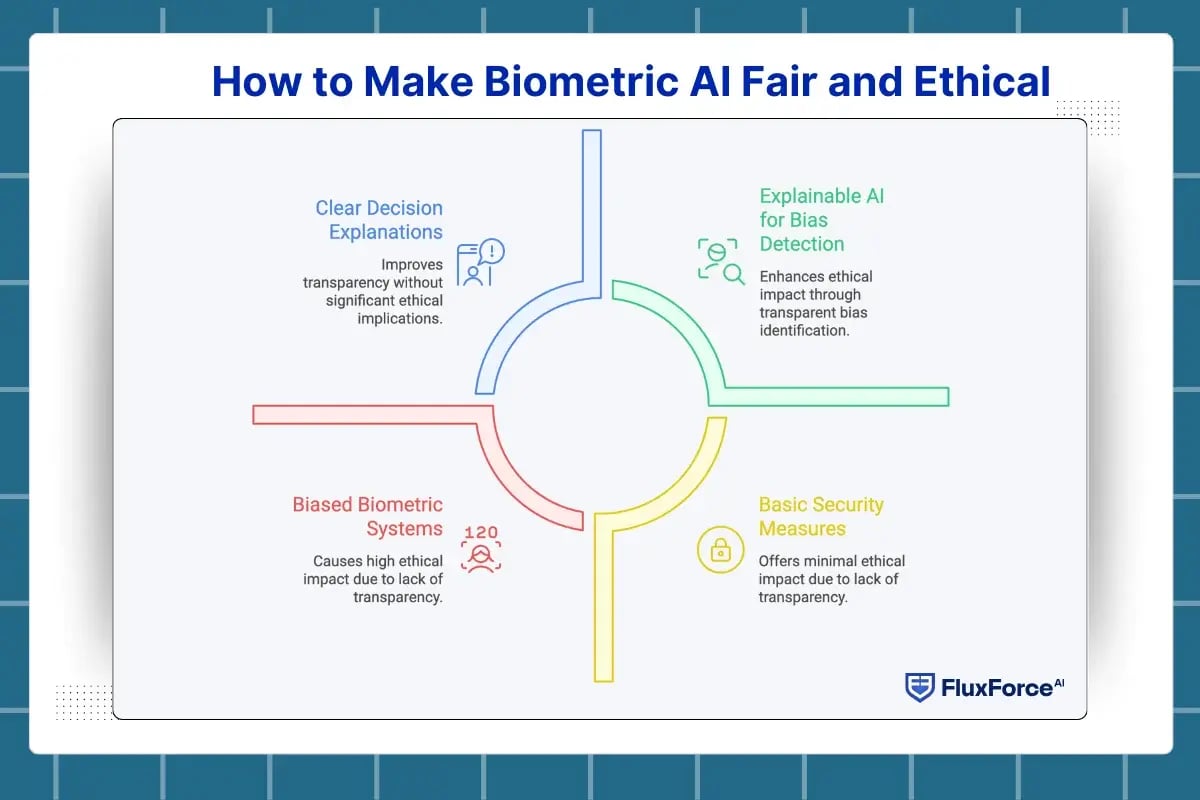
Why Bias in Biometric Systems Matters ?
When we talk about biometric authentication, accuracy is important—but fairness is just as critical. Many facial recognition AI systems perform worse for women or people of color. This can lead to frustration, denied access, or even legal trouble for companies.
Users expect systems to treat everyone equally. If a system is secure but biased, it loses trustworthy AI status. That’s why understanding and addressing bias is essential for responsible AI.
How Explainable AI Helps Spot Bias ?
XAI identifies bias at the signal level — which features are driving disproportionate denial rates across demographic groups. If facial match confidence scores consistently fall below threshold for users with darker skin tones, or if behavioral biometric baselines are calibrated to patterns that skew by gender, XAI makes those correlations visible in dashboard-level monitoring. Compliance teams can then address the specific signal rather than retraining the entire model. Organizations can then adjust their models to be fairer. This not only improves accuracy but also ensures AI transparency for users and regulators.
Designing Ethical AI Models
Ethical AI is about more than just accuracy. In biometric security, it means:
- Treating all users equally
- Giving clear reasons for decisions
- Protecting user privacy
For instance, instead of simply denying access, the system can explain that the camera angle or lighting affected the scan. This builds trust in AI systems and keeps users confident that the system is protecting them, not penalizing them unfairly.
Accountability in Biometric Systems
Tracking and reviewing decisions is key to AI accountability. By logging why access was denied or flagged, teams can find patterns of bias and improve the system.
Regular reviews and audits help organizations show regulators that their systems are fair and trustworthy. Combining explainable AI with ethical design ensures that biometric authentication is secure, reliable, and fair for all users.
Governing Biometric AI for Security and Risk Management
Governing Biometric AI for Security and Risk Management
How can organizations ensure their biometric authentication systems are not only secure but also reliable and fair? Governance is the answer. Proper oversight ensures that decisions are consistent, risks are minimized, and regulatory requirements are met.
Without clear governance, even secure systems can fail users. Mismanaged models may lead to biased outcomes, unexplained denials, or regulatory penalties. This is where trustworthy AI and responsible AI practices come into play.
Using Explainable AI for Risk Management
Explainable AI (XAI) allows teams to see why a biometric decision was made. This is crucial for risk management. When an access attempt is denied, the system can provide understandable reasons, such as unusual device behavior or a mismatch in face verification.
Clear explanations help security teams assess whether a risk is genuine or a false positive. By documenting these decisions, organizations can respond faster to incidents and reduce operational risk, while also maintaining AI transparency for auditors and regulators.
Creating Audit-Ready Biometric Systems
For compliance with regulations like PSD2 or GDPR, companies need secure biometric systems that can prove they operate fairly and accurately. Explainable AI enables audit-ready reports, showing:
- Why a login or transaction was flagged
- Patterns of repeated denials or errors
- Adjustments made to reduce bias
This transparency ensures AI accountability and helps organizations demonstrate compliance without compromising security.
Building Continuous Improvement Loops
Governance is not a one-time effort. Using AI explainability in identity verification, teams can continuously monitor, analyze, and improve their systems.
For example, tracking patterns of failed authentications can reveal recurring environmental issues or behavioral mismatches. Updates and retraining based on these insights strengthen system performance, reduce false positives, and improve trust in AI systems over time.
Explainability enhances biometric models' trustworthiness
Build secure, transparent systems with FluxForce AI
Conclusion
Biometric systems are becoming a core part of digital security, but trust cannot be built on accuracy alone. When users are denied access without explanation, confidence drops quickly. This is where Explainable AI makes the difference.
By bringing transparency, fairness, and accountability into biometric authentication, Explainable AI helps organizations move beyond black-box decisions. Trustworthy AI systems do not just protect identities. They communicate clearly, reduce bias, and support responsible decision-making.
As regulations tighten and user expectations rise, Explainable AI will define which biometric systems succeed. Systems that can explain their decisions will earn trust, pass audits, and scale with confidence.
In the end, secure biometric systems are not defined by how advanced they are, but by how well Explainable AI enables them to justify every decision they make.



Share this article