



















Listen To Our Podcast🎧
Introduction
Banks approve or deny millions of biometric logins every day such as face scans, fingerprint checks, voice verifications. Most of those decisions happen inside AI models that no one on the risk team can fully explain. That gap between automation and accountability is where fraud hides, audits fail, and customers get locked out for no visible reason.
Yet neither users nor the compliance teams behind them can see how those decisions are made or challenge them when they are wrong.
Why Biometric Security Raises New Trust Questions ?
Banks today rely heavily on AI-based authentication systems to verify identities and prevent fraud. Facial recognition, behavioral biometrics, and voice verification are now standard across mobile banking apps.
According to Cloud Security Alliance Zero Trust guidance and practitioner case studies, organisations that add explainability layers to AI‑driven access control commonly report 30–40% reductions in false positive alerts, along with fewer manual overrides and faster analyst decisioning.
So, the real question is not whether biometric security works.
The real question is whether these AI decisions can be trusted.
When AI Decisions Lack Transparency ?
When a legitimate customer is locked out or a transaction is blocked, both users and risk teams ask the same thing. Why did this happen?
Traditional AI models often provide an answer without a reason. That creates friction for customers, operational risk for banks, and serious challenges for fraud prevention in banking and regulatory compliance AI. In a regulated environment, decisions must support AI decision transparency, accountability, and fairness.
How Explainable AI Changes Biometric Authentication ?
Explainable AI in banking surfaces the reasoning behind every biometric decision — which signals were weighted, which thresholds were crossed, and why an outcome was approved, escalated, or denied. This gives compliance teams the decision intelligence they need to act. This directly supports audit-ready AI systems and stronger AI risk management banking.
To understand how this level of transparency helps detect and reduce bias in identity verification, read our blog “How Explainability Reduces Bias in Identity Verification.”
Building Trustworthy AI for Digital Banking
As XAI in banking continues to mature, banks face a growing responsibility. They must protect users from fraud while proving that biometric authentication systems are accurate, ethical, and compliant. Explainable AI becomes the bridge between biometric security and trustworthy AI in banking.
Next, we explore how explainable AI improves biometric authentication, strengthens fraud prevention in banking, supports AI fraud detection banking, and enables audit-ready AI systems without slowing down real-time decisions.
XAI enhances biometric authentication in digital banking
boosting security and trust with FluxForce AI

How Explainable AI Improves Biometric Authentication in Digital Banking ?
Deploying biometric authentication is step one. Making it reliable under real-world conditions like device changes, behavioral shifts, network anomalies is where most banks still struggle. Without explainability and AI decision transparency, every failure looks the same to the risk team.
They struggle to distinguish fraud from legitimate activity, increasing operational costs and customer friction.
Clarifying Decisions with Explainable AI
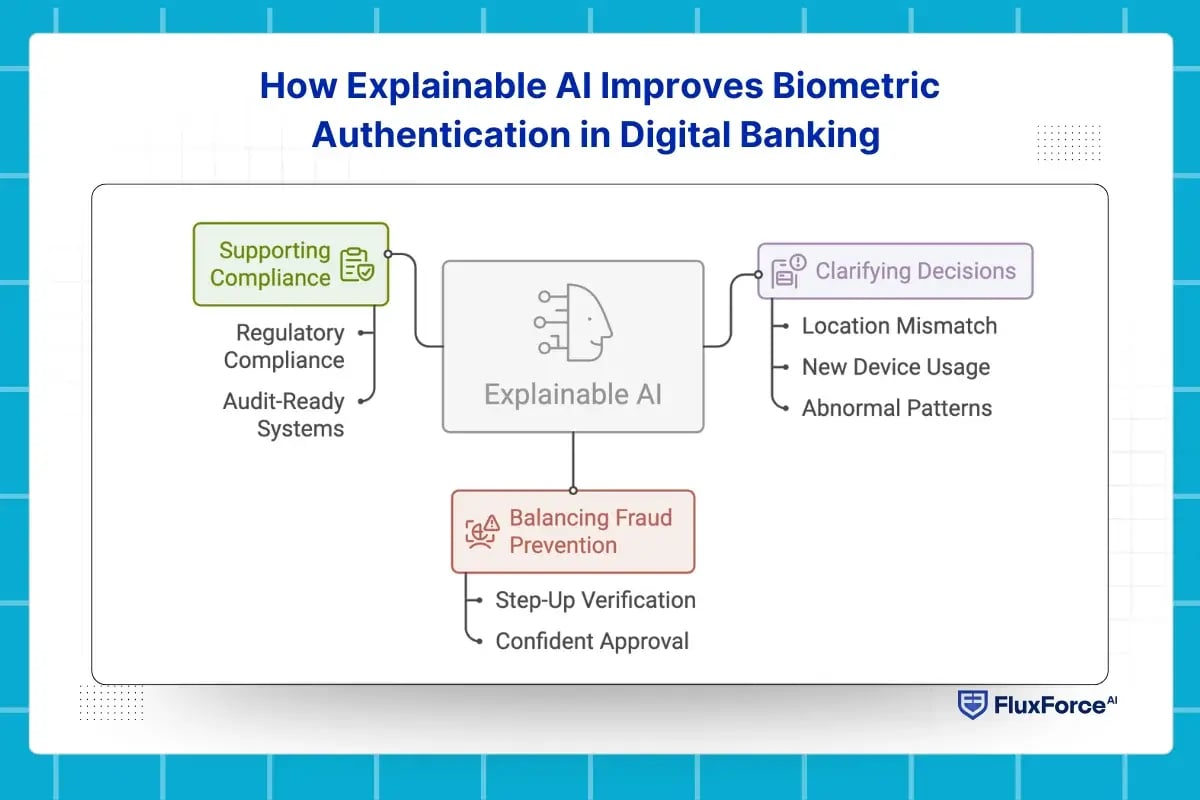
Explainable AI (XAI) in banking reveals why transactions are flagged. Signals like location mismatch, new device usage, or abnormal patterns improve biometric security. Risk teams can focus on real threats, reducing false positives and streamlining AI fraud detection banking.
Balancing Fraud Prevention and User Experience
XAI enables a more precise response to alerts. When a legitimate user triggers a flag — say, logging in from a new device — the system can identify the specific risk factor and prompt a step-up verification rather than a full account block. This distinction between "unknown" and "fraudulent" is what separates effective fraud prevention from customer-damaging overcorrection.
Supporting Compliance and Trust
Explainable AI in banking ensures regulatory compliance AI and audit-ready AI systems by tracing every decision. Teams gain operational clarity, reduce disputes, and strengthen AI risk management banking.
AI Transparency in Biometric Authentication for Digital Banking
Every biometric login — face, fingerprint, or voice — carries a compliance obligation as much as a security function. When authentication fails, the system must be able to show exactly why: which signal failed, by how much, and what the appropriate response should be. That is what XAI delivers.
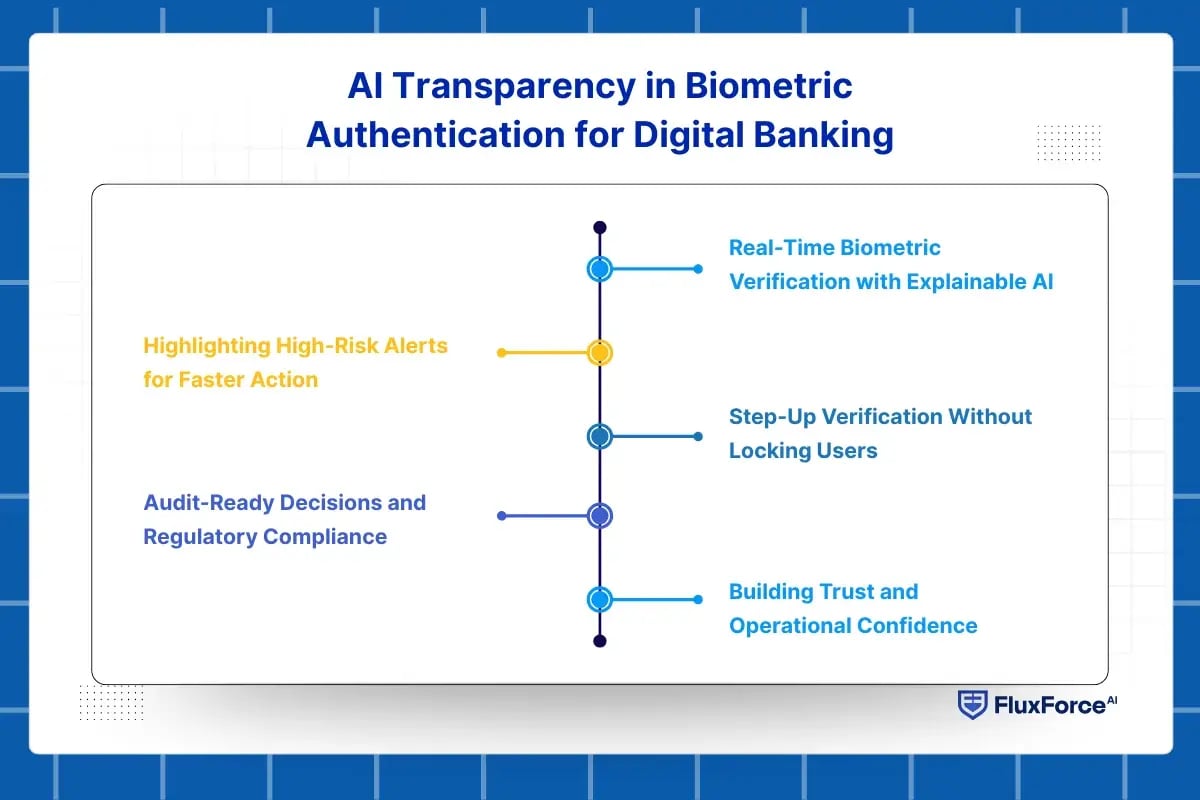
1. Real-Time Biometric Verification with Explainable AI
At a mid-size bank, analysts noticed that 15% of login attempts were falsely flagged due to device changes or minor behavioral shifts. Traditional AI models provided scores without explanations. With Explainable AI in banking, every failed authentication now shows drivers such as device ID mismatch, facial angle deviation, or typing pattern irregularities. Analysts immediately understand the reason, allowing faster, confident decisions while maintaining biometric security.
2. Highlighting High-Risk Alerts for Faster Action
AI-based authentication generates numerous alerts daily. XAI identifies the highest-risk events, such as multiple failed voice logins or rapid device switching. Analysts can prioritize these cases instead of reviewing low-risk attempts. A regional bank reported a 35% reduction in manual reviews after using Explainable AI for biometric security in banks, improving both AI fraud detection banking and operational efficiency.
3. Step-Up Verification Without Locking Users
In daily operations, explainable AI reduces friction. Analysts no longer need to manually justify decisions without evidence. Clear explanations support faster approvals, stronger declines, and better escalation handling. This directly improves digital fraud management and lowers operational costs.
Explainable outputs also support training and quality reviews which improves long-term accuracy.
4. Audit-Ready Decisions and Regulatory Compliance
Every biometric outcome is logged with the decision factors that drove it — device ID, geolocation delta, behavioral anomaly score. When regulators or internal audit teams request justification, teams can produce a structured decision trail in minutes rather than reconstructing logic manually. This is what the EU AI Act's transparency requirements and SR 11-7's model documentation standards now expect.
5. Building Trust and Operational Confidence
Transparency builds trust. Explainable AI in banking allows analysts, auditors, and even customers to see why a login or transaction is approved, escalated, or denied. Clear reasoning reduces false positives, accelerates authentication, and strengthens AI model explainability and trustworthy AI in banking, enabling biometric systems to scale safely.
How Banks Regain Control Over Biometric Authentication Decisions ?
Banks do not adopt biometric authentication to experiment with AI. They adopt it to reduce fraud, speed access, and lower operational cost. When biometric decisions cannot be explained, those goals break down. Explainable AI in banking exists to fix that exact gap by turning biometric outcomes into decisions teams can act on, defend, and improve.
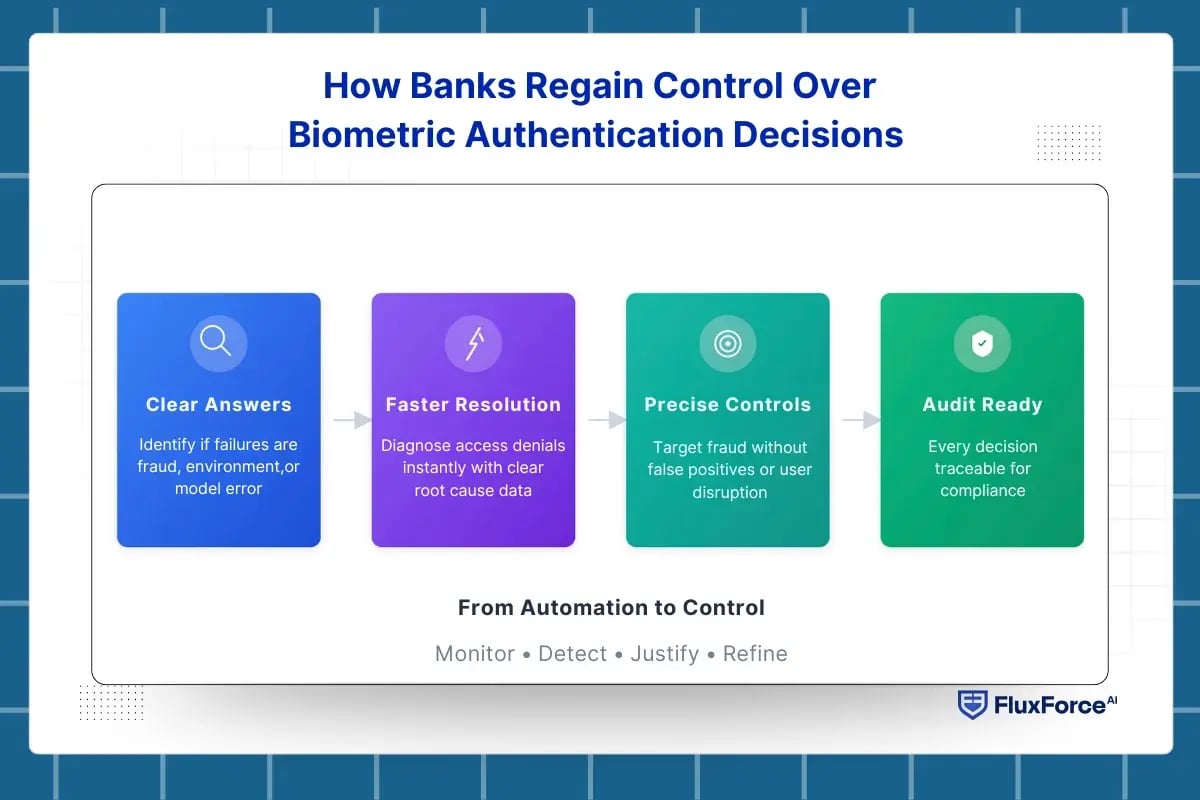
Clear Answers When Biometric Authentication Fails
From a user’s perspective, biometric authentication either works or it doesn’t. From a bank’s perspective, every failure triggers risk. Without explainability, teams cannot tell whether a failed login was caused by fraud, environmental issues, or model error.
Explainable AI for biometric authentication provides immediate clarity by exposing what influenced the decision. This allows support and risk teams to respond accurately instead of defaulting to account blocks or escalations that increase customer friction.
Faster Resolution for Customer Access Issues
Customer lockouts cost banks an average of $15–$25 per support escalation, according to Javelin Strategy & Research estimates for digital banking friction events. XAI shortens resolution time by showing support teams exactly why access was denied. Instead of reopening investigations, teams can see whether confidence thresholds dropped, biometric quality degraded, or device behavior changed.
This directly improves digital banking security while protecting customer experience and reducing support workload.
Stronger Fraud Decisions Without Overcorrecting
The common bank response to biometric fraud is blanket control tightening — lower thresholds, more friction, harder blocks. This drives false positive rates up and legitimate customer experience down. XAI breaks this cycle by showing exactly which signals indicate real fraud, allowing surgical control adjustments rather than system-wide overcorrection.
By understanding which biometric signals truly indicate risk, teams can strengthen controls where needed without disrupting legitimate users. This balance is critical for scalable AI-based authentication.
Decisions That Hold Up Under Audit and Review
When biometric authentication affects account access, regulators expect justification. Explainable AI ensures that each decision is traceable to clear inputs and logic. This removes ambiguity during audits and supports regulatory compliance AI without slowing authentication flows.
Banks gain audit-ready AI systems by design, not through manual reconstruction.
A Practical Shift from Automation to Control
The real value of explainable AI is not transparency alone. It is control. Banks gain the ability to monitor biometric performance, detect drift, justify outcomes, and refine thresholds continuously.
This is how trustworthy AI in banking is built in practice, not theory.
Implementing Explainable AI in Live Cross-Channel Fraud Decisioning
Explainable AI delivers value only when it is embedded directly into fraud workflows. In production environments, models must support fast decisions, consistent outcomes, and clear accountability across channels. Implementation requires structure, not experimentation.
Embedding Explainability into Transaction Decisioning Systems
Before a suspicious activity report is filed, risk teams must separate genuine threats from normal behavior. Explainable AI reveals which risk indicators and behavioral patterns contributed to an alert.
This transparency helps investigators understand the basis of escalation and reinforces a practical definition of what is a suspicious activity report within day-to-day operations.
Applying Unified Logic Across All Channels
Cross-channel fraud detection fails when models behave differently across payment types. Explainable AI enables shared features and consistent risk logic across cards, digital banking, and alternative payment channels. This creates unified fraud detection without rebuilding systems for each channel.
The result is stronger omnichannel fraud prevention and fewer conflicting decisions.
Reducing Review Time and False Positives
Explainable AI highlights the strongest risk signals for each alert. Analysts focus on high-impact cases instead of reviewing low-risk noise. This reduces false positives and improves throughput in payment fraud detection operations.
Clear explanations also shorten training cycles for new analysts.
Creating Audit-Ready Fraud Decisions
Every fraud action must be traceable. Explainable AI records decision drivers alongside outcomes. This supports audits, regulatory reviews, and internal model governance without manual reconstruction. Teams maintain control while scaling AI-driven fraud prevention.
This directly strengthens AI model transparency, AI risk management, and long-term operational trust.
XAI enhances biometric authentication in digital banking
boost security and trust with FluxForce AI
Bias, Fairness, and What Regulators Expect
Accuracy is not distributed evenly. NIST's Face Recognition Vendor Testing program found that many commercial facial recognition algorithms produce significantly higher false match and false non-match rates for women, darker-skinned individuals, and older adults than for lighter-skinned males. Inside a KYC or AML workflow, those error rates stop being a technical footnote. They become uneven denial rates across customer groups, which is a discrimination exposure before it is an engineering problem.
What that looks like on a single flagged login: typing cadence 40% outside the user's 90-day behavioural baseline, and facial match confidence at 62% against a 75% threshold. Two signals, both short of par, neither conclusive on its own. An analyst can weigh that. A bare "high risk" score gives them nothing to weigh, and nothing to write down if the decision is later challenged.
User tolerance is thinner than most onboarding teams assume. A 2024 Jumio Digital Identity Trends report found that nearly half of digital banking users lose confidence in a platform after two unexplained authentication failures. Trust in the system matters about as much as the accuracy of the model behind it.
What the Rules Require
The EU AI Act classifies biometric identification systems as high-risk AI. Articles 9 and 13 require transparency, human oversight, and bias monitoring for anything in that class, so decisions have to be explainable, auditable, and reviewable by a person rather than final at the point the model returns a score.
FATF's guidance on digital identity emphasizes non-discrimination in automated verification, and the NIST AI Risk Management Framework sets comparable expectations for traceability and fairness monitoring. Those are voluntary standards, but supervisors reference them more each year. FATF, the European Banking Authority, and the Financial Conduct Authority all expect an institution to justify a KYC decision, not point at the number the system produced.
Identity is one decision type. See the wider treatment of explainable AI in finance for how the same principles apply across lending, fraud, AML, and market risk.
Conclusion
Biometric authentication is now the main gateway to digital banking. As its use grows, banks must ensure that every decision is clear, fair, and reliable. Speed alone is not enough if teams cannot explain why access was approved or denied.
Explainable AI in banking brings that clarity. It helps teams understand biometric decisions, separate real fraud from technical issues, and keep models accurate over time. It also makes these decisions easier to review during audits and customer disputes.
Banks that operationalize XAI now gain more than transparency — they gain model control, audit readiness, and the ability to defend every biometric decision to regulators, customers, and internal governance teams. Those still running black-box biometric systems are one regulatory review away from a costly rebuild.
See how FluxForce.ai helps compliance teams turn black-box biometric decisions into auditable, explainable outcomes without replacing your existing systems.
Share this article