.webp)







Listen to our podcast 🎧
Introduction
AI models running across hybrid cloud environments are making real decisions right now: credit approvals, fraud flags, risk scores. No single team can see the full picture. Data sits in private cloud. Models run in public cloud. Governance sits somewhere between the two. When a regulator asks why a model decided what it did, the answer is rarely ready.
While these advances improve operational efficiency, they also introduce new vulnerabilities, increasing exposure to cyber threats. Traditional security measures often struggle to keep pace with sophisticated attacks, especially within internal networks.
The Growing Complexity of Hybrid Cloud Environments
Managing AI models across public and private cloud is a governance problem. When a model is trained in one environment, deployed in another, and monitored from a third, accountability gaps open fast. Who owns model behavior in production? Who gets notified when it drifts? Who holds the audit trail when the regulator calls?
Ensuring AI governance, regulatory compliance, and operational security requires real-time visibility into network traffic, data flow, and AI-driven decision-making.
Why Explainable AI (XAI) Matters ?
Explainable AI helps organizations understand the reasoning behind AI predictions. Explainable AI matters in hybrid cloud for one practical reason: when a model makes a decision you need to defend, you need to show your work. At the level of this specific prediction, on this specific date, using these specific inputs, from this specific environment. That is what DORA and the EU AI Act expect. Most organizations cannot produce it because they did not build explainability in from the start.
The Role of AI Risk Management
Effective AI risk management enables organizations to detect anomalies, monitor AI models, and assess risk in real time. CISOs, risk teams, and IT security leaders rely on these practices to safeguard operations, ensure compliance, and prevent potential disruptions caused by flawed or biased AI decisions.
That is the core problem this post addresses: AI risk management in practice, across hybrid cloud environments, in industries where a wrong or unexplainable decision carries regulatory and financial consequences.

Understanding AI Risks in Hybrid Cloud Environments
As organizations adopt hybrid cloud infrastructures, the complexity of managing AI systems increases.
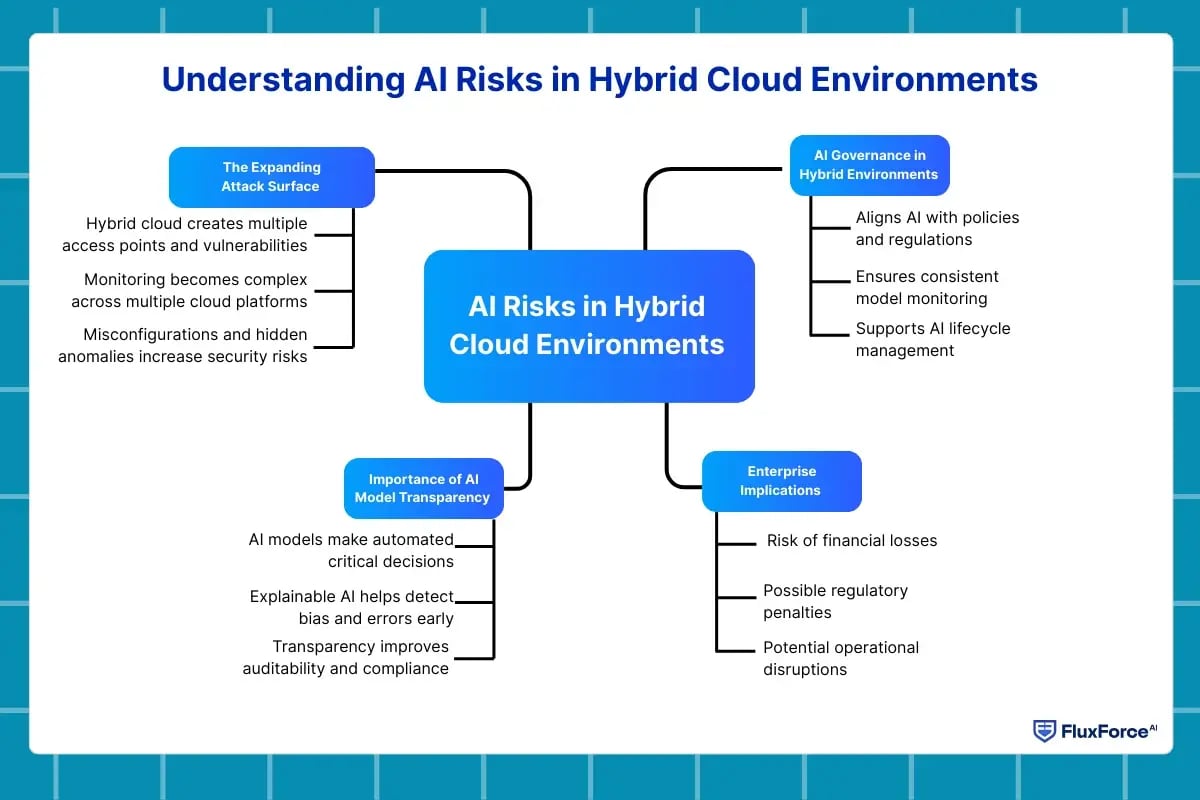
AI models handle sensitive operational and business data, and errors in these models can translate into significant financial, operational, or regulatory risks. Effective AI risk management ensures that organizations maintain visibility and control over AI-driven decisions while safeguarding against both external and internal threats.
The Expanding Attack Surface
Hybrid cloud environments combine on-premises systems with public and private cloud resources, creating multiple points of access. Each node introduces potential vulnerabilities, making hybrid cloud security a priority. Without comprehensive monitoring, subtle anomalies in network traffic, authentication logs, or system behavior can go undetected, allowing intrusions or unauthorized access to escalate.
- The average enterprise operates across 5–7 cloud platforms, increasing the complexity of monitoring AI models.
- Misconfigurations alone account for nearly 30% of cloud security incidents in large organizations.
Importance of AI Model Transparency
AI models in hybrid cloud setups often make critical decisions without human intervention. Lack of transparency can hide biases, misclassifications, or inefficiencies. This is where AI model explainability and model risk management become essential. Explainable AI allows stakeholders to understand why a model made a particular decision, identify weaknesses, and implement corrections before a minor error escalates into a serious risk.
- Transparency reduces regulatory exposure by ensuring auditability of AI-driven decisions.
- Explainable models help risk analytics teams validate predictions against historical patterns.
AI Governance in Hybrid Environments
Strong AI governance aligns AI operations with corporate policies, compliance requirements, and ethical standards. In hybrid cloud environments, governance frameworks must span multiple systems and datasets, ensuring consistency in model performance, version control, and risk mitigation.
Key governance activities include:
- Monitoring model drift to detect changes in AI behavior over time.
- Ensuring AI compliance with regulatory standards across jurisdictions.
- Applying AI lifecycle management to track model development, deployment, and decommissioning.
Enterprise Implications
Failure to manage AI risks in hybrid clouds can have serious consequences:
The consequences of unmanaged AI risk in hybrid cloud are specific. An incorrect automated credit decision creates fair lending exposure. An audit trail that cannot reconstruct a model's reasoning at a specific point in time fails regulatory review under SOX, GDPR, and the EU AI Act. Model behavior that drifts undetected shows up in a compliance finding or a customer complaint spike, well after the damage has accumulated.Adopting explainable AI approaches not only mitigates these risks but also builds trust with internal stakeholders and external regulators. Organizations equipped with robust AI observability can proactively detect anomalies and respond faster.
For teams mapping audit trail requirements to specific regulatory frameworks, our post on agentic AI audit trail automation covers how continuous documentation works across 50-plus compliance frameworks simultaneously.
Explainable AI for Hybrid Cloud Environments
Hybrid cloud architectures host AI models across multiple platforms, which can obscure how decisions are made. Explainable AI (XAI) provides transparency by clarifying model logic, allowing teams to act on predictions with confidence.
Understanding Explainable AI
Explainable AI reveals the reasoning behind model outputs, making complex algorithms interpretable for stakeholders. This transparency supports AI risk management by highlighting potential errors, biases, or inconsistencies before they affect operations.
Audit and compliance teams can use XAI insights to verify that predictions meet regulatory standards, while improving AI observability to detect unusual model behavior in real time.
Explainable AI for Hybrid Cloud Environments
In hybrid cloud environments, XAI enhances both security and operational efficiency:
- Risk identification: Teams can trace decision pathways, ensuring robust model risk management.
- Compliance assurance: Transparent AI simplifies reporting for audits, reinforcing AI compliance and cloud compliance.
- Performance optimization: Feature importance and prediction drivers help refine models without disrupting workflows.
How Explainable AI Improves Cloud Risk Models
Cloud-hosted AI models benefit from explainable AI in predictive accuracy and bias reduction. By understanding how models make decisions, risk and compliance teams can take preventive actions before issues escalate.
Implementing explainable AI also strengthens hybrid cloud AI governance frameworks by embedding transparency into corporate policies, making accountability measurable and actionable.
Key Considerations for Deployment
When applying XAI in hybrid clouds:
- Ensure models are auditable across all environments.
- Monitor for drift to maintain consistent accuracy.
- Align explainability metrics with operational and regulatory requirements.
Robust deployment of explainable AI supports proactive decision-making and reinforces AI governance across hybrid cloud infrastructures.
AI Risk Modeling for Regulated Industries
Organizations in highly regulated sectors face significant challenges in managing risks associated with AI models.
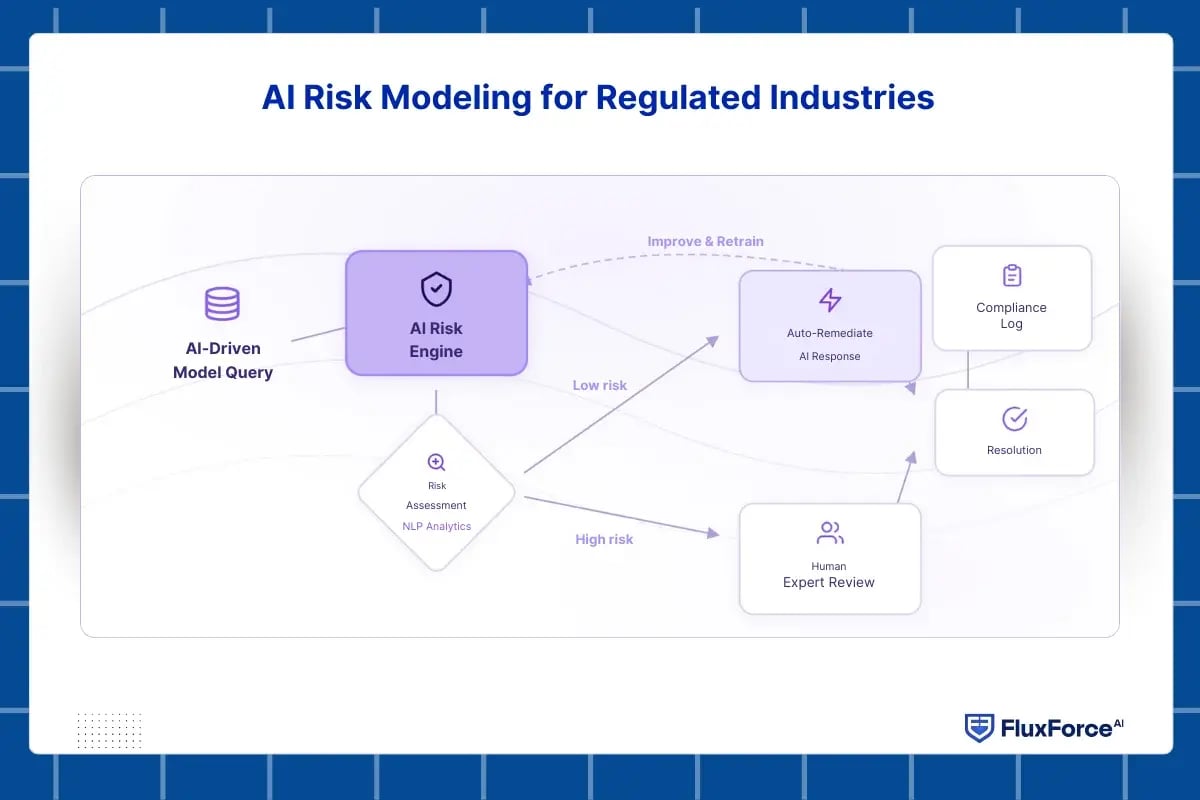
Strong AI risk management ensures that AI-driven decisions remain compliant with legal, operational, and ethical standards while reducing potential disruptions and losses.
For institutions under DORA, our post on DORA's 7 ICT risk requirements for banks maps the regulation's five pillars directly to AI model governance and hybrid cloud infrastructure requirements.
Banks need to understand the reason behind every alert before taking action. Explainable AI connects detection with reasoning, helping teams see what the model observed and why a payment was flagged. This clarity improves speed, accuracy, and customer trust while keeping controls aligned with compliance.
The Role of AI Risk Management
AI models can produce unexpected outcomes due to biased data, misaligned objectives, or unmonitored drift. Effective AI risk management helps organizations detect anomalies early, maintain compliance across jurisdictions, and build confidence among stakeholders by ensuring AI model transparency.
Incorporating AI observability allows continuous monitoring of model behavior, delivering real-time insights into performance and highlighting areas that need corrective action. This creates a proactive framework for managing AI risks.
Managing Risks in Hybrid Cloud Environments
Deploying AI across hybrid cloud environments introduces additional layers of complexity. Hybrid cloud risk management ensures that AI models perform consistently across public and private clouds while maintaining AI compliance and protecting sensitive data.
Integrating model risk management with explainable AI (XAI) allows organizations to evaluate the impact of predictions, identify vulnerabilities, and uphold accountability across multi-cloud systems. This approach helps secure AI operations without compromising agility or scalability.
Enhancing Decisions with AI Model Explainability
Understanding the rationale behind AI predictions is crucial in regulated industries. AI model explainability provides transparency by showing which factors influence a model’s decisions. This enables teams to verify compliance with regulatory and ethical standards, reduce operational risks, and communicate AI outcomes clearly to non-technical stakeholders.
Techniques like SHAP and LIME support AI model transparency, offering measurable insights into feature importance and guiding model refinement. These tools strengthen trust in AI while improving decision-making accuracy.
Leveraging Risk Analytics
Risk analytics enhances decision-making by combining AI outputs with statistical and operational insights. It highlights areas where model predictions deviate from expectations, prioritizes risks for immediate action, and provides decision-makers with actionable intelligence on AI operations.
Integrating risk analytics into AI governance frameworks ensures a holistic understanding of AI-driven risks, strengthening both compliance and hybrid cloud security. This approach allows organizations to anticipate and prevent potential disruptions proactively.
Explainable AI for Compliance and Audit
In regulated industries, AI decisions are evidence. A credit decline, a fraud flag, a risk score that triggers a review: each may need to be defended in front of a regulator, an internal auditor, or a customer. XAI ensures that defense is possible by generating the reasoning trail at the point of decision, not reconstructed after the fact.
Strengthening Compliance
Explainable AI strengthens compliance in three specific ways. First, it makes model predictions interpretable to compliance teams without requiring a data scientist to translate them. Second, it produces documentation that maps model outputs to specific regulatory standards, making the connection between a decision and the policy it applied explicit rather than inferred. Third, it surfaces risk patterns continuously rather than at the point of audit, so compliance teams are managing risk in real time rather than discovering gaps when a regulator asks.
In AML specifically, our post on using explainable AI to strengthen AML case investigations shows how this reasoning trail translates into defensible SAR filings and examination-ready evidence.
Observability and Monitoring
AI observability provides real-time insights into model behavior, enabling early detection of drift, biases, and anomalies. Continuous monitoring is crucial for hybrid cloud deployments.
Hybrid Cloud Oversight
Hybrid cloud risk management ensures consistent compliance across public and private clouds. Combining it with AI model explainability allows teams to validate predictions and maintain accountability in complex environments.
Audit-Ready Operations
Maintain detailed logs of model inputs, outputs, and changes. Use XAI tools to generate interpretable explanations for auditors and stakeholders. By integrating explainability, observability, and risk analytics, organizations strengthen compliance, transparency, and control over AI systems.
How to Ensure Safe and Compliant AI in Hybrid Cloud
Deploying AI across hybrid cloud environments can introduce uncertainty. Teams need practical strategies to ensure AI models remain secure, transparent, and reliable without adding unnecessary complexity.
Following structured practices improves hybrid cloud risk management while supporting compliance and operational efficiency.
Monitor AI Models Continuously to Avoid Surprises
Continuous observation is essential for safe AI operations. AI observability provides real-time insights into how models perform across private and public clouds, helping teams detect anomalies, unusual predictions, or emerging bias.
Benefits include:
- Immediate detection of potential operational risks before they affect processes.
- Ability to track model drift and data changes that might compromise accuracy.
- Proactive issue resolution that prevents service disruptions or regulatory breaches.
By integrating observability into hybrid cloud setups, organizations maintain confidence in their AI systems and reduce reactive firefighting.
Make AI Decisions Transparent for Compliance
Regulated industries require that AI-driven decisions be explainable and accountable. Explainable AI (XAI) enables teams to understand why a model makes specific predictions, providing evidence for audits and regulatory reporting.
Transparent AI systems:
- Build stakeholder trust by clearly showing the reasoning behind predictions.
- Simplify compliance processes by documenting model decisions.
- Reduce operational and reputational risks through accountable AI usage.
Making models understandable is not just a regulatory requirement—it improves decision-making across teams.
Use Risk Analytics to Guide Action
Integrating risk analytics with AI outputs allows decision-makers to identify potential threats and prioritize interventions.
Key advantages include:
- Highlighting areas where model behavior deviates from expected results.
- Quantifying operational impact to focus on high-priority risks.
- Supporting faster, informed actions to maintain hybrid cloud security and operational resilience.
This combination strengthens AI governance, helping teams respond to risks before they escalate.
Practical Steps for Effective AI Governance
To ensure consistent and safe AI operations in hybrid cloud environments, teams should follow these practices:
- Maintain detailed logs of model decisions to facilitate audits and accountability.
- Regularly validate models for bias, drift, and performance degradation.
- Apply standardized compliance and security policies across all cloud platforms.
These steps ensure AI risk management is proactive, reliable, and aligned with both operational goals and regulatory expectations.
Best Practices for Explainable AI and Hybrid Cloud Risk
Most AI risk failures in hybrid cloud are process failures, not technology failures. Models drift and no one notices because monitoring thresholds were never defined. Governance policies exist on paper but do not map to actual deployment environments. Audit trails are incomplete because logging requirements were specified after deployment rather than before. Organizations that follow structured practices can reduce operational risks, maintain regulatory compliance, and improve transparency for stakeholders.
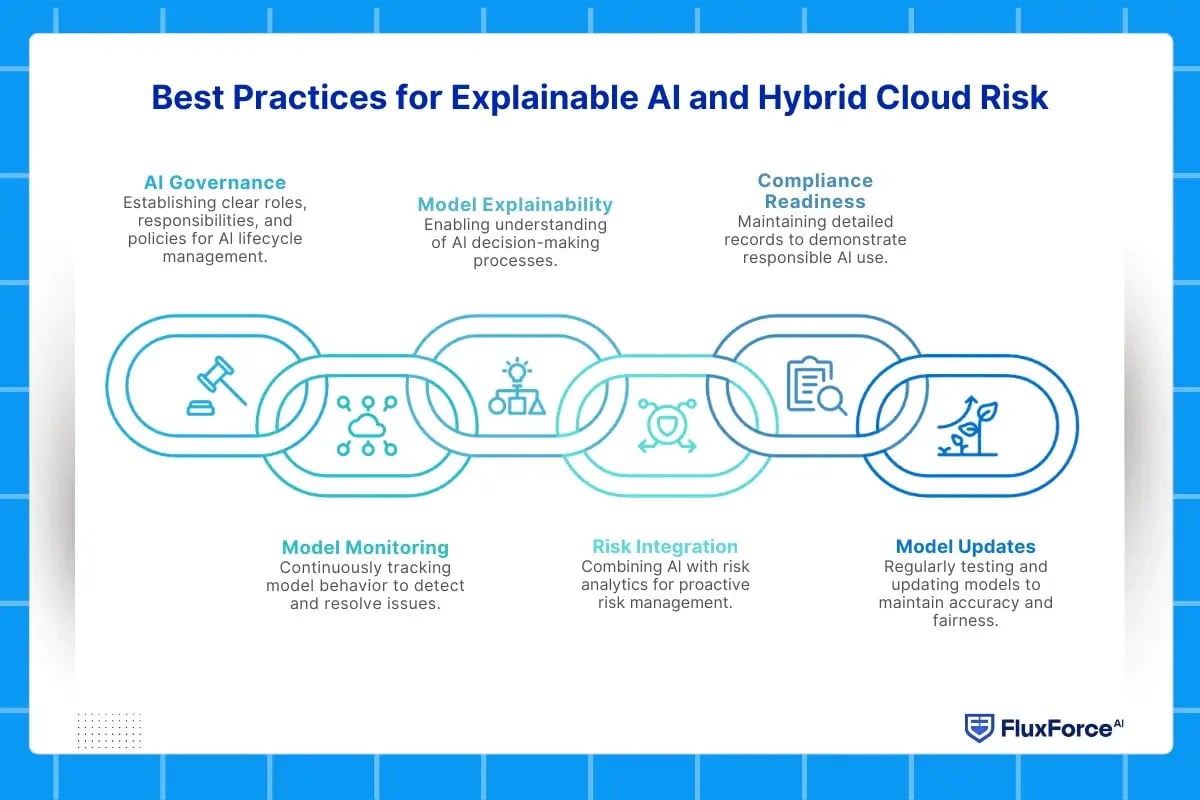
Establish Strong AI Governance
Effective AI governance is the foundation of safe and responsible AI adoption. Governance involves defining clear roles, responsibilities, and policies for every stage of the AI lifecycle, from model development to deployment.
Strong governance ensures:
Strong governance produces three measurable outcomes. Models meet the standards set by DORA, the EU AI Act, and internal risk policies because those standards are built into the execution logic, not checked after the fact. Both public and private cloud systems operate under the same risk protocols because governance is enforced programmatically, not communicated as guidelines. And compliance teams can audit any decision without requesting engineering support because explanations are generated automatically and stored alongside outputs.Governance frameworks should include periodic audits, approval workflows for model updates, and accountability mechanisms for AI-driven decisions.
Monitor Model Performance Continuously
Continuous monitoring through AI observability allows organizations to track model behavior in real time. AI models in hybrid cloud environments face a validation problem specific to multi-environment deployments: the data distribution in production may differ from what the model was validated on, especially when data moves across clouds with different preprocessing configurations. A model that scored accurately at deployment may be quietly misclassifying a customer segment three months later because the input data it receives in public cloud does not match the private cloud training distribution.
Key monitoring practices include:
- Tracking prediction accuracy and identifying anomalies before they escalate.
- Detecting bias in outcomes to prevent unintended consequences.
- Logging model inputs, outputs, and intermediate processes to provide a complete view for auditing and risk analysis.
By integrating observability tools into hybrid cloud infrastructure, teams gain insights into model performance across multiple environments, ensuring proactive issue resolution.
Prioritize AI Model Explainability
AI model explainability enables teams to understand why a model makes specific predictions. In regulated industries, this transparency is essential for accountability and compliance.
Practical approaches include:
- Feature attribution and model interpretability methods support AI model transparency by quantifying how much each input variable contributed to a specific prediction. These techniques translate model behavior into terms a risk officer or auditor can act on without requiring them to understand the underlying mathematics.
- Creating dashboards that visualize model decisions in simple terms for business and compliance teams.
- Documenting decision logic to support regulatory reporting and audits.
Explainable models not only meet regulatory expectations but also improve stakeholder confidence in AI-driven decisions.
Integrate AI With Risk Analytics
Combining risk analytics with AI provides a deeper understanding of potential issues and their operational impact. This approach allows organizations to anticipate risks, prioritize mitigation efforts, and make informed decisions.
Benefits of integrating risk analytics include:
- Highlighting areas where AI predictions deviate from expected outcomes.
- Quantifying operational and financial impact of model errors.
- Supporting risk-based decision-making to maintain hybrid cloud security.
This integration helps teams act quickly, ensuring AI-driven processes remain reliable and secure.
Maintain Compliance and Audit Readiness
Proper documentation and logging are critical for demonstrating responsible AI use. AI compliance requires detailed records of model development, deployment, and decision outputs.
Best practices include:
- Maintaining end-to-end audit trails of AI decisions.
- Storing logs securely in a hybrid cloud setup to prevent tampering.
- Periodically reviewing and updating documentation to reflect changes in models or regulations.
Clear compliance records make audits efficient and help organizations demonstrate accountability to regulators and stakeholders.
Regularly Update and Validate Models
AI models are not static—they must evolve with changing data and operational conditions. Regular testing and updates help maintain accuracy, reduce bias, and prevent drift.
Effective strategies include:
Bias and fairness assessments need specificity to be meaningful. A periodic assessment that does not define which demographic groups are being evaluated, which statistical tests are applied, or what deviation threshold triggers a retrain is not an assessment. It is a compliance gesture. Organizations that document these specifics in validation protocols reviewed and signed off by both data science and compliance teams are the ones that can demonstrate controlled AI risk management to a regulator rather than describing it in general terms.Consistent validation strengthens AI governance and ensures predictions remain reliable, reducing operational and regulatory risk.
Improve compliance, accuracy, and decision-making today.
XAI enhances hybrid cloud risk models
Conclusion
AI models running across hybrid cloud environments will keep getting more complex. Data sources multiply. Deployment environments shift. DORA, the EU AI Act, and GDPR keep adding requirements. What risk and compliance teams can control is visibility: how much they can see of what their models are actually doing, and how quickly they can produce evidence when someone asks. Build the audit trail before the audit. Explain the model before the regulator asks for it. Detect drift before it shows up in a compliance finding. Teams that build this capability now make faster decisions with more confidence, not because they have better models but because the evidence is already there.

Share this article