















.webp)



Listen to our podcast 🎧
.png)
Introduction
Traditional audit trails are often slow, scattered, and difficult to manage. Finance teams spend hours tracking changes in spreadsheets, emails, and multiple systems. Studies show that more than 60% of audits are delayed because records are incomplete or hard to access.
What Makes an Audit Trail “Living”?
A living audit trail is more than a static record. It is real-time, continuously updated, and context rich. Every action, change, or decision is logged automatically, along with the “why” and “who.”
Unlike traditional audit trails that are often incomplete or delayed, living audit trails adapt to your workflow, providing transparency as events happen.
With AI in auditing, audit trails do more than record history. They help companies spot errors, improve transparency, and respond to regulatory questions quickly. Organizations using AI-driven audit trails have reported up to 70% faster audit preparation, fewer mistakes, and better visibility across complex processes.
This guide explores how AI in auditing enables living audit trails, how to set up secure and scalable systems, and how businesses can turn compliance and monitoring from a reactive task into a proactive advantage.
Organizations Managing Compliance with AI:
- Financial Services: JPMorgan Chase and Goldman Sachs apply AI to credit risk models and trading algorithms under Federal Reserve supervision and SEC oversight.
- Insurance: Zurich Insurance and Allianz deploy AI in underwriting and claims processing, navigating state insurance regulations and fair pricing mandates.
- Healthcare: Kaiser Permanente and Mayo Clinic use AI for diagnostic support and treatment planning, subject to HIPAA requirements and FDA regulations for clinical decision support.
Why Continuous Audit Trail Matters ?
Auditors, compliance teams, and managers need accurate information immediately. Waiting days or weeks to reconstruct events can lead to errors, missed deadlines, and regulatory fines. According to Deloitte, organizations with fragmented audit trails spend 30% more time preparing for audits.
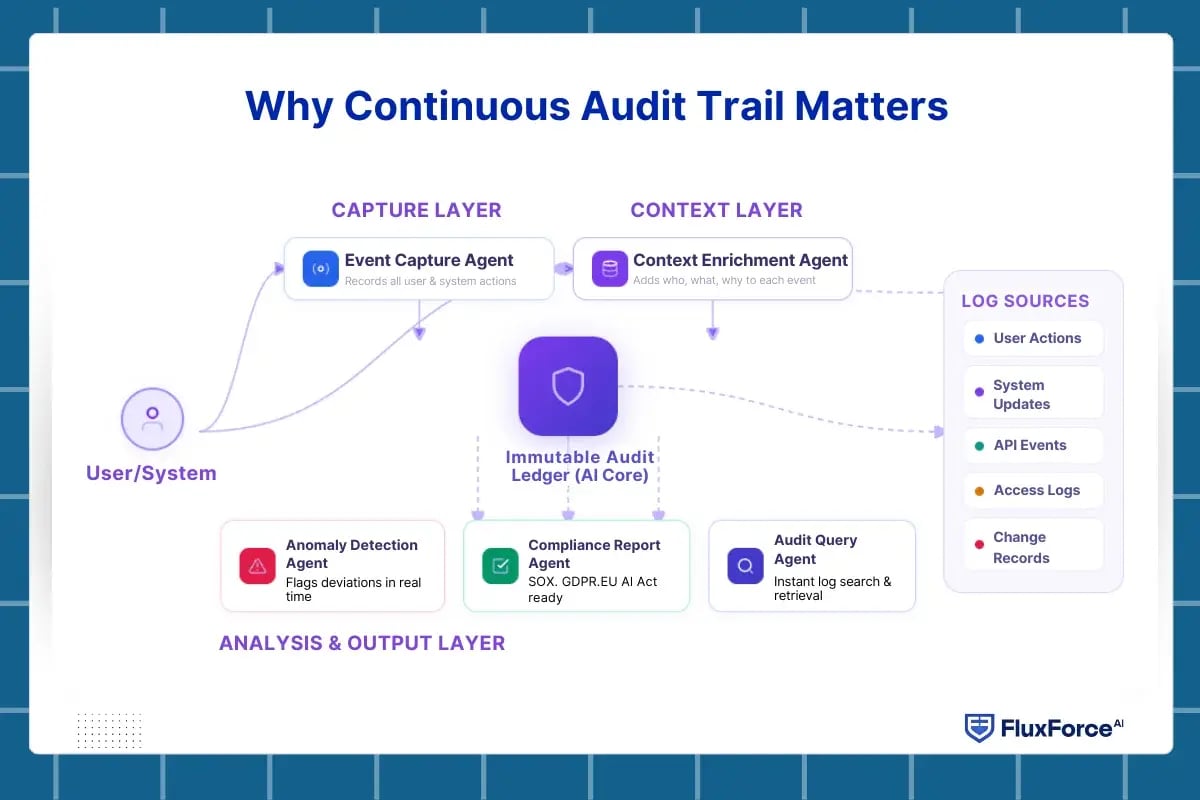
AI in auditing makes this possible by automatically capturing every event as it happens. From user actions to system updates, no step is missed.
Key Benefits of a Continuous Audit Trail
- Real-Time Transparency: Every action is tracked, making internal processes and compliance clear to auditors and regulators.
- Error and Fraud Prevention: AI can flag anomalies as they occur, preventing small mistakes from escalating.
- Efficient Audits: Continuous logs allow auditors to access data immediately, eliminating weeks of manual searches.
- Regulatory Readiness: With the increasing demands of frameworks like SOX, GDPR, and the EU AI Act, a continuous audit trail ensures your organization can provide evidence on demand.
How AI Transforms Audit Trails
AI does more than capture events. It adds context, showing who performed an action, what triggered it, and why it happened. This makes audits, investigations, and compliance reporting far more effective.
A continuous audit trail powered by AI:
- Records every system and user activity automatically.
- Flags unusual actions or deviations in real time.
- Maintains immutable records, reducing the risk of tampering.
- Enables post-event analysis to improve processes and reduce risks.
By turning static logs into a living system, AI in auditing allows organizations to monitor compliance, detect risks, and respond to incidents instantly.
Building Secure and Scalable AI-Driven Audit Trails
The growing complexity of transactions, regulatory demands, and internal controls requires solutions that are both agile and trustworthy.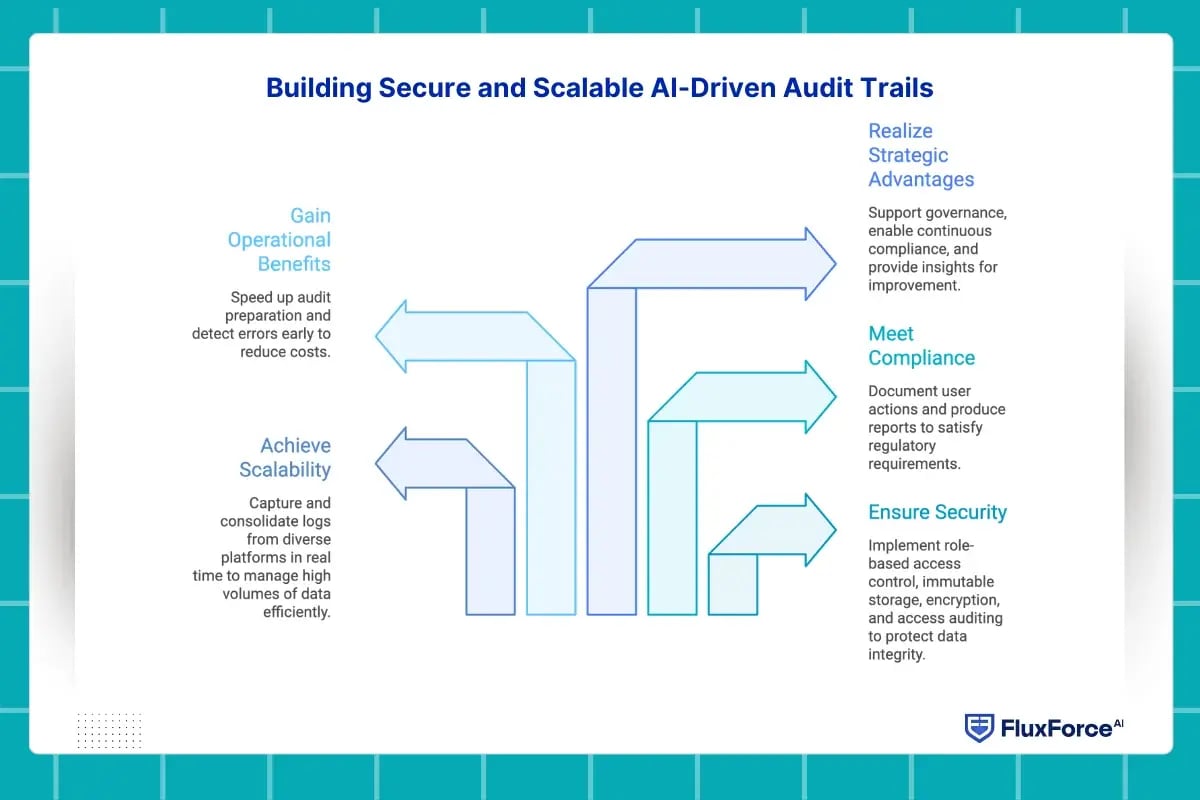
AI in auditing makes it possible to create a living, continuous audit trail that automatically records every action, captures context, and enhances transparency. These systems not only track events but also provide actionable insights, allowing organizations to respond quickly to errors, anomalies, or regulatory queries. By combining audit automation with compliance automation platforms, businesses can transform audit trails from reactive documentation into proactive risk management tools.
Ensuring Security and Data Integrity
A truly reliable AI-driven audit trail for compliance starts with security. Every record must be accurate, tamper-proof, and accessible only to authorized personnel. Key security features include:
- Role-based access control: Restricts who can view or modify audit logs.
- Immutable storage: Maintains a permanent record of actions to prevent unauthorized changes.
- Encryption: Protects sensitive data both in transit and at rest, essential for frameworks like SOC 2 compliance automation.
- Audit of access itself: Keeps track of who accessed the audit trail and when, adding an extra layer of accountability.
These measures ensure that the system meets regulatory standards while safeguarding internal data.
Scalability for Complex Operations
Large organizations process thousands of transactions daily, often across multiple systems. Traditional audit methods struggle to keep pace, resulting in delays and gaps in oversight. Continuous auditing and AI-enabled automated compliance monitoring solve these challenges by:
- Capturing and consolidating logs from diverse platforms in real time.
- Automatically tracking every transaction, approval, or system change without human intervention.
- Using intelligent algorithms to highlight unusual patterns, anomalies, or potential risks.
This scalable approach allows audit teams to manage high volumes of data efficiently, maintain full coverage, and reduce dependency on manual reconciliation.
Compliance and Regulatory Readiness
An AI-powered audit trail goes beyond recording events; it ensures organizations meet strict regulatory requirements. A well-designed system can:
- Document every user action, configuration change, and approval step.
- Produce reports that satisfy regulators for financial compliance automation, SOX, GDPR, and the EU AI Act.
- Enable proactive AI risk management by identifying trends or deviations before they escalate.
With audit automation and structured, AI-driven logs, businesses can respond immediately to regulatory inquiries, reducing the risk of fines or delays.
Operational Benefits
A living audit trail enhances day-to-day operations as well as strategic decision-making:
- Audit preparation becomes faster, as logs are continuously updated and searchable.
- Errors and inconsistencies are detected early, reducing the likelihood of costly mistakes.
- Teams gain greater visibility into workflows, approvals, and data changes, which strengthens internal controls.
By integrating AI in auditing, firms can maintain an accurate, detailed, and actionable record of all events, giving auditors, compliance officers, and executives confidence in the data.
Strategic Advantages
Beyond operational efficiency, a secure, scalable audit trail powered by AI provides long-term value:
- Supports organizational governance by enforcing accountability across teams.
- Enables continuous compliance, ensuring that controls are always monitored and updated.
- Provides insights for process improvement, risk mitigation, and resource allocation.
- Aligns audit practices with digital transformation initiatives, helping companies adopt advanced compliance automation software and platforms.
With these advantages, an AI-driven audit trail is no longer just a compliance tool; it becomes a strategic asset that informs both operational and executive decisions.
Real-World Applications of AI in Auditing
AI in auditing is no longer just a concept; it is actively shaping how companies track compliance automation and manage risk.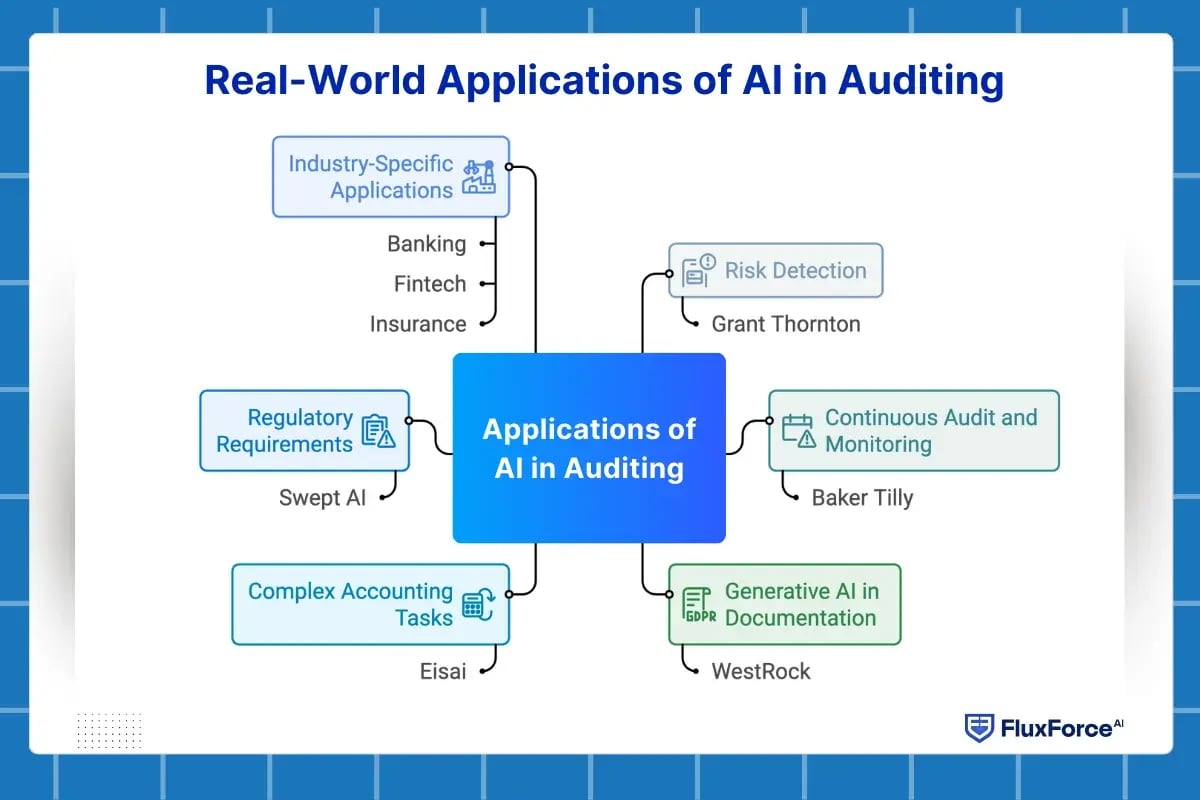
Instead of manually checking records or relying on samples, organizations now use AI audit trails to maintain continuous auditing, monitor processes in real time, and provide clear evidence for regulators. These applications show how automated compliance monitoring creates reliable, traceable, and actionable information.
AI in Risk Detection
Auditors need to find unusual transactions or potential fraud quickly. AI audit trails can scan thousands of records instantly and highlight issues that need attention. For example, Grant Thornton used AI-driven audit trail for compliance to identify high-risk transactions without manual effort. This allowed auditors to focus on decisions instead of searching through spreadsheets.
Key Benefit
-
Speeds up detection of errors and fraudulent activity.
Continuous Audit and Monitoring
A continuous audit trail ensures that every event is captured as it happens. Baker Tilly implemented automated compliance monitoring, so deviations are flagged immediately. This approach helps companies stay audit-ready at any time. By automatically keeping a detailed record of actions, real-time audit trail using AI reduces the chance of missing important information and helps demonstrate regulatory compliance automation.
Key Benefit
- Keeps processes transparent and ready for audits without last-minute effort.
Generative AI in Documentation
Creating reports and summaries can take auditors days. Generative AI can produce draft reports and suggested next steps by analyzing existing data. WestRock’s internal audit team used AI in auditing copilots to prepare work programs and reports, saving significant time while maintaining accurate documentation. This shows that AI-driven audit trail for compliance helps not only in tracking activity but also in supporting decisions.
Key Benefit
- Reduces time spent on reporting while keeping audit accuracy high.
AI in Complex Accounting Tasks
Large organizations often handle complicated operations such as lease accounting or multi-location finance tracking. Eisai, a pharmaceutical company, integrated AI to automate lease audits. AI created detailed logs for every lease, linked supporting documents, and verified calculations. This made it easier for auditors to confirm compliance and ensured that all records were up to date. Automated compliance monitoring was crucial for accuracy.
Key Benefit
- Simplifies complex audits and ensures consistent documentation.
Audit Trails for Regulatory Requirements
AI audit trail for regulatory compliance provides a clear record of who did what, when, and why. Swept AI captures every system action, policy enforcement, and user decision in a structured format. These logs allow companies to answer regulator questions or reconstruct past events quickly. Continuous auditing is especially helpful for frameworks such as SOX, GDPR, and the EU AI Act.
Key Benefit
- Makes regulatory reporting fast and reliable.
Industry-Specific Applications
AI in auditing is valuable in banking, fintech, and insurance. In finance, AI audit trail in banking can monitor large transaction volumes for anomalies and support anti-money laundering checks. Fintech firms use financial compliance automation to maintain regulatory compliance while scaling operations. In insurance, AML audit automation ensures that claims and policy changes are tracked accurately.
Key Benefit
- Adapts to industry-specific regulations and challenges.
Benefits Highlighted by Real Use Cases
The main advantages of AI in auditing, shown by real-world examples, include:
- Accurate Event Tracking: Every user and system activity is recorded in real time using AI audit trail for compliance.
- Simplified Investigations: Logs make it easy to verify decisions and trace errors.
- Regulatory Readiness: Regulatory compliance automation allows faster responses to audits.
- Operational Clarity: Teams can clearly see activity histories.
- Industry Adaptability: AI audit trail in banking, financial compliance automation, and AML audit automation adjust to specific needs.
These examples show that AI-driven audit trail for compliance is more than a tracking tool. It provides a living record supporting transparency, accountability, and continuous auditing.
Future Trends & Predictions for AI in Auditing
AI in auditing is changing fast. Companies face more rules, bigger volumes of transactions, and higher demands for clear reporting. Simple record-keeping is no longer enough. Businesses now need systems that spot risks early, give useful insights, and help make decisions quickly.
AI-Powered Predictive Auditing
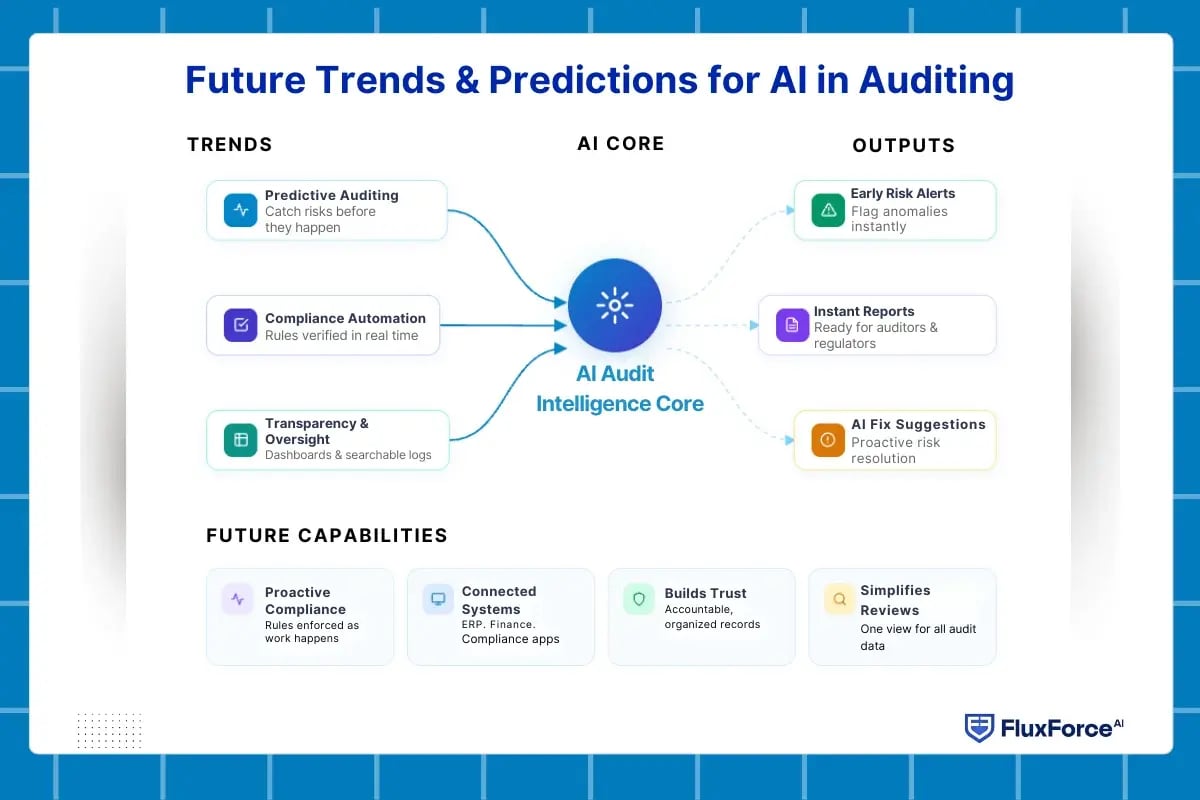
Predictive auditing lets AI look at patterns, find unusual activity, and warn teams before problems happen. Instead of waiting for auditors to find mistakes later, AI highlights potential issues right away.
- Early Risk Alerts: AI in auditing can catch unusual transactions, strange approval actions, or sudden spikes in activity.
- Better Processes: Companies can fix workflow problems based on insights from AI audit trails, reducing repeated mistakes.
This approach fits with continuous auditing and automated oversight, turning compliance into a proactive task instead of a reactive one.
Integration with Compliance Automation Platforms
Audit systems are starting to work together with larger compliance automation platforms. This links audit trails, risk checks, and regulatory reporting in one place, cutting manual work and reducing mistakes.
- Real-Time Checks: Automated compliance monitoring verifies every action against company rules and regulations as it happens.
- Quick Reports: AI can generate reports instantly for auditors and regulators without hours of manual work.
By connecting AI audit trails with compliance automation software, businesses can stay compliant continuously and respond fast to new rules.
Better Transparency and Oversight
Regulators and company leaders want more than proof of compliance. They want clear records showing accountability. AI audit trails will offer dashboards, searchable logs, and real-time summaries, making oversight easier and more reliable.
- Builds Trust: Organized audit records show responsibility and accuracy.
- Simplifies Reviews: Executives and auditors can see the data without searching through multiple systems.
Clear records strengthen controls and help companies manage risk over time.
Industry-Specific Applications
Different industries are using AI audit trails in ways that fit their rules:
- Banking & Fintech: AI audit trail in banking can detect fraud and support AML compliance.
- Insurance: Automated tracking keeps records of claims and policy updates, supporting financial compliance automation.
Each sector uses AI in auditing to follow regulations and improve daily operations.
The Future of Continuous Audit Trails
Continuous audit trails will become smarter and fully connected to business processes. Companies can expect:
- AI Suggestions: AI won’t just record actions but will suggest fixes and point out risks.
- Proactive Compliance: Automated systems will enforce rules as work happens, reducing mistakes and fines.
- Connected Systems: Audit trails will link to finance tools, ERP platforms, and compliance apps, creating one clear record.
AI in auditing will be more than a time-saver. It will help companies stay transparent, follow rules, and manage risks better.
Improve compliance, accuracy, and decision-making today.
XAI enhances hybrid cloud risk models
Conclusion
AI in auditing is changing how companies handle compliance, risk, and financial tasks. Old audit trails, which were slow and scattered, are being replaced by living, AI-driven audit trails that record every action as it happens. Using continuous auditing, automated compliance monitoring, and AI tools, businesses can find errors faster, prevent fraud, and respond to regulators right away.
A modern AI audit trail is more than just a record. It gives clear, accurate, and traceable evidence that helps with audits, internal checks, and everyday decisions. Companies in banking, fintech, insurance, and healthcare are already using AI audit trails for regulatory compliance and financial compliance automation, showing that AI can manage complex processes while keeping things clear and reliable.
Investing in AI-powered audit trails and compliance automation platforms gives companies both practical and long-term benefits. Teams can work faster, audits can be ready sooner, and regulators can trust the records. In short, AI in auditing turns a slow, reactive process into a smart, proactive tool for continuous compliance, risk control, and better business results.
The future of auditing will be connected, smart, and real-time, and companies that use AI now will be better prepared to meet rules, avoid mistakes, and make smarter decisions.
Share this article