.webp)








Listen To Our Podcast🎧
Introduction
“If you can’t explain your decision, people won’t trust it.”
This saying perfectly captures the challenge with modern identity verification AI. Even as AI systems improve, AI bias in facial recognition and bias in biometric verification still create unfair outcomes for users in KYC and AML workflows. Traditional black-box models hide the reasoning behind decisions, making it difficult to identify and fix bias.
Explainability in AI models address this by exposing the reasoning behind each verification decision. Compliance and security teams can see which factors are influencing approvals and denials, and whether those factors are creating unfair patterns across user groups.
Explainability reduces bias in identity verification, ensuring fairer outcomes
with FluxForce AI

Why Identity Verification AI Is Biased and How to Detect It ?
Identity verification AI learns patterns from historical data. When that data reflects past discrimination — uneven representation across skin tones, genders, or geographic origins — the model inherits those patterns. The result is a system that may work well on average but consistently underperforms for specific groups, often in ways that are invisible until an audit or discrimination complaint surfaces.
Explainability vs Black Box AI in KYC
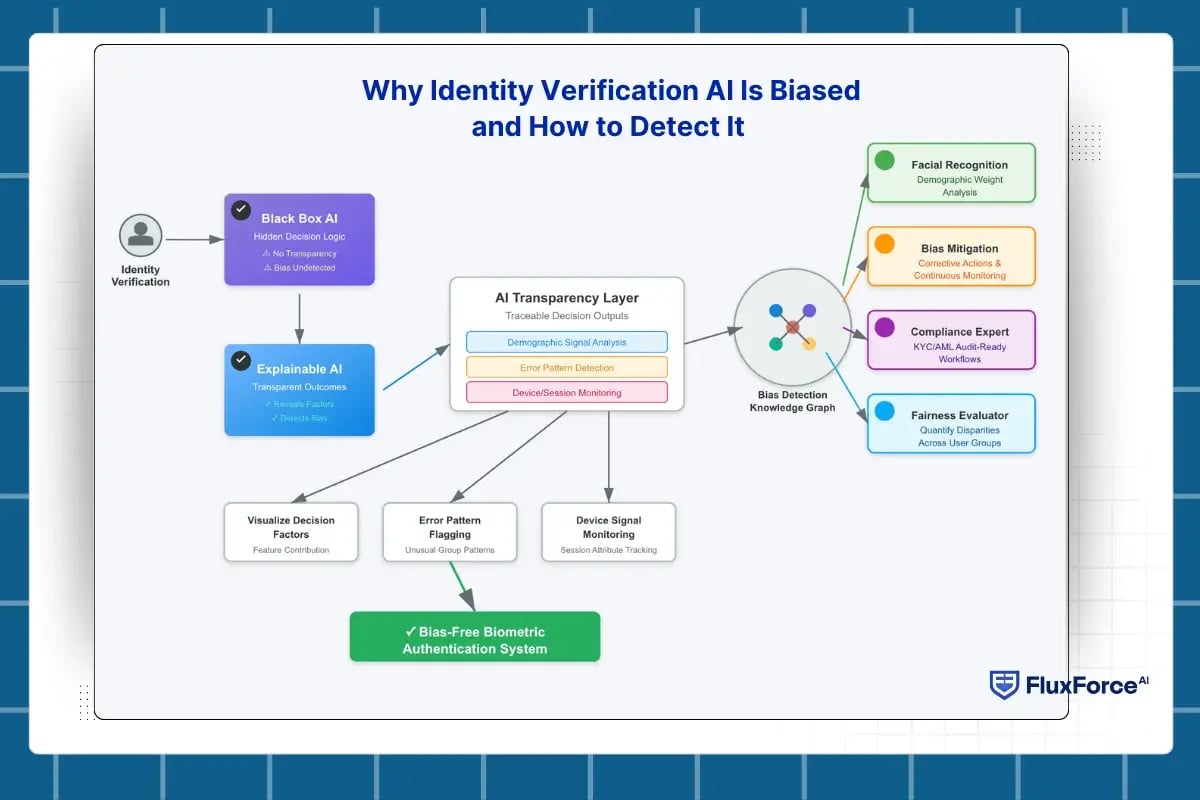
Traditional black-box AI hides decision logic. Explainability in AI models makes outcomes transparent, revealing factors like demographics, behavior, or device signals. This improves AI fairness in KYC and AML and ensures identity verification AI compliance.
AI Transparency in Identity Verification Systems
Transparent AI decision making provides traceable outputs for every verification attempt. Teams can see which features contribute most to denials or approvals, helping detect bias early, correct errors, and maintain audit-ready workflows. Examples include:
In practice, this means seeing which demographic signals carry the most weight in facial recognition decisions, identifying error rate patterns that cluster around specific user groups, and monitoring whether device or session attributes are acting as proxies for demographic factors.Explainable AI for Fair Identity Verification
Explainable models reveal drivers of failed verifications, enabling bias mitigation in biometric systems and supporting bias-free biometric authentication. By visualizing decision factors, teams can quantify disparities, implement corrective actions, and continuously monitor fairness.
How to Implement Explainable AI to Reduce Bias in Identity Verification ?
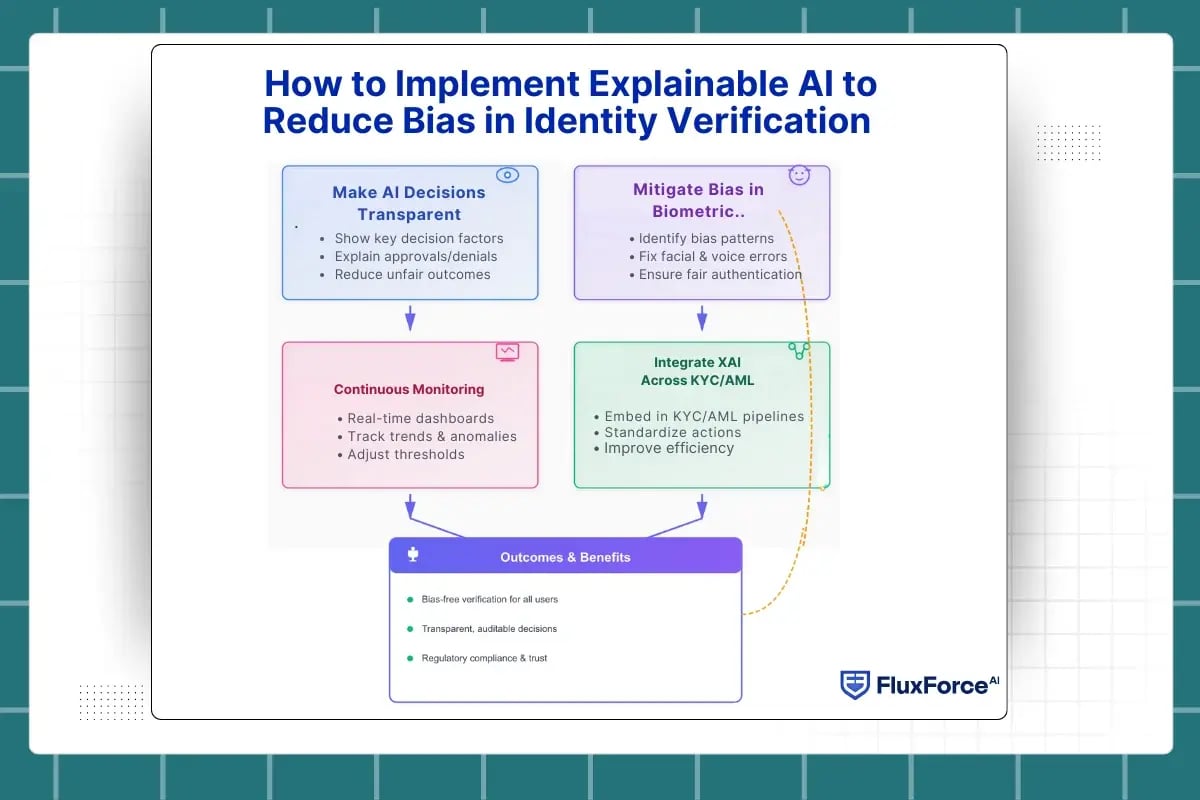
Implementation does not require replacing existing verification infrastructure. XAI layers integrate with current biometric and KYC engines, adding decision attribution without disrupting live workflows. The four steps below reflect how compliance-led organizations are deploying explainability to address bias systematically.
Make AI Decisions Transparent
Implementing explainability in AI models starts with making verification decisions visible. Every approval or denial should show the key factors influencing it—such as demographics, device posture, session behavior, or unusual patterns. Transparent AI decision making ensures that teams understand why a decision occurred, helping reduce unfair denials and reinforcing AI fairness in KYC and AML workflows.
Mitigate Bias in Biometric Systems
XAI enables teams to pinpoint where errors cluster — whether facial recognition underperforms for specific skin tone ranges, whether voice verification produces higher denial rates for non-native speakers, or whether behavioral biometrics flags users from specific device ecosystems at higher rates. Once visible, these patterns can be corrected through threshold adjustments, model retraining, or escalation routing — without waiting for a regulatory finding to trigger action.
Continuous Monitoring and Feedback Loops
Dashboards and real-time explanations allow security teams to monitor AI decisions continuously. With identity verification AI compliance in mind, teams can track trends, flag anomalies, and adjust thresholds to maintain fairness. This approach reduces false positives, strengthens reducing bias in AI models, and provides audit-ready documentation for regulators.
Integrate XAI Across KYC and AML Workflows
Bias does not exist only at the identity verification stage. It can enter at onboarding screening, transaction monitoring, adverse media checks, or risk scoring. Embedding explainability across the full KYC and AML pipeline means fairness is monitored at every decision point — not just the front door. This is the architecture that supports continuous compliance rather than point-in-time audit readiness.
What Changes When Explainability Is Applied to Identity Verification ?
Explainability does more than clarify individual AI decisions. It fundamentally changes how identity verification systems are governed, reviewed, and trusted.
This is where explainability reduces bias at scale.
From Outcome Review to Decision Accountability
In traditional identity verification AI, teams review outcomes after complaints or audit failures. Bias is discovered late, often through customer friction.
With explainable AI in identity verification:
- Every decision is attributable
- Responsibility shifts from “model behavior” to decision ownership
- Bias is treated as a measurable system issue, not an isolated error
This accountability forces earlier intervention and prevents bias from becoming systemic.
Human Oversight Becomes Informed, Not Reactive
Human review exists in most KYC systems, but without explainability, reviewers override decisions blindly. This creates inconsistency and hidden bias.
Explainability in AI models changes this by giving reviewers:
- Context behind each decision
- Clear reasons for failure instead of abstract risk scores
- Confidence to correct bias without weakening security
As a result, human oversight actively contributes to fair AI identity verification instead of masking model flaws.
Bias Mitigation Moves Into Policy, Not Postmortems
Without explainability, bias mitigation in biometric systems happens after damage is done. With explainable AI, bias patterns inform policy adjustments.
Organizations begin to:
- Adjust verification rules based on explainable trends
- Align AI decisions with ethical AI identity verification goals
- Proactively support bias-free biometric authentication.
Bias reduction becomes operational, not reactive.
Compliance Teams Gain Continuous Visibility
Regulators increasingly expect proof, not promises. Explainable machine learning in fintech provides continuous evidence that decisions are fair, traceable, and justified.
This strengthens:
- Identity verification AI compliance
- AI fairness in KYC and AML
- Long-term regulatory confidence
Explainability ensures bias reduction is demonstrable, not assumed.
How Explainable AI Strengthens Regulatory Readiness in Identity Verification ?
Why Compliance Fails Without Explainability in AI Models
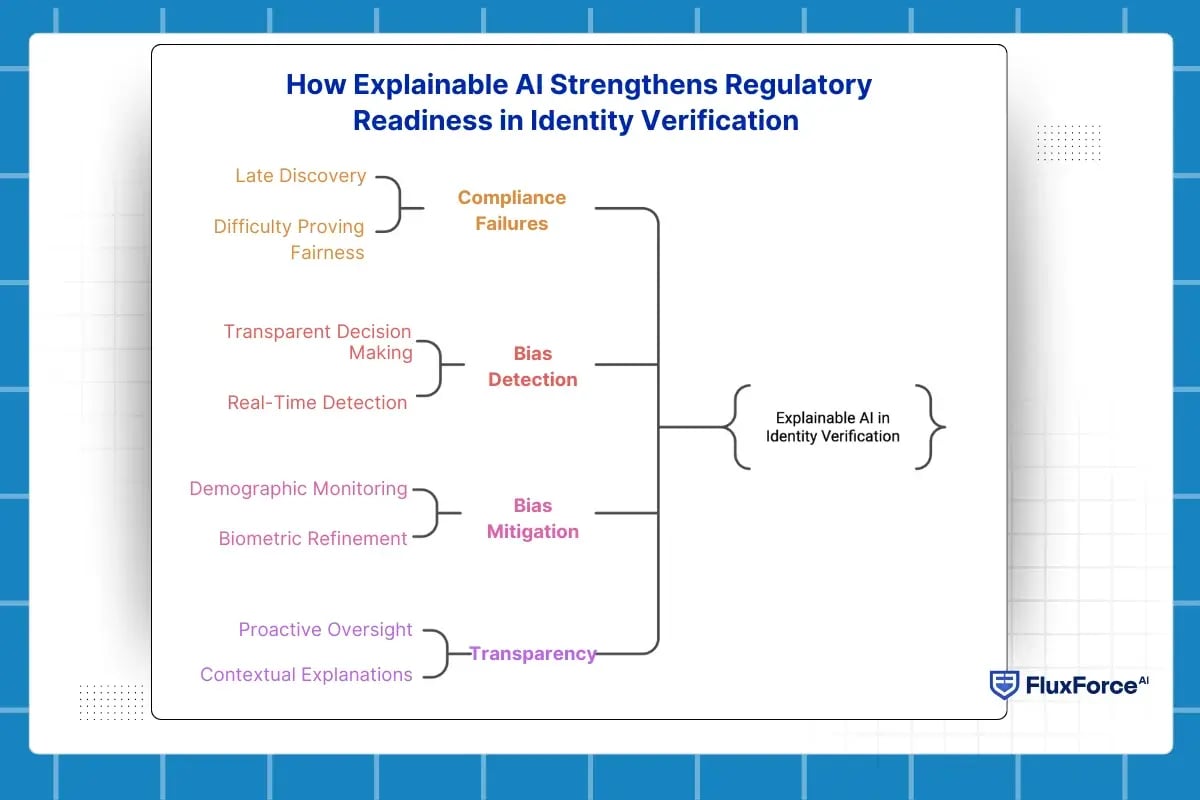
Regulators no longer accept outcome-level reporting as proof of fair AI. Under the EU AI Act, high-risk AI systems used in identity verification must demonstrate that decisions are explainable, auditable, and subject to human oversight. FATF's digital identity guidance and the NIST AI Risk Management Framework set similar expectations for traceability and fairness monitoring. Without explainability embedded in the verification workflow, compliance teams are producing reports about outcomes they cannot actually see inside — which is exactly the gap regulators are now targeting.
How Transparent AI Decision Making Improves Bias Detection ?
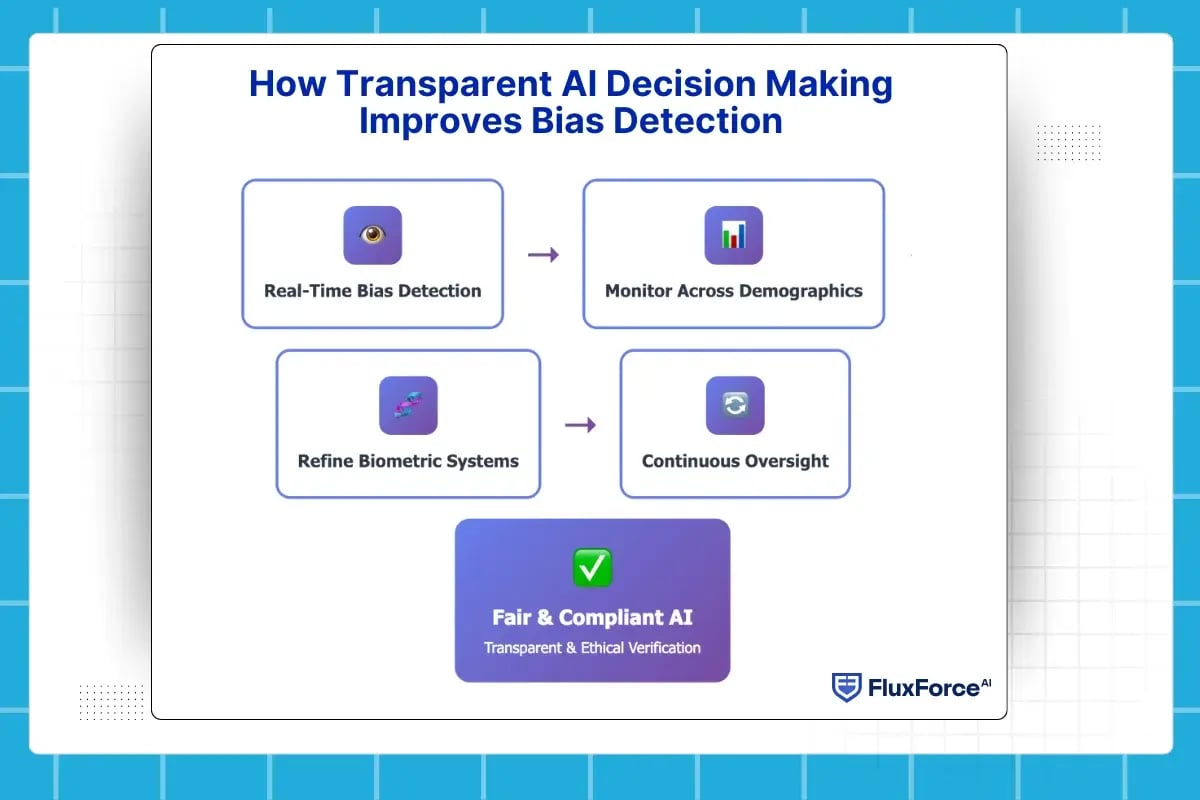
Transparent AI decision making allows teams to see the factors behind every approval or denial. This makes AI bias in identity verification detectable in real time instead of only after incidents occur.
With explainable systems, organizations can address issues as they arise, improving AI fairness in KYC and AML while maintaining identity verification AI compliance. Decisions become understandable and actionable, reducing errors and increasing confidence in automated workflows.
Reducing Bias in AI Models Across Verification Workflows
Explainability transforms how teams approach reducing bias in AI models. Instead of relying on overall accuracy metrics, teams can monitor how decisions vary across demographics, device types, and behavior patterns.
This insight enables precise corrections and continuous monitoring. By targeting specific bias drivers, organizations can enhance fairness and strengthen regulatory alignment without compromising verification security.
Bias Mitigation in Biometric Systems Through Explainable AI
Explainable AI plays a key role in bias mitigation in biometric systems. Patterns of errors in facial recognition, voice verification, or other biometric checks are revealed, allowing teams to refine thresholds and retrain models effectively.
Over time, this approach produces bias-free biometric authentication. Users experience consistent and equitable verification, which supports ethical and fair AI practices.
AI Transparency in Identity Verification Systems for Continuous Oversight
With AI transparency in identity verification systems, oversight becomes proactive rather than reactive. Each verification outcome includes contextual explanations, enabling compliance teams to review, understand, and justify decisions.
Continuous visibility replaces ad hoc audits and ensures that bias is identified, corrected, and documented continuously.
Embedding Explainable AI for Ethical and Compliant Identity Verification
By integrating explainable AI for KYC into verification workflows, organizations make fairness operational. Bias reduction becomes measurable, transparent, and defensible. This strengthens AI fairness in KYC and AML, ensures identity verification AI compliance, and builds long-term trust in ethical AI identity verification systems.
Explainability reduces bias in identity verification, ensuring fairer outcomes
with FluxForce AI
Conclusion
Bias in identity verification AI is not fixed by better intentions — it is fixed by better visibility. When explainability is embedded across KYC and AML workflows, compliance teams can detect unfair patterns as they emerge, correct them before they become regulatory findings, and demonstrate to auditors exactly how and why each verification decision was made. The banks and fintechs building this capability now are not just ahead on fairness — they are ahead on compliance readiness for the regulatory cycle that is already underway.

Share this article