.webp)








Listen To Our Podcast🎧
.png)
Introduction
Synthetic identity fraud is built on patience. A fraudster combines a real Social Security number with fabricated names, addresses, and contact details, then spends months behaving like a legitimate customer — paying on time, borrowing small amounts, building a credit profile that looks clean from every angle. By the time the fraud executes, the identity has earned enough trust to cause significant damage. This is exactly the gap explainable AI fraud detection is built to close, surfacing the missing signals before the damage compounds.
According to TransUnion's H1 2025 analysis, US lender exposure to synthetic identities across credit cards, auto loans, and personal loans reached $3.3 billion at end of 2024 — an all-time high since TransUnion began measuring in 2009. Synthetic account fraud attempts grew 153% from late 2023 to early 2024, and LexisNexis Risk Solutions reported that synthetic identity fraud now accounts for 11% of all global fraud, an eightfold increase from 2024. The fraud is scaling. Detection is not keeping pace.
For fraud prevention teams building scalable defenses, our guide on Synthetic Identity Crime: AI-Powered Fraud Detection Strategy for Fraud Prevention Leads explains how AI-driven detection frameworks identify synthetic identities before losses occur.
Most banks already rely on AI fraud detection and machine learning fraud detection tools. These systems are good at spotting familiar fraud patterns. But synthetic identities move slowly. They open small accounts, act like normal users, and build trust over time. By the time money is lost, the fraud has already spread.
This reveals a major gap in financial fraud detection. Many fraud detection AI tools give a risk score but not a clear reason. Investigators see an approval or a block, but not the logic behind it. Without that clarity, teams cannot act early or explain decisions later.
Why Explainability Matters From Day One ?
Digital onboarding is where synthetic identity fraud enters the financial system. According to Themis's 2025 Fraud Trends analysis, 95% of synthetic identities pass the onboarding process at financial institutions undetected. AI identity verification checks documents and faces — both of which can be real in a synthetic identity scheme. What is missing is the behavioral trail, the digital depth, and the network of connections that a genuine identity accumulates over years. Explainability surfaces what is absent, not just what is present.
Stopping synthetic fraud at scale requires AI that teams can interrogate — systems that show why a profile looks low risk, which signals are missing, and where the behavioral depth falls short of what a genuine identity would produce. That is what explainable AI delivers: not just a smarter score, but the reasoning that allows investigators to act before losses materialize.

Synthetic Identity Fraud Detection Techniques Banks Miss Without Explainable AI
After onboarding, most bank fraud detection systems shift their focus to transaction monitoring — looking for spending anomalies, velocity spikes, and behavioral outliers. Synthetic identity profiles produce none of these signals in the build phase.
According to Experian's Fraud Index data, false identity cases grew 60% in 2024 compared to 2023, with synthetic cases now representing nearly a third of all identity fraud. The growth is happening inside systems that appear to be working.
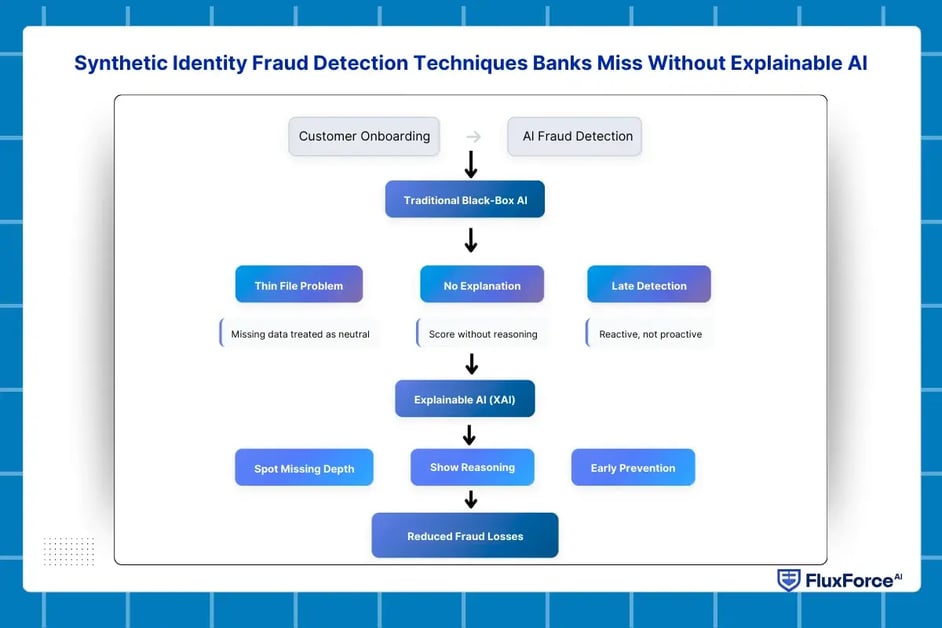
Synthetic identities are designed to look boring. They pay on time. They borrow small amounts. They do not rush. Traditional financial fraud detection tools are trained to spot speed, spikes, and clear misuse. Synthetic fraud avoids all three.
Thin Identities Look Safe to Traditional AI
A key problem in synthetic identity fraud detection is the “thin file.”
No history does not mean low risk. It often means missing context.
Most machine learning fraud detection models treat missing data as neutral. No social signals? Fine. No long device history? Acceptable. No credit past? Normal for a new customer. This is how digital identity fraud passes unnoticed.
Even advanced AI identity verification focuses on documents and face checks. Documents can be real. Faces can be real. What is missing is a real life trail.
Why Black-Box AI Makes This Worse ?
When fraud detection AI approves a synthetic profile, investigators rarely know why. The system gives a score, not a reason. That makes early action impossible.
Teams cannot answer basic questions:
- Why did this identity look trustworthy?
- Which signals mattered most?
- What warning signs were ignored?
Without answers, identity fraud prevention becomes reactive. Losses appear months later, and reviews come too late. This also weakens AI risk management, because decisions cannot be explained to auditors or regulators.
Where Explainable AI Fits In ?
Explainable AI (XAI) surfaces the specific risk signals that black-box fraud models process but do not communicate. In synthetic identity detection, the most valuable outputs are the absences: an email address created two weeks before application, an SSN with no prior credit history despite the stated age of the applicant, a device with no established usage pattern, and a network of connections that links to other thin-file accounts. These signals exist in the model's input data. XAI makes them visible to the investigator at the point of decision — not months later when the credit line has been maxed and abandoned.
With explainable AI fraud detection, banks stop guessing and start understanding. That is the turning point between late detection and early prevention.
Explainable AI for Fraud Detection in Banking and Financial Institutions
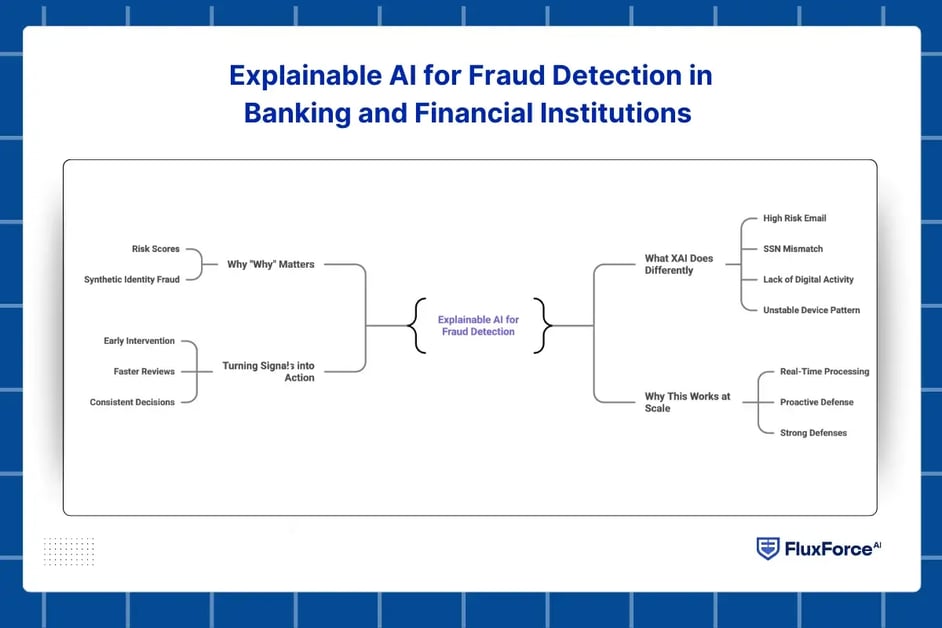
Why Knowing “Why” Matters More Than the Score
By now, most banks and financial institutions use AI fraud detection to decide who gets approved and who gets blocked. Risk scores are everywhere. But a score alone does not stop synthetic identity fraud.
The real problem is simple.
A number cannot tell you why an identity looks safe.
When a fraud detection AI system approves a synthetic profile, investigators often cannot explain the decision. Compliance teams cannot defend it. And risk teams cannot improve it. This is where traditional financial fraud detection hits a wall.
What Explainable AI Actually Does Differently
Explainable AI (XAI) changes how decisions are understood. Instead of hiding logic inside the model, XAI shows which signals influenced the outcome.
For example, with explainable AI in fraud detection, teams can clearly see:
- A very new email being treated as high risk
- An SSN that does not match age-related behavior
- A lack of long-term digital activity
- Devices or locations that do not form a stable pattern
This clarity matters. It allows identity fraud prevention teams to challenge risky profiles early, even when behavior looks normal on the surface.
Turning Early Signals Into Early Action
Synthetic identities rarely fail because of one big signal. They fail because of missing depth. Black-box models often ignore what is missing. XAI highlights it.
Synthetic identities rarely fail a single risk check. They fail the cumulative picture — thin digital footprint, SSN age mismatch, new device, no stable location pattern, isolated account network. Black-box models process all of these inputs but return only a composite score. XAI makes each contributing factor visible, allowing investigators to challenge profiles during the build phase — before the fraudster requests a high credit line, before the bust-out happens, and before the loss is written off as a routine charge-off.
According to Mastercard, projected synthetic identity fraud losses could reach $23 billion by 2030. The institutions that close that gap are those that shift detection from reactive score review to proactive signal interrogation.
Why This Works at Scale
Explainability is not about slowing systems down. Modern XAI works in real time, alongside machine learning fraud detection, across millions of profiles. When teams can see and trust decisions, fraud detection in banking becomes proactive. And proactive defense is the only way to stop synthetic identity fraud before it scales.
Clear decisions build strong defenses.
Advanced AI Techniques for Detecting Synthetic Identities
Catching synthetic identities requires AI that evaluates what is present and what is conspicuously absent. Traditional fraud detection looks for behavioral outliers — things that stand out. Synthetic fraud is engineered to avoid standing out. The detection techniques that work are those that measure profile depth, map identity connections across data sources, and surface the specific signals that distinguish a constructed identity from a genuine one.
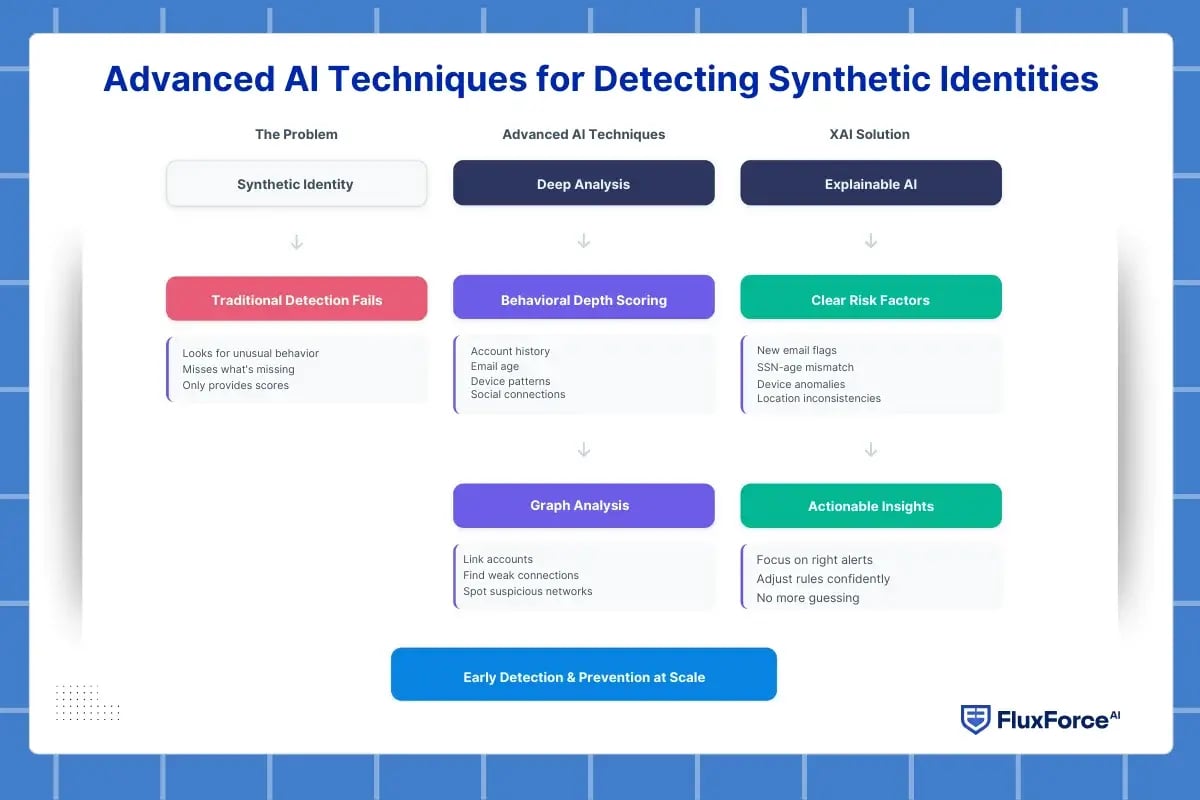
Checking Depth and Connections
Modern AI models for synthetic identity fraud dig into hidden patterns. Behavioral depth scoring measures account history, email age, device use, and social connections. Profiles that lack these signals are flagged as risky, even if outward activity seems normal.
Graph analysis links accounts, emails, devices, and addresses to find weak connections or small clusters of related profiles. This helps identity fraud prevention teams see suspicious networks that traditional tools miss.
Seeing Risk Clearly with Explainable AI
Detection only works when it’s understandable. Explainable AI (XAI) shows which factors drive the risk score, like a new email, an SSN that doesn’t match age expectations, or devices that appear in multiple locations in a short time. By making risk clear, XAI helps teams focus on the right alerts and adjust rules without guessing.
Scaling Across Millions of Profiles
By combining advanced models with XAI, scalable fraud detection using explainable AI is possible. Each profile is checked for history, connections, and inconsistencies, with clear explanations for why it’s flagged. This approach allows teams to detect synthetic identities early and prevent fraud before it grows.
How Explainable AI Strengthens Fraud Detection Decision-Making ?
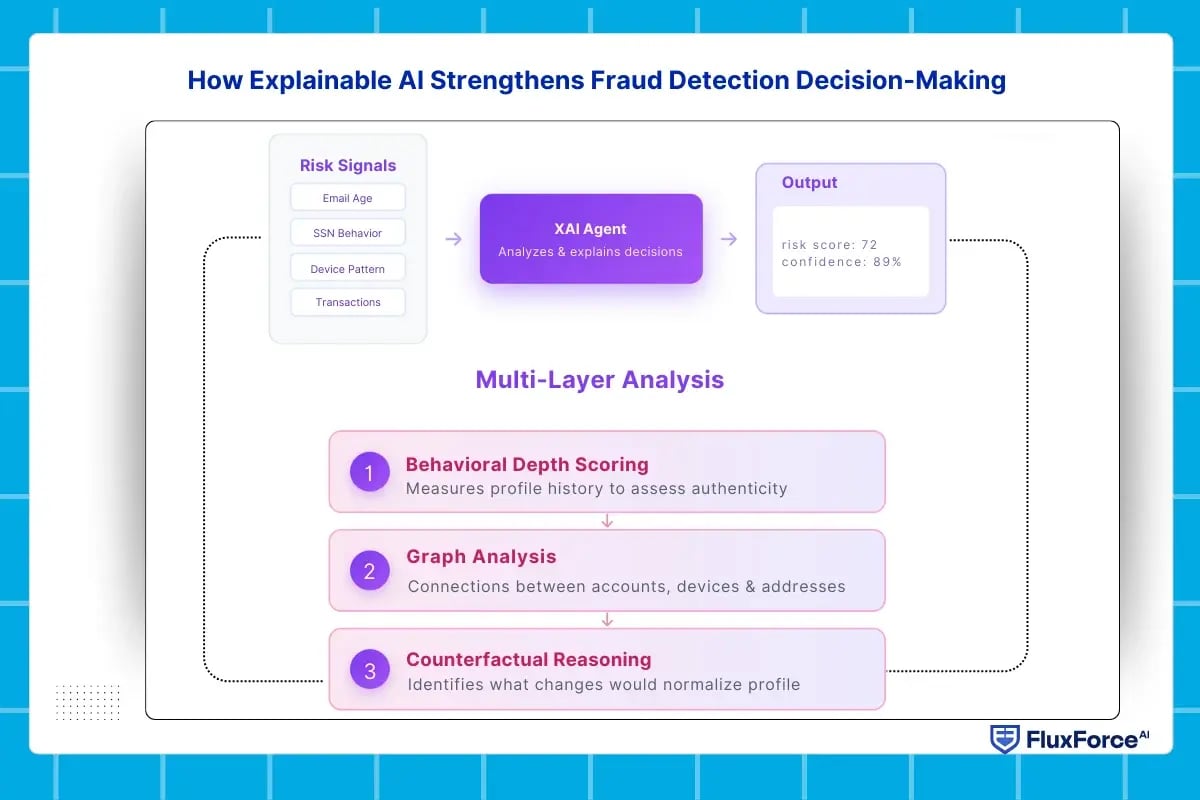
Moving Beyond Risk Scores
Many fraud detection AI tools provide only a score—high, medium, or low risk. But a number alone does not explain why a profile might be synthetic. Explainable AI (XAI) goes further by showing which features influence the decision. This gives investigators and compliance teams clear insight into the reasoning behind each flagged account, making identity fraud prevention more precise.
Breaking Down Signals
XAI highlights the factors that matter most:
- Email and account age: New addresses or domains indicate potential synthetic activity.
- SSN behavior mismatch: An SSN’s historical data compared to activity patterns reveals inconsistencies.
- Device and login patterns: Unusual or inconsistent devices can signal risky profiles.
- Transaction patterns: Small, consistent payments can hide synthetic profiles unless analyzed for depth.
By making each factor transparent, teams can prioritize high-risk profiles and avoid wasting time on false positives.
Integrating Multiple Layers of Analysis
Advanced AI models for synthetic identity fraud combine:
- Behavioral depth scoring to measure profile history.
- Graph analysis to see how accounts, devices, and addresses are connected.
- Counterfactual reasoning to identify what changes would make a profile appear normal.
XAI explains all these layers in a readable format, so investigators understand the why behind each alert without needing to interpret raw model outputs.
Applying Insights at Scale
With scalable fraud detection using explainable AI, organizations can process millions of profiles in real time. Every alert comes with a clear explanation of the risk factors involved, allowing teams to take early preventive action instead of reacting after losses occur. This makes financial fraud detection proactive, transparent, and reliable, giving institutions confidence in their AI risk management strategies.
Beyond Identity: Document, Invoice, and Payment Fraud
Synthetic identities are one way in. Fabricated documents are another, and the two turn up in the same case file more often than teams expect. A synthetic profile needs supporting paperwork to clear onboarding. A forged invoice needs a plausible payee behind it. Treating these as separate problems is what breaks the connection.
The money involved is substantial. Nasdaq's 2024 Global Financial Crime Report put worldwide losses from fraud scams and bank fraud at $485.6 billion for 2023. On payments specifically, the AFP Payments Fraud and Control Survey found 79% of organizations experienced attempted or actual payment fraud in 2024, and a Medius survey of US and UK finance teams recorded at least 13 invoice fraud attempts per month, with an average loss of $133,000 per incident.
Why the Same Model Logic Applies
Document fraud detection runs on the principle that drives synthetic identity detection: compare what is presented against what is expected. An invoice gets checked against historical vendor baselines, pricing ranges, and payment timelines. A unit price that creeps up 3% across four consecutive invoices clears every fixed threshold individually, and only looks wrong when the four are read as a sequence. A synthetic identity gets checked against credit file depth, address history, and network connections. Both flag deviation rather than a fixed rule breach, and both produce a score that tells an investigator nothing without the reasoning behind it.
What Regulators Expect From the Model
Model validation for these systems carries specific documentation obligations. The conceptual soundness requirement in SR 11-7 means the feature attribution behind each decision has to be recorded at initial validation and monitored afterward, so logic drift between formal review cycles becomes visible rather than silent. The EU AI Act adds Article 12 logging obligations for high-risk systems, and the OCC's model risk management guidance applies to any model driving high-impact financial decisions. A single explanation record generated at decision time can satisfy all three.
Synthetic identity is one fraud surface. See the wider treatment of explainable AI in finance for how the same principles apply across lending, fraud, AML, and market risk.
What to Look for in an Explainable AI Fraud Detection System
Not every vendor selling "explainable AI" gives investigators something they can act on. When evaluating an explainable AI fraud detection system, ask for the specific signal breakdown behind a score, not a generic confidence percentage. A real system names the factors: thin credit file, new email domain, missing device history, isolated account network, and ranks them by contribution.
We also check three practical points. Can the explanation be generated at decision time, not batched overnight? Can compliance pull a record of which signals drove a specific denial six months later? Does the explanation format match what an examiner under SR 11-7 or the EU AI Act actually needs, rather than a data science dashboard nobody outside the model team can read?
A fraud detection system that cannot answer these questions in real time is still a black box with a friendlier interface. The value of explainable AI fraud detection comes from the reasoning being usable by the people making the call, not just visible to the people who built the model.
Conclusion
Synthetic identity fraud is now 11% of all global fraud, according to LexisNexis Risk Solutions — and growing. The profiles that cause the most damage are the ones that look the most legitimate: thin files with clean behavior, real SSNs, and fabricated histories that pass every surface-level check. Explainable AI is what makes the difference between a fraud detection system that catches these profiles during the build phase and one that classifies the eventual loss as bad debt.
With XAI, identity fraud prevention becomes proactive, investigations are faster, and risk management is practical and auditable. Scalable solutions powered by XAI allow institutions to process millions of profiles daily while maintaining clarity and compliance. In an environment where fraud tactics evolve rapidly, scalable fraud detection using explainable AI is no longer a technical upgrade, it is essential for staying ahead, mitigating risk, and building trust in digital operations.



Share this article