.webp)








Listen to our podcast 🎧

Introduction
Banks and fintechs are facing an accelerating surge in synthetic identity fraud. Fraudsters now use AI to create identities that look real, bypassing traditional verification checks and opening multiple accounts at scale.
The cost of synthetic identity crime is rising fast. According to TransUnion’s 2024–2025 analysis, U.S. lenders faced more than $3.3 billion in exposure to synthetic identity fraud, reaching a record high. AI is changing the game. Using AI fraud detection and financial fraud analytics, banks can identify unusual patterns early. Real-time fraud prevention helps stop fraudulent accounts before they cause losses. The main goals for institutions today are to reduce onboarding fraud, prevent account-opening fraud, and stop credit application fraud.
How can banks detect synthetic accounts before they become active?
Experts suggest that combining AI with human oversight improves detection accuracy. Industry studies have found that AI-powered fraud prevention can reduce false positives by up to 70%, with many banks experiencing reductions in the 40%-60% range, improving detection accuracy and customer experience.
This blog explores synthetic identity crime detection strategies. It will also cover practical ways to enhance identity verification accuracy and minimize false positives in fraud detection.
FluxForce AI’s advanced fraud detection strategy
Detect threats fast—secure your data now!

How AI generated identities operate across banking channels ?
A synthetic identity is more than a fake name. It’s a carefully constructed persona. Fraudsters combine real and fabricated information to create accounts that appear legitimate.
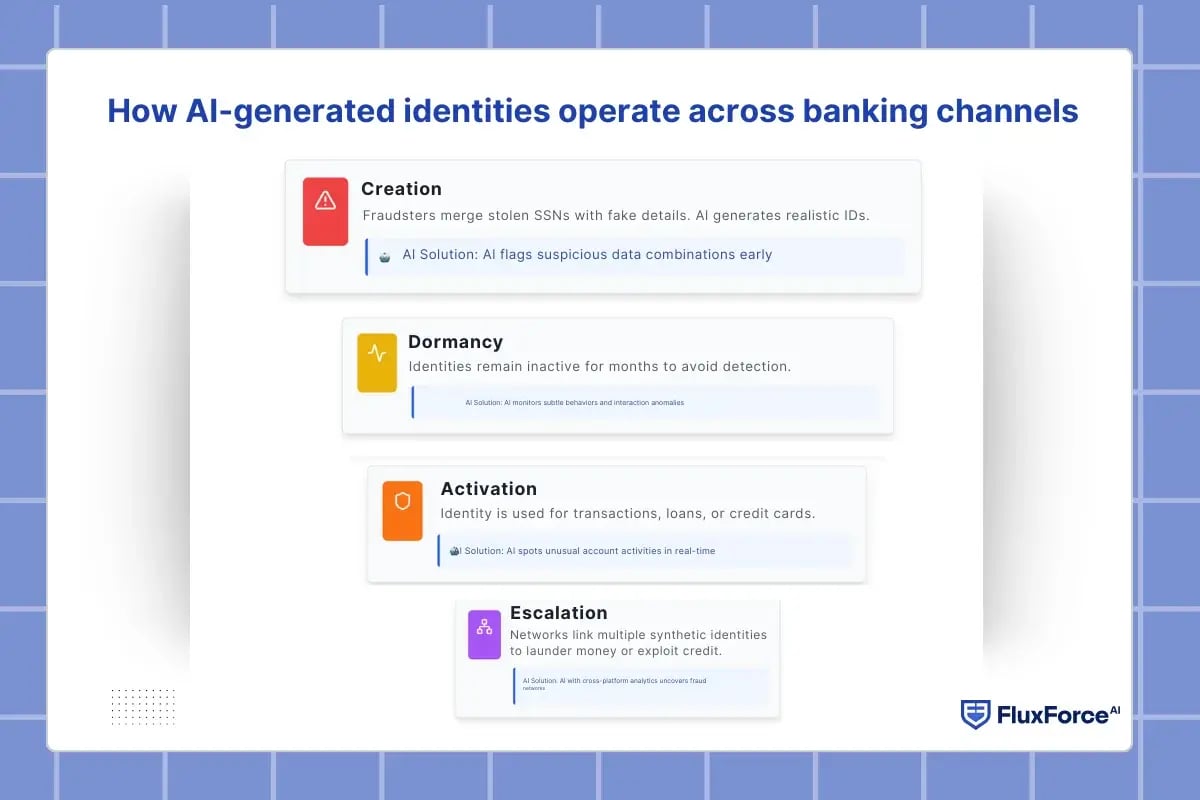
Synthetic identity detection AI can spot unusual combinations of personal data. For example, using device fingerprints, email behavior, and geolocation patterns, banks can identify accounts that look authentic but are synthetic.
The lifecycle of a synthetic identity
Creation:
Fraudsters merge stolen Social Security numbers with fake personal details. AI tools can even generate realistic IDs and documents. Using synthetic identity detection AI, banks can flag suspicious combinations early.
Dormancy:
Many synthetic identities remain inactive for months to avoid detection. During this period, traditional monitoring often fails. Synthetic identity detection AI monitors subtle behaviors and interaction anomalies, even for dormant accounts.
Activation:
Once the identity is “ready,” it can be used for transactions, loans, or credit cards. Synthetic identity detection AI helps spot unusual account activities in real-time, preventing major losses.
Escalation:
Advanced fraud networks link multiple synthetic identities. These networks can launder money or exploit credit at scale. Combining synthetic identity detection AI with cross-platform analytics allows banks to uncover these networks.
Experts note that the most successful fraud prevention programs use synthetic identity detection AI layered with human review. According to a 2025 Javelin Research report, institutions using AI for synthetic identity detection reduce fraud losses by over 30%. By understanding the life of a synthetic identity, banks can use synthetic identity detection AI to enhance identity verification accuracy, minimize false positives, and prevent account-opening fraud.
FluxForce AI’s advanced fraud detection strategy.
Detect threats fast—secure your data now!
Why traditional controls fail ?
Synthetic identity fraud is distinct because there is often no real victim to report the crime, allowing fraud to persist undetected. Industry research indicates that synthetic identities now account for a material and growing share of credit card charge‑offs and unpaid losses, particularly at large banks.
The strategy must shift from document trust to behavior trust. Synthetic identity detection AI tracks how identities behave over time. If a new customer shows perfect credit habits from day one, should that not trigger deeper checks?
Synthetic identity detection AI uncovers shared devices, emails, and digital trails criminals try to hide.
Another issue is trust. Most synthetic identities remain trusted for long periods before showing a sharp behavioral shift shortly before a bust‑out. Industry research shows that the majority of synthetic fraud losses occur after these late‑stage changes — often too late for traditional controls to react.
Fraud Prevention Leads need a strategy that blends network intelligence, behavioral identity risk scoring, and real-time AI decisioning. Only then can synthetic identity detection AI prevent onboarding fraud, stop account-opening attacks, and reduce false approvals before losses hit.
A practical strategy for Fraud Prevention Leads to stop synthetic identity crime
Fraud teams today face a major shift. Synthetic identity crime has become the fastest-growing financial scam and banks need synthetic identity detection AI as a frontline defense. This strategy helps Fraud Prevention Leads reduce onboarding fraud, prevent account-opening fraud, and stop credit application fraud while improving customer trust.
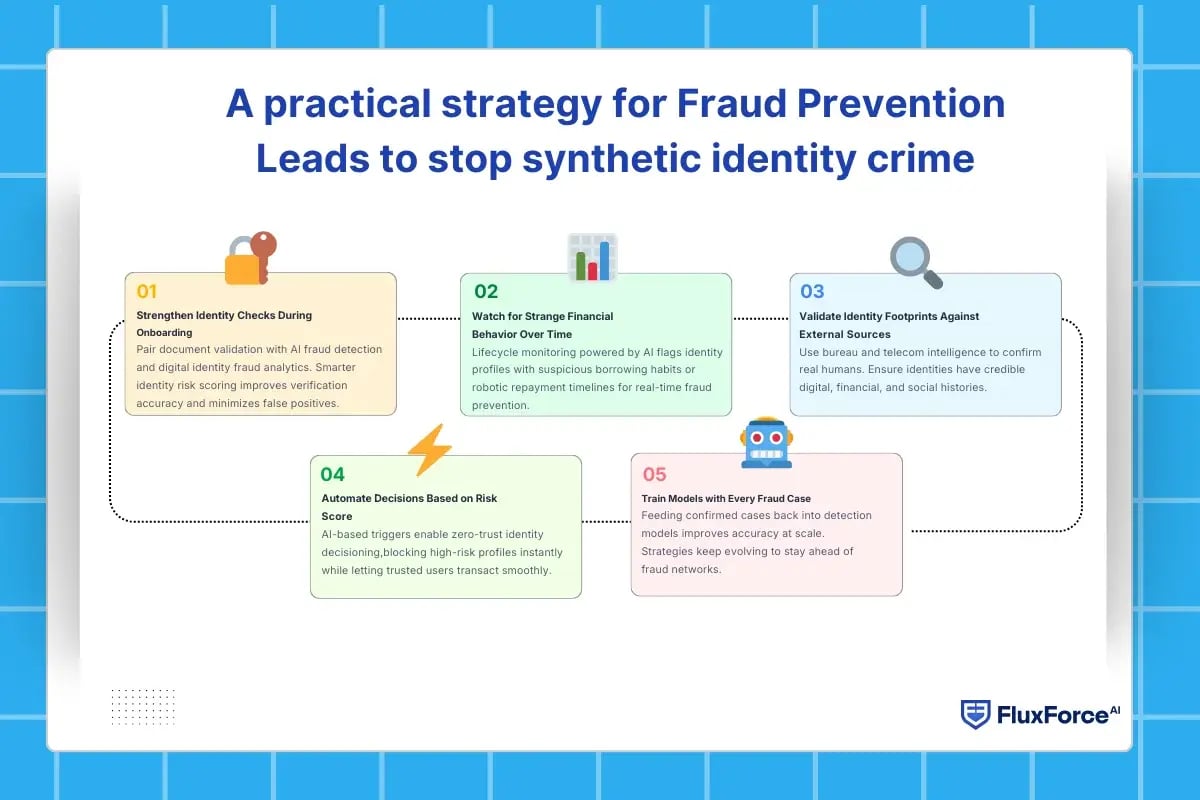
Strengthen identity checks during onboarding
Start by pairing document validation with AI fraud detection and digital identity fraud analytics. Criminals often pass basic KYC when identities are stitched from real and fake data. Smarter identity risk scoring during onboarding improves identity verification accuracy and minimizes false positives in fraud detection.
Watch for strange financial behavior over time
Synthetic identities build a perfect credit score before draining funds. Lifecycle monitoring powered by synthetic identity detection AI and financial fraud analytics flags identity profiles with suspicious borrowing habits or robotic repayment timelines. This supports real-time fraud prevention, so risk is stopped before the money leaves.
Validate identity footprints against external sources
Use bureau and telecom intelligence to confirm real humans. Integrating AI-powered fraud prevention into existing banking compliance automation ensures identities have credible digital, financial, and social histories. This helps uncover synthetic identity fraud hidden inside legitimate-looking accounts.
Automate decisions based on risk score
When the risk rises, automated controls can pause payments and credit changes. AI-based triggers enable zero-trust identity decisioning, blocking high-risk profiles instantly while letting trusted users transact smoothly. Fraud teams gain speed without manual overload.
Train models with every fraud case
Fraud networks update tactics weekly. Feeding every confirmed case back into synthetic id fraud detection models improves accuracy at scale. This enables fraud prevention lead strategies that keep evolving to stay ahead in fraud prevention in banking and fraud prevention in fintech environments.
KPIs that prove synthetic identity crime prevention is working
Fraud Prevention Leads must demonstrate measurable impact from synthetic identity detection AI. Success is not about alert volumes. It is about hard business outcomes, reduced losses, and stronger customer trust.
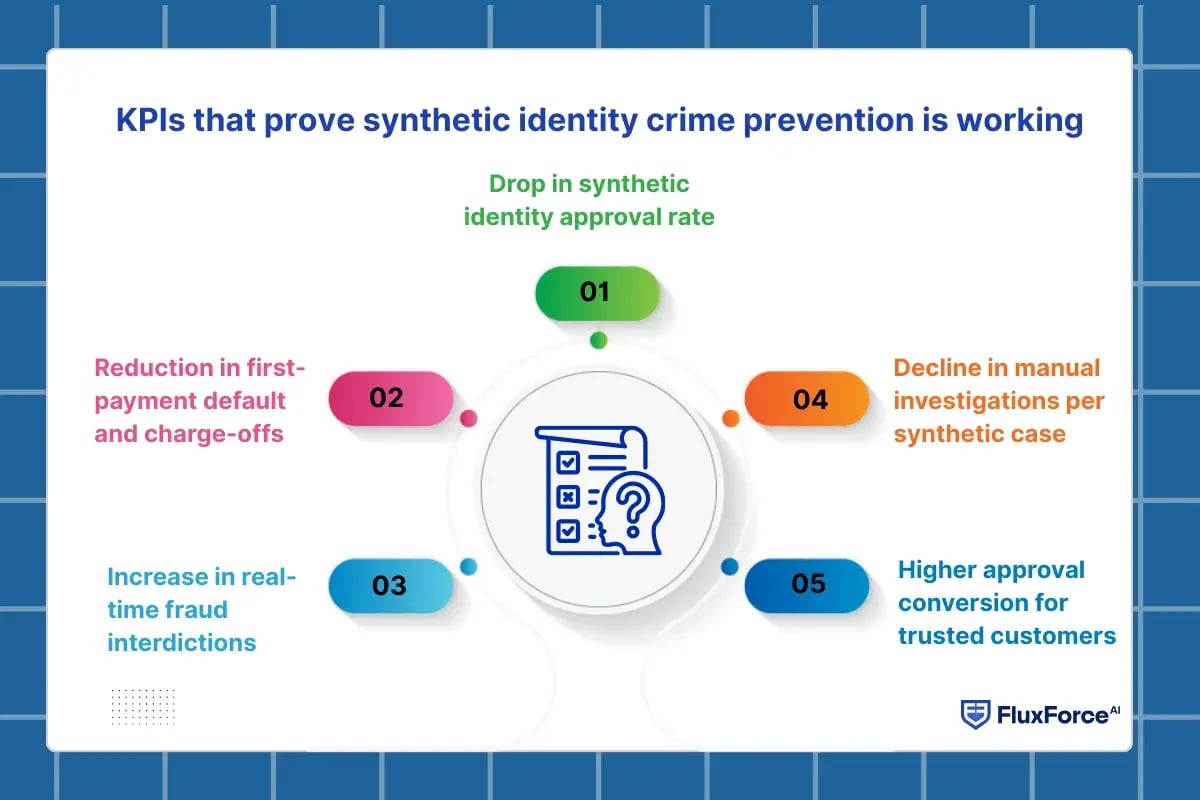
Drop in synthetic identity approval rate
A lower number of fraudulent identities making it past onboarding shows better identity verification accuracy and reduced onboarding fraud. This directly protects future exposure.
Reduction in first-payment default and charge-offs
Synthetic identities often default immediately. A downward trend signals that AI fraud detection is blocking high-risk profiles before credit is issued.
Increase in real-time fraud interdictions
Stopping fraud before funds exit is the top priority. More real-time fraud prevention events confirm the strategy is preventing credit application fraud and account takeover monetization.
Decline in manual investigations per synthetic case
Smarter identity risk scoring means fraud teams spend less time chasing false alerts. This raises productivity and cuts operational cost per identity review.
Higher approval conversion for trusted customers
When AI precision improves, legitimate users face fewer roadblocks. Enhanced onboarding flow proves false positives are minimized without adding friction.
Conclusion
Customers and regulators expect strong identity protection by default. Banks that still rely on outdated KYC stand out in all the wrong ways. Fraud Prevention Leads who deploy AI-powered fraud prevention build a competitive edge through safer onboarding and better decision confidence. This market shift is already underway. The real test is who becomes the leader in synthetic identity crime detection and who becomes the cautionary case study.
For a deeper look at this approach, read Detecting Synthetic Identity Fraud in Real-Time.


Share this article