.webp)








Listen To Our Podcast🎧
Introduction
While most banking CISOs understand the importance of securing APIs, controlling the number of requests per user or per endpoint is often overlooked. Excessive API requests over the past three years have contributed to a total of $45 million in operational losses across core banking systems.
Applying rate limiting quickly enforces request thresholds, prevents system overload, and generates data for detecting anomalous activity. For organizations, it is one of the key steps for supporting operational oversight, regulatory compliance, and API protection.
Within an enterprise API security architecture, request controls integrate with monitoring tools, access policies, and threat response workflows to maintain resilience and measurable protection for critical APIs.
This detailed discussion covers deployment considerations, monitoring and alerting methods, and API security best practices, targeting CISOs for ensuring resilient, auditable, and well-governed API environments.

How API Rate Limiting Works in API Security Architecture ?
API rate limiting is a key component of API security architecture that controls the number of requests a client can make within a specified time frame. Below is a detailed breakdown of how API rate limiting functions within a secure API framework:
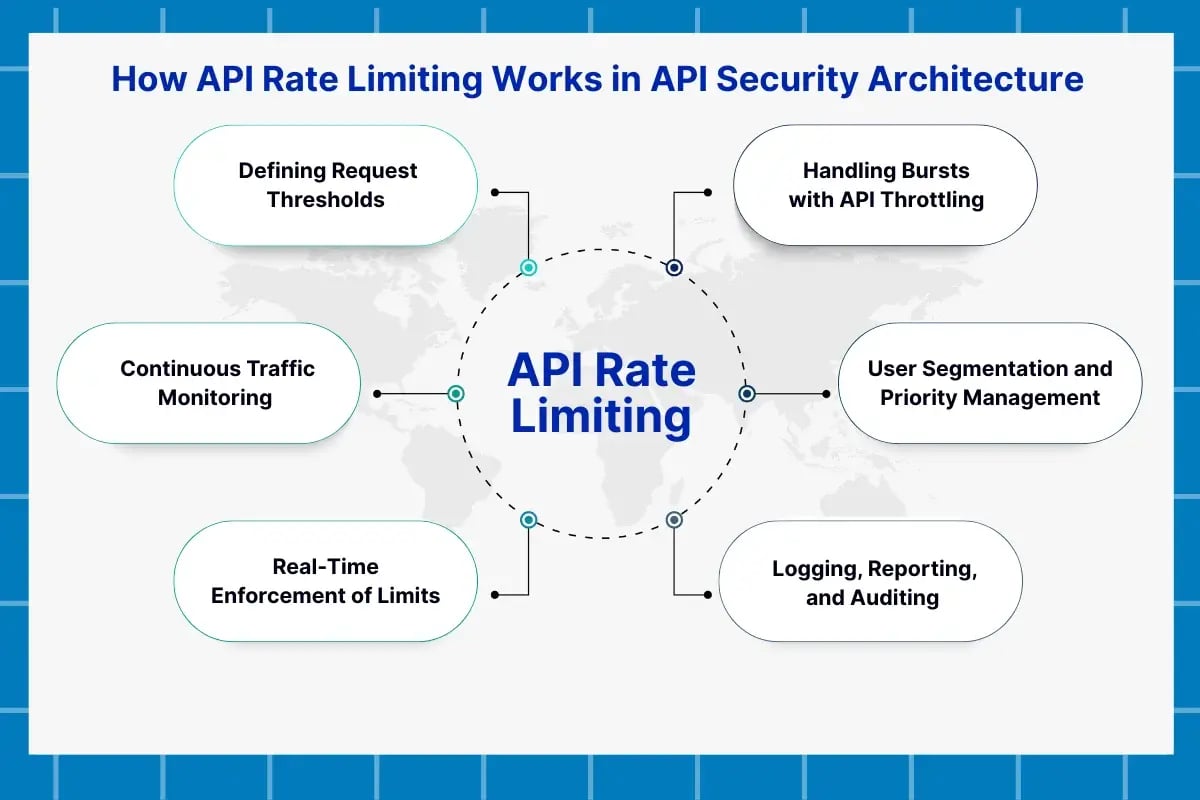
1. Defining Request Thresholds- APIs set limits on how many requests a client, user, or IP can make during a specific period. These thresholds are designed to prevent overload while maintaining normal operations for legitimate users.
2. Continuous Traffic Monitoring- The system monitors request patterns in real time to detect unusual spikes or potential attacks. Early detection allows security teams to respond before service disruption occurs.
3. Real-Time Enforcement of Limits- When a client exceeds the defined request limit, the API immediately enforces restrictions, typically returning HTTP 429 errors. This stops potential abuse and safeguards system performance.
4. Handling Bursts with API Throttling- API throttling complements rate limiting by controlling sudden spikes in traffic. It smooths bursts over time, preventing temporary overload without affecting long-term access.
5. User Segmentation and Priority Management- Different limits can be applied based on user roles, subscription levels, or client type. This ensures high-priority or critical systems maintain uninterrupted access.
6. Logging, Reporting, and Auditing- All rate-limiting events are logged for monitoring and compliance. CISOs can review these logs to analyse trends, refine policies, and maintain audit readiness.
Difference between rate limiting and throttling
While both mechanisms control API request flow, rate limiting and throttling implement distinct technical approaches with different security implications for banking infrastructure.
.webp?width=1200&height=800&name=api%20rate%20limiting%20(2).webp)
HSBC applies rate limiting to customer authentication APIs while using throttling for historical transaction report generation, balancing security requirements against user experience expectations.
API Rate Limiting as Part of a Comprehensive API Security Strategy
While API rate limiting serves as a core security fundamental for request volume control, it is only one component of a broader API protection framework that banking CISOs must orchestrate.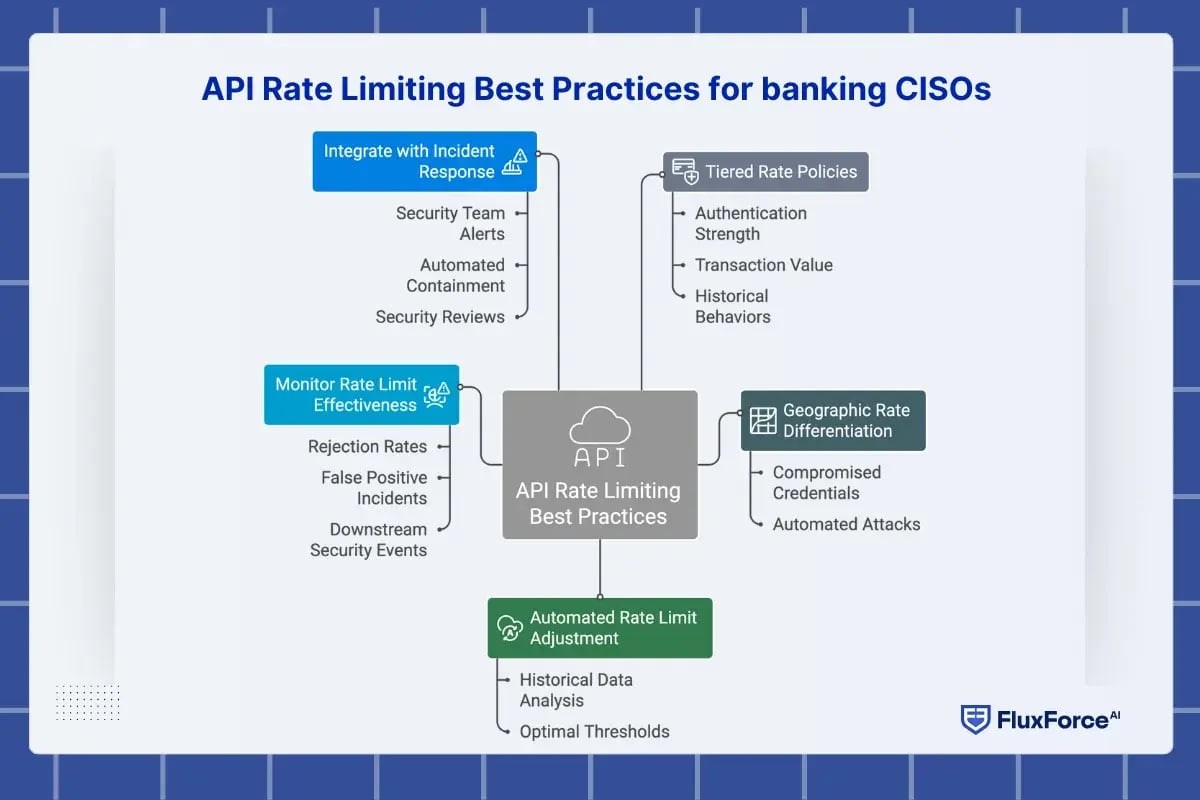
1. Authentication and Authorization Integration
Rate limiting works best when integrated with strong authentication and authorization. Modern API gateways can associate rate limits with authenticated clients by using OAuth 2.0 and JWT tokens to identify clients and apply policies accordingly. OAuth 2.0 tokens and JWT claims help enforce different access privileges and controls at the API gateway
2. API Threat Protection
Request controls complement behavioural analysis systems that detect credential stuffing, parameter tampering, and injection attempts. When rate limiting flags a client for excessive requests, threat protection systems examine request payloads for malicious patterns.
3. API Security Framework Alignment
Rate limiting requirements appear across multiple compliance frameworks. PCI DSS 4.0 mandates request monitoring for payment card APIs, while GDPR Article 32 requires technical measures to prevent unauthorized personal data access.
4. API Risk Management
Risk-based rate limiting adjusts thresholds according to real-time threat intelligence. When fraud detection systems identify elevated risk from specific IP ranges or geographic regions, API gateways automatically reduce rate limits for those sources.
Operational and Risk Benefits of Integrating API rate limiting for security
Request controls deliver measurable improvements in infrastructure stability, security response capability, and regulatory compliance when properly integrated into banking API environments.
1. Infrastructure Cost Reduction: Rate limits prevent resource exhaustion that would otherwise require emergency capacity scaling.
(TD Bank reduced cloud infrastructure spending by 23% annually after implementing granular rate controls that eliminated 4.7 billion unnecessary API calls generated by misconfigured partner applications).
2. DDoS Attack Mitigation: Distributed denial-of-service attacks targeting banking APIs face immediate containment when rate limits restrict per-client request volumes.
3. Fraud Detection Enhancement: Abnormal request patterns signal account takeover attempts, card testing operations, and data harvesting efforts.
4. Regulatory Compliance: Financial regulators increasingly expect documented API request controls. The Federal Reserve's SR 23-7 guidance explicitly references rate limiting as a risk mitigation control. BNY Mellon maintains rate limit audit logs covering 14 months of historical data to demonstrate compliance during regulatory examinations.
5. Third-Party Risk Management: Banking APIs serving fintech partners and data aggregators require strict rate enforcement to prevent single partners from monopolizing resources.
API Rate Limiting Best Practices for banking CISOs
Implementing effective rate controls requires a robust API security strategy supported by the proven practices listed below.
1. Design Tiered Rate Policies Based on Client Risk Profiles
Differentiate rate limits according to client authentication strength, transaction value, and historical behaviours. Internal microservices receive higher limits than external partners. Customer-facing mobile applications warrant different thresholds than batch processing integrations.
2. Implement Geographic Rate Differentiation
Request volumes from unexpected geographic regions often indicate compromised credentials or automated attacks. One of the key ways how CISOs can protect APIs involves applying stricter rate limits to regions with minimal legitimate traffic.
3. Deploy Automated Rate Limit Adjustment
Static rate limits fail to adapt to evolving threat patterns. Machine learning models analyse historical request data to recommend optimal thresholds that balance security and availability.
4. Monitor Rate Limit Effectiveness Through Security Metrics
Track rejection rates, false positive incidents, and downstream security event correlations. Rate limits that reject fewer than 0.1% of requests may prove too permissive, while limits exceeding 5% rejection rates likely block legitimate traffic.
5. Integrate Rate Limiting with Incident Response Workflows
Rate limit violations should trigger immediate security team alerts and automated containment actions. When a client exceeds thresholds, systems should temporarily revoke API access, force credential rotation, and initiate security reviews.
Conclusion
API rate limiting provides banking CISOs with quantifiable control over API request volumes, directly reducing infrastructure strain, attack surface exposure, and operational risk. The $45 million in documented losses from excessive API requests across banking systems demonstrates the financial impact of inadequate request controls.
Effective implementation requires integration with authentication systems, threat detection platforms, and risk management frameworks rather than standalone configuration. Rate limiting works best when combined with API security best practices including comprehensive monitoring, tiered access policies, and automated threat response.

Share this article