.webp)








Listen To Our Podcast🎧
.png)
Introduction
Identity security systems are widely deployed across enterprises, yet identity-based attacks still succeed because most security controls focus on authentication rather than detecting misuse after login.
Organizations already deploy MFA, conditional access, identity and access management (IAM) security platforms, and Zero Trust identity security frameworks. Despite these investments, breaches still begin with compromised identities because attackers increasingly operate inside legitimate sessions using valid credentials and stolen tokens.
This is the structural problem that standard controls cannot solve alone. Firewalls protect infrastructure. Antivirus detects malware. Identity and access management (IAM) controls who can log in. None of these ask the more important question: is this identity behaving as it should, right now, in this session?
In 2025, over 80% of breaches began with compromised identities. In many cases, the attacker did not break in. They logged in. Detection failed to spot misuse before damage spread. That question is what identity threat detection answers. It is why the digital identity security market is growing at nearly 25% annually and why banks, fintechs, and regulated enterprises are treating it as a governance control rather than a security upgrade.
Identity and access management (IAM) security determines who can access systems, while Zero Trust identity security governs how access policies are enforced. Neither continuously monitors how identities behave after authentication succeeds. That blind spot allows identity-based attacks like credential theft, token replay, and privilege abuse to blend in as normal activity.
This guide covers what identity threat detection is, how it works, how it differs from IAM and traditional fraud detection, and why it matters specifically for banking and financial services compliance.
Identity threat detection focuses on identifying suspicious identity behavior before misuse escalates into account takeover, privilege abuse, or lateral movement. Modern identity security programs now treat identities as active attack paths rather than static credentials. This approach is central to modern identity security and becomes critical in cloud and hybrid environments.
This guide is a clear starting point for beginners as it explains what is identity threat detection, how identity attacks really happen, and why identity threat detection and response (ITDR) is now essential.

What is identity threat detection ?
Identity threat detection, formally known as Identity Threat Detection and Response (ITDR) — is the security capability that monitors, analyzes, and responds to suspicious behavior tied to legitimate user accounts and identities in real time.
The critical distinction from identity and access management (IAM): IAM answers "can this user log in?" ITDR answers "should this identity be trusted right now?" IAM controls access rights. ITDR evaluates whether those access rights are being exercised appropriately, by the right person, in the right context, at the right time.
The ITDR market provides identity protection through behavioral analytics, AI-driven anomaly detection, and zero-trust frameworks — moving far beyond what traditional IAM tools monitor. White & Case LLP
In practice, identity threat detection continuously analyzes four signal streams:
This includes identifying unusual access sequences, unexpected privilege usage, abnormal API calls, or lateral movement carried out using valid credentials. These signals form the basis of identity threat monitoring and effective identity attack detection.
In modern environments, especially cloud and SaaS-heavy ones, identities move across services faster than traditional perimeter controls can follow. Detection brings visibility back to that movement.
- User identity verification checks
- Login patterns and behavioral anomalies (behavioral authentication)
- Device and network fingerprints
- Transaction and session flows
This proactive approach helps prevent account takeover detection failures and mitigates identity-based attacks.
For regulated banks, identity threat detection is not optional. Regulators in India, the EU, and the US increasingly expect audit trails and explainable decisions for any identity-based access risk. Systems that only detect fraud after the money moves leave institutions exposed.
AI-based identity threat detection tools now allow banks to combine identity fraud detection, session monitoring, and behavioral risk scoring to protect both customers and the institution—without adding friction for legitimate users.
What identity threat detection is not
Modern identity security assumes compromised identities rarely appear obviously malicious. Most attackers intentionally mimic legitimate user behavior to avoid identity attack detection systems.
Those functions belong to identity and access management (IAM) security. IAM security determines whether access should be granted, while identity threat detection evaluates whether approved access is being misused by compromised or abnormal identities.
It is also not a one-time control or a compliance exercise. Many breaches occur in environments with strong IAM hygiene because attackers operate inside legitimate sessions. Without detection, misuse blends into normal activity.
Why behavior matters more than credentials ?
Most identity-based attacks today rely on stolen tokens, OAuth abuse, session hijacking, or overprivileged accounts. The credentials are valid. The access looks authorized.
Behavior is the giveaway.
Identity threat detection focuses on behavior because it is often the only reliable signal that an identity has become an attack path.
How Identity Threat Detection Works ?
Understanding how identity threat detection works is key for any bank or fintech evaluating these solutions.
At its core, it combines multiple layers of monitoring, analytics, and AI to detect unusual behavior in real time. Here’s what happens under the hood:
Continuous monitoring of user activity – Every user, device, and account develops a behavioral signature over time: typical login hours, usual devices, normal transaction volumes, characteristic navigation patterns. ITDR systems build these baselines automatically from historical activity data. The baseline becomes the reference point against which all future activity is measured.
Behavioral authentication – AI models learn normal user patterns. Any deviation triggers an alert. For example, a user accessing the system from a new device in a foreign location might be flagged for review.
Identity verification signals – Integration with user identity verification systems ensures that users are who they claim to be, while detecting stolen or synthetic identities.
Cross-system correlation – Signals from core banking systems, trade finance platforms, and digital identity security layers are correlated to detect hidden risks.
AI and explainability – Modern AI-based identity threat detection uses explainable AI (XAI) methods, such as SHAP or LIME, so risk decisions are auditable and defensible for compliance and regulatory reporting.
Alerts and automated response – Once suspicious activity is detected, alerts are sent to fraud operations, security, and compliance teams, enabling fast intervention without disrupting legitimate users.
This layered approach ensures identity security while protecting customers and the bank from identity-based attacks, credential theft, and other emerging threats.
As one risk officer puts it:
“You cannot secure what you do not observe. Identity threat detection fills the blind spots IAM leaves behind.”
By combining identity risk management, behavioral signals, and explainable AI, banks can maintain both identity protection solutions and identity monitoring solutions in a single framework—making audits simpler and risk mitigation faster.
Identity Threat Detection for Banks
In modern banking, protecting digital identities is no longer optional. Every login, transaction, API call, and vendor interaction carries measurable risk. This is where identity threat detection becomes critical.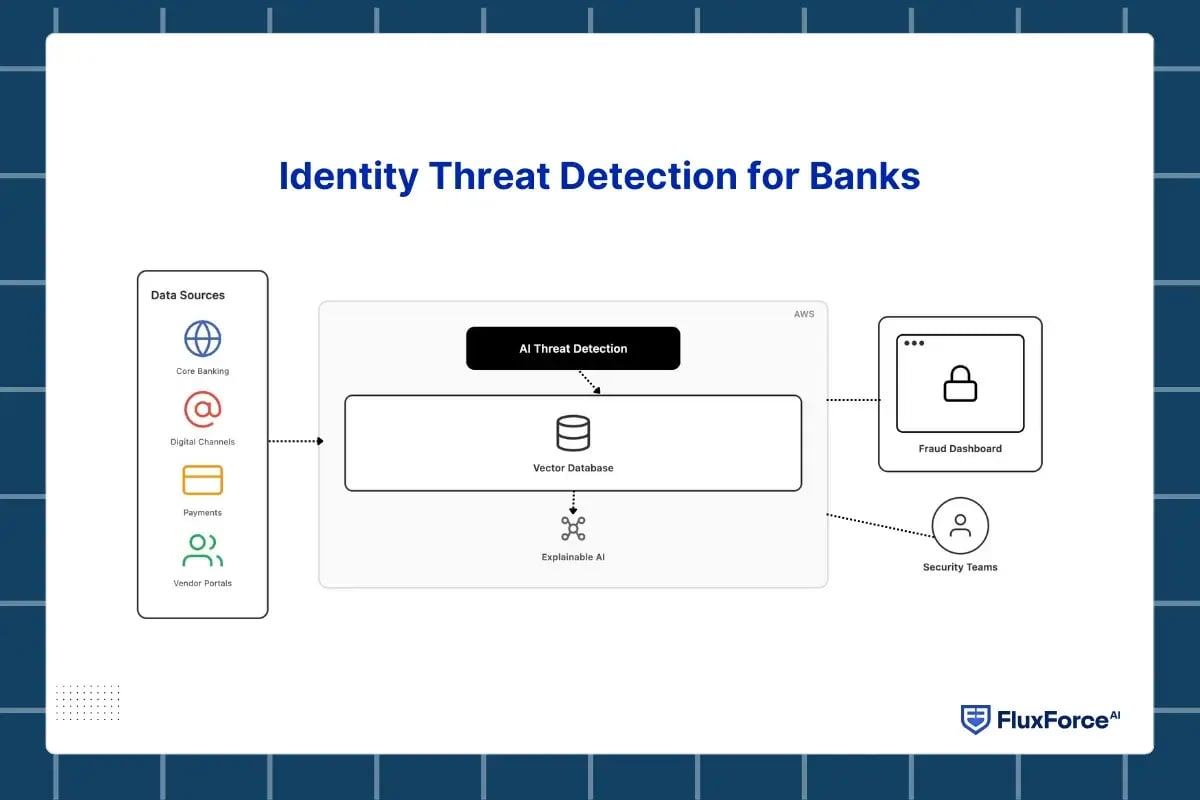
Traditional identity and access management (IAM) systems focus on access control. They decide who can log in and what they are allowed to do. What they do not do well is detect when a legitimate identity is being misused.
Identity threat detection for banks focuses on behavior, not just credentials. Each customer, employee, or third party account develops a behavioral baseline over time. This includes login timing, device fingerprints, access frequency, transaction patterns, and system touchpoints.
When activity deviates from this baseline, the system flags it for investigation. Context matters. A new device alone may be benign. A new device combined with abnormal fund movement, elevated privileges, or access to sensitive trade or payments workflows represents a credible identity risk.
This is where behavioral authentication plays a decisive role. It ensures that operational teams are not flooded with noise, but are alerted only when risk is material and defensible.
How identity-based attacks succeed without identity threat detection ?
Most identity-based attacks begin with valid access. Attackers steal credentials or hijack sessions. OAuth misuse and leaked tokens are common entry points in cloud environments.
Once inside enterprise environments, attackers intentionally reduce suspicious activity by operating during normal business hours and using approved tools, SaaS applications, and trusted administrative workflows. To identity and access management (IAM) security, the activity appears legitimate.
Without continuous identity threat monitoring, this misuse frequently blends into legitimate enterprise activity until broader compromise occurs.
Common patterns seen in real environments
Account takeover often starts with low-privilege users. Attackers explore permissions over time. They look for paths to higher access. This leads to privileged access threats that appear authorized but were never intended.
In cloud environments, cloud identity security issues often involve over-permissioned service accounts or long-lived API tokens.
Why does IAM not stop this ?
IAM evaluates access at the moment of login. It does not assess behavior across sessions.
Identity threat detection exists to surface identity misuse that traditional controls cannot see.
Why IAM alone fails and why identity threat detection is important ?
Many organizations assume stronger IAM automatically means stronger identity security. In practice, this assumption leaves a critical gap that attackers exploit every day.
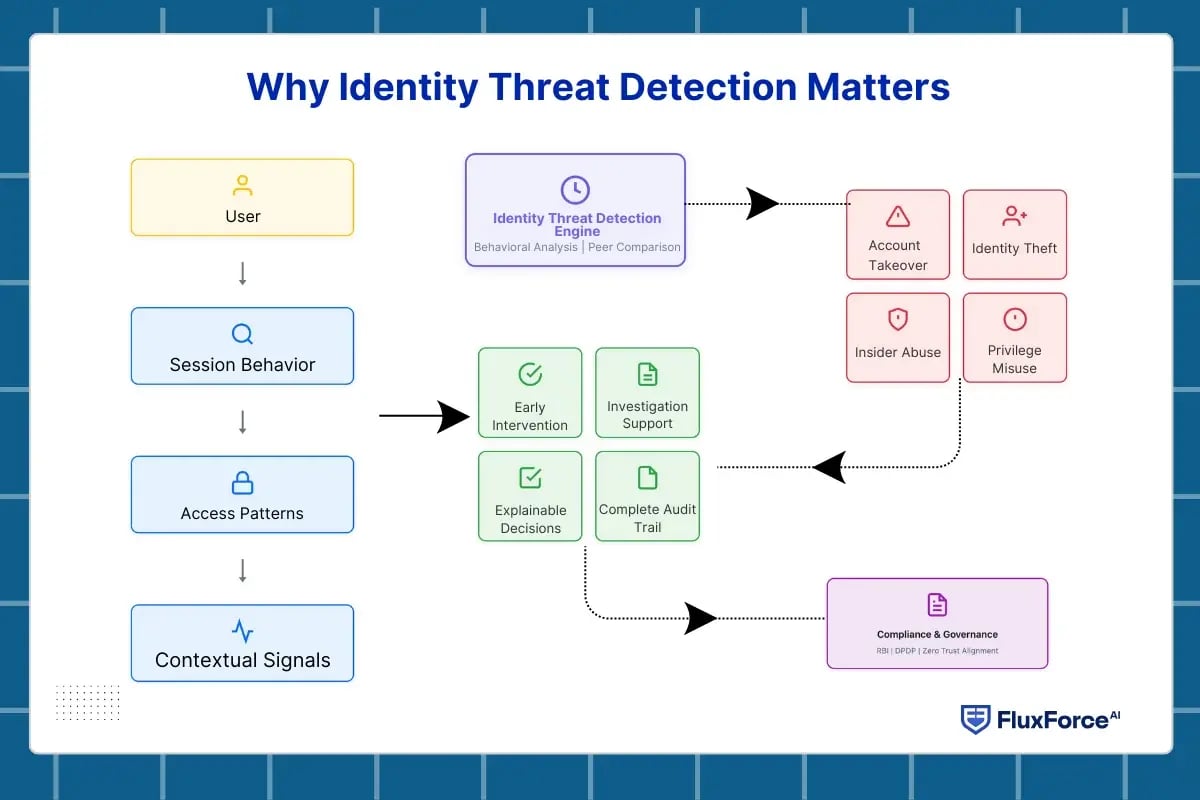
The limits of traditional IAM
Identity and access management (IAM) security is designed to decide whether access should be allowed. It enforces authentication and authorization. Once access is granted, its role is largely complete.
This creates a blind spot.
Attackers increasingly target valid credentials, OAuth tokens, and privileged sessions because traditional IAM security controls trust approved authentication activity by default. When access is legitimate, IAM has no reason to intervene. This is why breaches frequently occur in environments with mature IAM deployments.
Why identity misuse stays invisible ?
IAM security is primarily preventative, while identity threat detection and response (ITDR) continuously identifies misuse after authentication succeeds.
When a compromised identity accesses new systems or escalates privileges, the actions appear authorized. Cyber identity threats operate inside approved access paths and avoid detection.
Where identity threat detection fits
Identity threat detection closes this gap by monitoring identity behavior after access exists. It enables early identity threat monitoring and identity breach detection.
IAM controls entry. Identity threat detection protects what happens next.
Identity-based cyber attacks examples seen today
Understanding identity threat detection becomes easier when you see how identity attacks actually play out in real environments.
Example 1: Credential theft and silent account takeover
An employee falls for a phishing email. Credentials are captured. MFA is bypassed using a stolen session token.
The attacker logs in successfully. No alerts fire. Access is valid. Over days, the account is used to read emails and access internal tools. This is a classic identity-based attack that IAM alone cannot detect.
Example 2: Privilege abuse through over-permissioned accounts
A low-privilege identity has access to automation tools or cloud roles it does not truly need. An attacker exploits this access to request higher privileges.
The escalation looks authorized. This leads to privileged access threats that appear legitimate to access controls.
Example 3: Cloud identity misuse
A service account token is exposed in code or logs. The token is reused to access cloud APIs from outside the organization.
There is no login failure. No endpoint malware. This is a common cloud identity security failure that requires behavior-based detection.
Why these examples matter
All of these attacks rely on valid identities. They bypass traditional controls. Identity threat detection is designed to surface these patterns before damage spreads.
All of these attacks rely on valid identities. They bypass traditional controls. Identity threat detection is designed to surface these patterns before damage spreads.
Difference between IAM and ITDR
At first glance, IAM and ITDR sound similar. Both deal with identities. Both are often discussed under the same “identity security” umbrella. In practice, they solve very different problems.
IAM focuses on access decisions
Identity and access management (IAM) security is built to control access. It verifies identities, enforces authentication such as MFA and applies authorization policies based on roles, devices, or location.
IAM answers a point-in-time question. Should this identity be allowed access right now?
Once access is granted, IAM has limited visibility into how that access is used.
ITDR focuses on identity misuse
Identity threat detection and response (ITDR) assumes that some identities will be compromised. Its role is to detect when trusted identities start behaving in risky or malicious ways.
ITDR monitors identity activity across users, workloads, and privileged accounts. It looks for abnormal patterns that indicate identity-based attacks, privilege abuse, or lateral movement.
This makes identity threat detection continuous rather than transactional.
Why the difference matters
IAM is preventative. ITDR is detective.
Relying on IAM alone means trusting every approved session. Modern cyber identity threats exploit that trust.
In a modern identity security strategy, IAM grants access. ITDR ensures that access is not quietly turned into an attack path.
How identity threat detection works in real environments ?
Identity threat detection is not a single alert or rule. It is a continuous process that combines context, behavior, and risk across the full identity lifecycle.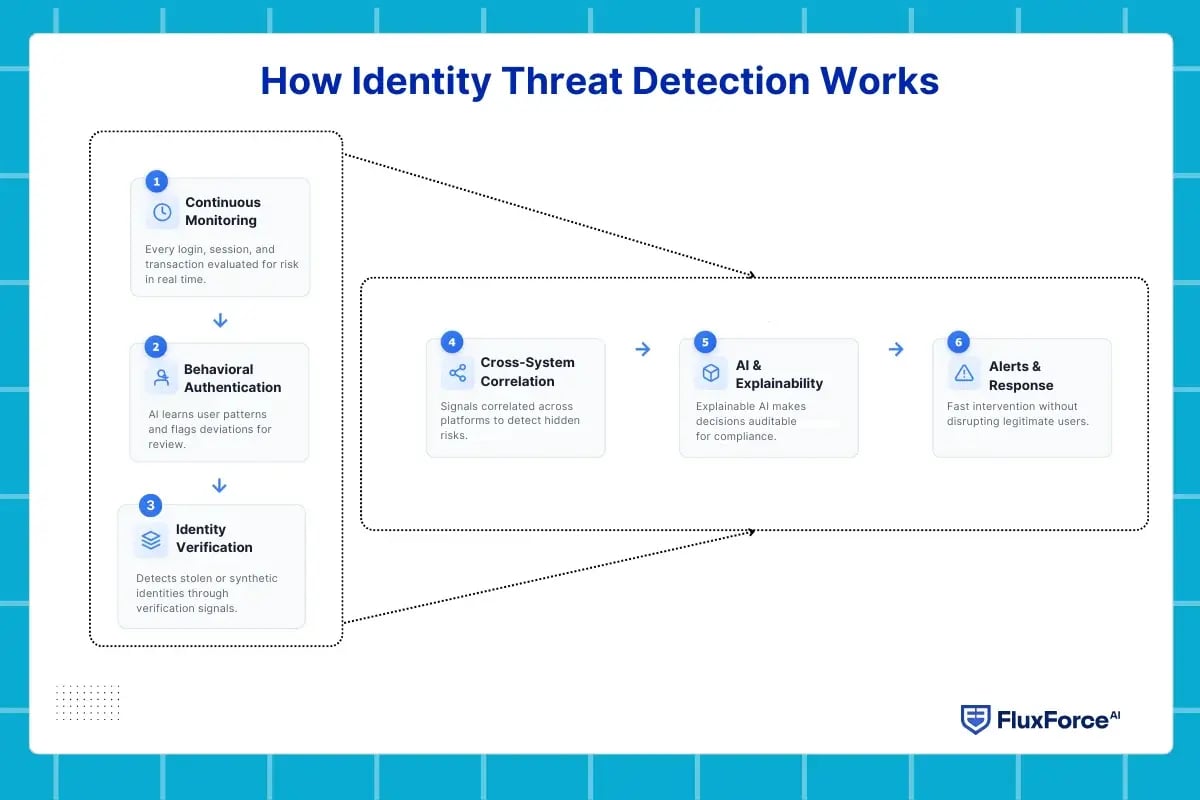
Step 1: Establishing identity context
Identity threat detection begins by establishing behavioral context for users, service accounts, machine identities, and privileged administrators.
This includes the identity type, assigned roles, historical access patterns, and typical usage scope. A human user, a service account, and a privileged admin identity all behave differently. Treating them the same leads to noise or blind spots.
Context is critical for meaningful identity attack detection.
Step 2: Monitoring behavior across time
After authentication succeeds, identity threat monitoring continuously tracks how identities interact across sessions, cloud services, APIs, SaaS platforms, and enterprise infrastructure.
This includes access frequency, movement between resources, changes in privilege usage, and interaction with sensitive services. Slow-moving identity-based attacks often reveal themselves only when behavior is viewed over time rather than at login.
Step 3: Identifying risky deviations
Identity attack detection focuses on behavioral deviations that indicate possible misuse, privilege escalation, lateral movement, or compromised cloud identity activity.
Examples include sudden access to unfamiliar systems, privilege use outside normal workflows, or identity activity that expands beyond its usual scope. These patterns often signal cyber identity threats that IAM controls cannot see.
Step 4: Supporting response and containment
Identity threat detection and response (ITDR) connects detection to investigation.
Security teams gain visibility to confirm misuse, limit identity access, and prevent escalation. Detection does not replace response processes. It enables them to act before identity misuse turns into widespread impact.
This depth is what makes identity threat detection effective in modern enterprise environments.
Conclusion
Identity has become one of the most exploited attack surfaces in modern enterprise cybersecurity environments. Users, service accounts, and privileged identities now drive how work gets done and how breaches unfold.
This is why identity threat detection matters today. IAM security and Zero Trust identity security remain foundational for authentication, authorization, and enterprise access governance. They determine who can access systems and under what conditions. What they do not do is detect when trusted identities are misused after access is granted. Most successful identity-based attacks operate quietly inside valid sessions and approved permissions.
The ITDR market is projected to grow from $16 billion in 2025 to $76.54 billion by 2032. Identity is the primary attack surface in digital financial systems, and the tools defending it have not kept pace with the sophistication of attacks against it.
For banks and regulated enterprises, identity protection solutions that operate only at the authentication point address the front door while leaving the rest of the building unmonitored. AI-based identity threat detection closes this gap by monitoring behavior continuously — inside authorized sessions, across connected systems, throughout the full lifecycle of each identity relationship.
FluxForce AI delivers ITDR built for regulated banking environments: behavioral baselines that flag anomalous session activity, cross-system correlation that surfaces lateral movement, explainable AI risk scoring that satisfies RBI, DPDP, and EU AI Act audit requirements, and automated response workflows that prevent financial and regulatory damage before it occurs.
Connecting AI risk management framework governance to identity threat detection operations is the final step, ensuring that every ITDR decision is governed, documented, and defensible within the institution's broader AI compliance program.
Related Reading: Synthetic Identity Fraud: The Fastest-Growing Threat Banks Aren't Catching explains how attackers create fake-but-valid identities that bypass traditional banking controls.


Share this article