.webp)








Listen To Our Podcast🎧
Introduction
Artificial intelligence is changing how organizations operate. From automating decisions to improving customer experiences, AI brings great potential. At the same time, it introduces new responsibilities. AI compliance is essential for any organization that wants to reduce risk and maintain regulatory trust.
AI governance ensures AI systems are managed and monitored according to internal policies. AI risk management identifies potential risks in AI decision-making and sets up controls to prevent them. Together, they form the foundation of responsible AI compliance, helping organizations act ethically and transparently.
For CROs, AI compliance produces measurable outcomes: reduced operational incidents from model failures, faster regulatory examination responses, and documented risk controls that satisfy board-level oversight requirements. CISOs gain audit-ready AI systems with secure data handling and traceable decision records. Compliance leaders use AI compliance frameworks to track regulatory adherence across models and ensure every automated decision produces an explanation that stands up under scrutiny. Organizations that let AI compliance slip face regulatory penalties, operational disruptions, and examination findings that take months of remediation work to resolve.
AI governance and AI risk management work together at every layer of an organization's compliance program. AI governance defines accountability: which team owns each model, what approval process applies before deployment, and how escalation works when a model produces an unexpected output. AI risk management identifies where those models can fail and sets up controls to prevent or contain the failure. Together, they satisfy what the EU AI Act, GDPR, and financial supervisory bodies require organizations to demonstrate during examination: that automated decisions are controlled, explainable, and traceable.

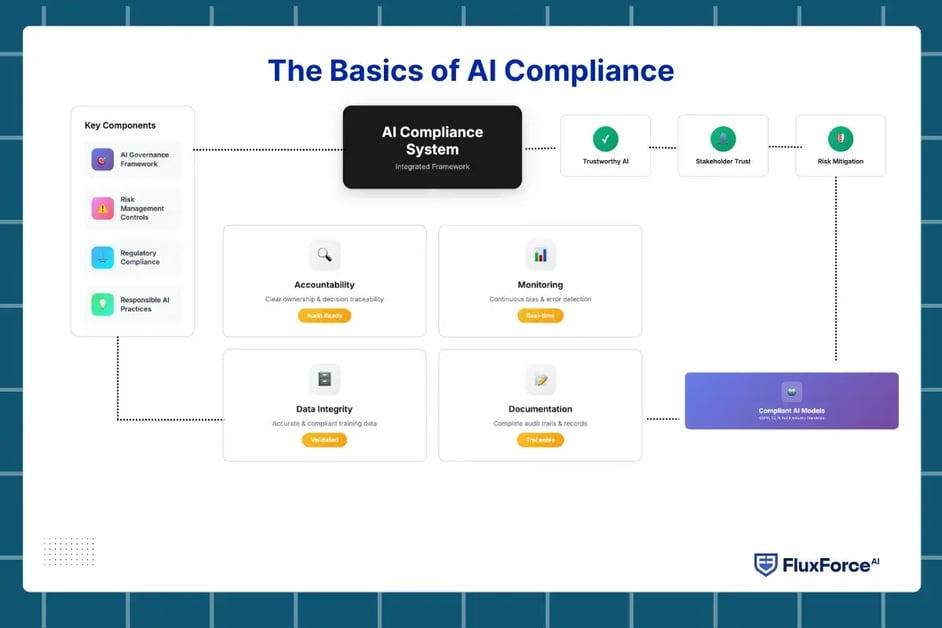
The Basics of AI Compliance
AI compliance is the structured practice of ensuring AI systems operate within legal, regulatory, and ethical boundaries across their full lifecycle. Organizations that deploy AI in credit decisions, fraud detection, customer onboarding, or risk scoring need AI governance frameworks that define who owns each model, how decisions are audited, and what happens when a model produces an outcome that regulators question.
Understanding AI Governance
A robust AI governance framework ensures that AI systems are managed systematically. Key elements include:
- Accountability: Every AI model has a clear owner responsible for decisions.
- Explainability: Decisions made by AI are traceable and understandable.
- Policy Alignment: AI operations comply with internal policies and external regulations.
- Integration Monitoring: AI interactions with other systems are tracked for reliability and security.
CROs and compliance leaders can measure governance effectiveness through audit readiness, decision traceability, and compliance adherence.
AI Risk Management Essentials
AI risk management identifies potential risks and implements controls to prevent failures. Focus areas include:
- Model Accuracy & Bias: Detecting errors or unfair outputs to maintain reliability.
- Data Integrity: Ensuring training and operational data is accurate and compliant.
- Operational Impact: Evaluating how AI errors may affect business processes and outcomes.
- Regulatory Frameworks: GDPR, EU AI Act, or industry-specific standards.
- Internal Standards: Ethical AI deployment and monitoring practices.
- Documentation & Audit Trails: Detailed records that demonstrate compliance and accountability.
Effective risk management supports measurable KPIs, such as reduced operational incidents, faster error resolution, and mitigation of regulatory exposure.
Compliance Requirements
Organizations must comply with:
- Regulatory Frameworks: GDPR, EU AI Act, or industry-specific standards.
- Internal Standards: Ethical AI deployment and monitoring practices.
- Documentation & Audit Trails: Detailed records that demonstrate compliance and accountability.
Maintaining proper documentation ensures transparency and provides evidence for regulators and auditors.
Responsible AI Practices
Responsible AI practices go beyond compliance. They ensure ethical and transparent AI operations:
- Decisions are explainable and understandable.
- Systems are continuously monitored for bias, errors, and performance drift.
- Feedback loops are in place to improve AI behavior over time.
KPIs for responsible AI may include bias detection rates, error reduction, and resolution times for flagged issues.
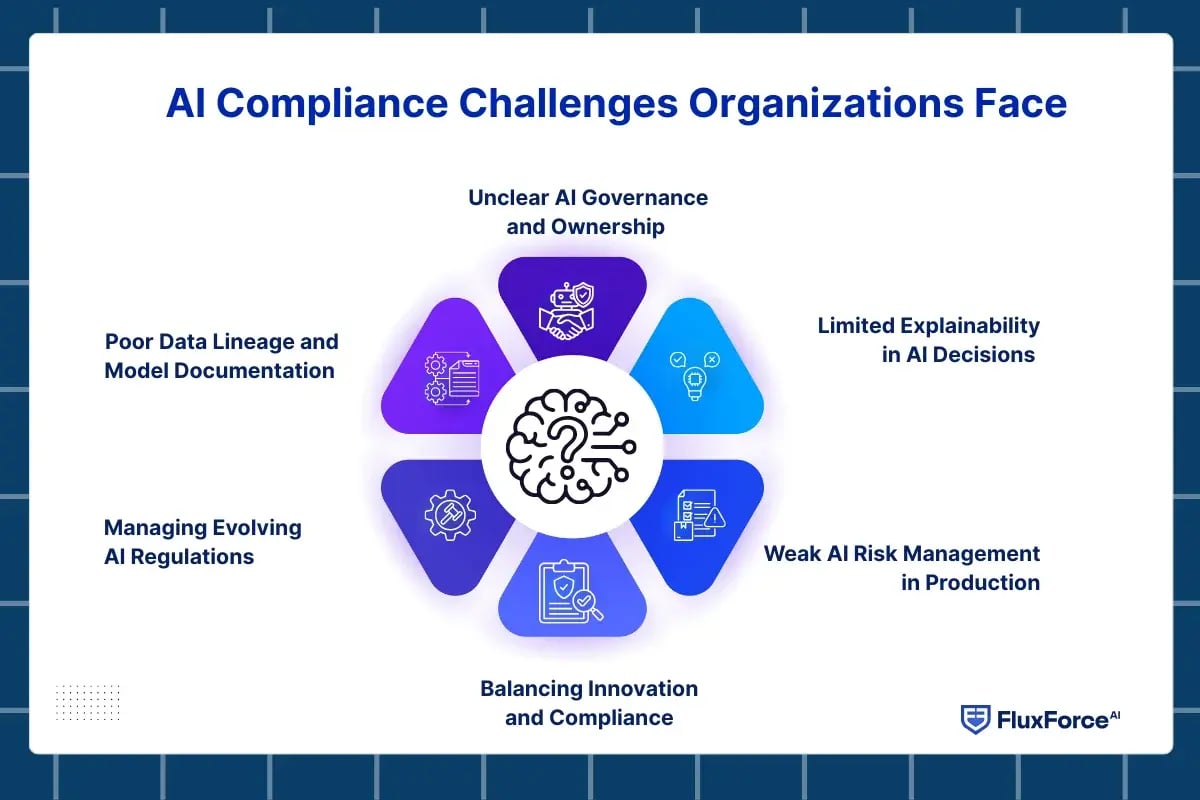
AI Compliance Challenges Organizations Face
As AI adoption scales, many organizations struggle to translate AI compliance basics into day-to-day operations. Policies may exist, but gaps often appear when AI systems interact with real data, real users, and real regulatory scrutiny. These challenges directly affect AI risk management, governance KPIs, and regulatory readiness.
1. Unclear AI Governance and Ownership
A common challenge in AI governance frameworks is unclear ownership. AI systems are often built by data teams, deployed by product teams, and reviewed later by compliance.
When ownership is not clearly defined:
- AI model governance becomes inconsistent
- Accountability during audits is delayed
- Risk escalation paths remain unclear
This weakens AI governance and increases exposure to regulatory findings.
2. Limited Explainability in AI Decisions
Many AI systems struggle with explainability. This becomes a major issue for AI regulatory compliance, especially when decisions affect customers, credit, pricing, or risk scoring.
Without explainability:
- Compliance teams cannot justify AI outcomes
- Regulators question decision transparency
- Manual reviews increase operational effort
Explainability is a core requirement of responsible AI compliance and a key KPI for compliance leaders.
3. Weak AI Risk Management in Production
Organizations often assess AI risk during development, but ongoing AI risk management in production is overlooked.
Common issues include:
- Model drift going undetected
- Bias reappearing after deployment
- Lack of continuous risk monitoring
This creates gaps between stated policies and actual compliance performance.
4. Poor Data Lineage and Model Documentation
Strong AI model governance depends on traceable data and clear documentation. Many organizations cannot clearly explain where training data came from or how models evolved.
This affects:
- Audit readiness
- Incident investigation
- Regulatory confidence
Without data lineage, meeting AI compliance requirements becomes difficult.
5. Managing Evolving AI Regulations
AI regulations are changing across regions. Organizations operating globally face challenges aligning policies with new AI regulations and local enforcement expectations.
This often leads to:
- Reactive compliance updates
- Inconsistent controls across regions
- Increased compliance workload
A proactive AI compliance strategy is needed to manage regulatory change effectively.
6. Balancing Innovation and Compliance
Business teams push for speed. Compliance teams push for control. Without alignment, organizations either slow innovation or increase risk. The real challenge is building AI compliance for enterprises that enables innovation while maintaining governance and regulatory trust.
How AI Changes What It Means to Be “Being Compliant”
AI changes compliance from a periodic review exercise into a continuous operational discipline. Traditional compliance programs verified that processes were followed. AI compliance requires verifying that automated decisions are correct, explainable, and within regulatory boundaries at every execution, not just during audit cycles. The shift from process verification to decision verification is what makes AI compliance structurally different from the compliance programs most financial institutions built over the previous two decades. 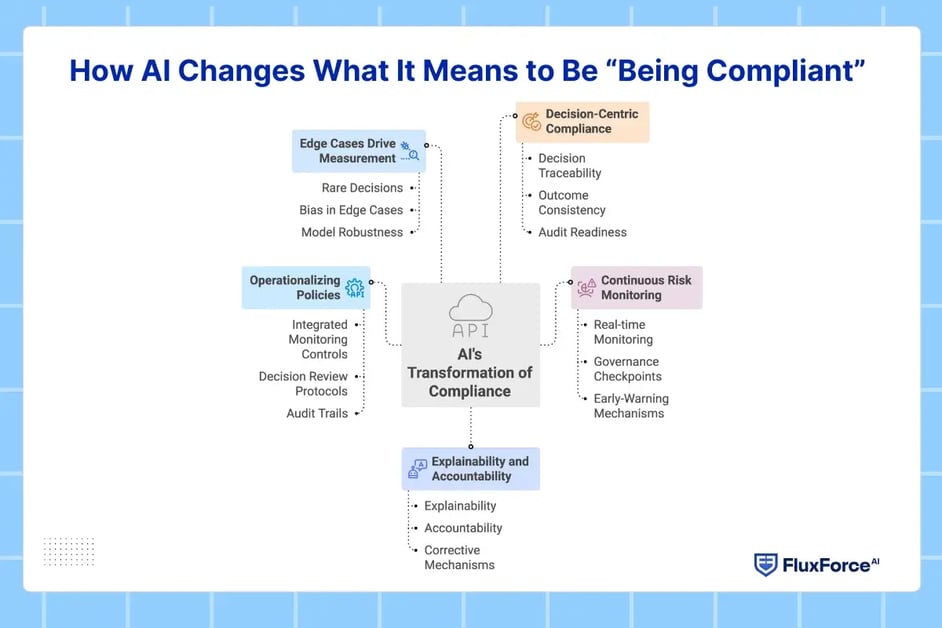
1. Compliance Is Decision-Centric
Historically, compliance evaluated whether processes were followed. AI shifts the focus to decision outcomes. Regulatory expectations increasingly emphasize understanding how automated decisions are made and whether they align with legal and ethical standards.
Key considerations include:
- Decision traceability: Can the organization show which inputs influenced the AI decision?
- Outcome consistency: Are similar cases treated consistently over time?
- Audit readiness: Are all model updates, retraining events, and parameter changes documented for review?
Without this decision-level visibility, compliance efforts may be technically complete but operationally deficient.
2. Continuous Risk Monitoring Becomes Essential
AI models are dynamic. Data drift, model retraining, and changing operational contexts introduce continuous risk exposure. Static compliance reviews or annual audits are no longer sufficient.
Organizations must implement:
- Real-time monitoring of AI outputs to detect anomalies
- Governance checkpoints for model updates and integration changes
- Early-warning mechanisms for potential compliance violations
This ensures organizations can intervene proactively rather than reacting to regulatory findings.
3. Explainability and Accountability
Accurate outcomes alone do not constitute compliance. Regulators and auditors now expect:
- Explainability: Teams must justify why AI made a particular decision
- Accountability: Human owners must be responsible for automated outcomes
- Corrective mechanisms: Clear procedures to address non-compliant or high-risk outputs
Focusing on these ensures compliance is not only documented but defensible under scrutiny.
4. Operationalizing Policies
Compliance policies remain necessary, but they are insufficient when applied to AI. Policies must be operationalized into:
- Integrated monitoring controls
- Decision review protocols
- Audit trails covering data lineage, model changes, and output justification
This operational focus ensures AI compliance moves from theory to practice.
5. Edge Cases Drive Measurement
Regulators pay attention to outliers and high-impact decisions, not just overall accuracy metrics. Organizations must evaluate:
- How rare or exceptional decisions are generated
- Whether bias or unintended consequences occur in edge cases
- The robustness of model governance across all decision scenarios
This perspective aligns compliance evaluation with real operational risk rather than superficial metrics.
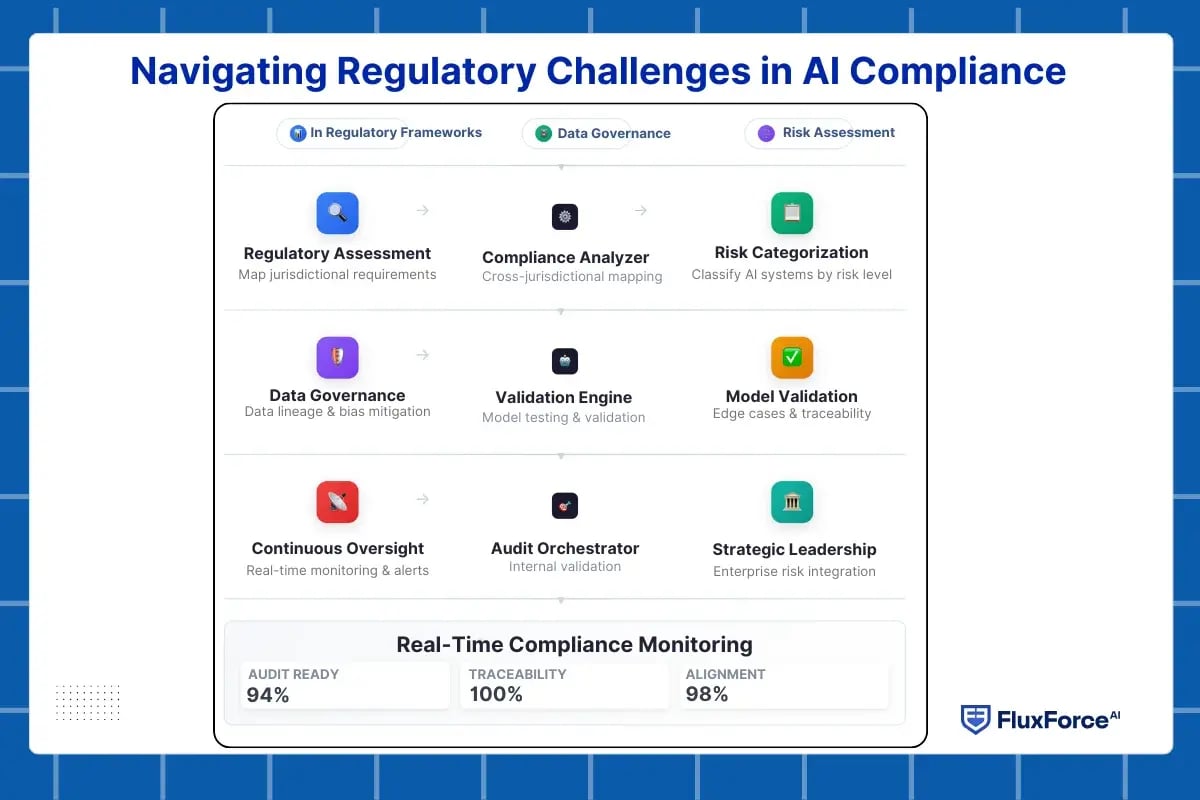
Navigating Regulatory Challenges in AI Compliance
AI regulations are multiplying across jurisdictions faster than most compliance programs can track. The EU AI Act, US agency guidance from the CFPB and OCC, and emerging national frameworks in India and the Asia-Pacific region each impose different documentation, explainability, and oversight requirements. Organizations operating across multiple jurisdictions face AI regulations that conflict in timing, scope, and enforcement priority, creating compliance programs that satisfy one framework while inadvertently falling short of another.
1. Fragmented and Evolving Regulations
Regulators worldwide are responding differently to AI adoption, creating complex compliance demands:
- United States: Focus is on fairness, explainability, and preventing discriminatory outcomes. Agencies such as the CFPB and OCC expect banks and fintechs to provide decision-level justification for automated actions.
- European Union: The AI Act introduces a risk-based categorization. High-risk AI systems must undergo rigorous conformity assessments, including human oversight and transparency obligations.
- India: Emerging AI regulations emphasize responsibility, ethical deployment, and traceability, requiring companies to maintain detailed records of AI system behavior.
Implication for leadership: Compliance is not simply local; global operations must maintain cross-jurisdictional alignment, creating KPIs such as the percentage of AI systems meeting all regulatory frameworks and audit readiness across regions.
2. High-Risk AI Use Cases Under Scrutiny
AI systems affecting critical decisions attract heightened regulatory attention. Organizations must anticipate oversight in:
- Credit and risk scoring: Models must prove bias mitigation, consistency, and auditability.
- Fraud detection and transaction monitoring: Automated decisions must be traceable and defensible in real time.
- Insurance claim adjudication: AI outputs must comply with transparency standards and allow human intervention.
- Customer onboarding/KYC: Decisions impacting access require strong.
3. Data Governance as a Regulatory Imperative
AI compliance failures often stem from poor data governance, not model design. Regulators now expect:
- Comprehensive data lineage: Every AI decision should trace back to its input dataset, preprocessing steps, and model version.
- Continuous monitoring for data drift: Inputs may change over time, potentially affecting outcomes.
- Bias detection and mitigation: Models must demonstrate fairness across demographic, financial, and operational segments.
4. Model Validation Beyond Accuracy Metrics
Regulators are no longer satisfied with generic accuracy or performance statistics. Compliance now requires:
- Edge-case evaluation: High-risk or rare events must be examined for compliance adherence.
- Scenario-based testing: Models should be stress-tested under evolving conditions.
- Decision traceability audits: Every output must be reproducible and defensible.
5. Continuous Oversight and Real-Time Monitoring
AI compliance is dynamic. Organizations must integrate compliance into operational workflows:
- Implement real-time dashboards showing decision patterns and anomalies
- Define thresholds for automated alerts when outputs deviate from regulatory expectations
- Conduct periodic internal audits to validate model behavior under evolving conditions
6. Strategic Leadership Considerations
For executives, AI compliance is not just about avoiding fines—it is about maintaining organizational control and reputational trust:
- Decisions must be defensible in regulatory reviews, audits, or legal challenges
- Integrating AI compliance into enterprise risk management ensures alignment with broader business objectives
- Proactive adaptation to regulatory changes positions the organization as a trusted leader in responsible AI adoption
Conclusion
AI compliance in regulated industries requires continuous operational discipline across every model in production. Every automated decision must be traceable, explainable, and aligned with current regulatory requirements under the EU AI Act, GDPR, DORA, and applicable sector-specific frameworks. Organizations that build this discipline into their governance architecture produce examination-ready documentation as a byproduct of normal operations rather than as a preparation exercise that consumes compliance team capacity before each regulatory review.
FluxForce is an Agentic OS for Regulated Industries. For financial institutions building AI governance and AI compliance programs that satisfy regulatory examination requirements without adding manual overhead, FluxForce runs multi-agent compliance workflows across fraud monitoring, AML detection, and regulatory reporting, producing audit-ready documentation continuously as automated decisions execute.
For organizations evaluating how to build AI governance and compliance programs that satisfy regulatory examination without manual overhead, the FluxForce regulatory compliance automation solution provides a starting point.



Share this article