.webp)








Listen to our podcast 🎧
.jpeg)
Introduction
While the deployment of AI models across fintech is roaring, the demand for transparency and explainability is rising just as quickly. With each new model integration, compliance managers struggle to maintain consistent AI model governance across every model they deploy.
A study by Gartner predicts that 60% of AI projects will miss their value targets by 2027, largely due to fragmented and reactive governance structures.
For Chief Data Officers who need clear visibility and consistent control across all model activities, adopting automated compliance monitoring frameworks is essential.
This article outlines practical fintech compliance strategies designed to help organizations strengthen controls, improve efficiency, and ensure responsible AI adoption throughout the entire model lifecycle.
The Governance Gap: Where Most Fintechs Still Struggle
Hiring designated managers for AI and compliance does not guarantee sufficient governance when fragmented processes, manual oversight, and lack of real-time insights persist across the organization.
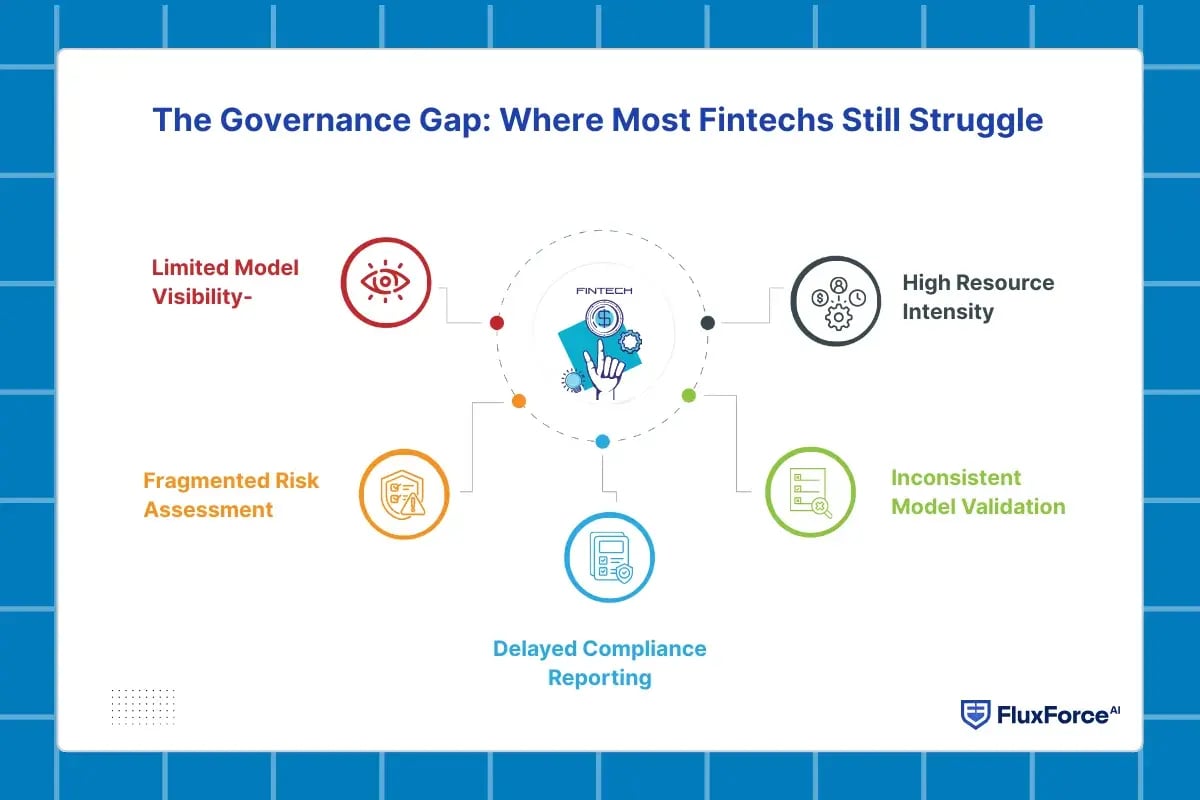
- Limited Model Visibility- Many fintechs struggle to consolidate AI activities across multiple business units. Without automated dashboards and centralized monitoring, compliance managers cannot track model performance, risk exposure, or regulatory adherence in real-time.
- Fragmented Risk Assessment- Manual risk scoring leads to inconsistent evaluations, leaving some high-risk models insufficiently monitored. For instance, a credit scoring AI might pass internal reviews but still exhibit geographic or demographic bias that could trigger regulatory concerns.
- Delayed Compliance Reporting- Manual report generation is slow and error prone. A regulatory audit can reveal missing logs, delayed risk assessments, or incomplete bias evaluations, resulting in penalties or reputational damage.
- Inconsistent Model Validation- Validating models in isolation, without standardized audit trails or automated performance monitoring, reduces the organization’s ability to demonstrate adherence to regulations. Continuous monitoring is critical for fintech models that evolve with market conditions.
- High Resource Intensity- Over-reliance on human intervention consumes significant time, reducing the ability to scale governance across multiple AI initiatives.
Core Pillars of an Advanced AI Model Governance Framework
A robust governance framework embeds compliance, transparency, and accountability into every stage of the AI model lifecycle.
1. Model Lifecycle Management
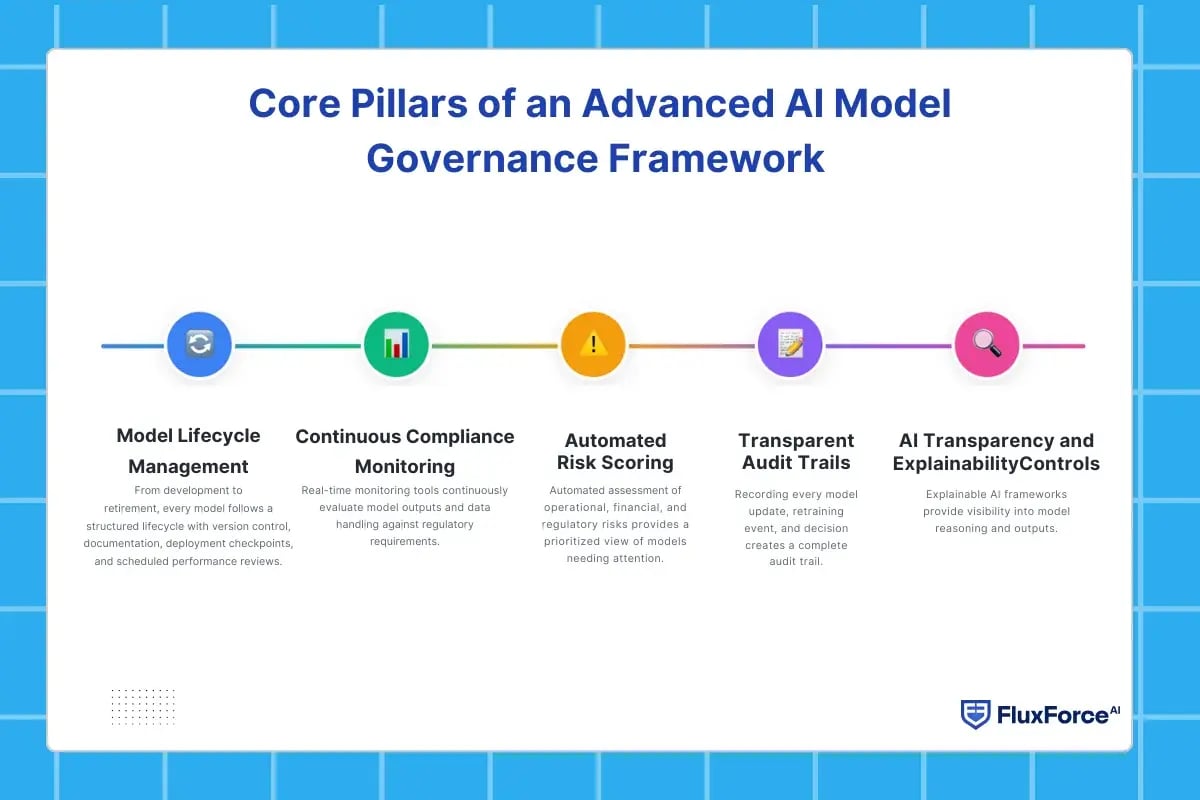
From development to retirement, every model should follow a structured lifecycle. This includes version control, documentation, deployment checkpoints, and scheduled performance reviews. Proper lifecycle management ensures traceability and consistent governance across all AI initiatives.
2. Continuous Compliance Monitoring
Real-time monitoring tools continuously evaluate model outputs and data handling against regulatory requirements. Proactive alerts enable immediate action for potential deviations before they escalate into regulatory or operational risks.
3. Automated Risk Scoring
Automated assessment of operational, financial, and regulatory risks provides a prioritized view of models needing attention. Risk scoring allows CDOs to allocate resources efficiently, focusing on high-impact areas.
4. Transparent Audit Trails
Recording every model update, retraining event, and decision creates a complete audit trail. This ensures accountability and provides regulators with clear evidence of compliance, reducing audit preparation effort.
5. AI Transparency and Explainability Controls
Explainable AI frameworks provide visibility into model reasoning and outputs. By understanding how a model reaches its decisions, managers can detect bias, validate fairness, and demonstrate responsible AI practices.
How Automating Regulatory Compliance Supports Every Stage of AI Models
Automating compliance ensures that each AI model, from development to deployment, is continuously monitored for regulatory adherence, operational integrity, and fairness. Automation reduces human errors, accelerates decision-making, and provides measurable oversight.
1. Immediate Detection of Policy Deviations
Automated systems track model inputs, outputs, and usage rules in real time. For example, if a lending AI begins using unauthorized customer data, the system triggers an alert instantly. This prevents regulatory violations before they occur, rather than discovering them during periodic audits.
2. Bias and Fairness Tracking
AI models may unintentionally favor certain demographics or regions. Automated compliance tools calculate fairness metrics, such as the distribution of approved loans across different income groups. If the system identifies a deviation beyond pre-set thresholds, it flags the model for review, ensuring that AI-driven decisions remain unbiased.
3. Model Drift Detection
AI models degrade over time if market or customer behaviour changes. Automated compliance platforms track accuracy metrics, such as default prediction rates in loan scoring models. For example, if fraud detection accuracy drops from 98% to 85%, the system alerts the risk team, prompting retraining or recalibration.
4. Automated Regulatory Reporting
Preparing regulatory reports manually can take weeks. Automation generates structured, audit-ready reports showing model decisions, performance metrics, and validation checks. For instance, a CDO can produce an “AI fairness report” for RBI or internal audits with a single click.
5. Operational Efficiency Gains
Instead of compliance teams manually reviewing hundreds of model outputs, automation prioritizes high-risk events. Teams can focus on critical interventions rather than routine checks, saving thousands of human hours a year, in line with what our 2026 compliance budget research found for mid-market teams.
6. Scalable Oversight Across Models
As fintech companies deploy multiple AI models across lending, fraud detection, and personalization, automated compliance ensures consistent monitoring across all systems. Centralized dashboards provide a single view of all models’ compliance status, making scaling governance practical without increasing headcount.
Intelligent Automation Strategies for Strengthening Model Risk Management (MRM)
Managing risks that come from using AI models requires intelligent automation to detect, assess, and mitigate operational, financial, and regulatory risks before they impact customers or the business.
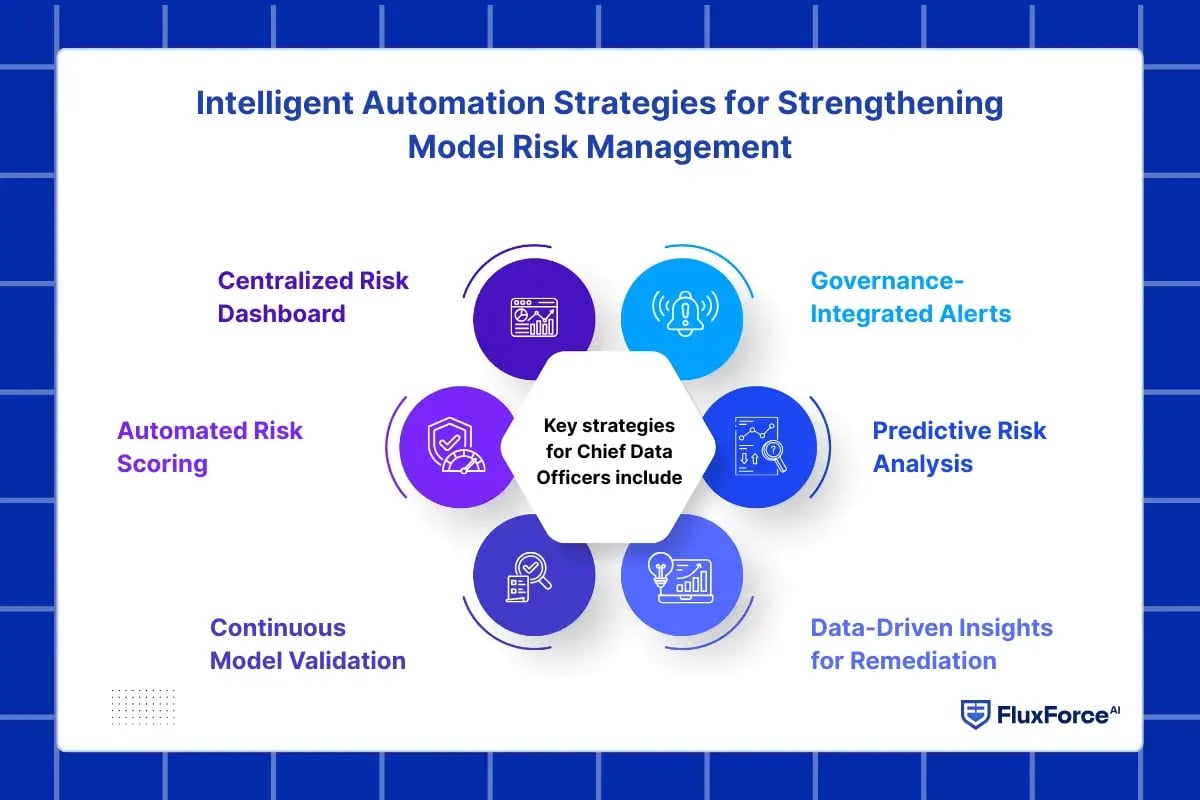
Key strategies for Chief Data Officers include:
1. Centralized Risk Dashboard
A dashboard consolidates model-level risk metrics, showing compliance status, fairness scores, and performance trends. For example, CDOs can instantly see which loan scoring models are underperforming or exhibiting bias, reducing response time from weeks to hours.
2. Automated Risk Scoring
Each model receives a dynamic risk score based on performance, regulatory adherence, and data quality. Models with high-risk scores trigger deeper investigation or corrective actions, enabling resource prioritization.
3. Continuous Model Validation
Automated validation tests whether retrained models maintain fairness and accuracy. For example, if a fraud detection model is retrained on new transaction data, the system automatically checks detection rates, false positives, and bias indicators.
4. Governance-Integrated Alerts
When performance, fairness, or data issues occur, alerts feed directly into governance workflows. For instance, if a credit approval model starts rejecting a disproportionate number of low-income applicants, the system immediately escalates the issue to compliance managers.
5. Predictive Risk Analysis
AI tools predict potential compliance failures by analysing trends across models. For example, predictive analysis can show which models are likely to drift beyond acceptable thresholds in the next quarter, enabling proactive retraining.
6. Data-Driven Insights for Remediation
Automated analytics highlight why a model underperforms and suggest corrective actions. A CDO can see whether bias originates from training data imbalance, feature selection, or algorithmic design, improving remediation precision.
Operationalizing Responsible AI for Scalable, Trustworthy Fintech Systems
For ensuring responsible AI adoption in fintech, it is essential to embed ethical, transparent, and compliant practices into every stage of model design, deployment, and monitoring.
1. Continuous Ethical Auditing
Ethical auditing ensures AI models comply with fairness, transparency, and regulatory standards. Automated tools flag potential bias or discriminatory outcomes. For example, a credit scoring AI may be audited daily to ensure approval rates across income groups remain equitable.
2. Transparent Decision Frameworks
Explainable AI provides insights into model decisions. Managers can identify which features influenced approvals or rejections, ensuring decisions are defensible and regulators can trace the reasoning.
3. Standardized Compliance Reporting
Automation produces structured reports that satisfy regulatory and internal audit requirements. For example, monthly reports may show model accuracy, fairness metrics, retraining events, and incidents of policy deviation, all ready for submission.
4. Ethical Data Management
Automated controls enforce data quality, privacy, and retention rules. For instance, customer data used in AI training is continuously checked for proper anonymization, storage compliance, and alignment with RBI guidelines.
5. Scalable Governance Implementation
Responsible AI practices are applied consistently across all deployed models. Whether the organization launches new fraud detection tools or personalized lending algorithms, automation ensures governance scales without creating gaps.

Conclusion
AI model governance in fintech requires a structured approach that reduces operational risk and aligns with regulatory expectations. Chief Data Officers increasingly depend on automated compliance workflows to track model performance, manage data lineage, and demonstrate audit readiness.
A strong governance strategy ensures every model, whether used for credit scoring or fraud detection, follows transparent, repeatable controls. By integrating automation into the compliance lifecycle, CDOs can scale oversight, reduce human error, and maintain regulatory confidence without slowing innovation. Automated compliance, continuous monitoring, and operationalized responsible AI collectively create a resilient, trustworthy AI ecosystem. This approach empowers fintech organizations to innovate safely, protect customer interests, and meet evolving regulatory standards.


Share this article