.webp)





Listen to our podcast 🎧
Introduction
What does a bank do when it cannot explain why its AI system rejected a loan or marked a transaction as risky? This is the question many financial leaders face today. Automated decisions move fast, but without a clear explanation, they create confusion, customer complaints, and pressure from regulators. This is why explainable AI in finance has become a core part of safe AI risk management.
Most banks now use AI for credit scoring, fraud checks, KYC, collections, and risk alerts. The problem is simple. Many of these systems work like black boxes. They give answers without showing how they reached them. This lack of clarity increases black-box AI risks, makes regulatory compliance for AI difficult, and weakens AI decision accountability. It also slows down internal teams when they need to explain why an alert was triggered or why a customer was flagged.
This blog will show why explainable AI is essential for banks, how transparent AI models help them meet current regulatory expectations, and why the future of financial automation depends on XAI for financial institutions. It will also explain how tools like explainable machine learning support safer decisions, fewer errors, and a stronger AI governance framework in modern banking.

Why Black-Box AI cannot work in modern banking?
Accuracy alone is not enough
Banks can no longer rely on AI models that produce results without explanation. Regulators, auditors, and boards now demand explainable AI finance. A model that cannot show why it made a decision exposes the bank to compliance failures and operational risk. Transparent AI models and audit-ready XAI are now essential for credit scoring, fraud detection, and AML checks.
Real operational failures
According to ECB Banking Supervision’s 2025 data collection, AI adoption in European banks increased sharply between 2023 and 2024, with credit scoring and fraud detection among the most widely deployed use cases. Separately, industry surveys show that over 90% of global banks now use AI in at least one core-related function, intensifying the need for explainability as AI scales into regulated decision‑making. Regulators like the FCA and the Reserve Bank of India stress that decisions must be traceable and auditable. Banks that continue with black-box models risk failing regulatory compliance for AI and undermining AI decision accountability.
Why Financial Institutions Need Explainable AI Now?
Using XAI for financial institutions gives risk teams the ability to verify decisions, reduce errors, and satisfy audit requirements. Explainable machine learning supports AI fairness and bias mitigation and strengthens financial model transparency. Institutions gain more control and confidence without sacrificing model performance.
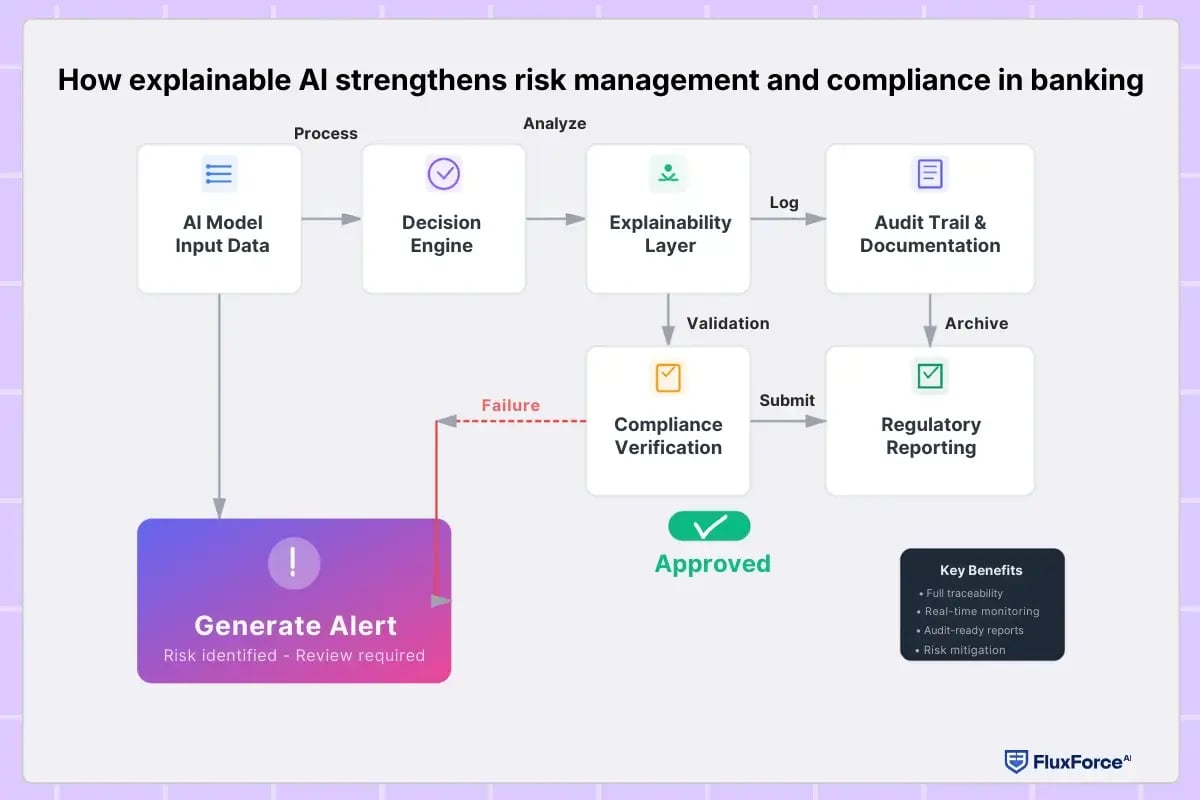
How explainable AI strengthens risk management and compliance in banking ?
Financial institutions face growing pressure to explain every AI decision. Opaque systems create black-box AI risks, regulatory exposure, and operational inefficiencies. Explainable AI in finance is now critical for safe, accountable automation.
Reducing black-box AI risks
AI that cannot explain its decisions exposes banks to errors and disputes. Transparent AI models make it clear why a loan is approved or a transaction flagged, helping teams act confidently and prevent mistakes.
Supporting regulatory compliance
Regulators such as the FCA and RBI require clear AI decision records. Audit-ready XAI ensures every automated outcome can be reviewed and defended, making compliance-driven AI adoption easier and more reliable.
Enhancing accountability
Internal audit and risk teams can trace AI outputs to specific inputs using audit-ready XAI. This strengthens AI decision accountability and aligns with modern AI governance frameworks.
Practical applications
Banks use interpretable credit scoring models, explainable fraud detection models, and AI-powered AML tools. These solutions demonstrate how XAI for financial institutions improves decision quality and operational efficiency.
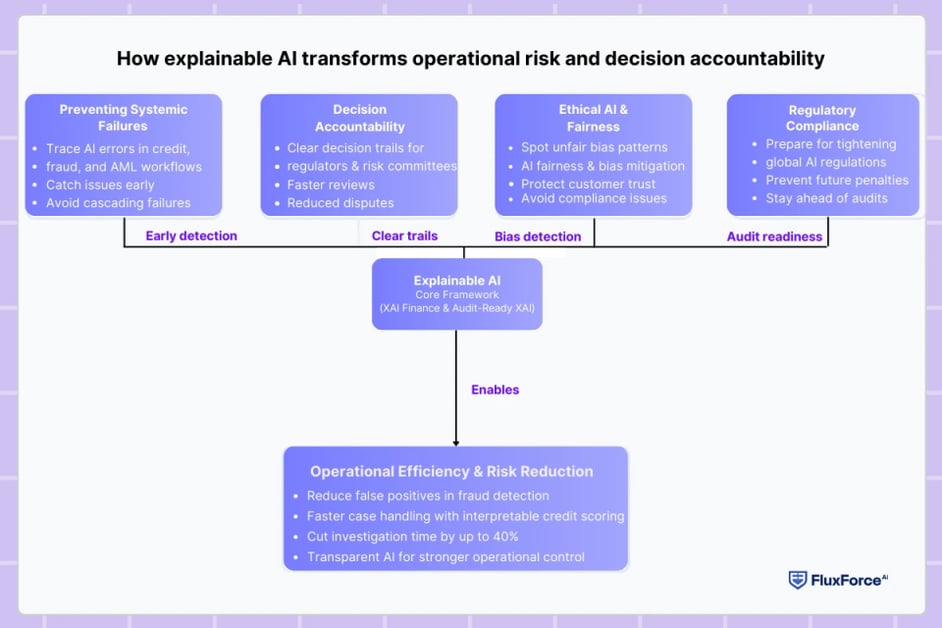
How explainable AI transforms operational risk and decision accountability ?
Preventing systemic failures in automated decision-making
AI errors can spread quickly across credit, fraud, and AML workflows. With explainable AI finance and audit-ready XAI, teams can trace strange outcomes back to specific model decisions. This helps banks catch issues early, avoid cascading failures, and maintain stronger control than black-box models allow.
Embedding accountability across the decision chain
Regulators and risk committees expect clarity behind every automated outcome. XAI for financial institutions creates a clear decision trail, improving AI decision accountability for analysts and executives. When every AI output is explainable, reviews are faster and disputes drop significantly.
Operationalizing fairness and ethical AI practices
Bias in automated decisions can damage trust and trigger compliance issues. Using explainable machine learning, banks can spot unfair patterns and apply AI fairness and bias mitigation methods before they affect customers. This supports real ethical AI in financial services, not just policy on paper.
Quantifying efficiency and reducing operational risk
XAI streamlines workflows by reducing false positives in fraud checks and clarifying decisions in credit reviews. Banks using transparent AI models and interpretable credit scoring models report faster case handling and fewer errors. According to peer-reviewed research published in the International Journal of Scientific Research and Management (2025), XAI-based fraud detection models achieve greater than 99% detection accuracy while providing healthy explanations for each prediction — demonstrating that explainability and performance are not competing objectives.
Preparing for future regulatory expectations
Rules around regulatory compliance for AI are tightening across global markets. Investing early in transparent AI and audit-ready XAI prepares banks for upcoming audits and prevents future penalties. As explainability becomes mandatory, institutions with strong XAI foundations will stay ahead of compliance pressure.
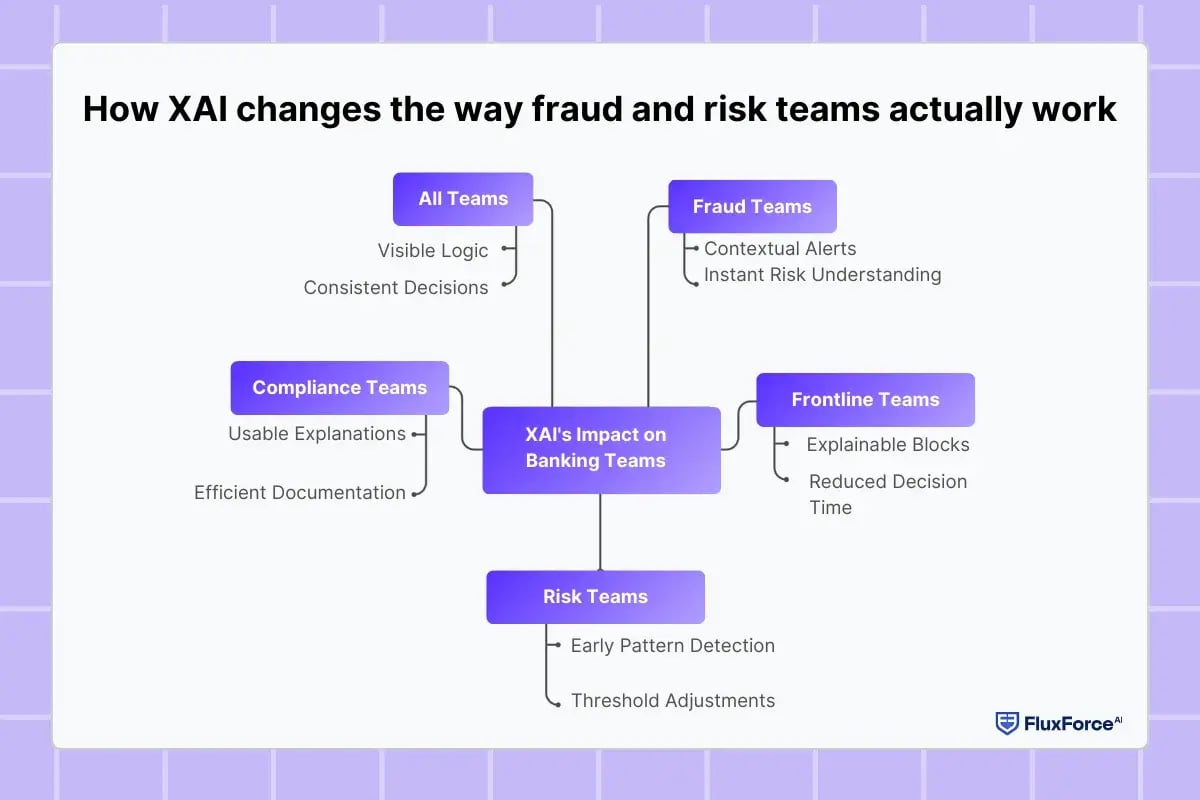
How XAI changes the way fraud and risk teams actually work ?
Fraud teams get context, not just alerts
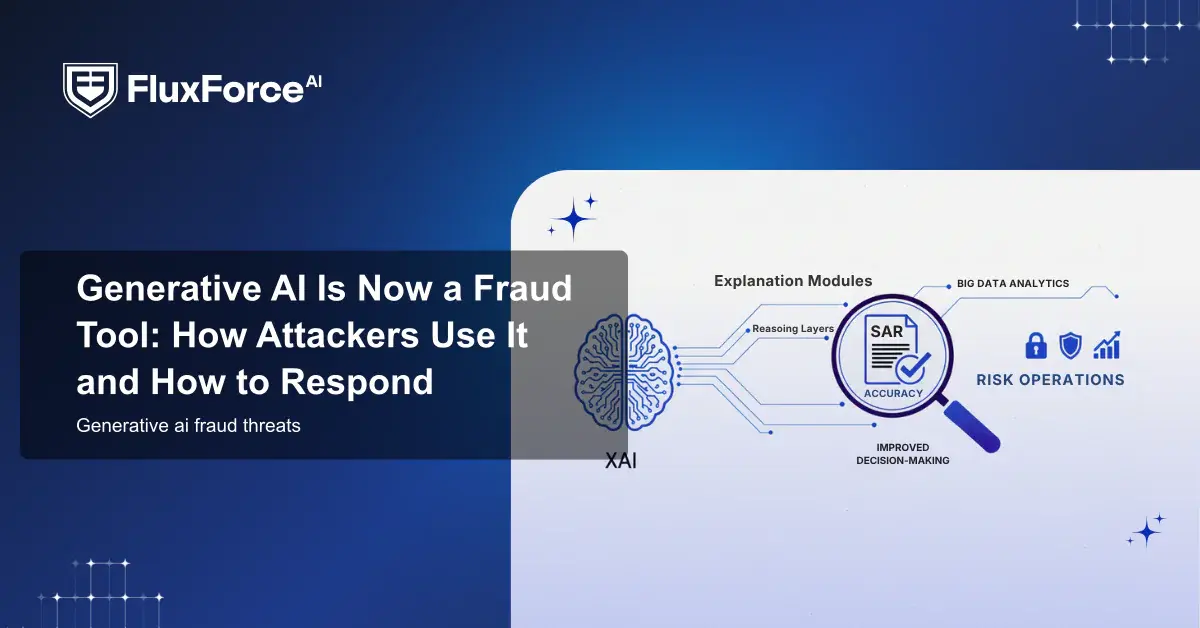
In most banks, analysts open a fraud alert and have no idea why it was triggered. They see a score, a timestamp, and a transaction list — that’s it. With XAI, the system shows exactly what stood out. It might be spending outside the customer’s usual pattern or a sudden shift in device behavior. Instead of blindly reviewing cases, analysts understand the risk instantly and clear or escalate with confidence.
Suspicious transactions stop becoming bottlenecks
When a high-value transaction gets blocked, the frontline team must react fast. Without explanations, they usually escalate everything “just to be safe.” This slows down payments and angers customers. With explainable AI, the reviewer can see the top reasons for the block, such as conflicting location data or mismatched device fingerprints. It shortens decision time from minutes to seconds.
Risk teams detect changes in fraud patterns earlier
Fraud doesn’t look the same every month. When patterns shift, black-box models usually miss the early signs. XAI gives analysts a clear view of which features suddenly matter more. If transactions from a specific merchant category or region start appearing in flagged cases, risk teams see it immediately and adjust thresholds before losses build up.
Compliance teams finally get usable explanations
Regulators want the reasoning. XAI gives compliance officers the exact chain: the trigger, the contributing factors, and the model’s confidence. This turns a process that once took an hour into a task completed in ten minutes, with cleaner documentation and fewer follow-up questions.
Teams trust the system because the logic is visible
People inside banks often push back on automation because they cannot verify the model’s thinking. XAI fixes that. When teams can see why the system made a call, they stop second-guessing it and start relying on it as a partner. This trust speeds up reviews, reduces escalations, and brings real consistency to decisions.
Conclusion
Explainability is the only way banks can scale AI without increasing risk. When decisions become traceable, teams work faster, audits become smoother, and models stay aligned with regulations. As explored in Understanding Decision Paths: The Core of Explainable AI, visibility into how models reach decisions is what turns automation into accountable, regulator‑ready intelligence. Banks that invest in explainable AI, transparent AI, and audit-ready XAI now will be the ones that innovate safely while everyone else struggles to justify their automated decisions.

Share this article