.webp)







Listen To Our Podcast🎧
Introduction
Impossible travel detection is the fraud control that catches a login from Mumbai eight minutes after the same account logged in from Chicago. No airline covers that distance in eight minutes, so the second session is either a stolen credential or a shared account, and a bank's fraud engine needs to know which within seconds, not hours.
We have spent years building detection logic for banks and fintechs, and impossible travel is one of the few signals that is almost never a false alarm on its own. The problem is what happens after the alert fires: a legacy rules engine flags it, a queue fills up, and a compliance analyst reviews it three hours later, long after the money has moved.
This guide breaks down how impossible travel detection actually works, where rule-based systems fall short, and what changes when agentic AI takes over the decision loop instead of just the alert.
- How impossible travel detection tells a stolen login apart from a customer using a VPN or roaming SIM
- The exact signals (geolocation, device, velocity, behavior) that feed a real detection model
- Why manual compliance review queues quietly inflate the cost of every fraud case
- 5 specific ways agentic AI changes impossible travel detection versus static rules
- How to estimate the ROI of moving from manual review to automated fraud decisioning
- What FluxForce's approach to impossible travel detection looks like in practice
Onboard Customers in Seconds

What Is Impossible Travel Detection in Banking?
Impossible travel detection is a fraud control that flags account activity from two geographic locations that a person could not physically travel between in the time elapsed. If an account logs in from Toronto and then from Berlin nine minutes later, no commercial flight makes that trip, so the system treats the second login as high risk.
Banks use it primarily on login events, wire transfers, and card-not-present transactions, since these are the moments a stolen credential turns into a loss. It is one of several identity signals recommended under risk-based, multi-factor authentication frameworks like NIST's Digital Identity Guidelines, which push financial institutions toward continuous, context-aware authentication rather than a single password check.
Why This Signal Matters More Than It Used To
Account takeover has grown alongside mobile banking adoption, and it depends entirely on a fraudster logging in from somewhere the real customer isn't. Impossible travel detection is one of the only checks that catches this without asking the customer to do anything extra.
Fraud costs organizations 5% of revenue annually (ACFE Report to the Nations), and account takeover, the exact crime impossible travel detection is built to catch, is one of the fastest-growing categories inside that number.
How Impossible Travel Detection Works: The Core Signals
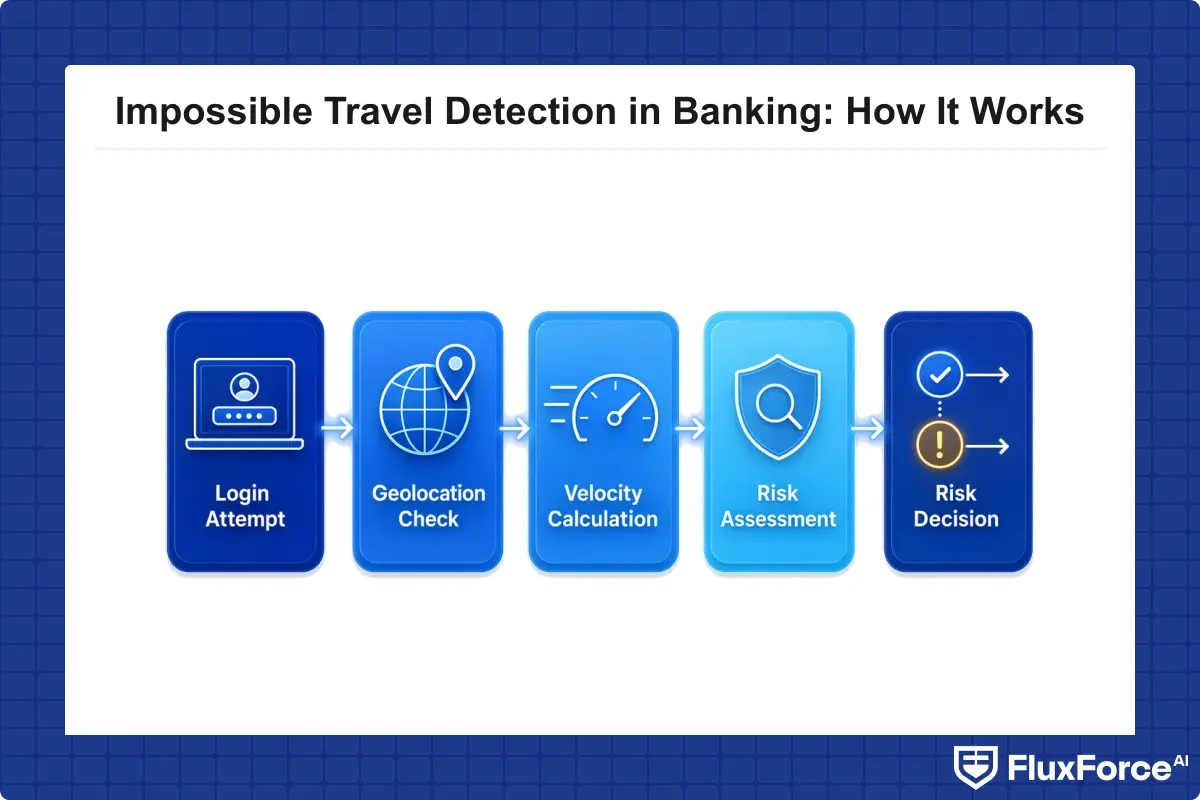
Impossible travel detection compares the geographic distance between two login or transaction events against the time elapsed, using IP geolocation, device data, and a calculated maximum feasible travel speed to flag physically implausible activity.
Geolocation and Login Velocity Checks
The base calculation is simple: distance divided by time. If the resulting speed exceeds what a commercial flight can achieve, roughly 500 to 600 mph with a buffer for time zones and airport handling, the system flags the pair of events. This is the oldest and most literal form of the check.
Device and Session Fingerprinting
Distance alone produces false positives. A customer on a VPN, a corporate proxy, or a roaming SIM can look like they teleported without doing anything wrong. Device fingerprint, browser signature, and session token continuity narrow that down, because a genuine device switch usually comes with other changes a spoofed session doesn't have.
Behavioral Baselining Across Sessions
The most reliable version of this check does not just look at one login. It builds a rolling profile of where, when, and how a specific customer normally accesses their account, then measures new activity against that individual baseline instead of a single global rule. This is where agentic ai financial services platforms pull ahead of static systems, because a baseline that updates itself catches drift a fixed rulebook misses.
Why Manual Compliance Reviews Can't Catch Impossible Travel Fast Enough
Manual compliance cost is the quiet budget line nobody presents to the board, but it shows up every time a flagged login sits in a queue instead of getting resolved in real time.
The Real Cost of Compliance in Financial Services
The cost of compliance financial services teams carry isn't just headcount. It's the wire that clears while an analyst is still three tickets behind in the queue, the customer who gets locked out over a false alarm and calls the branch angry, and the audit trail that has to be rebuilt by hand because the review notes live in five different systems. In our client engagements, a single unresolved impossible travel alert commonly sits in queue for two to six hours during business hours, and considerably longer overnight or on weekends, which is exactly the window fraud needs.
Total Cost of Ownership of a Manual-Review Fraud Platform
Total cost of ownership fraud platform math rarely accounts for review labor, false-positive customer service load, and the opportunity cost of losses that clear before anyone looks at the alert. A platform that only generates alerts, without resolving them, moves the cost from software to headcount. It doesn't remove it.
Our related breakdown on manual compliance vs. AI automation goes deeper into where that labor cost actually lands across a typical compliance team.
5 Ways Agentic AI Improves Impossible Travel Detection
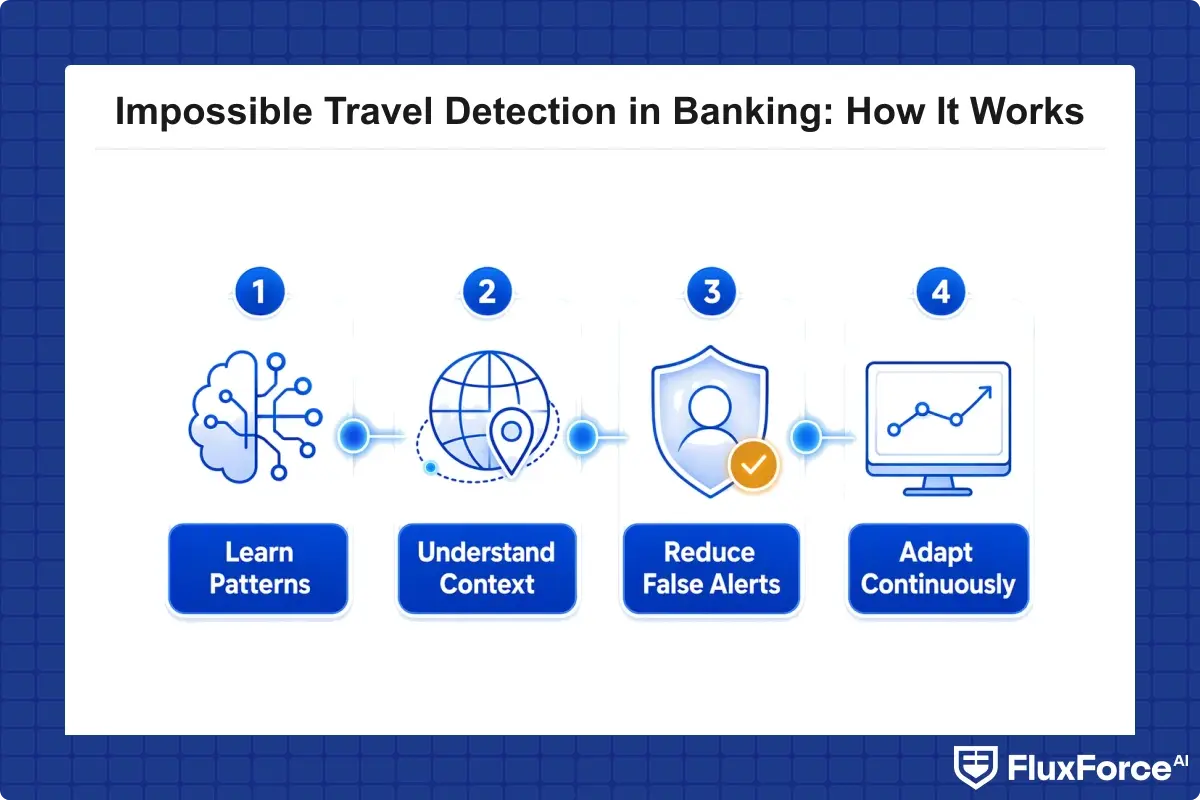
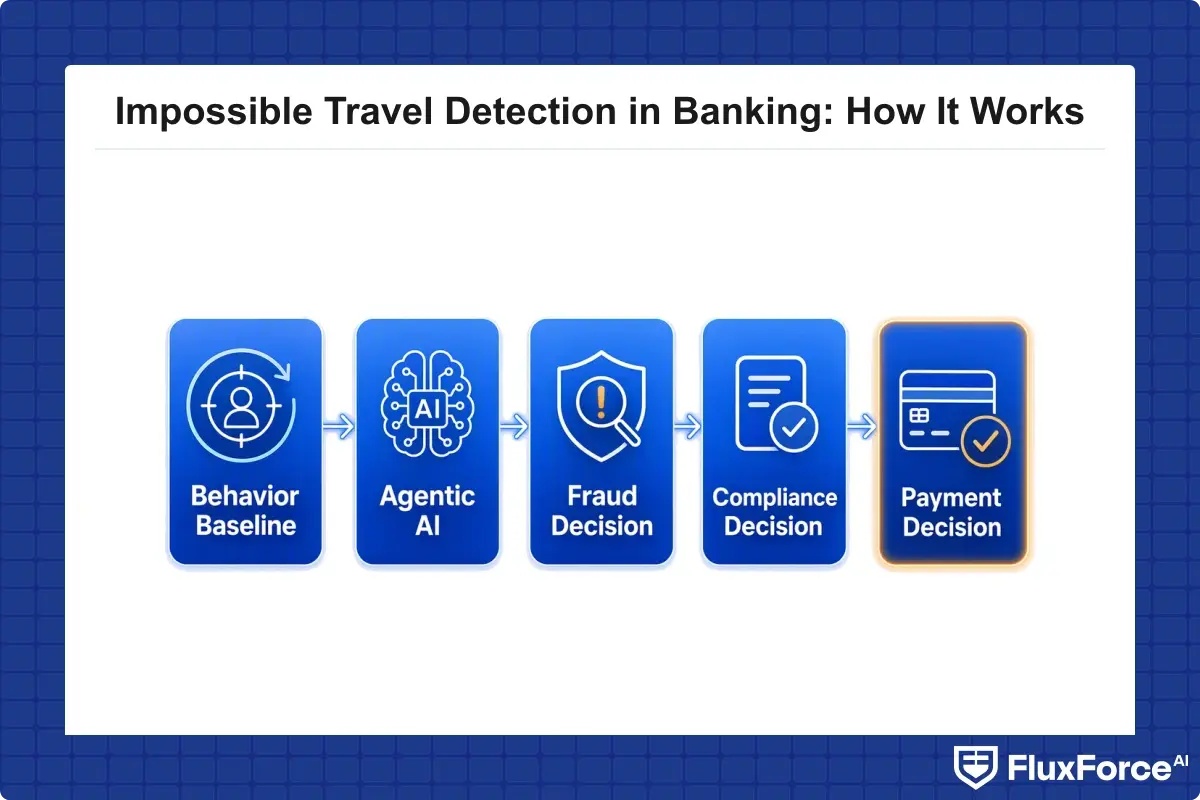
Agentic ai banking systems don't just generate an alert and hand it to a human. They carry the investigation forward, which changes what detection actually delivers.
1. It Correlates Travel Signals With Device and Behavior in Real Time
Instead of a single distance-over-time check, an agentic system pulls device fingerprint, IP reputation, transaction pattern, and historical baseline into one decision, in the same second the event happens.
2. It Builds a Personal Travel Baseline Instead of a Static Rulebook
A customer who travels for work every month looks different from one who has never left their home city. Agentic systems learn that difference per account, which is the single biggest driver of false-positive reduction. Our piece on how agentic AI fraud agents cut false positives by 80 percent covers the mechanics of that baseline learning in more depth.
3. It Resolves Low-Risk Alerts Autonomously Before a Human Ever Sees Them
Not every impossible travel flag needs an analyst. A clearly low-risk case, small transaction, known device, short distance discrepancy, can be auto-cleared with a logged rationale, so human review time goes to the cases that actually need judgment.
4. It Explains Its Own Decisions for Audit and Compliance
Every auto-resolved or escalated case comes with a plain-language rationale tied to the specific signals that drove it. That matters for examiners as much as it matters for customers who ask why their card got blocked.
5. It Shares Risk Signals Across Channels in Real Time
A flagged login on mobile should inform the risk score on a wire transfer request five minutes later on web. Agentic systems keep that context live across channels instead of treating each system as its own silo, something rule-based platforms bolted together over a decade almost never do well.
Impossible Travel Detection vs Traditional Rule-Based Alerts
Rule-Based Alerts vs Agentic AI Detection
| Aspect | Rule-Based Impossible Travel Alerts | Agentic AI Detection |
|---|---|---|
| Trigger logic | Fixed distance/time threshold | Threshold plus device, behavior, and channel context |
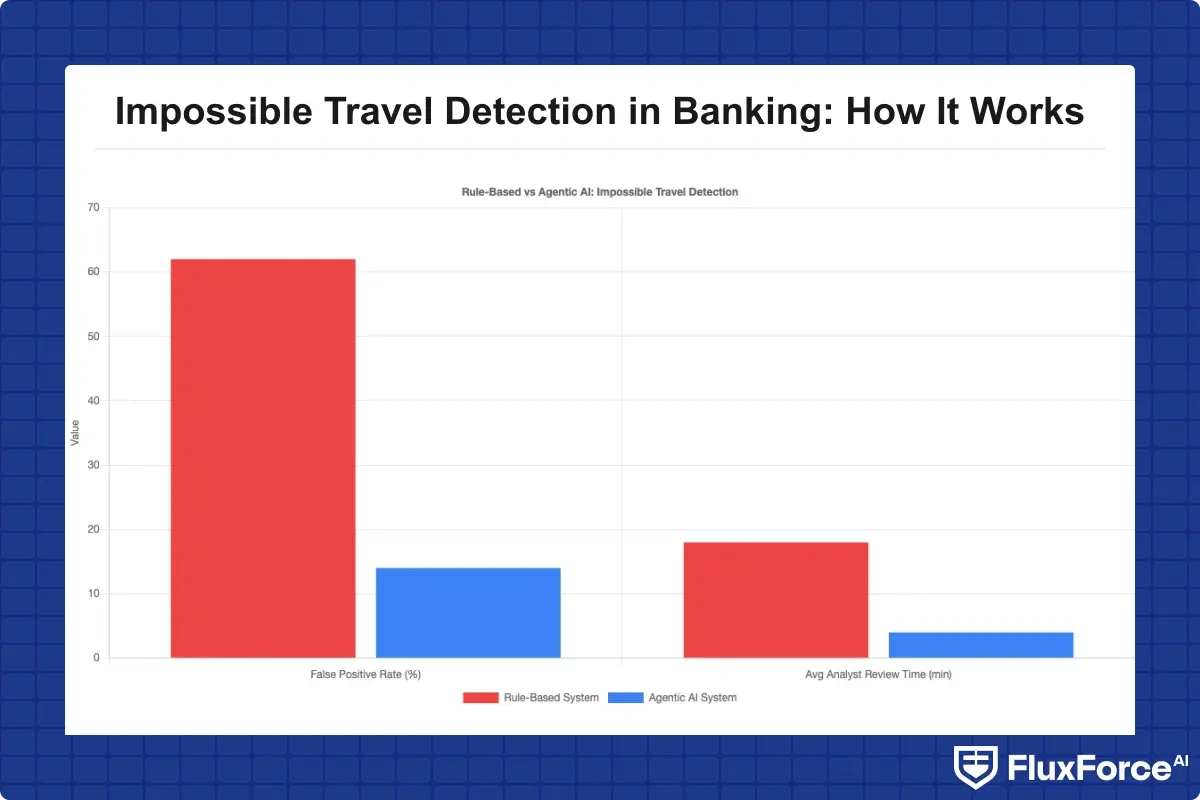
| False positive rate | High, especially for VPN and roaming users | Meaningfully lower once a personal baseline is established |
| Resolution | Alert sits in a queue for a human | Low-risk cases resolved autonomously, others escalated with context |
| Audit trail | Manual analyst notes | Auto-generated, signal-linked rationale |
| Maintenance | Rules tuned manually as fraud patterns shift | Baseline adapts continuously per account |
For a deeper look at how rule-based systems specifically fail on false positives, see our comparison of rule-based systems vs. AI for false positive reduction.
What Is the ROI of Fraud Prevention Automation?
Fraud prevention ROI comes from three places: fewer completed fraud losses, fewer analyst hours spent on false positives, and fewer customers lost to unnecessary account lockouts. In practice, the second two add up faster than the first.
Compliance automation roi is easiest to make concrete with a simple comparison. If a bank's compliance team spends, in our experience, an average of 20 minutes reviewing each impossible travel alert, and a mid-size retail bank generates several hundred such alerts a month, that is dozens of analyst-hours a month spent on a single alert type before AI has resolved a single case on its own.
A false positive that locks out a real customer often costs more than the fraud it might have caught. One blocked paycheck deposit or missed mortgage payment can trigger a churn event that a single averted fraud loss never offsets.
Fraud prevention roi calculations should also account for the security architecture underneath the detection layer. Impossible travel detection works best layered inside a broader zero trust security architecture, where every session is continuously verified rather than trusted after a single login check.
How FluxForce Approaches Impossible Travel Detection
We built FluxForce because we kept seeing the same gap: banks had alerting, but not resolution. FluxForce is an agentic AI layer that sits on top of existing fraud and compliance data and closes that gap.
FluxForce AI's Detection Engine
FluxForce ai correlates geolocation, device fingerprint, transaction pattern, and account-specific behavioral baseline in a single pass, and it can auto-resolve the clear cases while routing ambiguous ones to a human with a full rationale attached. That resolution layer is what separates it from an alerting tool bolted onto a rules engine. Banks evaluating a core banking modernization roadmap often add impossible travel detection as one of the first agentic modules, since it plugs into existing identity and transaction data without a full core rebuild.
What a FluxForce Review Shows Compliance Teams
In a fluxforce review, compliance teams typically look at three things: how much of the current alert volume gets auto-resolved, how the rationale trail holds up under an examiner's questions, and how the false-positive rate shifts over the first 90 days as the behavioral baseline matures. Those are the numbers that turn a pilot into a full rollout, more than any raw detection accuracy figure on its own.
Related reading: why legacy fraud detection fails without agentic AI and zero trust plus agentic AI as the new normal for banking security.
The Future of AI in Banking: 2026 and Beyond
AI in Banking 2026: Where the Hype Meets Reality
Ai in banking 2026 conversations tend to swing between two extremes, full autonomy on one side and skepticism that any of it works on the other. The honest answer sits in between. Ai in banking hype vs reality plays out clearest in fraud: the parts of detection that are pattern-matching against a baseline are ready for autonomy now, and the parts that require judgment calls on ambiguous, high-value cases still belong with a human analyst.
Agentic AI in Financial Services Beyond Fraud
Future of ai in banking extends past fraud into compliance reporting, KYC refresh cycles, and payment routing decisions, anywhere a repeatable judgment call currently eats analyst time. Ai automation banking adoption is following the same pattern as impossible travel detection: start with the highest-confidence, lowest-ambiguity decisions, prove the resolution rate, then expand scope.
- Impossible travel detection flags logins or transactions that are geographically impossible given the time between them, and it is one of the highest-confidence fraud signals available.
- Distance and time alone produce false positives; device fingerprinting and behavioral baselining are what make the signal reliable.
- Manual compliance review queues turn a fast signal into a slow one, and the manual compliance cost shows up in analyst hours, customer churn, and audit rework.
- Agentic AI changes the model from alert-and-wait to correlate-resolve-explain, cutting both false positives and review time.
- Fraud prevention ROI and compliance automation ROI come mostly from resolution speed and false-positive reduction, not just raw catch rate.
- Impossible travel detection works best as one module inside a broader zero trust and core banking modernization strategy, not a standalone bolt-on.
Onboard Customers in Seconds
Conclusion
Impossible travel detection is a simple idea, a login can't happen in two cities at once, but making it reliable takes more than a distance-over-time formula. Every bank running a rules-only version of this check is absorbing hours of manual compliance cost and turning away real customers over VPN-triggered false alarms.
The fix is behavioral baselining, autonomous resolution of low-risk cases, and cross-channel signal sharing, the three things a static rules engine was never built to do. Together they are what separates an alert queue from an actual fraud prevention ROI story.
Adopting this in practice means layering an agentic detection engine over your existing identity and transaction data, not ripping out your core systems. Banks that have made this shift report auto-resolving the majority of low-risk impossible travel alerts within the first quarter, freeing analysts for the cases that actually need a human. If your compliance team is still reviewing every impossible travel flag by hand, start by measuring how many of them could have resolved themselves.

Share this article