.webp)







Listen To Our Podcast🎧
Introduction
Zero trust DORA compliance is now the baseline expectation for any bank, insurer, or payments firm operating in the EU, not a future-state ambition. The Digital Operational Resilience Act took effect on January 17, 2025, and it ties ICT risk management, incident reporting, and third-party oversight directly to how well an institution can prove its access controls actually work under stress (EUR-Lex, Regulation (EU) 2022/2554).
Most compliance teams we talk to are still running perimeter-based security models with quarterly access reviews bolted on top. That approach cannot produce the continuous evidence DORA auditors expect. The gap between what regulators ask for and what legacy infrastructure can deliver is exactly where zero trust architecture earns its keep.
This guide breaks down what DORA actually requires, why perimeter security falls short, and how a zero trust model built on agentic AI banking systems closes the resilience gap without adding headcount to your compliance function.
- What DORA compliance actually requires from ICT risk management and incident reporting
- Why manual compliance cost keeps climbing even as headcount grows
- The 5 pillars of a zero trust DORA compliance framework you can implement in phases
- How agentic AI banking tools reduce false positives and speed up resilience testing
- A practical way to calculate fraud prevention ROI and compliance automation ROI before you buy anything
- Where FluxForce fits if you're evaluating vendors for this shift
Onboard Customers in Seconds

What Is DORA Compliance and Why Does Zero Trust Matter Now?
DORA compliance means an EU financial entity can demonstrate continuous ICT resilience, not just a passing annual audit. The regulation requires real-time incident classification, mandatory reporting windows, and proof that third-party ICT providers are monitored on an ongoing basis, not reviewed once a year.
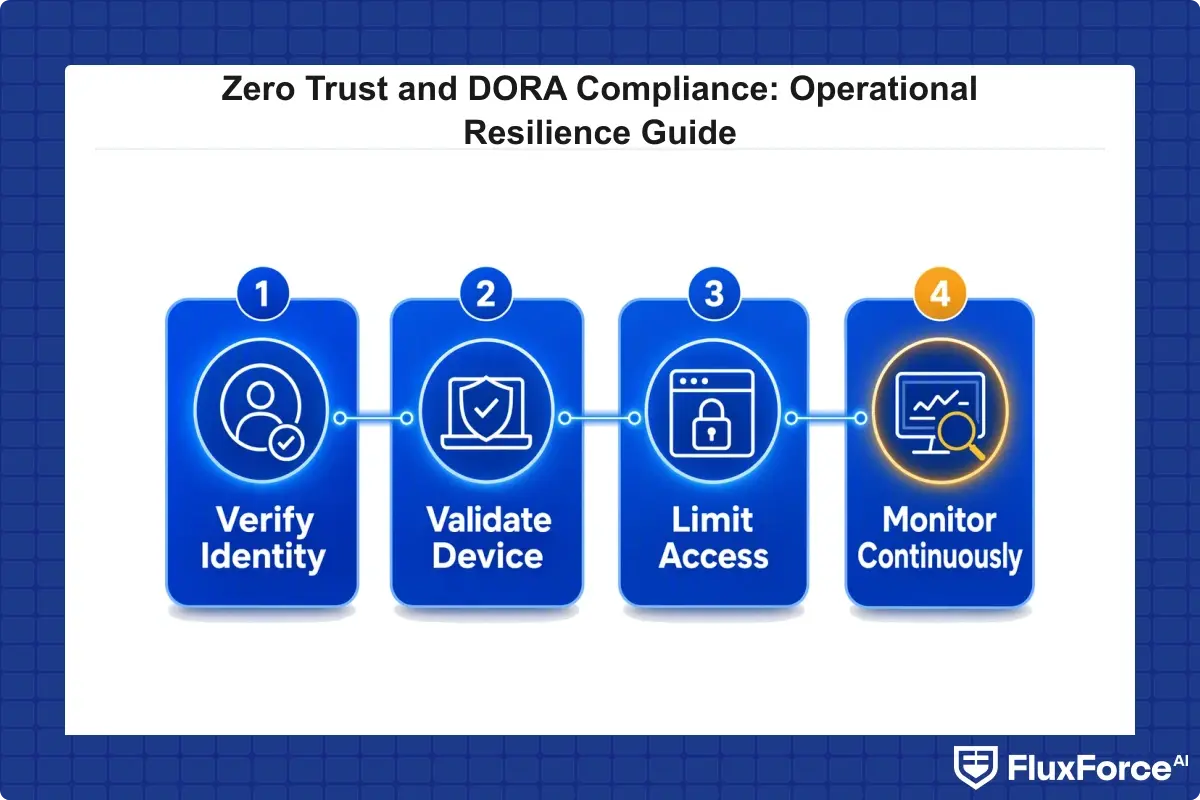
Zero trust matters here because DORA's resilience testing provisions assume you can verify every access request, every session, and every privilege change at the moment it happens. A network perimeter with broad internal trust cannot produce that trail.
What Counts as an ICT-Related Incident Under DORA?
DORA defines an ICT-related incident broadly: any event that compromises the availability, authenticity, integrity, or confidentiality of ICT systems. That includes a stalled batch job, a misconfigured API, or an internal account accessing data outside its normal pattern. Our API security strategies for CISOs in banking piece covers how API-level monitoring feeds directly into this reporting obligation.
Why Perimeter-Based Security Fails DORA's Resilience Testing Requirements
Perimeter models grant broad trust once a user or service is inside the network. DORA's testing requirements ask you to simulate failure scenarios and prove containment. If an attacker (or a compromised vendor credential) has broad internal access, containment testing fails before it starts. That single gap is why regulators keep circling back to identity-level controls in their guidance.
DORA's incident reporting clock starts the moment an anomaly is detected, not when it's confirmed, which means a zero trust system that flags unusual access in seconds instead of hours can be the difference between a minor filing and a major one.
The Real Cost of Manual Compliance in Financial Services
Manual compliance cost is not just salaries. It's the opportunity cost of compliance officers doing evidence collection instead of risk analysis, and it's the fines that show up when a manual review misses something a continuous system would have caught. The cost of compliance financial services firms carry has grown every year DORA, PSD2, and GDPR requirements have stacked on top of each other.
How Much Does Manual Compliance Cost a Mid-Size Bank?
In our client engagements, mid-size banks running manual quarterly access reviews typically spend the equivalent of two to three full-time compliance analysts just preparing evidence packages for auditors. That's before you count the incident response hours spent manually tracing which system or vendor touched an affected account. This is our own estimate from project work, not a third-party statistic, and it varies a lot by institution size and existing tooling maturity.
The Hidden Cost of Compliance Automation ROI Delays
Here's the honest tradeoff: compliance automation ROI doesn't show up in month one. Teams that delay automation because the first-year cost looks high usually end up paying it anyway, just later, in overtime during an audit cycle or in the cost of a missed reporting deadline. Our regulatory compliance automation strategy for compliance officers post walks through how to build the business case internally.
| Approach | Manual Compliance | Zero Trust + AI Automation |
|---|---|---|
| Evidence collection | Quarterly, manual export and review | Continuous, logged automatically |
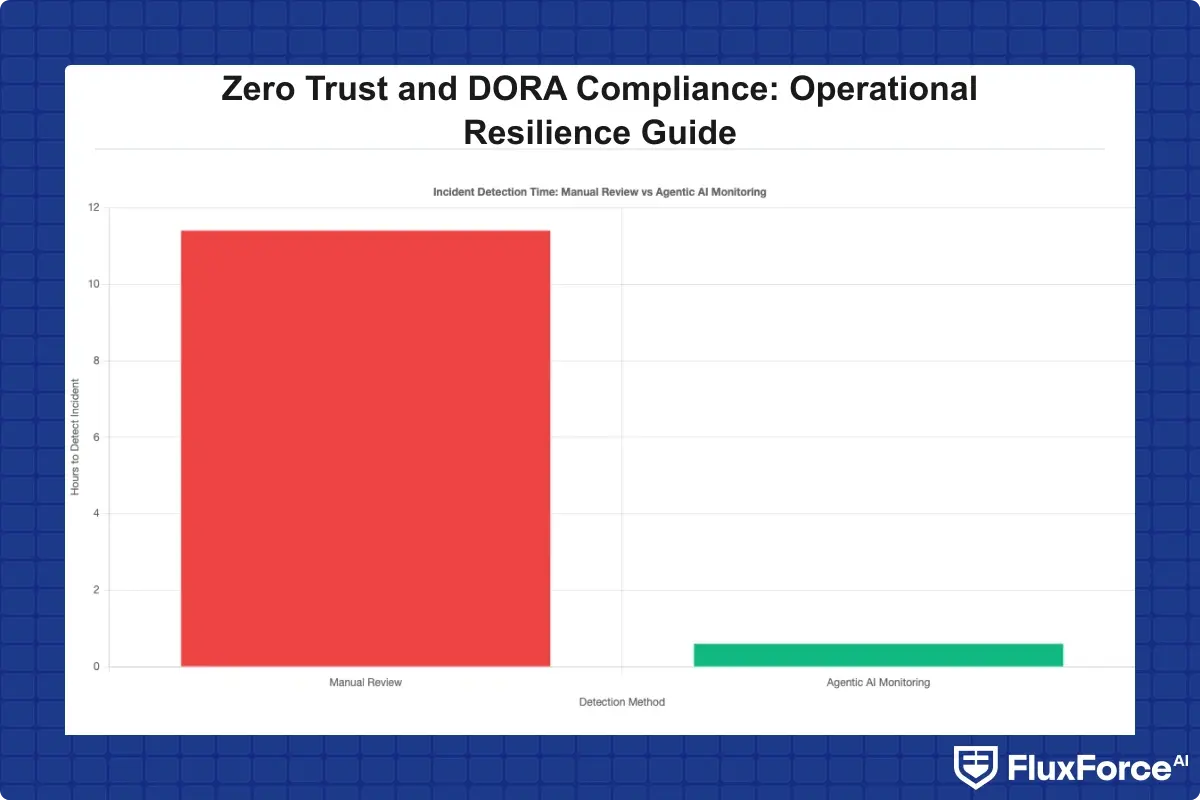
| Incident detection time | Hours to days | Seconds to minutes |
| Third-party vendor monitoring | Annual questionnaire | Continuous access scoring |
| Audit prep effort | Weeks per cycle | Days, evidence is already structured |
| False positive rate | High, rule-based flags | Lower, context-aware scoring |
5 Pillars of a Zero Trust DORA Compliance Framework
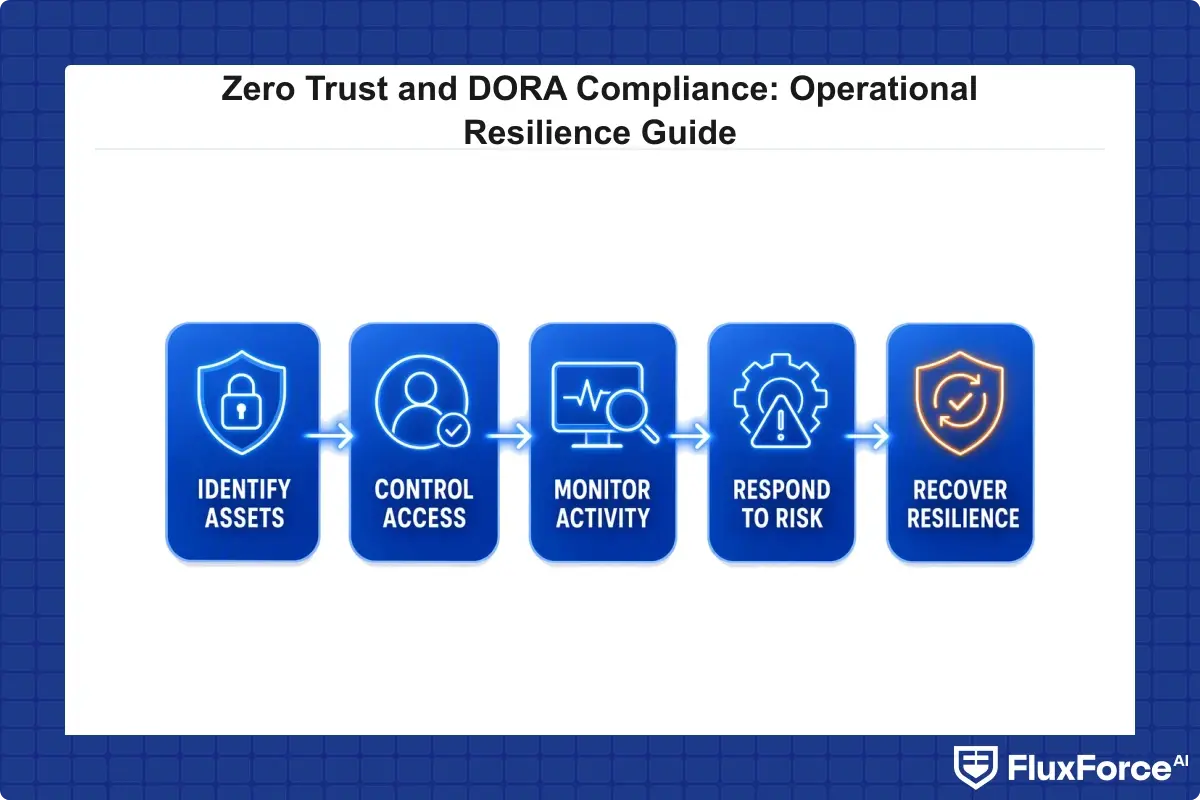
A workable zero trust DORA compliance program isn't one product, it's five overlapping controls that together produce the continuous evidence DORA expects.
1. Identity Verification at Every Access Point
Every user, service account, and API call gets verified individually, not once at login. This is the foundation that makes the rest of the framework possible.
2. Least-Privilege Access by Default
Accounts get only the permissions needed for the current task, scoped and time-limited. Our banking access controls guide for ops heads covers how to phase this in without breaking existing workflows.
3. Continuous Monitoring and Micro-Segmentation
Networks are broken into small segments so a compromised credential in one system cannot move laterally into another. This is what makes DORA's containment testing pass.
4. Automated Incident Classification and Reporting
When an anomaly is flagged, the system classifies severity and timestamps it automatically, which is exactly the evidence trail DORA's reporting windows demand.
5. Continuous Third-Party Risk Scoring
Vendor and ICT third-party access gets scored on an ongoing basis instead of an annual questionnaire, closing DORA's third-party risk management gap directly.
How Agentic AI Banking Systems Strengthen Operational Resilience
Agentic AI banking systems do the continuous verification work that a compliance team cannot do manually at scale. Instead of a static rule set flagging every unusual login, an agentic system builds behavioral context and only escalates what actually warrants human review.
Agentic AI Financial Services Use Cases for Continuous Monitoring
The clearest agentic ai financial services use cases we see in production are transaction anomaly detection, automated vendor access reviews, and real-time API traffic scoring. Our Zero Trust + Agentic AI piece goes deeper into how these agents coordinate with existing identity systems rather than replacing them.
AI in Banking 2026: Hype vs Reality Check
Ai in banking 2026 conversations are full of promises about fully autonomous compliance. The honest answer is it depends on the use case. Agentic systems are genuinely good at pattern detection and evidence assembly today. They are not yet good at making final regulatory judgment calls, and treating ai in banking hype vs reality with that distinction in mind will save you a bad procurement decision. The future of ai in banking looks more like augmented compliance teams than unattended ones, at least through this regulatory cycle.
The institutions getting real value from ai automation banking today are the ones using it to cut detection time, not the ones trying to remove humans from the reporting decision entirely.
Zero Trust vs Perimeter Security: Which Model Meets DORA Requirements?
DORA doesn't name zero trust explicitly, but its resilience testing and incident reporting timelines effectively rule out perimeter-only models for any institution that wants to pass an audit without scrambling.
Zero Trust vs Perimeter Security
| Factor | Perimeter Security | Zero Trust Architecture |
|---|---|---|
| Trust assumption | Broad trust once inside the network | No implicit trust, verified continuously |
| DORA incident evidence | Reconstructed after the fact | Logged in real time |
| Third-party access control | Static, often shared credentials | Scoped, individually scored |
| Resilience testing outcome | Containment often fails | Containment is built in |
| Regulatory audit prep | Manual reconstruction | Evidence already structured |
Our continuous user verification guide for banking risk heads covers the phased migration path from a legacy perimeter model, which matters because ripping out existing infrastructure overnight is not realistic for most institutions.
Calculating Fraud Prevention ROI and Compliance Automation ROI
Before signing any vendor contract, run the numbers yourself. Fraud prevention roi and compliance automation roi are both measurable, and vendors who won't help you model them before the sale are a red flag.
How to Calculate Fraud Prevention ROI
- Baseline your current false positive rate and the analyst hours spent clearing them each month
- Estimate fraud losses avoided using your last 12 months of confirmed fraud cases
- Add the compliance audit hours saved from having automated evidence instead of manual logs
- Subtract the platform's total annual cost, including implementation and training
- Divide the net savings by cost to get your ROI multiple
A simple illustration: if a platform costs $120,000 a year and it saves 1,500 analyst hours at $60/hour ($90,000) plus $150,000 in avoided fraud losses, that's $240,000 in value against $120,000 in cost, a 2x return in year one.
Total Cost of Ownership for a Fraud Prevention Platform
Total cost of ownership fraud platform calculations need to include integration time, not just the license fee. Legacy core banking systems often need middleware to feed data into a zero trust layer, and that integration cost is where a lot of first-year budgets get blown. Our core banking modernization strategy post covers how to sequence that work so it doesn't stall the compliance timeline.
Why FluxForce Is Built for Zero Trust DORA Compliance
We built FluxForce specifically for the gap this guide describes: institutions that need continuous DORA evidence but can't rip out their existing core systems to get it.
FluxForce Review: Core Features for DORA Compliance
FluxForce ai combines continuous identity verification, agentic transaction monitoring, and automated incident classification in one layer that sits alongside your existing infrastructure rather than replacing it. If you're doing a fluxforce review against other vendors, the differentiator is that our agents are trained on financial services access patterns specifically, not generic IT security logs, which cuts the false positive tuning period most institutions dread. For institutions modernizing their core systems at the same time, core banking modernization is the natural pairing since zero trust controls work best when they're designed in rather than bolted onto legacy architecture.
Future of AI in Banking: Where FluxForce Fits
The future of ai in banking is not a single autonomous system, it's a layered set of agents each handling a narrow, well-defined task under human oversight. That's the model we've built toward, and it's why our roll out regulatory compliance agents in 90 days framework focuses on phased deployment rather than a big-bang replacement.
- DORA compliance requires continuous evidence, which perimeter-based security cannot produce on its own.
- Manual compliance cost is rarely just salaries, it's the audit prep hours and missed-deadline risk hiding behind them.
- A zero trust DORA compliance framework rests on five pillars: identity verification, least-privilege access, micro-segmentation, automated incident classification, and continuous third-party scoring.
- Agentic AI banking tools are strongest at detection and evidence assembly today, not at replacing human regulatory judgment.
- Fraud prevention ROI and compliance automation ROI should be modeled with your own numbers before any vendor contract is signed.
- Total cost of ownership for a fraud prevention platform includes integration time with legacy core systems, not just the license fee.
Onboard Customers in Seconds
Conclusion
Zero trust DORA compliance comes down to one question auditors will keep asking after January 2025: can you prove, continuously, that your access controls actually work? Perimeter security and quarterly reviews cannot answer that question fast enough, and the manual compliance cost of trying keeps climbing every reporting cycle.
The fix is a combination of continuous identity verification, agentic AI banking monitoring, and automated incident classification built around the five pillars this guide laid out. None of that requires replacing your core systems overnight.
In practice, adopting this model means phasing in least-privilege access first, layering agentic monitoring on top, and using the resulting evidence trail to cut audit prep time from weeks to days, the same outcome our clients see when they model fraud prevention ROI honestly before buying anything. If your current compliance stack still relies on quarterly manual reviews, start by mapping which of the five pillars you're missing today, and build from there.
FAQ
See faqJson.
Share this article