.webp)







Listen To Our Podcast🎧
Introduction
Agentic AI frameworks decide how your fraud, AML, and compliance agents plan, call tools, and hand work to humans. Pick the wrong one and you get a demo that impresses in week two and fails an audit in month six.
Regulated teams have a harder job than most. Every agent action needs a reason, a log entry, and often a human sign-off. This guide compares five widely used frameworks against those constraints and gives you a four-phase rollout you can start now.
- How five agentic AI frameworks differ on state, control flow, and auditability
- Which selection criteria matter most for banks, insurers, and supply chain teams
- How agents reduce false positives and fraud alert fatigue in transaction monitoring
- A 4-phase rollout, from a Phase 1 (Now) pilot to a governed production platform
- Where each framework is likely to hurt you in a regulated setting
Onboard Customers in Seconds

What Are Agentic AI Frameworks and Why Do Regulated Teams Care?
Agentic AI frameworks are software libraries that let a language model plan multi-step work, call tools, keep state, and coordinate with other agents. They sit between the model and your systems, which makes them the place where control, logging, and permissions either exist or do not.
For a bank or insurer, that layer matters more than the model. Models change every few months. The orchestration layer is what your auditors will read.
How does AI detect fraud when agents are involved?
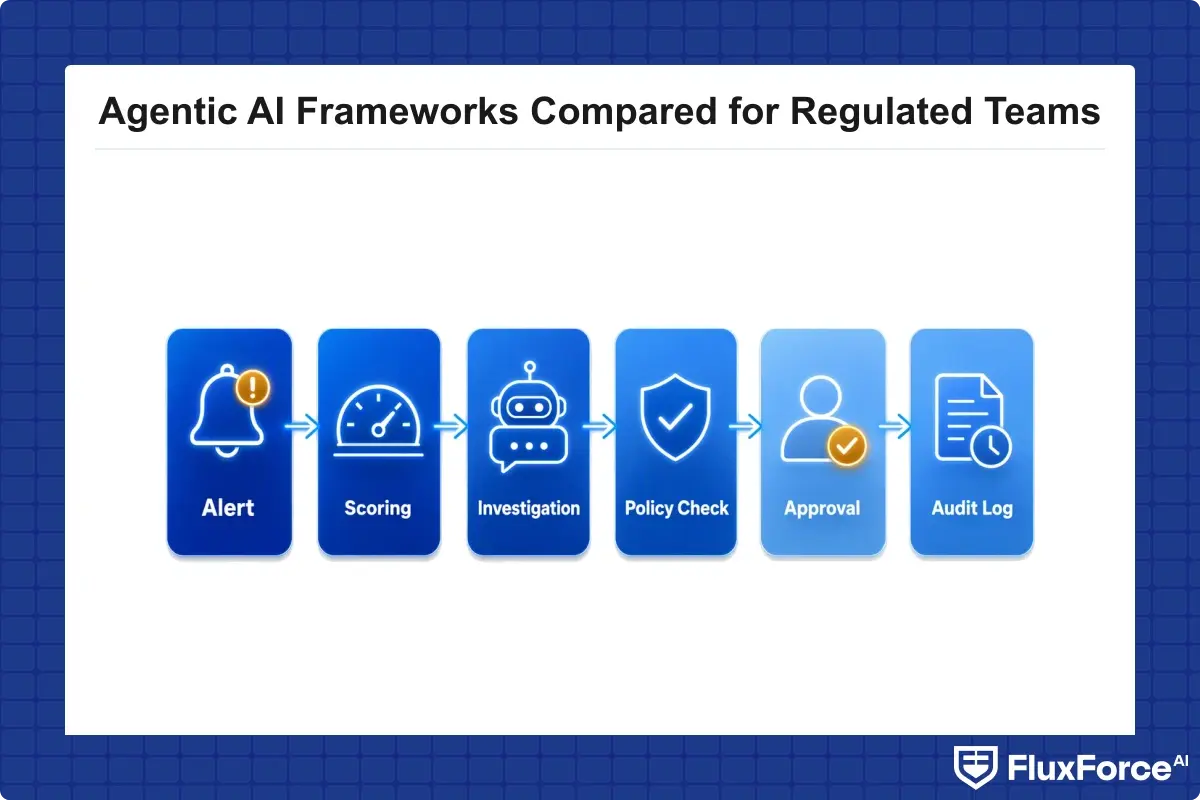
Traditional scoring flags a transaction and stops. An agentic setup goes further: one agent pulls customer history, another checks device and network signals, a third drafts the case narrative, and a human approves the outcome. The question of how AI detects fraud becomes a question of how well those steps are chained and recorded.
AI fraud detection explained: where agents fit
AI fraud detection explained simply: a scoring model finds suspicious patterns, and agents do the investigation work around it. Machine learning fraud detection still produces the risk score. Agents gather evidence, apply policy, and write the rationale. Our earlier comparison of AI versus traditional fraud detection covers the scoring side in more depth.
5 Agentic AI Frameworks Compared for Regulated Use
The five below are the ones we see most often in evaluations. All are open source or have open SDKs, and each publishes official documentation. Comparisons here reflect our own engagement experience, not a benchmark.
1. LangGraph
LangGraph models an agent as an explicit graph with shared state, checkpoints, and interrupt points. That maps well to approval gates, because you can pause a run before a payment hold and resume it after review.
The tradeoff is engineering effort. You define nodes and edges yourself, which is a feature for auditors and a cost for small teams.
2. Microsoft AutoGen
AutoGen focuses on conversations between agents, including human proxies. It suits analyst-in-the-loop workflows where several specialists debate a case.
Conversation-driven control flow is harder to predict. For regulated work, you need to constrain who can speak, when, and with which tools.
3. CrewAI
CrewAI uses roles, goals, and tasks, so a compliance workflow reads almost like an org chart. It is quick to prototype.
The honest limitation: role-based abstractions hide detail. You will likely add your own logging to meet record-keeping rules.
4. OpenAI Agents SDK
The OpenAI Agents SDK is lightweight, with handoffs, guardrails, and tracing built in. It is a good fit when you already standardize on one model provider.
Check data residency and vendor concentration before adopting it. Many banks need a multi-model option.
5. Semantic Kernel
Semantic Kernel is Microsoft's SDK for .NET, Python, and Java. Enterprises with existing .NET estates often find it easiest to place under current identity and deployment controls.
Its planning features are less opinionated than LangGraph's graphs, so governance patterns are yours to design.
Framework Comparison Table: LangGraph vs AutoGen vs CrewAI and Others
| Framework | Strongest fit | Watch out for |
|---|---|---|
| LangGraph | Approval gates, resumable investigations | More code to write and maintain |
| AutoGen | Multi-analyst review conversations | Unpredictable turn-taking |
| CrewAI | Fast role-based prototypes | Thin built-in audit detail |
| OpenAI Agents SDK | Single-provider stacks, tracing | Vendor concentration risk |
| Semantic Kernel | .NET enterprises, existing identity controls | Governance patterns are DIY |
In regulated work, the framework with the most explicit control flow usually beats the one with the most autonomy. If you cannot replay a decision step by step, you cannot defend it.
What Should Regulated Teams Require From Agentic AI Frameworks?
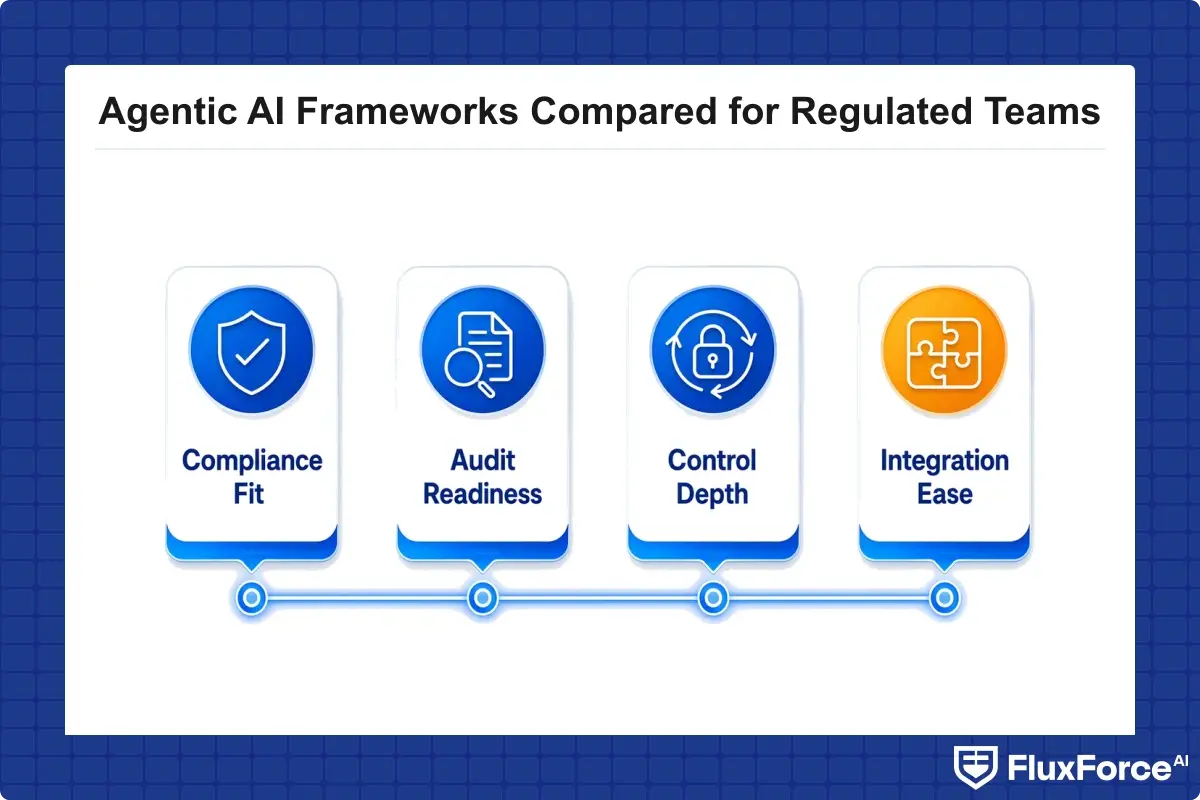
Start from the obligations, not the feature list. Guidance such as the NIST AI Risk Management Framework and the EU AI Act points to the same needs: traceability, human oversight, and documented risk controls.
Audit trails and human approval
Ask five questions of every candidate:
- Can every tool call and model output be logged with a timestamp and run ID?
- Can a run pause for human approval and resume with the same state?
- Can you restrict which tools each agent may call?
- Can you replay a past decision with the same inputs?
- Can you swap the underlying model without rewriting workflows?
If a framework fails two or more, plan to build the missing pieces yourself.
Real time fraud detection in banks: latency needs
Real time fraud detection banks run on card and payment rails, where the decision window is measured in milliseconds. Agents are too slow for that path. Keep the scoring model inline for real time fraud detection, and use agents asynchronously for investigation, enrichment, and case writing.
This split is the most common design mistake we correct. Putting a multi-step agent on the authorization path adds latency and failure modes you do not need.
How Do Agentic AI Frameworks Cut Fraud Alert Fatigue?
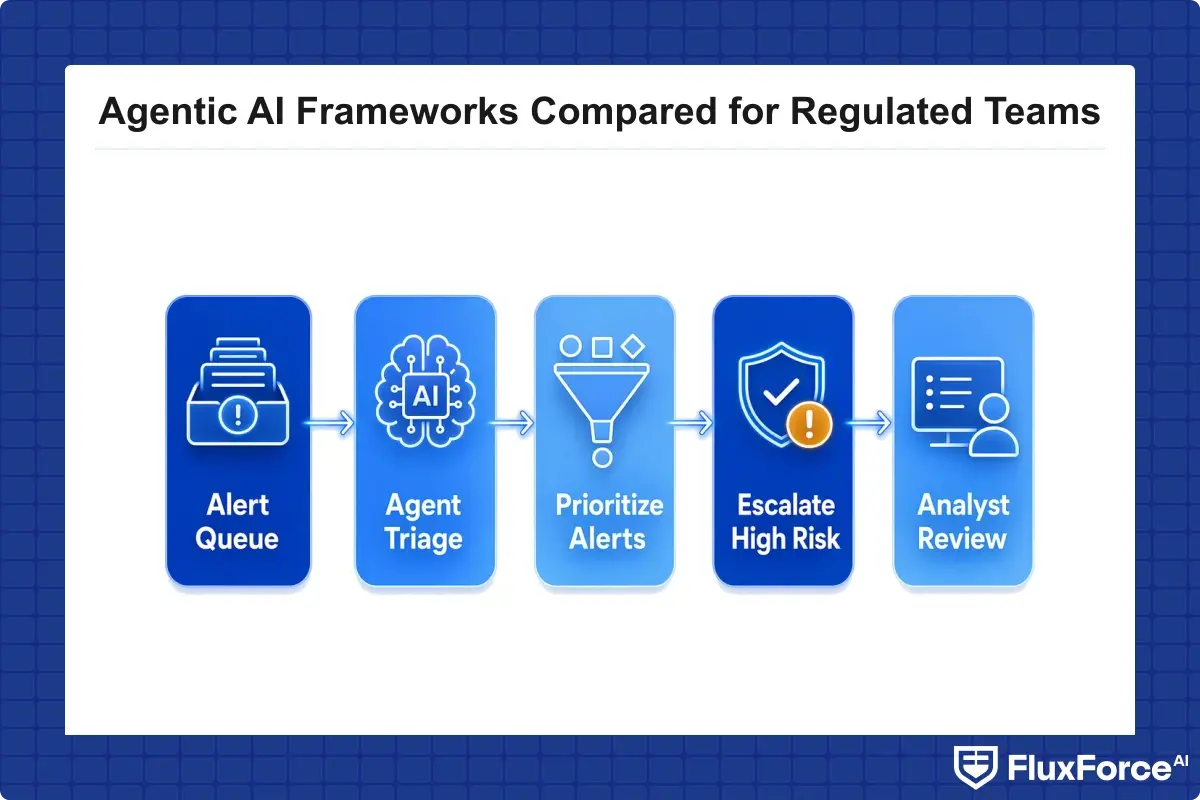
Agents cut fraud alert fatigue by doing the first-pass investigation, so analysts see a summarized case instead of a raw alert. The alert volume does not disappear, but the time spent per alert falls.
This is where transaction monitoring software gets its biggest lift. Rule engines generate large queues, and most alerts close as benign. Our post on how agentic AI fraud agents cut false positives walks through one such deployment.
False positives in fraud detection: the cost and the rate
False positives fraud detection teams live with are expensive in two ways: analyst hours and customer friction. The false positive cost fraud programs carry includes declined good customers, who often churn silently. Measure your false positive rate fraud detection baseline before you add agents, or you will not be able to prove improvement.
How to reduce false positives in AML with agents
How to reduce false positives in AML comes down to context. An agent can check counterparty history, expected activity for the customer segment, and prior closed alerts before escalating. To reduce false positives transaction monitoring queues generate, route only unresolved cases to humans and log why the rest were closed.
For a side-by-side view, see rule-based systems versus AI for false positives.
Always measure your alert-to-case conversion rate before deploying agents. A false positive reduction you cannot measure against a baseline is a claim, not a result.
Rules-Only vs Agent-Assisted Monitoring
| Aspect | Rules only | Agent-assisted |
|---|---|---|
| First-pass review | Analyst reads raw alert | Agent summarizes evidence |
| Context checked | Whatever the analyst opens | History, peers, prior alerts |
| Audit record | Analyst notes | Logged steps plus analyst sign-off |
| Tuning effort | Manual threshold edits | Feedback from closed cases |
4 Phases to Roll Out Agentic AI Frameworks Safely
In our client engagements, a first governed pilot typically takes a few months, though your timeline depends on data access and model risk review. The phases below keep scope small until controls are proven. Our guide to rolling out compliance agents in 90 days covers the early stretch in detail.
1. Phase 1 (Now): Pick one workflow and one framework
Choose a single, high-volume, low-risk workflow such as alert summarization. Run two frameworks against it side by side. Agents recommend only; humans decide every case.
2. Phase 2: Add logging, guardrails, and evaluation
Stand up run-level logging, tool permissions, and a test set of past cases. Have model risk and compliance review the design before any autonomy is granted.
3. Phase 3: Connect to production systems
Integrate with case management and your AI fraud detection software. Buying fraud detection software with agent workflows built in is often faster than assembling scoring, orchestration, and audit tooling yourself. Either way, keep humans on approval steps.
4. Phase 4: Expand with measured autonomy
Raise autonomy only where the data supports it, for example auto-closing a narrow class of low-risk alerts. Review monthly and keep a rollback path. Many teams will find AI fraud detection in banking works best with autonomy widened one workflow at a time.
- Agentic AI frameworks are the control layer auditors will inspect, so choose for traceability first and features second.
- LangGraph offers the most explicit control flow, while CrewAI and AutoGen trade some predictability for speed and flexibility.
- Keep scoring inline for real time fraud detection and use agents asynchronously for investigation.
- Measure your false positive baseline before deployment, or you cannot prove agents helped.
- Roll out in four phases, starting with recommend-only agents and humans deciding every case.
Onboard Customers in Seconds
Conclusion
Choosing among agentic AI frameworks is really a decision about audit risk. Regulated teams that skip the evaluation criteria tend to rebuild logging and approval flows after the pilot, which erases the speed they were chasing.
Three things solve most of it: explicit control flow you can replay, human approval gates on consequential actions, and a measured baseline for false positives and alert handling time. Apply those to any framework in the table above and the shortlist gets short quickly.
A realistic path is one workflow in Phase 1, governance in Phase 2, and production integration only after that. Teams that measure carefully can show results from the first pilot. For deeper security context, our piece on zero trust and agentic AI is a good next read. Pick one alert-triage workflow this week and run two frameworks against it.
Share this article