.webp)







Listen To Our Podcast🎧
Introduction
Zero trust identity and access management is the practice of verifying every user, device, and service on every request instead of trusting anything because it sits inside the network. For a bank, that shift matters because most serious breaches now start with a stolen credential, not a broken firewall.
A teller, a developer, a payment API, and an AI agent all hold access that an attacker would like to borrow. If one of those identities is compromised and your controls only check it at login, the attacker inherits everything that identity can reach.
This guide explains what zero trust IAM means in a bank, the controls that make it work, what it costs, and how to roll it out without stalling operations.
- How zero trust IAM differs from perimeter and password-only security in a banking environment
- The 5 controls every bank needs before it can call its identity program zero trust
- Where agentic AI banking fits into identity decisions, and where it does not
- How to compare manual compliance cost against automated verification
- A 6-step rollout plan you can start with your existing core systems
- Which numbers to use when building a fraud prevention ROI case for your board
Onboard Customers in Seconds

What Is Zero Trust Identity and Access Management in Banking?
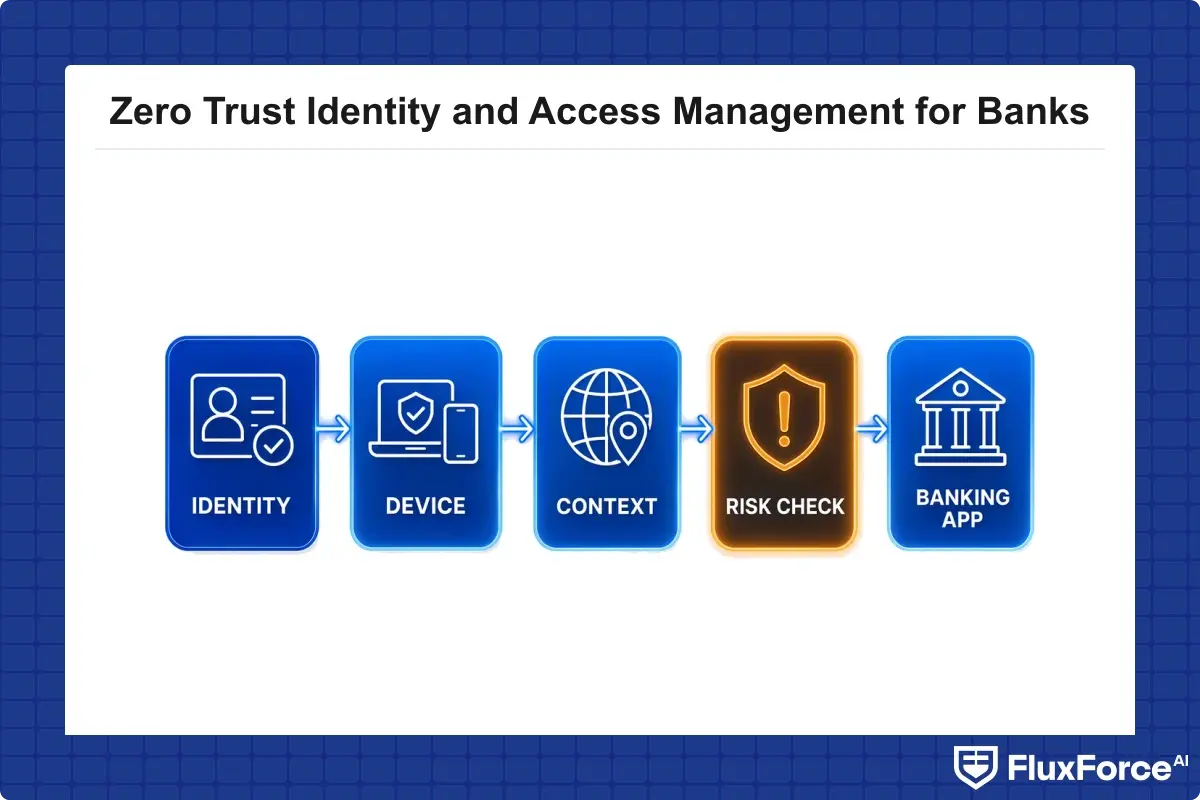
Zero trust identity and access management is a security model where no user, device, or service is trusted by default, and every access request is verified against identity, device health, context, and risk before it is granted. NIST describes the underlying principles in SP 800-207, the Zero Trust Architecture standard, which most bank regulators and auditors now use as a reference point.
The idea sounds abstract until you apply it to a branch, a mobile app, and a cloud data warehouse at the same time. Each of those is a place where a single stale permission can turn into an incident.
How does zero trust differ from perimeter security?
Perimeter security assumes that anything inside the network is friendly. Zero trust assumes the network is already hostile and asks a fresh question on every request: who is this, what are they using, and does this request make sense right now?
The practical difference is the blast radius. A compromised account under a perimeter model can wander. Under zero trust, the same account hits a policy check at each hop and gets stopped early.
Which identities does a bank actually have to govern?
Most teams undercount them. Beyond employees and customers, a bank governs:
- Contractors and third-party vendors with temporary access
- Service accounts and API keys used by payment and core banking systems
- Privileged administrators on databases and cloud consoles
- Non-human identities, including automation scripts and AI agents
In our experience, service accounts are the most neglected group. They rarely rotate credentials and almost never trigger a review.
5 Core Controls of Zero Trust Identity and Access Management
These five controls are the working parts of any zero trust identity program. Skip one and the model has a hole that attackers find quickly. The same principles apply to banking access controls for operations heads, where the day-to-day friction shows up first.
1. Strong, phishing-resistant authentication
Passwords and SMS codes are the weakest link. Move privileged and customer-facing flows to hardware keys or passkeys, and treat one-time codes as a fallback rather than a default.
2. Least-privilege access with just-in-time elevation
Give people the minimum permissions for their role, and grant elevated rights only for the length of a task. A database administrator should not hold standing production access on a Tuesday afternoon.
3. Continuous verification
A login is a single moment. Continuous verification keeps scoring the session using device posture, location, behavior, and transaction patterns. This is the control that catches a hijacked session after the password check has passed. Our post on continuous user verification for banks covers the signals that matter most.
4. Micro-segmentation of systems and data
Split core banking, payments, and analytics into separate zones with their own access policies. If an attacker lands in one zone, they do not automatically see the others.
5. Full logging and audit-ready evidence
Every access decision needs a record: who, what, when, why it was allowed. Regulators such as those enforcing the EU's Digital Operational Resilience Act (DORA) expect banks to demonstrate control over ICT access, not just claim it.
A zero trust program is only as strong as its least-governed identity. Service accounts and API keys, not employees, are where most banks find their first unowned access path.
Why Do Banks Need Continuous Verification Instead of One-Time Login?
Because fraud has moved into the session. Account takeover, session hijacking, and synthetic identities all pass an initial check and misbehave afterward. A control that only fires at login cannot see any of that.
Continuous verification also protects customers without adding friction to every action. Low-risk requests pass quietly, and only unusual ones trigger a step-up challenge. That is how you keep mobile conversion healthy while still blocking abuse, a balance we cover in zero trust for mobile-first banks.
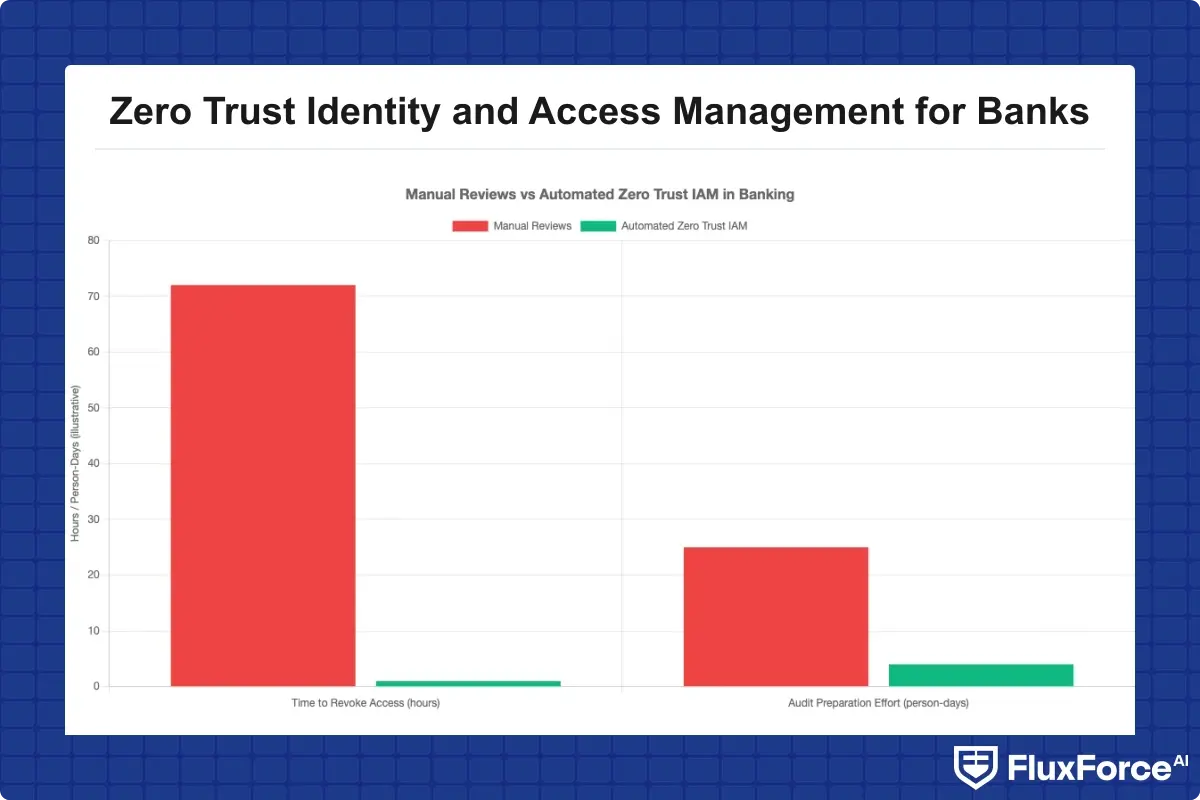
Manual Access Reviews vs Automated Zero Trust IAM
The table below compares the two approaches on the points that decide budgets.
| Factor | Manual reviews | Automated zero trust IAM |
|---|---|---|
| Review frequency | Quarterly or annual campaigns | Continuous, per request |
| Time to revoke access | Days to weeks | Minutes |
| Audit evidence | Assembled by hand from spreadsheets | Generated automatically |
| Staff effort | Heavy, repetitive, error-prone | Focused on exceptions |
| Detection of misuse | After the fact | During the session |
The honest tradeoff: automation needs clean identity data first. If your role definitions are a mess, automating them just makes the mess faster. Plan for a cleanup phase.
How Does Agentic AI Banking Change Identity Decisions?
Agentic AI banking uses autonomous software agents that investigate, decide, and act on tasks such as alert triage and access review. In identity, that means an agent can score a risky session, gather context, and recommend or apply a step-up challenge without a human opening a ticket.
The security implication runs both ways. Agents help you decide faster, and they are also new identities that need the same least-privilege treatment as any employee. We explored that pairing in Zero Trust plus Agentic AI.
AI in Banking Hype vs Reality
The discussion of ai in banking hype vs reality comes down to scope. Agents are strong at high-volume, well-defined decisions such as triaging alerts and reviewing entitlements. They are weak where judgment, accountability, or novel fraud patterns are involved, and those cases still need a person.
Our position is simple: let AI automation banking handle the repetitive volume, and keep humans on approvals for privileged access and policy changes.
The Future of AI in Banking and Agentic AI in Financial Services
The future of ai in banking looks less like a chatbot and more like governed agents inside core workflows. Agentic AI financial services deployments will be judged by auditability: can you show why an agent granted or denied access? If not, regulators will not accept it.
For ai in banking 2026 planning, treat explainability and identity governance for agents as launch requirements, not later upgrades.
Every AI agent you deploy is an identity. If it has no owner, no scope, and no audit trail, you have added an attacker's favorite entry point, not removed a manual task.
What Does Zero Trust Cost, and How Do You Prove the ROI?
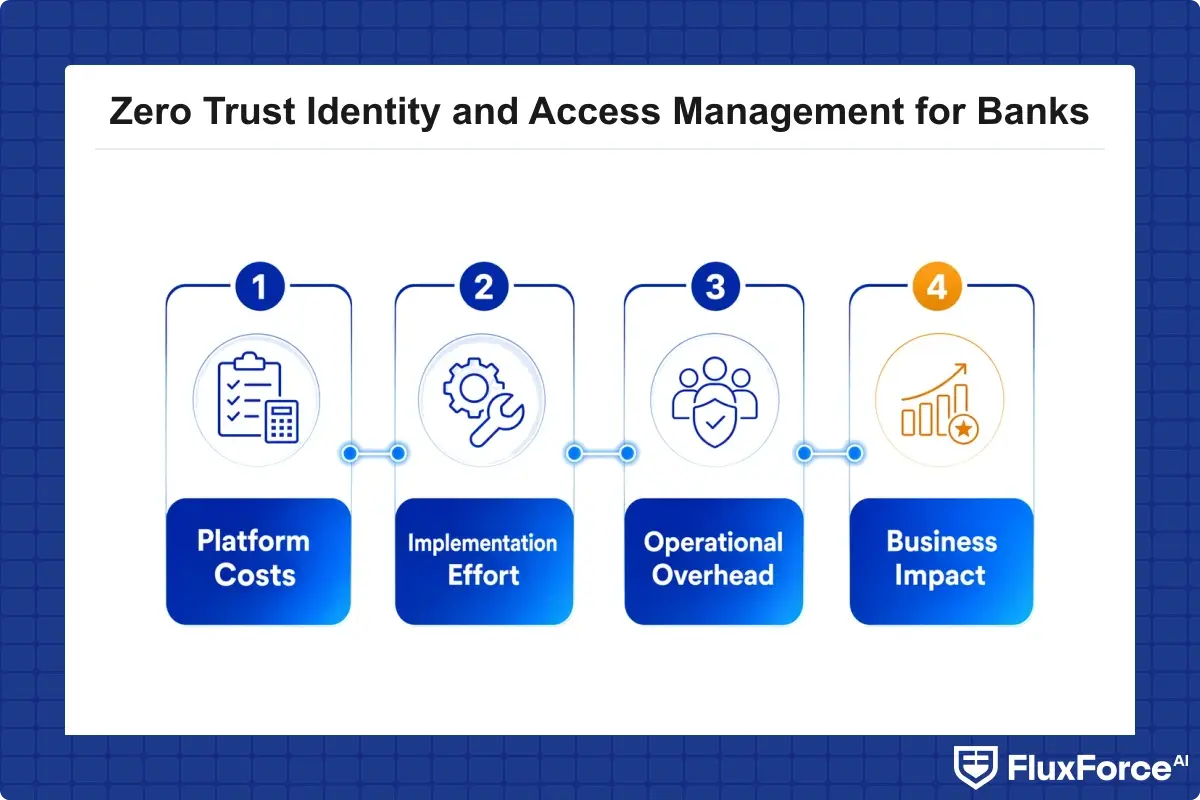
The budget conversation usually stalls because the costs are visible and the avoided losses are not. Build the case from three numbers: what you spend today on manual work, what fraud and incidents cost you, and what the new platform costs to run.
Manual Compliance Cost and the Cost of Compliance in Financial Services
Manual compliance cost hides in analyst hours, spreadsheet-based access reviews, and audit preparation sprints. The cost of compliance in financial services is rarely one line item, which is why it gets underestimated. Our comparison of manual compliance vs AI automation walks through where the hours actually go.
To estimate compliance automation ROI, use this simple frame:
- Count hours spent on access reviews and audit evidence per quarter
- Multiply by your fully loaded hourly cost
- Subtract the hours that remain for exceptions after automation
- Compare the saving against annual platform cost
Total Cost of Ownership for a Fraud Platform
When you calculate the total cost of ownership for a fraud platform, include more than the license. Add integration work, data cleanup, staff training, false-positive handling, and the cost of retiring the systems it replaces.
For fraud prevention ROI, count blocked account takeovers, reduced investigation time, and fewer false declines that annoy good customers. Use your own loss data. Vendor averages are a poor substitute for your actual numbers.
When you read any FluxForce review or vendor comparison, ask for the same breakdown: implementation effort, exception rates, and audit output. FluxForce AI publishes its approach openly, but test every claim against your own pilot data.
6 Steps to Roll Out Zero Trust Identity and Access Management
You do not need to replace everything at once. In our client engagements, a focused first phase typically runs 8 to 12 weeks, depending on how clean the identity data is. The steps below follow the maturity path CISA lays out in its Zero Trust Maturity Model.
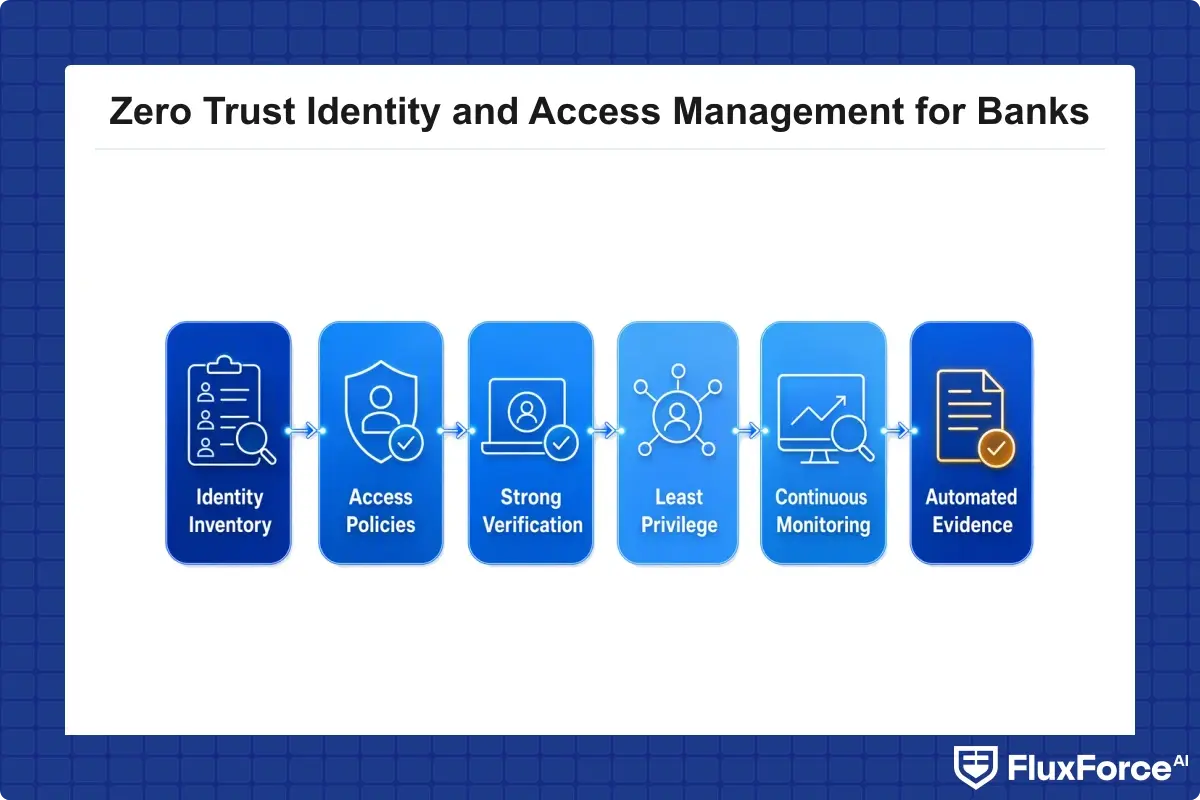
1. Inventory every identity
List employees, contractors, service accounts, API keys, and AI agents. Assign an owner to each. Unowned identities are your first findings.
2. Protect your most sensitive assets first
Start with payments, core banking, and privileged consoles. Pilot on one high-value system before widening scope.
3. Enforce phishing-resistant authentication
Move administrators and high-risk customer actions to passkeys or hardware keys. Retire SMS codes for anything privileged.
4. Replace standing access with just-in-time access
Remove permanent elevated rights and require time-boxed approval. This one change usually removes the largest share of unnecessary exposure.
5. Turn on continuous risk scoring
Feed device, behavior, and transaction signals into a risk engine. Start in monitor-only mode to tune thresholds before you enforce.
6. Automate evidence and reviews
Generate audit logs and access recertifications automatically. If your core systems are the constraint, core banking modernization is often what makes fine-grained access policy possible on legacy platforms.
- Zero trust identity and access management verifies every request, so a stolen credential no longer grants free movement.
- Five controls do the work: strong authentication, least privilege, continuous verification, segmentation, and audit-ready logging.
- Service accounts and AI agents are identities too, and they need owners, scopes, and logs.
- Agentic AI is best used for high-volume decisions, with humans approving privileged changes.
- Build your ROI case from your own manual compliance cost and loss data, not vendor averages.
- Start with your most sensitive systems and expand in six steps rather than attempting a full rebuild.
Onboard Customers in Seconds
Conclusion
Zero trust identity and access management gives banks a way to stop treating login as the finish line. The problem is that quarterly reviews and password checks leave attackers days or weeks of free movement after a single stolen credential.
Three things close that gap: continuous verification on every session, least-privilege access with just-in-time elevation, and automated evidence that keeps auditors satisfied without a spreadsheet sprint. Add governed AI agents on top and your team spends its time on exceptions, not routine reviews.
The path is realistic. A focused first phase runs 8 to 12 weeks in our experience, and the six steps above let you prove value on one system before scaling. Start this week by inventorying every service account and AI agent in your environment, then pick the one payments or core banking system to pilot first.
Share this article