.webp)







Listen To Our Podcast🎧
Introduction
Real time transaction monitoring is the difference between stopping a suspicious wire while it is pending and reading about it in a batch report the next morning. Banks that still screen overnight give funds a full day to move through mule accounts, and examiners notice.
This guide walks through how banks actually deploy real time transaction monitoring: the stages, the rules, the people, and the regulatory duties that sit around it. We keep it practical, including what a small compliance team can realistically run.
- How real time monitoring differs from overnight batch review, and where batch still makes sense
- The 5 stages banks follow to go from pilot to production
- What a BSA/AML compliance checklist looks like for a community bank or a lean fintech team
- How SAR and CTR deadlines fit into an alert workflow
- Where KYC automation and enhanced due diligence feed the monitoring engine
- What the EU AI Act means for models that score transactions
Onboard Customers in Seconds

What Is Real Time Transaction Monitoring?
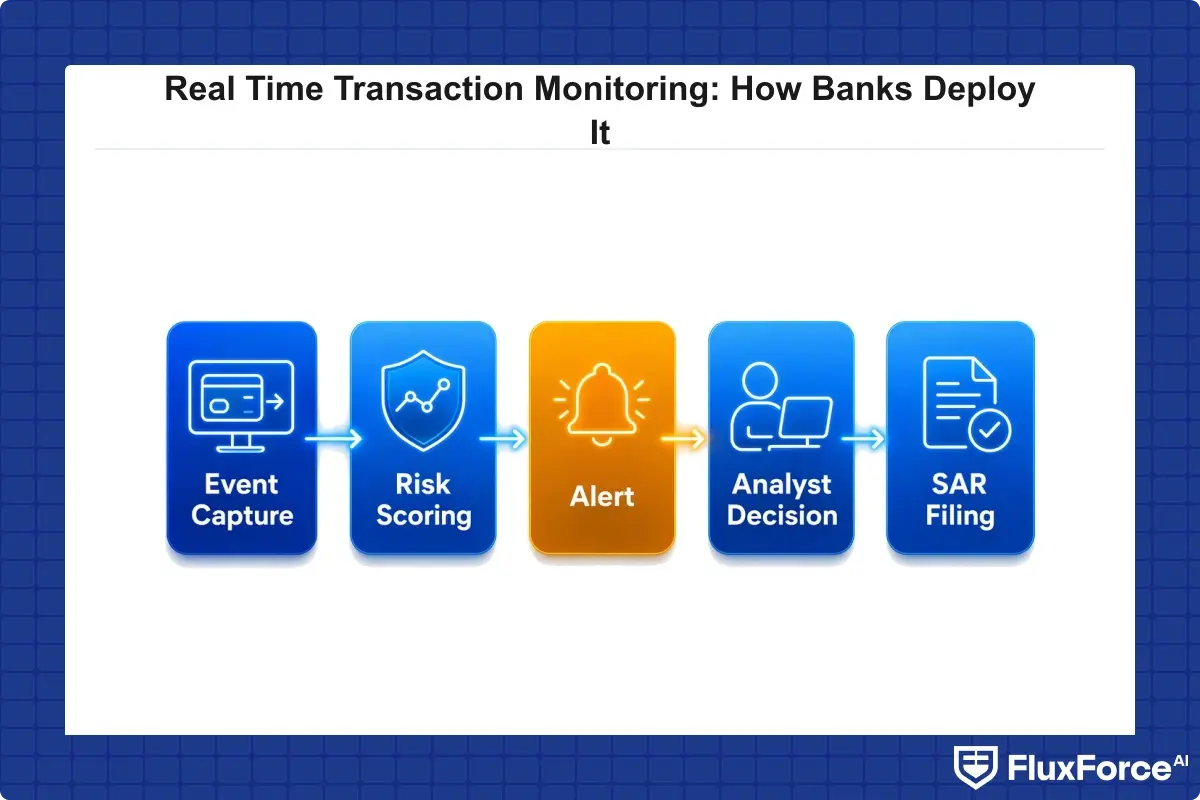
Real time transaction monitoring is the automated screening of payments, transfers, and account activity as they happen, so suspicious behavior is flagged before or within seconds of settlement. It applies rules, statistical models, and customer risk context to each event instead of waiting for an end-of-day file.
It is one core control inside any AML compliance program, alongside customer due diligence, sanctions screening, and reporting.
How Does Real Time Differ From Batch Monitoring?
Batch systems score yesterday's transactions overnight. Real time systems score each event in the payment flow, which lets a bank hold, step up authentication, or route to an analyst before money leaves.
| Factor | Batch monitoring | Real time monitoring |
|---|---|---|
| Detection timing | Hours to a day after settlement | During authorization or within seconds |
| Intervention | Recall attempts after the fact | Hold, decline, or step-up before release |
| Best fit | Slow-moving patterns like structuring across weeks | Instant payments, card-not-present, wires |
| Infrastructure | Simple, scheduled jobs | Streaming pipeline with low-latency scoring |
| Analyst workload | Large morning queue | Continuous, smaller queues |
The honest answer is that most banks run both. Real time catches fast-moving risk; batch analytics still find slow patterns that no single transaction reveals.
What Does Anti Money Laundering Technology 2026 Look Like in Practice?
Anti money laundering technology 2026 is mostly streaming event pipelines, entity resolution across accounts, and machine learning scores layered on top of proven rules. The rules stay because examiners can read them. The models earn their place by cutting noise, not by replacing the rulebook.
One real limit: models trained on your own history inherit your blind spots. Plan on periodic tuning, not a one-time install.
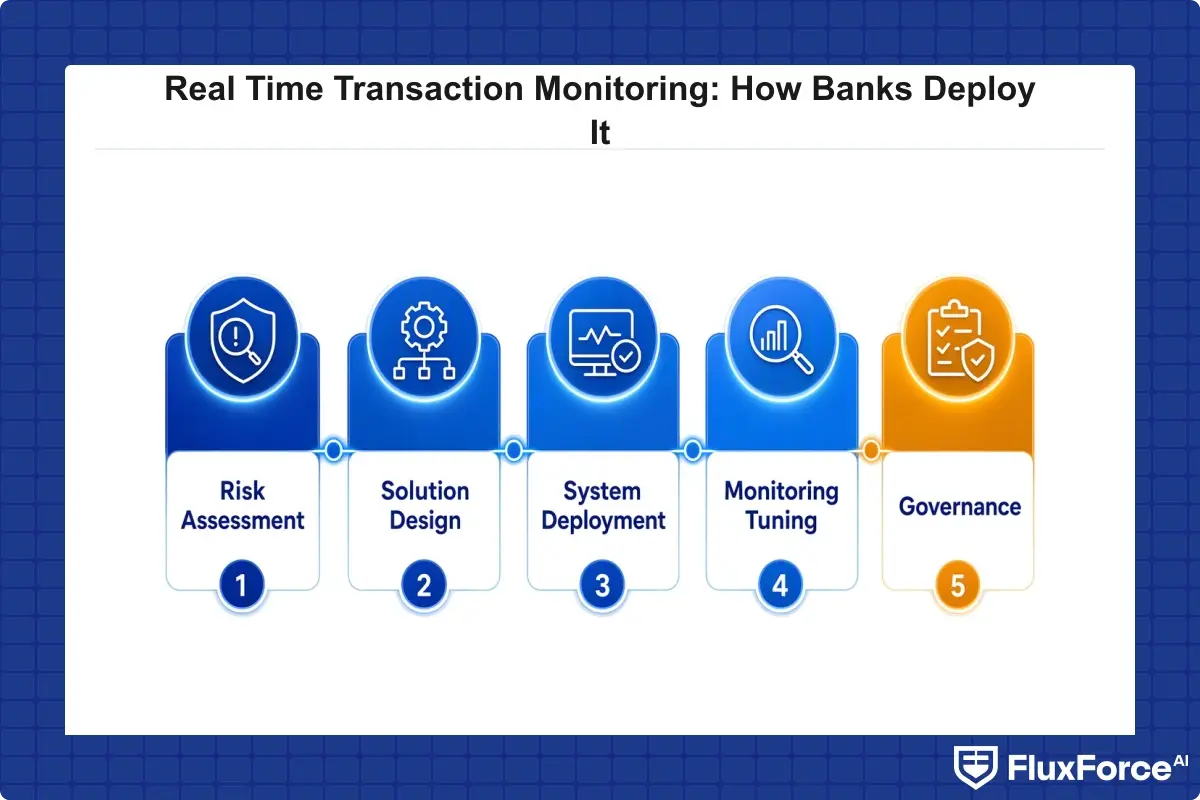
5 Stages of a Real Time Transaction Monitoring Deployment
In our experience, banks that fail at deployment usually skip stage 1 or stage 4. Here is the sequence that holds up.
1. Risk Assessment and Scoping
Start with an AML risk assessment guide mindset: list products, channels, geographies, and customer types, then rank where laundering could occur. The output decides which scenarios you build first. The FFIEC BSA/AML Manual is the reference examiners use, so map your assessment to it.
2. Data Pipeline and Integration
Monitoring is only as good as its inputs. Connect core banking, card processor, wire, ACH, and KYC data into one event stream, with consistent customer IDs. Most delays here come from legacy cores, not from the monitoring tool.
3. Scenario and Model Design
Build a first set of scenarios: rapid movement of funds, structuring near reporting thresholds, unusual geographies, and dormant accounts that suddenly activate. Add model scores as a second signal, and document why each threshold was chosen.
4. Parallel Run and Tuning
Run the new engine beside the old one for at least one full reporting cycle. Compare alerts, find the ones only one system caught, and tune. Our experience is that this stage is where false-positive volume is won or lost. Our post on rule-based systems vs AI for false positives covers the tradeoffs in detail.
5. Go-Live, Governance, and Validation
Switch over with clear ownership: who tunes, who approves threshold changes, who signs off on model validation. Keep an audit trail of every change. An untracked threshold edit is exactly what an exam finding is made of.
A monitoring system is a control, not a product. If you cannot show an examiner why a threshold was set and who approved its last change, it is not doing its job.
How Does Real Time Monitoring Support AML Compliance for Community Banks?
It gives community banks continuous coverage of suspicious activity without adding analysts for every new payment rail. Smaller institutions face the same Bank Secrecy Act duties as large ones, with a fraction of the staff.
What Belongs on a BSA AML Compliance Checklist?
A practical BSA AML compliance checklist covers these items:
- A written, board-approved AML program and a named BSA officer
- A documented AML risk assessment, refreshed at least when products or geographies change
- Customer identification and due diligence procedures
- Transaction monitoring with documented scenarios and tuning history
- SAR and CTR filing procedures with deadline tracking
- Independent testing and staff training records
That is the baseline for BSA AML compliance community banks are examined against. Real time monitoring feeds item 4 and speeds up item 5.
How Can a Fintech BSA AML Small Team Keep Up?
A fintech BSA AML small team of two or three people cannot review every alert by hand. Prioritize by risk score, auto-close alerts that match documented benign patterns, and reserve analyst time for cases with more than one converging signal.
The tradeoff: auto-closure needs strong governance. Sample closed alerts every month and record the results. Teams building this for a fast-growing product will find AML compliance fintech programs live or die on that discipline.
Choosing AML Compliance Software
When comparing AML compliance software, ask for latency at your peak transaction volume, explainability of each alert, and how rule changes are versioned. Ask to see a full alert-to-SAR trail. If a vendor cannot show it, keep looking.
SAR Filing and CTR Filing Rules in a Real-Time Workflow
Monitoring only matters if alerts turn into decisions on time. The clock is set by regulation, and FinCEN's filing guidance is the source to check.
What Are the SAR Filing Requirements 2026 for Banks?
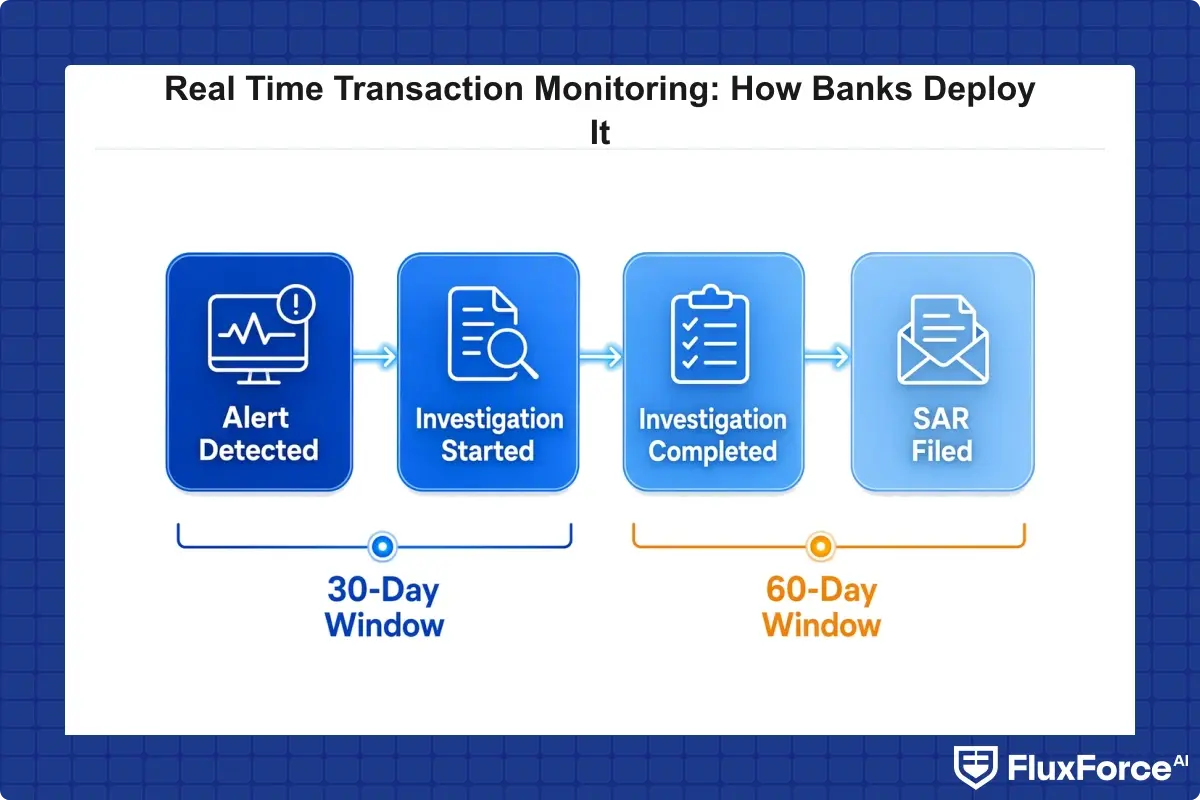
Under current FinCEN rules, a bank generally files a SAR within 30 calendar days of first detecting facts that may warrant one, extended up to 60 days if no suspect has been identified. Banks are generally required to file for suspicious transactions of $5,000 or more, and certain insider abuse or known-violation cases apply at lower amounts. Confirm current thresholds and forms with FinCEN before finalizing procedures, since these requirements are updated periodically.
SAR Filing Best Practices for Faster Turnaround
SAR filing best practices come down to structure. Pre-populate customer and transaction data from the alert, use a standard narrative template (who, what, when, where, why suspicious), and keep the case timeline in one system. This is how teams improve SAR filing efficiency without cutting corners on narrative quality.
A Suspicious Activity Report Guide for Analysts
This short suspicious activity report guide applies to every case:
- Write the narrative so a stranger could follow it without the case file
- Cite specific dates, amounts, accounts, and the pattern that raised concern
- Record why you did or did not escalate, even for closed alerts
- Never tell the customer a SAR is under consideration
CTR Filing Rules in Brief
CTR filing rules require a report for cash transactions over $10,000 in a business day, and multiple cash transactions by or for the same person are aggregated. Real time systems can track the running daily total and flag structuring attempts as they build, instead of after the day closes.
A SAR clock starts at detection, not at case assignment. An alert that sits unread in a queue for two weeks eats half your filing window.
For teams standardizing this workflow, regulatory compliance automation can route alerts, track deadlines, and assemble filing packets so analysts spend their time on judgment.
Connecting KYC Automation and Enhanced Due Diligence to Monitoring
Monitoring compares behavior to what you expected of the customer. Without good onboarding data, the engine has nothing to compare to.
What Are the KYC CDD Requirements Banks Must Meet?
The KYC CDD requirements banks follow come from FinCEN's customer due diligence rule: identify and verify customers, identify beneficial owners of legal entity customers, understand the nature and purpose of the relationship, and monitor on an ongoing basis to update customer information.
KYC automation 2026 tooling pulls document verification, sanctions checks, and risk scoring into one onboarding flow. Our piece on AML screening in digital lending shows how that plays out in a lending workflow, and sanctions screening automation covers the list-matching side.
An Enhanced Due Diligence Guide for High-Risk Customers
This enhanced due diligence guide applies to politically exposed persons, high-risk jurisdictions, and complex ownership structures:
- Collect source-of-funds and source-of-wealth documentation
- Get senior management approval to onboard or continue
- Set tighter monitoring thresholds and shorter review cycles
- Document every exception and its rationale
EDD customers should carry a higher risk score into the monitoring engine automatically, so their alerts trigger earlier.
Why Does AI Change the Rules for Monitoring Models?
AI scoring cuts noise, but it also brings model risk. Agentic approaches can triage alerts before an analyst sees them, and our post on agentic AI cutting false positives by 80% shows one such approach.
What Does the EU AI Act Mean for Financial Services?
EU AI Act financial services obligations depend on risk class. The EU AI Act text lists creditworthiness assessment among high-risk uses, which brings requirements for data governance, documentation, human oversight, and logging. Fraud detection systems are treated differently from credit scoring in the Act, so check where your specific model falls with legal counsel.
Even where the Act does not strictly apply, the same habits help US examiners: explainable outputs, versioned models, and a human who can override.
- Real time transaction monitoring stops suspicious payments before settlement, while batch review still catches slow patterns.
- Deploy in 5 stages, and do not skip the risk assessment or the parallel run.
- A BSA/AML checklist gives small teams a defensible baseline, whether a community bank or a fintech.
- SAR clocks start at detection, so alert queue speed is a compliance issue.
- Good KYC and enhanced due diligence data make every monitoring alert sharper.
- AI models need documentation, oversight, and validation before they earn examiner trust.
Onboard Customers in Seconds
Conclusion
Real time transaction monitoring matters because a SAR clock of 30 calendar days starts when suspicion arises, not when a batch job finishes. Overnight review wastes hours that regulators and criminals both notice.
Three things fix that: a documented risk assessment, a tuned scenario set with clear ownership, and automated case routing tied to SAR and CTR deadlines. Together they keep the program defensible and the analyst queue manageable.
In practice, a bank can start with one payment rail, run parallel for a full reporting cycle, then expand. Small teams should expect to spend the first months tuning. Review your current alert-to-SAR turnaround this week and pick the single stage above where your program is weakest.
Share this article