.webp)







Listen To Our Podcast🎧
Introduction
Payment transaction monitoring across cards, ACH and wires used to mean three separate systems, three separate vendor contracts, and three separate teams staring at three separate dashboards. That setup made sense when card fraud, ACH fraud and wire fraud looked like different problems. It doesn't make sense anymore, because the fraud itself has stopped respecting those boundaries.
A mule account today might receive a card-not-present payment, move funds through ACH within the hour, then push the balance out by wire before your card team and your wire team have even compared notes. If your monitoring stack is split by rail, that's the gap the fraud walks through.
We've worked with banks and fintechs untangling exactly this problem, and the fix is rarely "buy a better card fraud tool." It's rethinking payment transaction monitoring as one discipline across all three rails, on one platform, with rules a regulator can actually read.
- Why splitting card, ACH and wire monitoring into separate tools creates blind spots fraud actively exploits
- The real cost of running point solutions instead of a unified risk platform
- What an AI security operations platform for payments actually needs to include
- Why explainable AI has become a compliance requirement, not a nice-to-have
- How configurable AI autonomy lets you keep humans in the loop where it matters
- A practical comparison of point solutions vs a consolidated platform approach
Onboard Customers in Seconds

What Is Payment Transaction Monitoring Across Cards, ACH and Wires?
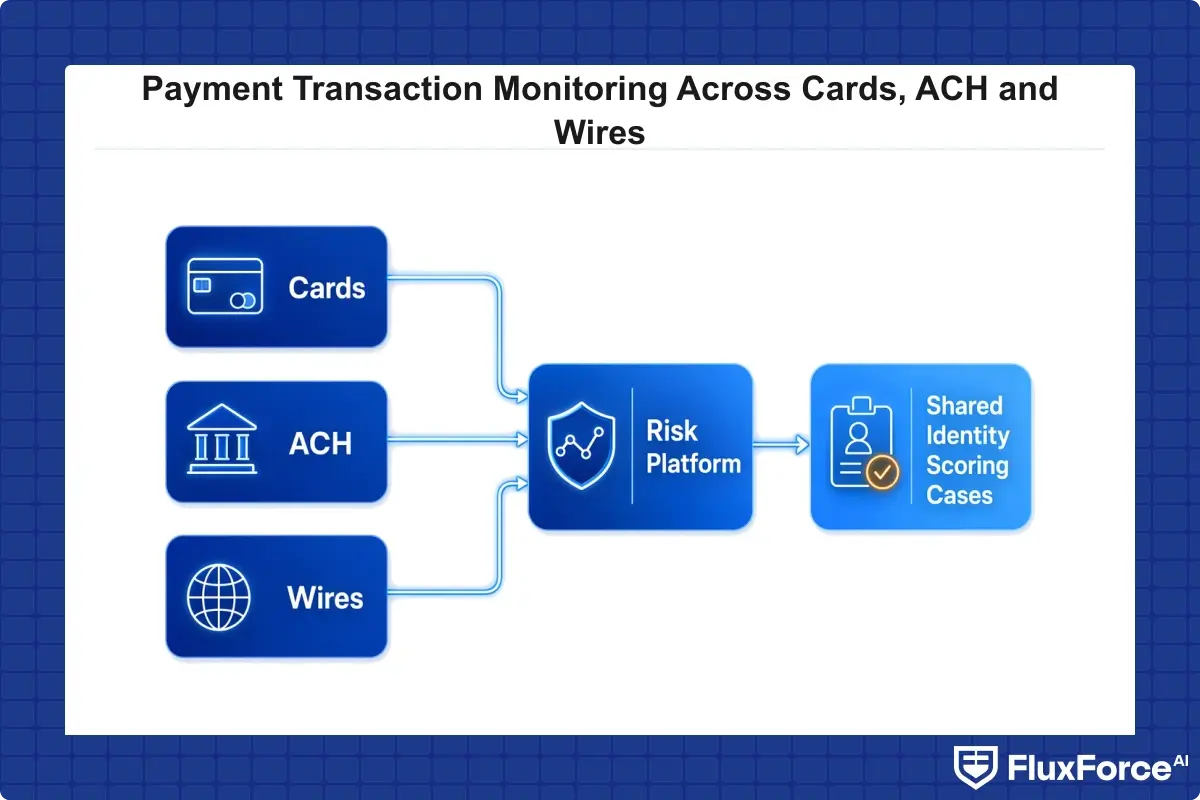
Payment transaction monitoring across cards, ACH and wires is the practice of screening every payment rail a bank or fintech supports through one connected risk view, rather than three isolated ones. It means a single case management workflow, a shared customer risk score, and one audit trail that covers a transaction no matter which rail it travels on.
Historically, monitoring grew rail by rail. Card networks pushed issuers toward card-specific fraud scoring decades before ACH origination tools existed, and wire monitoring came out of anti-money laundering requirements that predate both. The result at most mid-size banks is three vendors, three data models, and three teams who rarely compare notes until an examiner asks them to.
Why Rail-Specific Monitoring Creates Blind Spots
Fraud rings deliberately route money across rails because they know your systems don't talk to each other. A synthetic identity might pass a card application check, sit dormant for 90 days to build history, then originate ACH transfers that a card-only model never sees.
How Regulators View Cross-Rail Risk
Examiners increasingly ask for a single customer risk view spanning all payment types, not a rail-by-rail report. The Financial Crimes Enforcement Network's suspicious activity reporting guidance treats the customer relationship, not the payment rail, as the unit of analysis, which is one reason FinCEN's SAR filing requirements increasingly show up in exam findings when a bank can't reconstruct a cross-rail pattern quickly.
A fraud ring that moves money from card to ACH to wire in under an hour will beat any monitoring stack that scores each rail separately, because no single rail's data ever shows the full pattern.
Why Point Solutions Fail: 4 Hidden Costs of Fragmented Monitoring
Buying a best-of-breed tool for each rail feels rigorous. In practice it just moves the cost from the tool budget to everywhere else. Here are the four costs we see most often in point solutions vs platform financial services comparisons.
1. Duplicate Vendor Overhead
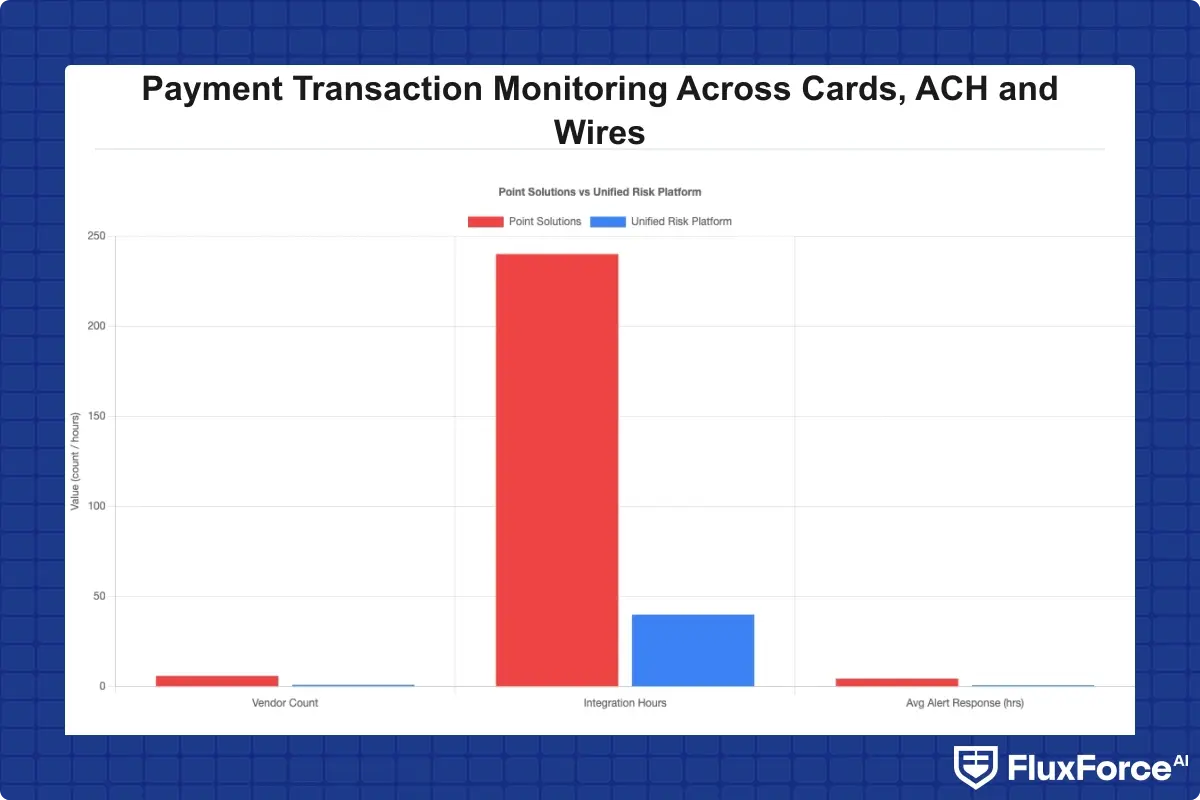
Each point solution comes with its own contract renewal, its own integration surface, and its own support escalation path. Vendor consolidation fintech strategy exists specifically because finance teams got tired of reconciling three invoices for what is functionally one job: knowing whether a payment is legitimate.
2. Fragmented Case Management
When a card analyst and a wire analyst work the same customer in two different case systems, nobody sees the combined picture until someone manually stitches it together, usually after the money is gone.
3. Inconsistent Risk Scoring
A customer can look low-risk to the card model and high-risk to the ACH model, because the two models were trained on different data with different thresholds. That inconsistency is exactly what sophisticated fraud rings probe for.
4. Slower Regulatory Response
When an examiner asks for a cross-rail transaction history, pulling it from three systems with three data formats can take days. On one platform, it's a query.
How a Unified Risk Platform Consolidates Cards, ACH and Wires
A unified risk platform is not just three tools glued together with a shared login. It means one data model where a customer, an account, and a transaction are the same object regardless of rail, and one scoring engine that can weigh signals from all three.
This is also where fraud compliance identity platform thinking matters. Identity verification, transaction monitoring and compliance reporting have historically lived in separate systems even within a single rail. Bringing them together means the KYC risk score set at onboarding actually feeds the transaction monitoring model, instead of sitting unused in a different database. Our earlier piece on card fraud detection strategy for risk heads covers how that identity-to-transaction link changes case outcomes on the card side specifically; the same logic extends cleanly to ACH and wire.
What Changes for the Compliance Team
Instead of reconciling three SAR pipelines, compliance gets one alert queue with rail as a filter, not a silo. Investigation time drops because the analyst isn't re-pulling identity data that's already sitting in the case.
What Changes for the Fraud Team
Cross-rail velocity checks become possible: a customer moving unusually large sums through ACH minutes after a card decline is a pattern only visible when both rails feed the same engine.
Why Explainable AI Matters for Payment Compliance
Moving to AI-driven payment transaction monitoring raises a fair question from compliance and legal teams: can we explain a decision to an examiner? This is where explainable ai compliance stops being an academic concept and becomes the difference between a model you can defend and one you have to retire.
Explainable ai finance means a system that can show, for any flagged transaction, which specific signals drove the score: an unusual beneficiary, a velocity spike, a device mismatch. Xai fraud detection is not optional in a regulated environment because a model that can't explain itself can't survive an exam.
What Regulators Actually Ask For
Ai model explainability regulators increasingly require goes beyond a general model description. Examiners want to trace a specific alert back to the specific inputs and weights that produced it, on demand. The NIST AI Risk Management Framework is the clearest public reference point for what "explainable enough" looks like in a regulated deployment, and it's worth reading before you sign off on any vendor's black-box model.
The Black Box Problem in Practice
Black box ai compliance risk shows up quietly at first: a model performs well in testing, then an examiner asks why a specific customer was flagged and nobody on the team can answer beyond "the model said so." That answer doesn't hold up, and it shouldn't. Our post on rule-based systems vs AI for false positive reduction walks through where teams draw that line between model sophistication and explainability in more depth.
An AI model that can't show its work to an examiner is a liability wearing a fraud-detection badge, regardless of how accurate it tests in a lab.
Ai audit trail automation closes the loop here. Every score, every override, every analyst decision gets logged automatically, so when an examiner asks for the history on a case, it's a report, not a reconstruction project.
5 Components of an AI Security Operations Platform for Payments
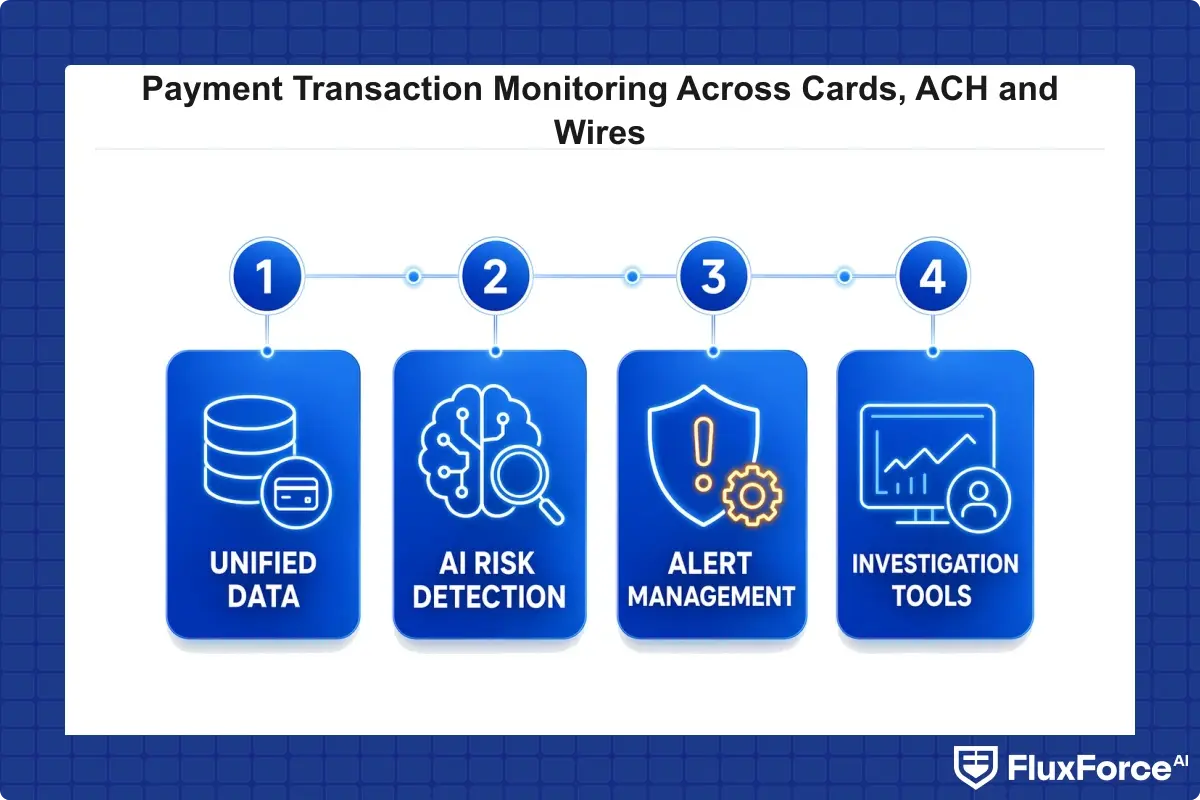
An ai security operations platform for payments is more than a fraud model bolted onto a dashboard. Based on the deployments we've supported, five components consistently separate a platform that holds up under exam pressure from one that doesn't.
1. Cross-Rail Identity Resolution
The same customer, wherever they transact, must resolve to the same risk profile. Without this, cards, ACH and wires each build a partial, contradictory picture.
2. Multi-Agent Investigation Workflows
A multi agent ai system splits investigation work the way a strong analyst team would: one agent triages incoming alerts, another gathers supporting evidence, another drafts the SAR narrative, with a human reviewing before anything is filed. This is different from a single monolithic model trying to do everything at once, and it maps more naturally onto how compliance teams actually work.
3. Explainable Scoring Engine
Every score needs a reason attached, in language a non-technical reviewer can read, not just a probability number.
4. Configurable Autonomy Controls
Different institutions, and different transaction sizes within the same institution, need different levels of AI independence. This has to be a setting, not a hard-coded assumption.
5. Continuous Audit Logging
Every decision, human or AI, gets timestamped and stored in a format examiners can query directly.
This is also where deploying dedicated fraud detection software built around these five components saves months compared to assembling them from separate vendors. Ai agents financial services teams deploy for payment monitoring need to be built with all five from day one, because retrofitting explainability or audit logging onto an existing model is far harder than designing for it up front.
Configurable AI Autonomy: How Much Should the Model Decide Alone?
Not every flagged transaction deserves the same level of AI independence, and treating them all the same is how institutions either drown analysts in low-value alerts or, worse, let a high-value wire clear on autopilot.
Configurable ai autonomy means the institution sets thresholds for when an AI agent can act alone (blocking an obviously fraudulent card transaction under a set dollar amount, for instance) and when it must route to a human before anything happens. A $50 card decline and a $2 million wire transfer are not the same risk decision, and they shouldn't be governed by the same autonomy setting.
Where Human-in-the-Loop Still Wins
Human in the loop ai banking is not a hedge against AI, it's a design choice for the transactions where the cost of a false positive (blocking a legitimate large wire) or false negative (missing a sophisticated fraud pattern) is highest. An ai agent fraud detection system should flag and pause here, not decide alone.
Where Full Automation Makes Sense
For high-volume, low-dollar card transactions, waiting for a human reviewer on every alert isn't just slow, it's the reason legitimate customers get declined at checkout. Our piece on how agentic AI cuts false positives covers the volume side of this tradeoff directly, and the zero trust plus agentic AI framework we've written about applies the same logic to access decisions more broadly.
Point Solutions vs Unified Platform
| Factor | Point Solutions (per rail) | Unified Risk Platform |
|---|---|---|
| Vendor contracts | 3 separate agreements, 3 renewal cycles | 1 agreement, 1 renewal cycle |
| Case management | Separate queues per rail, manual stitching | One queue, rail as a filter |
| Identity view | Rebuilt or duplicated per system | Shared across cards, ACH, wires |
| Explainability | Varies by vendor, often opaque | Consistent scoring rationale across rails |
| Exam response time | Days, pulling from multiple systems | Hours, single query |
| Cross-rail fraud detection | Blind to patterns spanning rails | Built to catch cross-rail velocity |
Wire transfer processing itself sits on infrastructure the Federal Reserve documents directly, and understanding how Fedwire and same-day ACH actually settle is worth a read for any team designing monitoring rules around settlement timing, since the fraud window narrows considerably once same-day settlement is involved.
- Fraud increasingly moves across cards, ACH and wires within a single incident, so rail-specific monitoring creates the exact gap that's being exploited.
- Point solutions cost more than their sticker price once you count duplicate vendor overhead, fragmented case management and slower exam response.
- A unified risk platform links identity, transaction and compliance data so a customer's risk profile is consistent no matter which rail they use.
- Explainable AI is a compliance requirement now, not a differentiator, because examiners expect to trace any flagged transaction back to specific signals.
- Configurable AI autonomy lets institutions automate low-risk, high-volume decisions while keeping humans in the loop on high-value transactions.
- A real AI security operations platform needs cross-rail identity resolution, multi-agent workflows, explainable scoring, configurable autonomy and continuous audit logging, together, not as separate add-ons.
Onboard Customers in Seconds
Conclusion
Payment transaction monitoring across cards, ACH and wires only works when it stops being three monitoring problems and becomes one. The institutions still running three separate rail-specific tools aren't just paying for redundant vendor contracts, they're leaving the exact gap between rails that coordinated fraud rings already know how to exploit.
The fix comes down to three things: a unified risk platform that gives every rail the same identity and risk view, explainable AI that can show its reasoning to an examiner on demand, and configurable AI autonomy that lets low-risk decisions move fast while high-value transactions still get a human's eyes. None of these require replacing your entire tech stack overnight.
In practice, adopting this approach means consolidating case management first, then layering in cross-rail identity resolution, then tuning autonomy thresholds rail by rail, which is roughly the order our clients have found least disruptive to daily operations. If your card, ACH and wire monitoring still live in three different systems, the honest next step is mapping where those systems already overlap in customer data, because that overlap is usually where the biggest blind spot is hiding.
FAQ
Placeholder
Share this article