.webp)







Listen To Our Podcast🎧
Introduction
Real time sanctions screening is the practice of checking a payment against OFAC, UN, EU, and other watchlists in the seconds before it settles, rather than hours or days later in a batch job. For banks and fintechs rolling out FedNow, RTP, or other instant rails, this is no longer optional. Once a payment settles in under ten seconds, there is no overnight batch window left to catch a sanctioned counterparty.
We have watched compliance teams at community banks and mid-size fintechs try to bolt real-time payments onto AML compliance software built for next-day batch runs. The result is either a bottleneck that defeats the purpose of instant payments, or a screening gap that a regulator will eventually find. Neither is acceptable when the Bank Secrecy Act still applies at instant-payment speed.
This guide breaks down how real time sanctions screening actually works, what a BSA AML compliance checklist should cover for community banks running instant rails, and how kyc automation and SAR/CTR workflows need to change to keep up.
- How real time sanctions screening differs technically from daily batch screening
- The 5-step flow a payment goes through between initiation and settlement
- A 6-point BSA AML compliance checklist built specifically for community banks
- Why KYC automation in 2026 is shifting from onboarding-only checks to continuous monitoring
- How SAR filing and CTR filing rules apply when a real-time alert turns into a confirmed match
- What the EU AI Act means if your screening model is trained or hosted anywhere in the EU
Onboard Customers in Seconds

What Is Real Time Sanctions Screening?
Real time sanctions screening is the automated check of payment parties, beneficiaries, and correspondent banks against sanctions and watchlists at the moment a transaction is initiated, with a pass/hold decision returned before the payment is allowed to settle. It replaces or supplements end-of-day batch screening, which checks transactions after they have already moved.
How it differs from batch and near-real-time screening
Batch screening runs once or twice a day against a full ledger of transactions. Near-real-time screening runs on a short delay, often minutes, queued behind a message broker. True real time sanctions screening has to return a decision inside the payment rail's own latency budget, which for FedNow and RTP is measured in single-digit seconds.
Why instant rails force this shift
ACH and wire transfers gave compliance teams a buffer. A wire initiated at 4pm could still be screened, held, and released the next morning without breaking the payment. Instant payment rails settle irrevocably. If the screening check does not complete before settlement, the bank has either delayed a legitimate payment past its promised speed or let a sanctioned transaction through. There is no middle ground.
On an instant payment rail, sanctions screening has maybe 2-3 seconds of the total transaction budget to run, match, and return a decision, before the payment either releases or holds automatically.
Why Instant Payments Raise the Stakes for AML Compliance
Instant payments do not just compress the screening window, they change the risk profile of aml compliance work across the bank. A transaction that clears in seconds cannot be clawed back the way an ACH return or wire recall can.
The irrevocability problem
Once an instant payment settles, the receiving bank has typically already made funds available. If a true sanctions match surfaces after settlement, the institution is now managing a post-facto blocked-funds and reporting situation instead of a simple hold. That is a materially worse outcome for aml compliance fintech teams than a delayed batch alert.
The alert-fatigue problem
Instant rails also increase transaction volume and frequency, which means more screening events per account per day. If the underlying matching logic is not tuned, false positive rates climb and analysts drown in alerts. We have seen community bank compliance teams of two or three people try to review hundreds of daily real-time alerts manually. It does not scale, and it is why rule-based systems increasingly lose ground to AI-driven transaction monitoring for AML false positive reduction.
The vendor concentration problem
Most community banks route instant payments through a core processor or a payments hub that embeds screening as a feature, not a standalone control. That is workable, but the compliance officer still owns the outcome. Understanding exactly what the vendor's matching engine does, and where its blind spots are, is part of any serious regulatory compliance automation strategy for a bank moving onto instant rails.
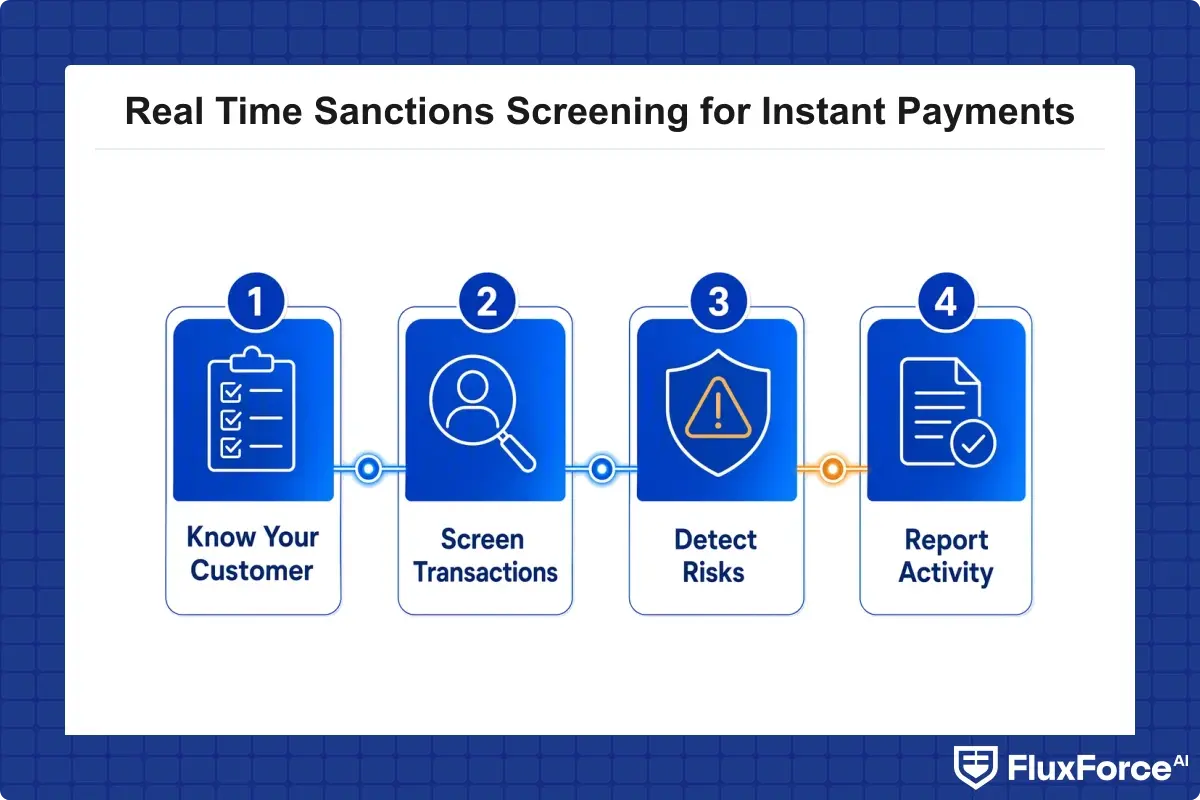
How Does Real Time Sanctions Screening Work? 5 Steps From Payment to Release
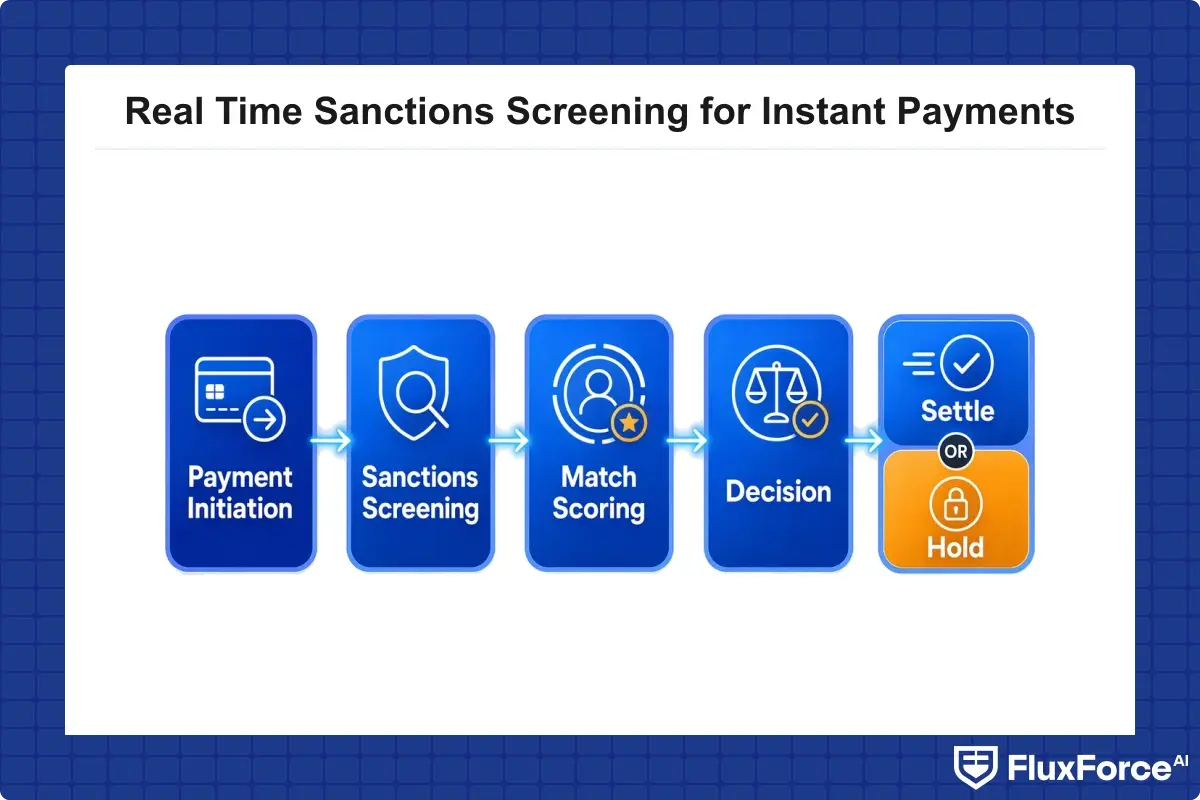
A compliant real time sanctions screening pipeline runs through five distinct steps for every instant payment, in a window most institutions target at under 500 milliseconds for the screening portion alone.
1. Message capture and normalization
The payment message (ISO 20022 for FedNow and most RTP traffic) is parsed and the relevant name, address, and account fields are normalized: stripping honorifics, standardizing transliteration, and resolving abbreviations before any comparison runs.
2. List matching against current watchlists
The normalized fields are checked against OFAC's Specially Designated Nationals list, the EU consolidated list, UN sanctions lists, and any internal or PEP lists the institution maintains. Watchlists must be refreshed continuously, since OFAC updates its sanctions programs without a fixed schedule.
3. Fuzzy match scoring
Exact-string matching produces too many misses and too many false positives on its own. A scoring model weighs phonetic similarity, transliteration variants, and partial matches, producing a confidence score rather than a binary yes/no.
4. Automated decisioning
Scores below a defined threshold auto-clear. Scores above a second threshold auto-hold. Scores in between route to a human analyst, ideally with the matching evidence already assembled so the review takes seconds, not minutes.
5. Settlement or hold with an audit trail
The payment either releases to settlement or is held pending review, and every step, including the model version and match score, is logged for exam evidence. This last step is where a lot of aml compliance software falls short: the decision itself is fast, but the audit trail is bolted on afterward instead of built in.
6-Point BSA AML Compliance Checklist for Community Banks
Community banks adopting instant payments need a bsa aml compliance checklist that accounts for real-time speed, not just the periodic reviews built for batch-era rails. Here are the six items we tell fintech bsa aml small teams to lock down first.
1. A documented real-time screening SLA
Write down the maximum acceptable latency for the screening step itself, separate from the overall payment SLA, and test it under peak load, not just in a demo environment.
2. Watchlist refresh cadence in writing
Define how often OFAC, UN, and EU lists are pulled and confirm the vendor contract specifies the same cadence. A list that is 24 hours stale defeats the point of real-time screening.
3. A fallback procedure for screening outages
Decide in advance whether payments queue, hold, or fail closed if the screening service is unreachable. "Fail open" is rarely defensible to an examiner.
4. Independent model validation
The fuzzy-matching model needs periodic validation by someone outside the team that built or configured it, with documented false positive and false negative rates.
5. A staffing plan for real-time alert review
This is where most bsa aml compliance community banks checklists fall short: a two-person compliance team cannot review real-time alerts around the clock without either automation support or a documented after-hours escalation path.
6. Board-level reporting on screening performance
Quarterly reporting to the board should include screening volume, hold rate, false positive rate, and any near-misses, not just SAR counts.
A screening program that only measures "alerts cleared" is missing the metric that actually matters to examiners: how long a true match sat in queue before a human reviewed it.
KYC Automation in 2026: CDD, EDD, and Ongoing Monitoring
Kyc automation 2026 priorities have shifted from speeding up onboarding to keeping customer risk profiles current between onboarding events, because a customer who was low-risk at account opening is not guaranteed to stay that way once they start using instant payment rails.
KYC and CDD requirements for banks on instant rails
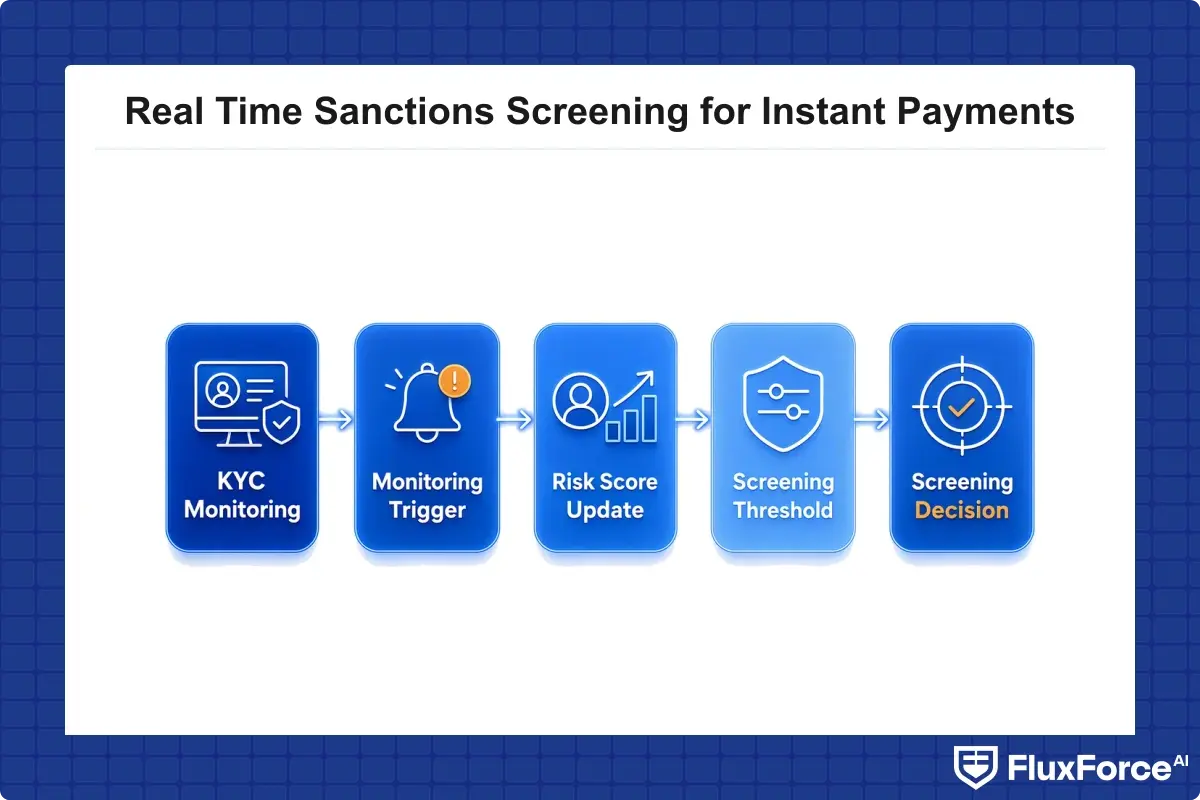
Basic kyc cdd requirements banks must satisfy, identity verification, beneficial ownership, and customer risk rating, do not disappear with instant payments. What changes is the expectation that risk ratings feed directly into the sanctions screening threshold a customer's transactions are held to. A higher-risk customer should trigger a lower auto-clear threshold automatically.
When enhanced due diligence applies
An enhanced due diligence guide for instant-payments customers typically flags accounts with cross-border activity, high transaction velocity, or connections to higher-risk jurisdictions for EDD, which means deeper source-of-funds documentation and more frequent review, not a one-time deeper onboarding check.
Continuous monitoring over periodic review
The old model of an annual or biennial KYC refresh does not match instant-payment risk. Automated triggers, a large change in transaction volume, a new counterparty jurisdiction, a name-match near-miss, should kick off an ad hoc review instead of waiting for the scheduled date. This is the same logic behind KYC/AML and identity verification strategies built for CISOs managing high-risk supplier and counterparty risk more broadly.
SAR and CTR Filing in a Real-Time World
Instant payments do not change the underlying sar filing requirements 2026 institutions must follow, but they compress the operational timeline around detection.
SAR filing efficiency under time pressure
FinCEN still requires a Suspicious Activity Report within 30 calendar days of initial detection of facts warranting a filing, per FinCEN's SAR filing guidance. That 30-day window has not shortened, but sar filing efficiency now matters more because real-time alerts arrive faster and in higher volume, so a backlog forms quickly if the SAR narrative workflow is still manual.
CTR filing rules still apply at machine speed
Ctr filing rules requiring a Currency Transaction Report for cash transactions over $10,000 are largely unaffected by instant payments, since CTRs are cash-focused, but institutions running both channels need one unified reporting workflow so analysts are not toggling between two disconnected systems for SAR and CTR cases that touch the same customer.
SAR filing best practices for a real-time alert queue
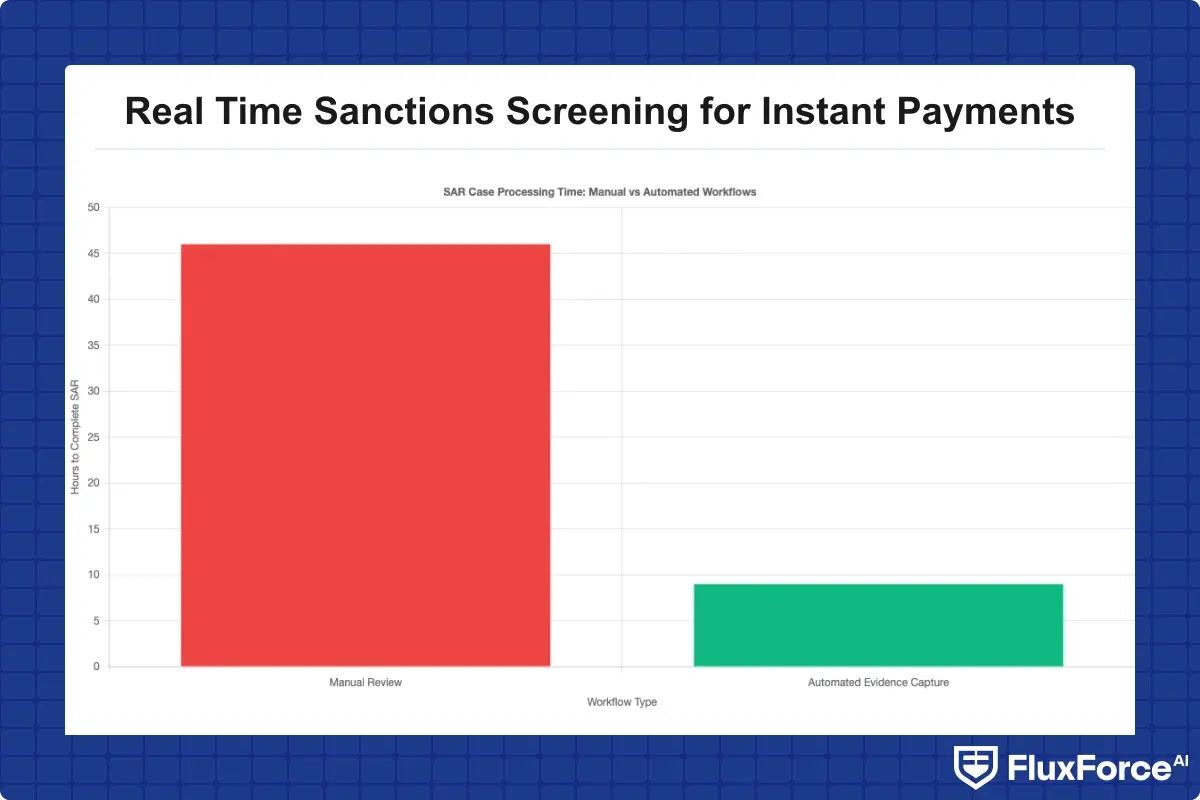
A short suspicious activity report guide for real-time teams: capture the automated match evidence (score, list source, timestamp) directly into the case file at the moment of the hold, rather than reconstructing it later. This is the single biggest driver of sar filing best practices adoption we see work in practice, because it cuts the narrative-writing time from hours to minutes. Programs that automate this handoff have reported meaningful reductions in review backlog, similar to the false-positive gains described in how agentic AI fraud agents cut false positives by roughly 80% in transaction monitoring more broadly.
Real Time Sanctions Screening vs Batch Screening
| Batch Screening | Real Time Sanctions Screening | |
|---|---|---|
| Screening timing | Once or twice daily, after settlement | Before settlement, in seconds |
| Payment types fit | ACH, wire, check | FedNow, RTP, instant card rails |
| False positive handling | Reviewed next business day | Must resolve in-window or auto-hold |
| List refresh need | Daily is often sufficient | Continuous refresh required |
| Audit trail | Built from end-of-day logs | Captured at decision time, per transaction |
| Staffing model | Business-hours review team | 24/7 coverage or automated triage |
Building an AML Risk Assessment for Small Fintech Teams
An aml risk assessment guide written for a large bank's compliance department rarely fits a five-person fintech BSA/AML team, which is why fintech bsa aml small team programs need a scaled-down version that still covers the required elements.
Start with the products and rails, not the org chart
Map every payment rail (ACH, wire, RTP, FedNow) and every product (checking, lending, embedded payments) against its inherent sanctions and money laundering risk before assigning controls. This anti money laundering technology assessment should drive which accounts get the tightest screening thresholds.
Right-size the control set to actual headcount
A small team cannot manually review thousands of real-time alerts, so the risk assessment needs to explicitly account for where anti money laundering technology 2026 tooling replaces manual review, and where human judgment is still required by policy, not just by convenience.
Document the EU AI Act angle if applicable
If your screening model is developed, deployed, or serves customers connected to the EU, the eu ai act financial services provisions classify certain AI-based creditworthiness and fraud/AML systems as higher-risk applications requiring documentation, human oversight, and transparency measures under the EU's AI Act regulatory framework. Small teams often miss this because they assume EU rules only apply to EU-headquartered firms; a US fintech screening EU counterparties can still be in scope.
Institutions serious about tightening this whole stack, screening, KYC, and reporting, into one workflow are increasingly looking at how DORA compliance automation strategies for banking apply the same continuous-monitoring logic to operational resilience requirements alongside AML. The overlap in tooling is significant, and teams that roll out compliance agents in a 90-day program tend to consolidate screening, KYC refresh, and SAR drafting into a single case management layer rather than three disconnected tools.
- Real time sanctions screening must complete before an instant payment settles, typically inside a 2-3 second window, because instant rails are irrevocable.
- A BSA AML compliance checklist for community banks needs six specific controls: documented SLA, list refresh cadence, outage fallback, model validation, real-time staffing, and board reporting.
- KYC automation in 2026 is moving from one-time onboarding checks to continuous monitoring triggered by transaction behavior.
- SAR filing still allows 30 days under FinCEN rules, but capturing match evidence at the moment of the hold is what actually improves sar filing efficiency.
- CTR filing rules remain cash-transaction focused and largely unchanged by instant payments, but should run through the same case management workflow as SAR.
- Small fintech BSA/AML teams need a risk assessment scaled to headcount, with explicit EU AI Act consideration if any EU counterparties are in scope.
Onboard Customers in Seconds
Conclusion
Real time sanctions screening is now a hard requirement, not a competitive advantage, for any bank or fintech running instant payment rails. The math is unforgiving: a payment that settles in under ten seconds leaves almost no room for the batch-era screening habits most BSA/AML programs were built around.
The fix is not a single tool. It is continuous watchlist refresh, automated match scoring with a documented audit trail, and KYC automation that updates risk ratings from actual transaction behavior instead of waiting for a scheduled review. Get those three right and a five-person compliance team can realistically manage a real-time alert queue without drowning.
In practice, that means auditing your current screening latency against the checklist in this guide, confirming your SAR workflow captures match evidence at the moment of the hold rather than after the fact, and checking whether your risk assessment even mentions the EU AI Act. Start with the 6-point BSA AML compliance checklist above, run it against your current instant-payments program this quarter, and fix the gaps before an examiner finds them for you.
Share this article