Automated Identity Verification: How Banks Get It Right
Secure. Automate. – The FluxForce Podcast
We use cookies to improve your experience and analyze site traffic. By continuing to browse, you agree to our use of cookies.
Introduction
Automated identity verification has moved from a nice-to-have to the backbone of digital account opening at every bank, fintech, and insurer we work with. A customer who used to wait two or three business days for a human reviewer to check a driver's license now gets approved, flagged, or declined in under a minute. That speed only matters if the system catches what a tired reviewer at 4 p.m. on a Friday would miss.
The tension is real. Faster onboarding pulls in more revenue, but synthetic identities and deepfake-generated selfies are specifically built to slip past weak checks. This guide breaks down how banks actually get automated identity verification right: the technology stack, the fraud it stops, and the deployment steps that separate a compliant rollout from a checkbox exercise.
In This Article, You'll Learn
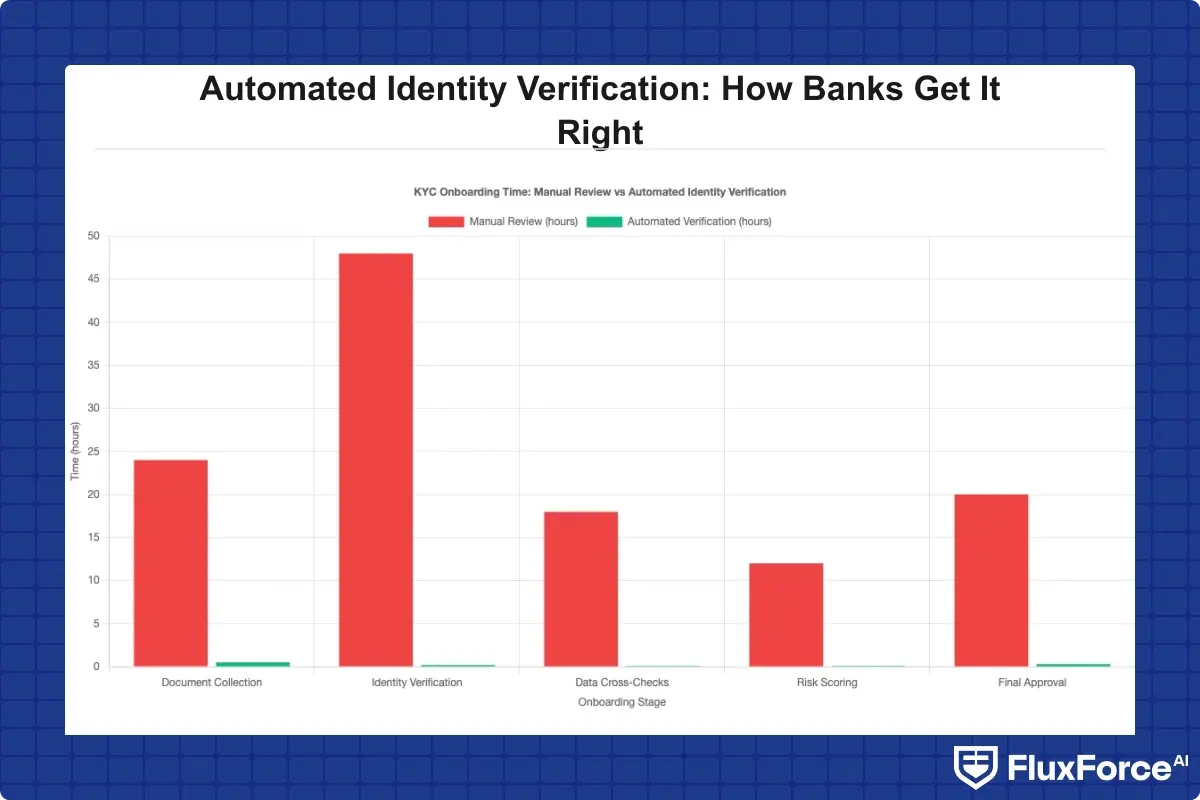
How automated identity verification cuts KYC onboarding time without loosening fraud controls
The 4 hidden costs manual identity checks pile onto compliance and support teams
How biometric identity verification and liveness detection catch deepfakes that static document scans miss
Why a zero trust security framework changes how banks think about identity after onboarding, not just during it
What to look for in an identity verification API before you sign a vendor contract
The 5-step deployment sequence banks use to go live without a compliance gap
Onboard Customers in Seconds
Verify identities instantly with biometrics and AI-driven checks to reduce drop-offs and build trust from day one.
Automated identity verification is the use of software, biometric matching, and data checks to confirm a customer's identity without a human reviewer manually inspecting each document. It combines document authentication, biometric identity verification, database cross-checks, and risk scoring into a single decision, usually returned in seconds.
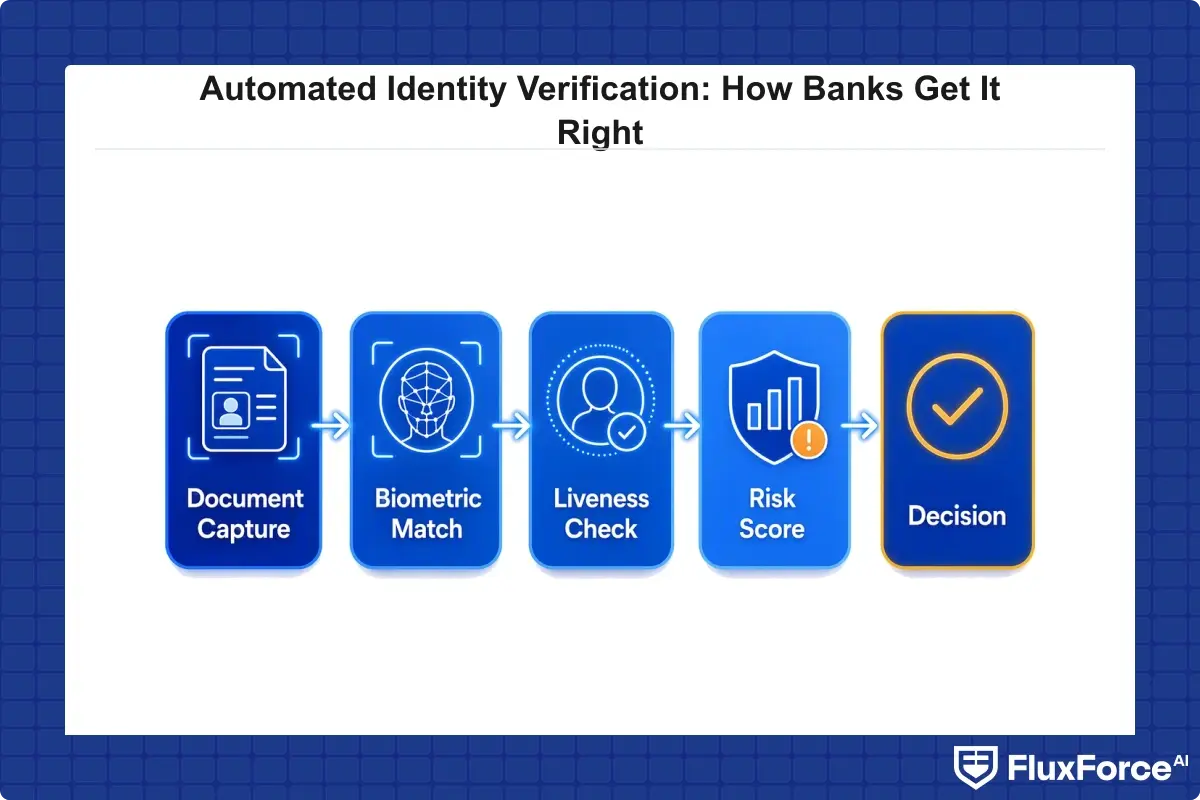
For banks, this isn't a single tool. It's a pipeline: capture a government ID, extract the data, match a live selfie against the ID photo, check the person against watchlists and device signals, then hand back a pass, fail, or manual-review decision. Identity verification fintech vendors package these steps behind one API call, but the underlying logic still has to satisfy the same KYC and AML obligations a manual process would.
How Digital Identity Proofing Works
Digital identity proofing follows a fairly consistent sequence across vendors:
Document capture: the customer photographs a passport, driver's license, or national ID
Data extraction and validation: optical character recognition pulls the name, date of birth, and document number, then checks the document's security features against known templates
Biometric match: a selfie or short video is compared to the photo on the document
Liveness and risk checks: the system confirms a live human is present, not a photo or a video replay, and cross-references device and behavioral signals
“
Key Insight
A document scan alone confirms the ID is real; only the biometric and liveness layers confirm the person holding it is the actual owner, which is why skipping either step reopens the door to synthetic identity fraud.
Biometric Identity Verification and Document Checks
Biometric identity verification and document checks solve different problems. Document checks confirm the ID itself hasn't been altered or fabricated. Biometric checks confirm the live applicant matches the person the document belongs to. Banks that rely on document checks alone are the ones we see get hit hardest by synthetic identity fraud, because a fabricated identity with a real, unaltered stolen Social Security number can pass a document check every time.
4 Hidden Costs of Manual KYC Onboarding
Manual KYC onboarding looks cheap on a spreadsheet because there's no software license line item. In practice, it carries costs that rarely show up until a compliance audit or a bad quarter forces someone to add them up.
1. Abandoned Applications
Every extra day a customer waits for identity approval increases the odds they open an account somewhere else instead. Digital-first applicants expect a decision in minutes, not days, and kyc onboarding speed has become a real differentiator between competing banks and fintechs.
2. Reviewer Fatigue and Inconsistent Decisions
Human reviewers checking hundreds of documents a day get less accurate as the shift goes on. Two reviewers looking at the same borderline case can reach opposite conclusions, which creates both fraud risk and fair-lending exposure.
3. Fraud That Scales Faster Than Headcount
Fraud rings run scripted, high-volume application attempts. A manual team sized for normal volume gets overwhelmed the moment a ring targets the bank, and the backlog itself becomes an opening for more fraud to slip through unreviewed.
4. Compliance Documentation Gaps
Manual reviews are harder to audit consistently. Every reviewer needs to document rationale, and when that documentation is thin, examiners flag it during regulatory review. Our KYC/AML identity verification strategy for CISOs covers how thin documentation trails specifically show up as findings.
Manual Review vs Automated Identity Verification
Factor
Manual Review
Automated Identity Verification
Typical decision time
Hours to days
Seconds to minutes
Consistency across cases
Varies by reviewer and shift
Same rules applied every time
Deepfake and synthetic ID detection
Relies on reviewer judgment
Liveness detection and biometric matching built in
Audit trail
Manual notes, inconsistent detail
Structured logs, timestamped decisions
Cost to scale during a fraud spike
Requires more headcount fast
Scales with existing infrastructure
How Biometric Identity Verification Stops Synthetic Identity Fraud
Biometric identity verification stops synthetic identity fraud by tying an application to a live, matched human face instead of just a set of data points that could belong to a fabricated identity. Synthetic identity fraud blends a real piece of data, often a stolen or child's Social Security number, with fabricated details to build a credit profile that doesn't correspond to any real person applying for the account.
Liveness Detection Fraud Prevention
Liveness detection fraud prevention checks whether the face in front of the camera is a live person, not a printed photo, a video replay, or an injected digital image. Modern liveness checks ask for subtle movement, analyze skin texture and depth, and detect the artifacts that show up when a video feed has been manipulated. Fraud rings that used to succeed with a printed photo or a static video loop now get blocked before the application is ever submitted for review.
Deepfake Detection Banking Use Cases
Deepfake detection banking use cases have expanded well past account opening. Video-call impersonation during high-value wire approvals and synthetic voice fraud during phone-based verification are both growing attack paths. According to the NIST Digital Identity Guidelines (SP 800-63B), identity assurance levels should account for presentation attack detection, which is the formal term for exactly this kind of liveness and deepfake screening.
“
Key Insight
A stolen ID photo defeats a document check every time, but a live, randomized liveness challenge is much harder to fake in real time, which is why the strongest identity verification api providers layer both checks instead of relying on either alone.
Synthetic Identity Fraud Detection in Practice
Synthetic identity fraud detection in practice combines biometric checks with data consistency scoring: does the applicant's claimed history, device fingerprint, and behavioral pattern actually line up with a real person's life, or does it look assembled? We go deeper into the scoring logic in Detecting Synthetic Identity Fraud in Real-Time, which is worth reading alongside this piece if synthetic fraud is your biggest onboarding risk.
Why Zero Trust Financial Services Need an Identity Verification API
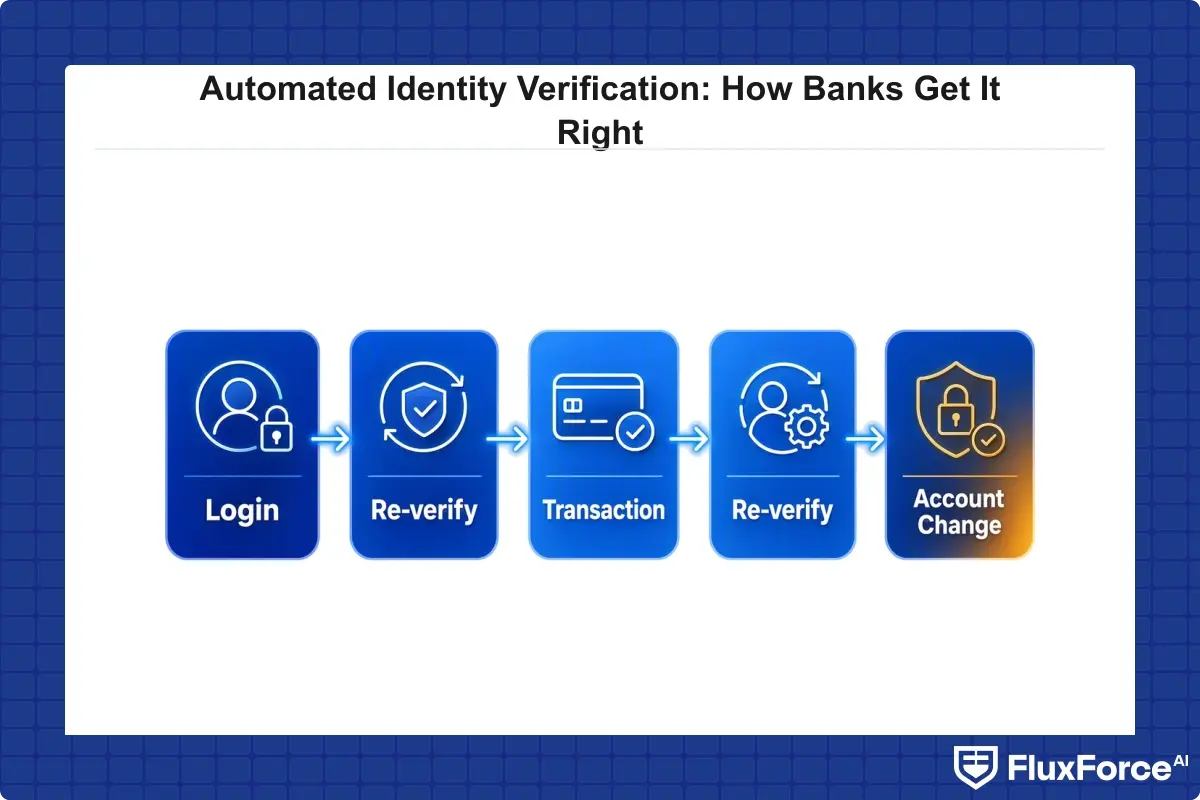
Identity verification can't stop at account opening. A zero trust security framework treats every session, transaction, and access request as something to verify again, not something to trust because it happened once at signup. For zero trust financial services, an identity verification api becomes infrastructure that gets called repeatedly, not a one-time gate.
Zero Trust Security Framework Basics
The NIST Zero Trust Architecture standard (SP 800-207) defines zero trust as a model where no user or device is implicitly trusted, even after initial authentication. Applied to banking, that means a customer who passed identity verification at signup still gets re-verified for a large wire transfer, a password reset, or a login from a new device. We cover the access-control side of this in Zero Trust + Agentic AI: The New Normal for Banking Security.
Integrating an Identity Verification API Into Onboarding
Integrating an identity verification api into onboarding typically means a few REST calls: submit the document image, submit the biometric capture, receive a risk score and decision. The technical lift is small compared to the vendor evaluation work. We recommend banks pressure-test candidate vendors specifically on kyc aml automation capabilities, since identity verification and downstream AML monitoring perform much better when they share the same risk signals instead of running as two disconnected systems. Teams handling digital lending onboarding should also read AML Screening and Monitoring in Digital Lending for how this connects to ongoing transaction monitoring.
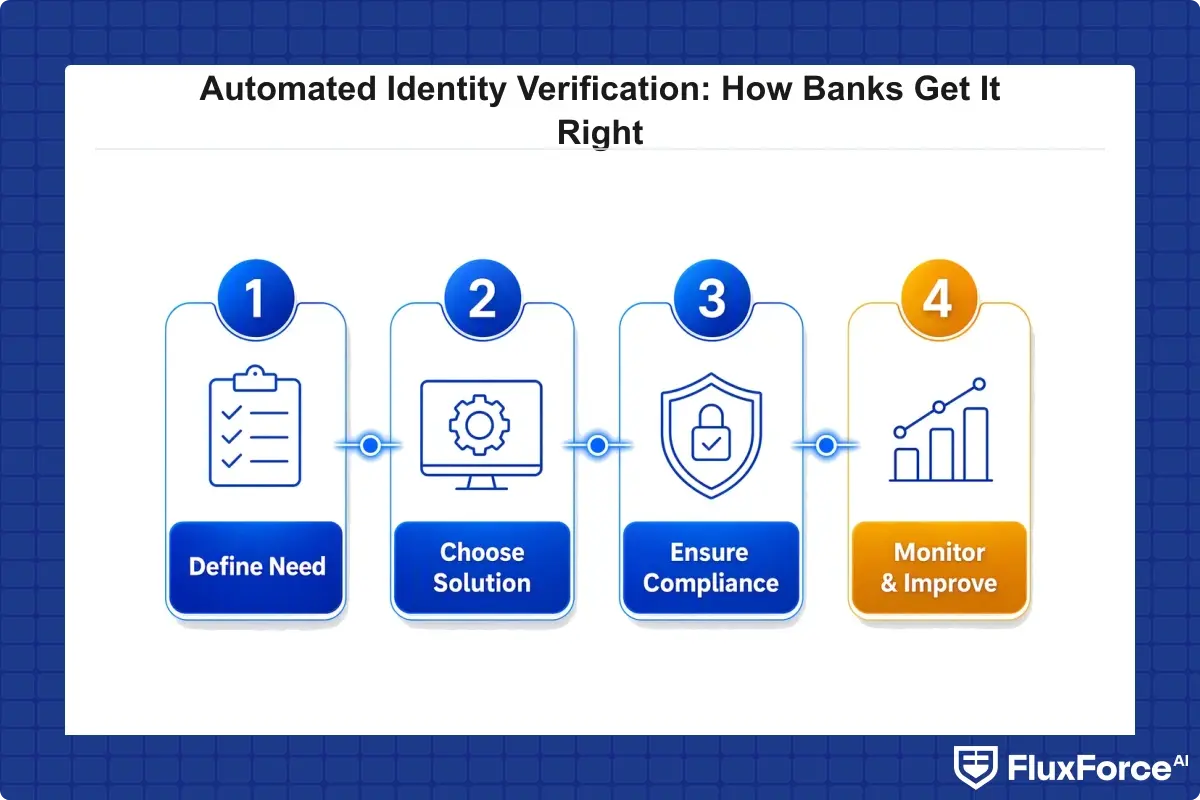
5 Steps Banks Use to Deploy Automated Identity Verification
Rolling out automated identity verification well takes more than picking a vendor and flipping a switch. Here's the sequence that avoids a compliance gap on launch day.
1. Map Current KYC Requirements to the New Flow
Document every field, disclosure, and retention rule your current manual process satisfies, then confirm the automated flow covers each one before go-live.
2. Run the New System in Shadow Mode
Route real applications through both the manual and automated process for several weeks without letting the automated decision go live, then compare outcomes to catch mismatches early.
3. Set Manual-Review Thresholds
Not every application should auto-approve or auto-decline. Define the risk-score band that routes to a human reviewer, and staff for that reduced volume rather than the old full manual queue.
4. Train Compliance and Support Teams on the New Exceptions
Frontline staff need to know what an automated decline looks like to a customer and how to escalate a false decline, since that becomes their most common ticket type after launch.
5. Monitor False Positive and Fraud-Catch Rates Monthly
Track both sides: how many legitimate customers are getting bounced, and how much fraud is still getting through. A system tuned only for fraud-catch rate will frustrate good customers, and one tuned only for approval speed will let fraud back in.
Key Takeaways
Automated identity verification combines document checks, biometric matching, and liveness detection into a single decision that used to take days and now takes seconds.
Manual KYC onboarding carries four hidden costs: abandoned applications, reviewer fatigue, fraud that outscales headcount, and thin compliance documentation.
Biometric identity verification and liveness detection fraud prevention are what actually stop synthetic identity fraud and deepfake-based impersonation, not document checks alone.
A zero trust security framework extends identity verification past onboarding into every login, transfer, and account change.
A staged rollout, shadow mode first, then manual-review thresholds, then monthly monitoring, is what separates a clean launch from a compliance gap.
Onboard Customers in Seconds
Verify identities instantly with biometrics and AI-driven checks to reduce drop-offs and build trust from day one.
Automated identity verification is no longer optional for banks competing on onboarding speed, but speed without the right layers just moves fraud downstream faster. The four hidden costs of manual review, slow approvals, inconsistent decisions, fraud that outpaces staffing, and thin audit trails, are exactly what automated systems are built to remove.
The fix comes down to three things: biometric identity verification paired with liveness detection, a zero trust security framework that keeps checking identity after onboarding, and an identity verification api that shares risk signals with your broader AML program instead of operating in isolation. None of this requires ripping out your core banking stack.
In practice, adopting this looks like a shadow-mode pilot first, tuned manual-review thresholds second, and a monthly review of false positives against fraud-catch rate once live, the same five-step sequence we walked through above. Start by mapping your current KYC requirements against what an automated flow would need to cover, and you'll know within a few weeks whether your vendor shortlist is ready for production.
Frequently Asked Questions
Automated identity verification typically returns a decision in seconds to a few minutes, compared to hours or days for manual KYC review. The speed gain comes from running document authentication, biometric identity verification, and watchlist checks in parallel instead of relying on a human reviewer working through each step sequentially.
Yes, when paired with liveness detection. Liveness detection fraud prevention analyzes movement, depth, and texture in real time, which is much harder for a deepfake or video replay to fake than a static document photo. Biometric identity verification alone, without a liveness check, is more vulnerable to a high-quality deepfake.
Synthetic identity fraud combines a real piece of stolen data, often a Social Security number, with fabricated personal details to create an identity that doesn't correspond to any real applicant. It's hard to catch with document checks alone because the underlying data can be genuine; synthetic identity fraud detection depends on biometric matching and behavioral consistency scoring to expose the fabrication.
No. An identity verification API automates the mechanics of document capture, biometric identity verification, and risk scoring, but the bank remains responsible for meeting its KYC and AML regulatory obligations. The API needs to be configured and documented to satisfy those same requirements, not treated as a compliance shortcut.
A zero trust security framework treats identity as something to re-verify continuously, not just at account opening. In zero trust financial services, that means re-checking identity signals at login, before large transfers, and after a device change, rather than trusting a customer indefinitely based on their original KYC onboarding approval.
The biggest risk is going live without a shadow-mode testing period. Running the automated system alongside the existing manual process for several weeks, before it makes live decisions, surfaces mismatches in edge cases and manual-review thresholds before they turn into either false declines or a fraud gap.
Not meaningfully. A liveness detection fraud prevention check typically adds only a few seconds, usually a short prompt to blink, turn the head, or read a number aloud, well within the overall automated identity verification flow that still completes in under a minute for most applicants.
.webp)









Share this article