.webp)







Listen To Our Podcast🎧

Introduction
KYC onboarding is where banks, fintechs, and insurers lose customers before they ever generate revenue. Compliance teams build identity checks to satisfy regulators, but every extra form field or blurry document scan gives an applicant one more reason to close the tab. We have watched clients lose a meaningful share of started applications between the first upload prompt and account activation, and almost none of that loss comes from fraud. It comes from friction.
The fix is not weaker checks. It is a better-designed flow that uses biometric identity verification and liveness detection to confirm a real, present human in seconds, while still catching synthetic identity fraud and deepfake attempts that slower manual review often misses. Done right, kyc onboarding speed and rigor stop being a trade-off.
This piece is written for the people who own that trade-off: compliance officers who need defensible audit trails, developers who have to integrate an identity verification api without a six-month project, and operations teams who get paged when the drop-off dashboard turns red.
- Why most KYC drop-offs happen in the first 90 seconds of the flow, not during document review
- How biometric identity verification and liveness detection reduce steps without reducing rigor
- The difference between rule-based identity checks and AI-driven digital identity proofing, in a side-by-side table
- How synthetic identity fraud detection actually works against fabricated identities that pass individual checks
- A 4-step process for redesigning your onboarding flow around a zero trust security framework
- What to ask an identity verification api vendor before you sign a contract
Onboard Customers in Seconds

What Is KYC Onboarding and Why Do Drop-Offs Happen?
KYC onboarding is the identity verification and risk-screening process a financial institution runs before opening an account or approving a transaction. It typically combines document capture, biometric matching, database checks, and sanctions screening into a single applicant journey.
Drop-offs happen for reasons that have little to do with fraud risk:
- Redundant data entry: asking for information the ID document already contains
- Poor camera guidance: applicants fail document capture repeatedly with no clear feedback
- Dead time: a 30-60 second wait for manual review with no status update
- Device mismatches: a flow built for desktop breaks on the mobile browser most applicants actually use
- Ambiguous rejections: a failed check with no explanation, forcing a support call
Each of these is a design defect, not a compliance requirement. Regulators care that you verified identity to an appropriate standard, documented under frameworks like the NIST digital identity guidelines; they do not mandate that the process take twelve minutes.
How does slow document capture cause applicants to quit?
Applicants abandon during document capture when the interface does not tell them why a scan failed. A blurry-edge rejection with no guidance reads as a broken product, and most people will not retry a form that already feels unreliable.
The Real Cost of Slow KYC Onboarding Speed
A slow flow is not just an annoyance metric on a dashboard. It compounds in three ways that hit revenue directly.
Every additional screen in a KYC flow is a decision point where an applicant can choose a competitor instead. Onboarding speed is a conversion metric before it is a compliance metric.
First, acquisition cost is wasted. Marketing spent real money getting that applicant to the sign-up page; a flow that loses them at document upload burns that spend with nothing to show for it. Second, the applicants most likely to abandon a clunky flow skew toward higher-value, digitally native customers who have other options. Third, support volume rises, because every ambiguous rejection generates a ticket or a call, and that cost lands on operations, not marketing.
We have seen this play out most clearly at insurers extending KYC into claims and underwriting, where the same friction problem shows up twice, once at policy issuance and again at claims. Our AML risk checks in policy issuance guide covers how that duplication gets fixed.
What is a reasonable KYC onboarding completion time?
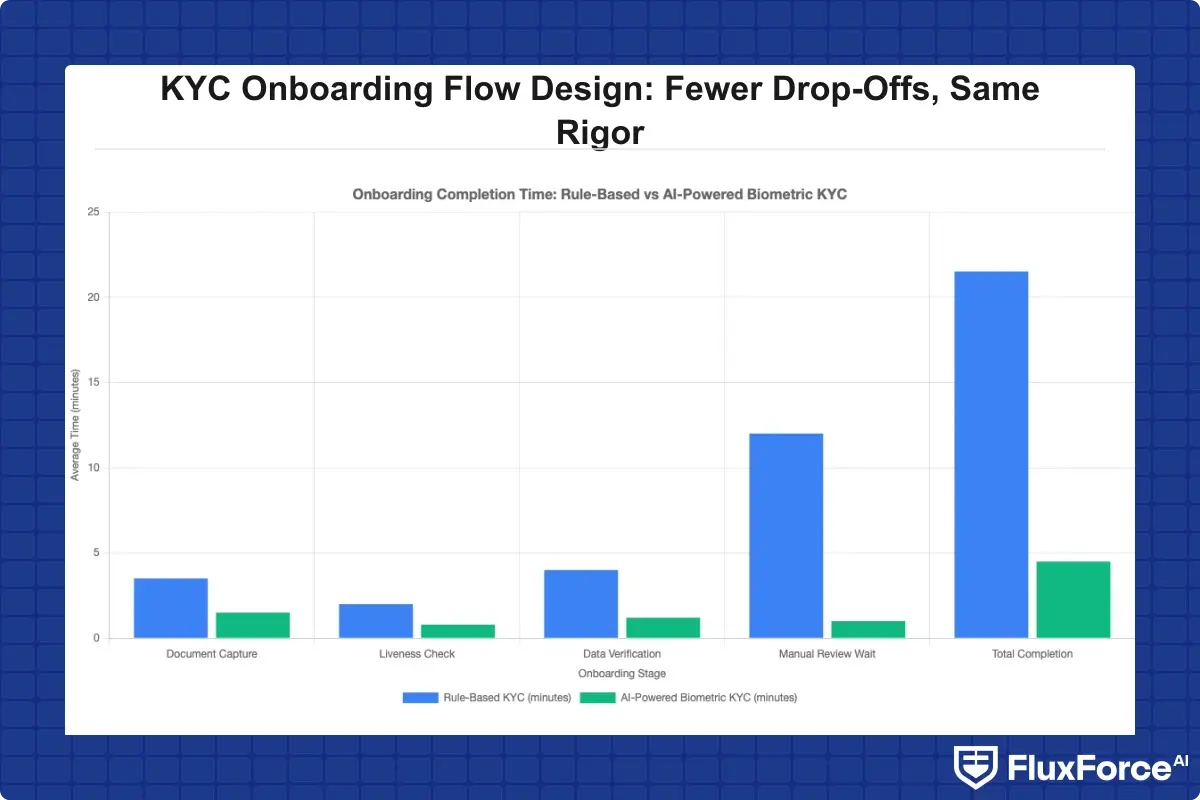
A well-designed flow with biometric identity verification and automated document checks should complete in under two minutes for a low-risk applicant, with manual review reserved for flagged cases rather than the default path.
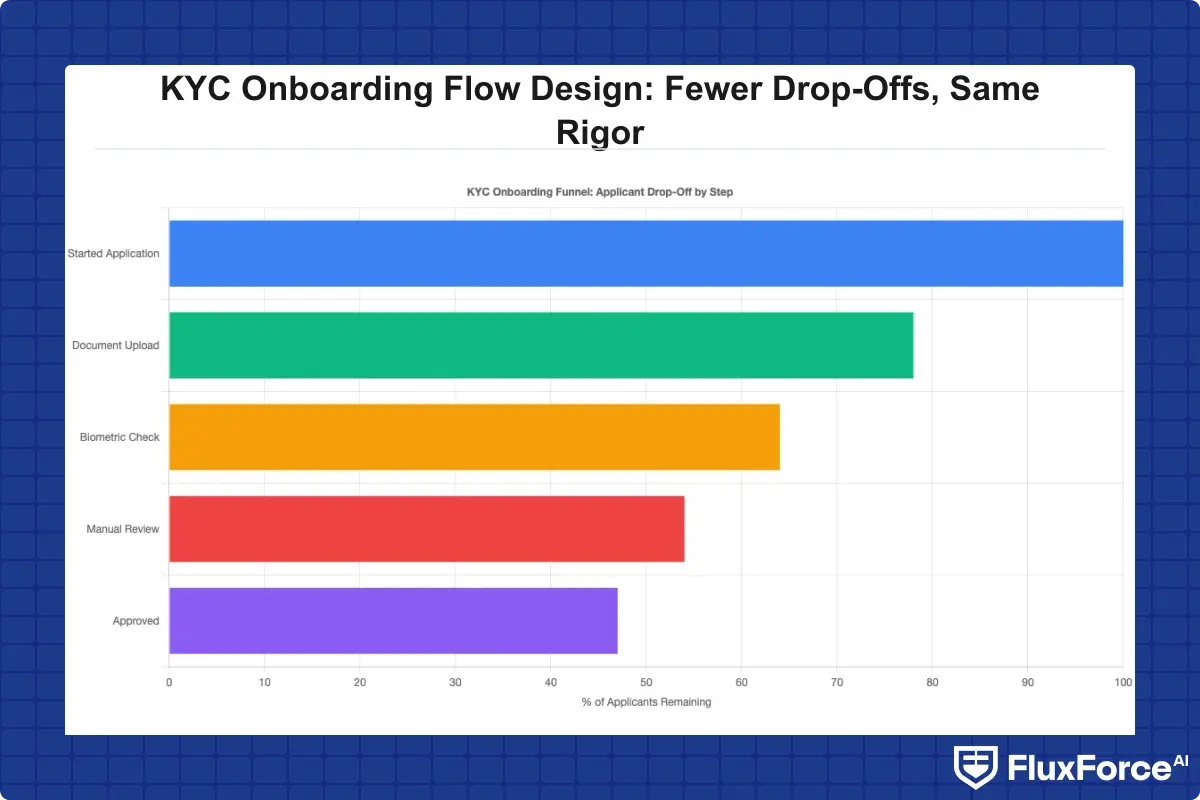
5 Reasons Identity Verification Fintech Programs Lose Applicants
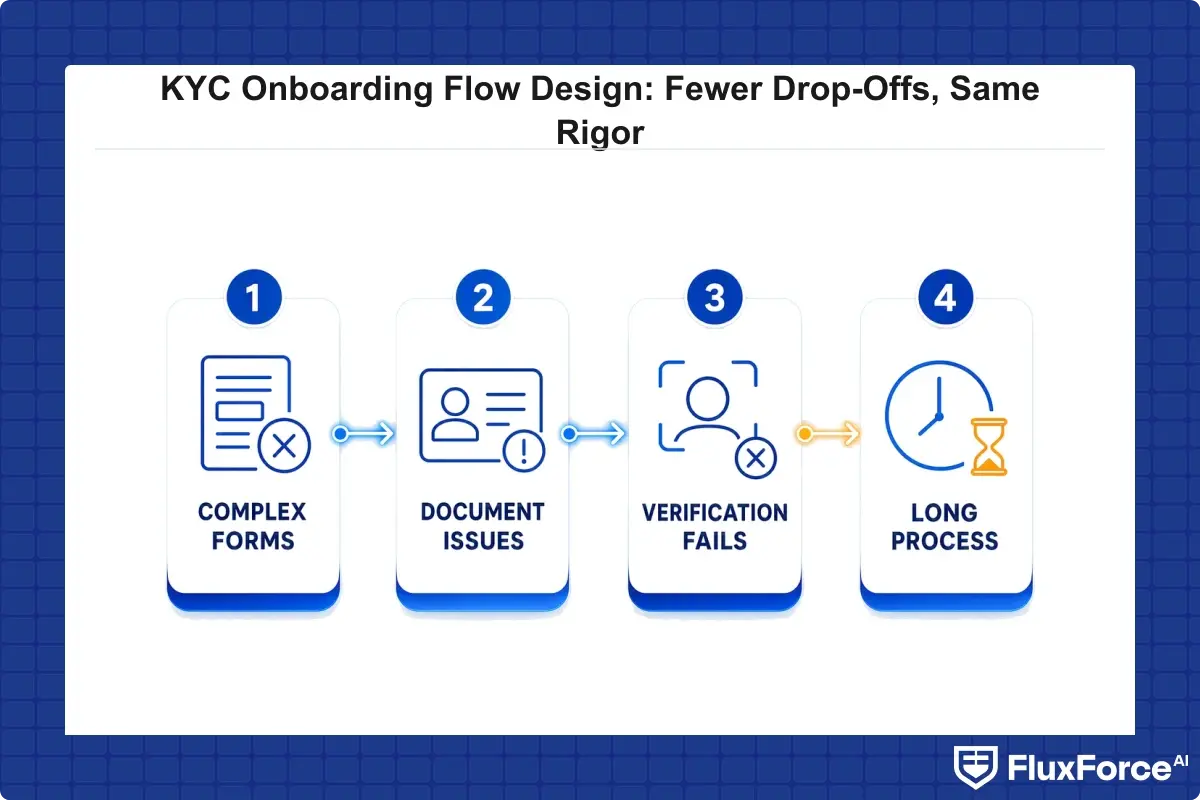
Fintechs run leaner compliance teams than banks, which makes flow design decisions matter more, not less. Here are the five most common reasons identity verification fintech programs bleed applicants.
1. Asking for information before establishing trust
Requesting a Social Security number or full address before the applicant has even uploaded an ID front-loads risk in the applicant's mind. Sequence data collection so identity proofing happens first.
2. No liveness check, so document fraud slips through
Without liveness detection fraud controls, a flow that only matches a selfie to a document photo can be beaten with a printed photo or a recorded video. That gap gets exploited quickly once discovered.
3. Treating every applicant the same
A flow with one fixed level of scrutiny for every applicant either under-checks high-risk cases or over-checks low-risk ones. Risk-based step-up verification keeps the default path fast.
4. Slow or opaque manual review queues
When a case needs human review, applicants who get no status update assume the application failed and leave. A simple "under review, expect a response by tomorrow" message cuts abandonment measurably.
5. No fallback when biometric checks fail
Legitimate applicants fail liveness checks sometimes, because of lighting, an older phone camera, or a disability. A flow with no fallback path (document-only verification with manual review) loses real customers to false rejections.
How Biometric Identity Verification and Liveness Detection Cut Friction
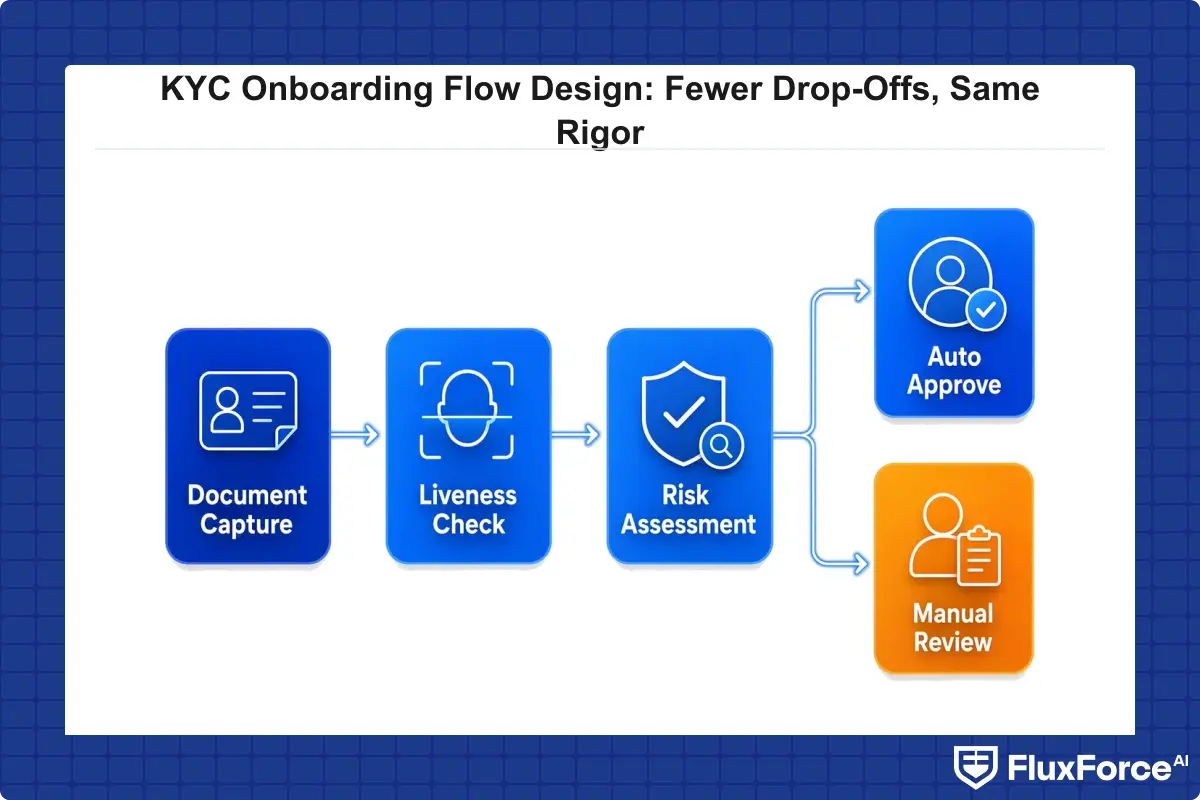
Biometric identity verification confirms an applicant's identity by matching a live selfie or video against their ID document, while liveness detection confirms the applicant is a real, present person rather than a photo, video replay, or synthetic face. Together they replace several minutes of manual document review with a check that runs in seconds.
Modern liveness detection fraud controls use passive signals, such as micro-movements, skin texture, and depth cues captured from a phone camera, so the applicant does not need to perform an awkward series of prompted actions. That single change removes one of the most common abandonment points in mobile KYC flows.
Why does liveness detection matter more now than five years ago?
Generative AI has made static-photo and video-replay attacks trivial to produce, and deepfake detection banking controls have become a baseline requirement rather than an advanced feature. A liveness layer built only to catch printed photos will not catch a well-produced synthetic video.
This is also where a purpose-built identity verification api earns its cost. Building liveness detection and deepfake resistance in-house means keeping pace with attack techniques that evolve monthly, something few internal teams have the bandwidth to do. A dedicated kyc aml automation platform bundles that detection work with the document and sanctions checks compliance teams already need, so the onboarding flow stays fast without compliance teams accepting a weaker standard.
Stopping Synthetic Identity Fraud Without Adding Steps
Synthetic identity fraud combines real and fabricated data, a real Social Security number paired with a fake name and date of birth, for example, to create an identity that passes individual verification checks because each data point checks out on its own. The FinCEN advisory on synthetic identity fraud describes this as one of the fastest-growing fraud typologies in consumer lending, precisely because it defeats checks built to catch stolen, not fabricated, identities.
Effective synthetic identity fraud detection does not rely on any single check. It correlates signals across the application: does the device fingerprint match prior fraud attempts, does the phone number's tenure align with the claimed identity's age, does the document's issuance pattern match known templates. None of that correlation requires the applicant to answer more questions.
A fabricated identity can pass a credit bureau check, a document scan, and an address lookup individually. Synthetic identity fraud is caught by cross-signal correlation, not by adding another single-point check.
Our deep dive on detecting synthetic identity fraud in real time walks through the specific signal combinations that catch fabricated identities without slowing down the applicants who are exactly who they claim to be.
Building a Zero Trust Security Framework for KYC Onboarding
A zero trust security framework treats every session as unverified until proven otherwise, and continuously, rather than granting trust once at account opening and assuming it holds forever. Applied to kyc onboarding, that means the identity check does not end when the account is approved.
Zero trust financial services programs re-verify identity at risk-triggering moments: a large withdrawal, a login from a new device, a change to account credentials. This matters because credential theft and account takeover happen well after onboarding, when the initial verification has already faded from relevance.
Zero trust in KYC design means three things in practice:
- No standing trust: a passed onboarding check does not exempt an account from future re-verification
- Context-aware step-up: higher-risk actions trigger a fresh identity check, not just a password prompt
- Continuous signal collection: device, behavioral, and biometric signals feed a running risk score rather than a one-time gate
Banking access teams applying this model to broader account security, not just onboarding, get more detail in our zero trust security architecture guide for banking ops heads.
Rule-Based vs AI-Powered KYC Onboarding
| Factor | Rule-Based Checks | AI-Powered Biometric Verification |
|---|---|---|
| Speed | Minutes, often with a manual review queue | Seconds for the majority of low-risk applicants |
| Fraud coverage | Strong on known patterns, weak on synthetic identities | Correlates cross-signal data, built to catch fabricated identities |
| Deepfake resistance | Minimal, static document matching only | Active and passive liveness detection fraud controls |
| False positive handling | Fixed thresholds reject edge cases outright | Risk-based scoring routes edge cases to review instead of auto-reject |
| Maintenance burden | Rules need manual updates as fraud patterns shift | Models retrain on new fraud signals continuously |
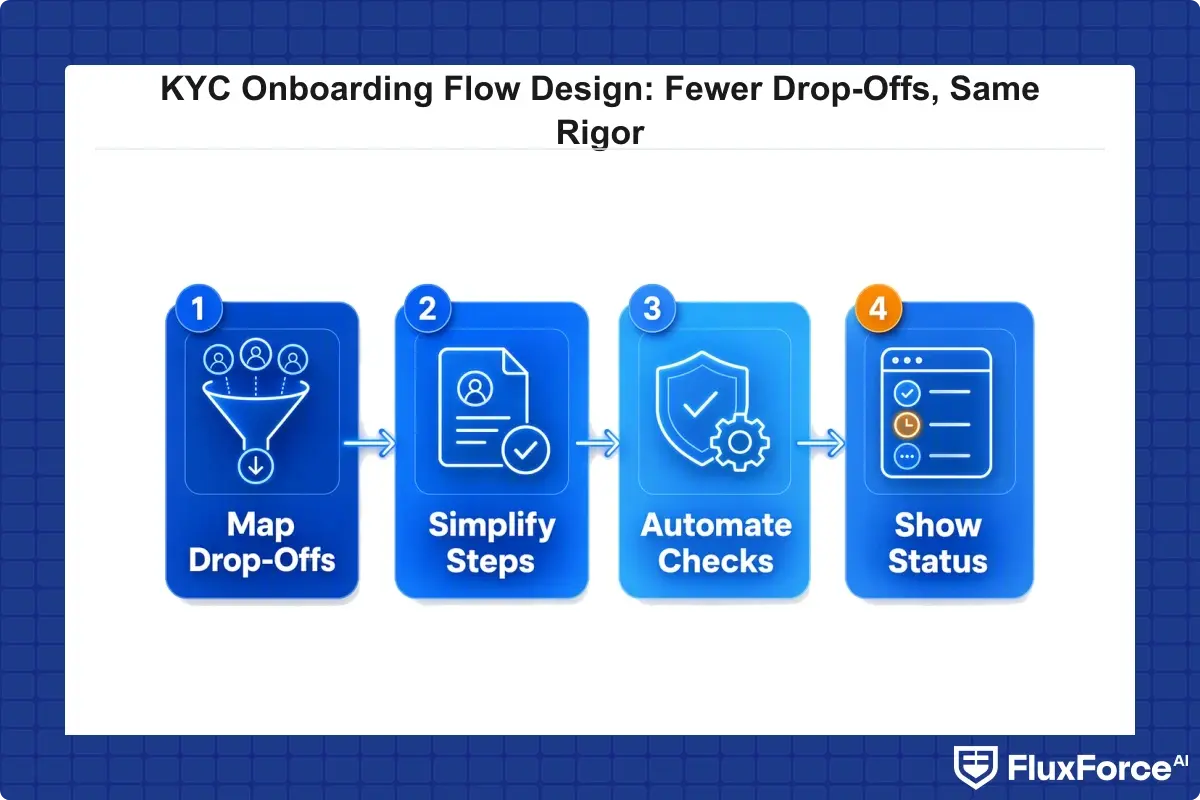
4 Steps to Redesign Your KYC Onboarding Flow
Redesigning an onboarding flow does not require ripping out your compliance stack. It requires sequencing and automating what is already there.
1. Map every current drop-off point
Instrument the existing flow to find exactly where applicants abandon, document upload, biometric check, or manual review wait. Fix the step causing the largest loss first rather than redesigning the whole flow at once.
2. Move to risk-based step-up verification
Set a default path for low-risk applicants that relies on biometric identity verification and automated checks, and reserve manual document review for applications that trigger specific risk signals.
3. Integrate liveness detection and synthetic identity fraud detection
Add passive liveness detection to catch deepfake and replay attacks, and layer in cross-signal correlation to catch synthetic identities that pass individual checks. An identity verification api with both built in avoids stitching together separate vendors for each control.
4. Give applicants clear status at every stage
Replace silent waiting with a visible status: verified, under review with an expected timeframe, or a specific, actionable rejection reason. This single change reduces support tickets as much as it reduces abandonment.
CISOs evaluating how this fits into a broader digital identity proofing strategy across supplier and partner onboarding, not just retail customers, should also see our KYC/AML identity verification strategy for CISOs.
- Most KYC onboarding drop-offs are caused by flow design, not by the level of scrutiny required.
- Biometric identity verification and liveness detection cut verification time from minutes to seconds for low-risk applicants.
- Synthetic identity fraud passes single-point checks and requires cross-signal correlation to catch.
- Deepfake detection banking controls are now a baseline requirement, not an advanced add-on.
- A zero trust security framework extends identity checks past onboarding into ongoing account activity.
- Risk-based step-up verification, not uniform scrutiny, is what keeps fast and rigorous from being a trade-off.
Onboard Customers in Seconds
Conclusion
KYC onboarding drop-offs are a design problem wearing a compliance costume. Institutions that lose applicants in the first two minutes of an application are not failing a regulatory bar; they are running a flow built around manual review timelines that biometric verification made unnecessary years ago.
Three things close that gap: biometric identity verification paired with passive liveness detection to confirm a real applicant in seconds, synthetic identity fraud detection that correlates signals instead of checking data points in isolation, and a zero trust security framework that keeps verifying identity after the account opens, not just at the start.
Adopting this does not mean replacing your compliance stack. It means resequencing it: automated checks first for the low-risk majority, manual review reserved for what actually needs a human, and clear status messaging throughout. Teams that make this shift typically cut their onboarding time from minutes to under two for most applicants, without loosening what gets checked.
Start by mapping where your current flow loses applicants, then move the biggest leak to an automated, risk-based path first.


Share this article