.webp)







Listen To Our Podcast🎧
Introduction
Agentic AI architecture is changing how banks, fintechs, insurers, and supply chain companies detect fraud and stay compliant without drowning their teams in false alerts. Instead of a single model scoring transactions, an agentic system runs multiple specialized AI agents that investigate, cross-reference, and escalate the way a junior analyst team would, just at machine speed. For CISOs and compliance officers watching headcount stay flat while transaction volume climbs, that shift matters.
This is not a rip-and-replace pitch. Most regulated firms still run rule-based transaction monitoring software as their backbone, and that is fine as a starting point. The question is how to layer agentic AI on top without breaking audit trails or triggering a regulator's skepticism.
We will walk through a practical four-phase rollout, explain how does AI detect fraud at each layer, and show where the real cost of fraud alert fatigue hides on your balance sheet.
- What agentic AI architecture actually means versus a single fraud-scoring model
- The 4-phase rollout path regulated firms use to adopt agentic AI without a compliance freeze
- Why fraud alert fatigue is a budget problem, not just an analyst morale problem
- How machine learning fraud detection differs from rules engines in practice
- A side-by-side comparison of rule-based versus agentic AI architecture
- 5 criteria for evaluating AI fraud detection software before you sign a contract
Onboard Customers in Seconds

What Is Agentic AI Architecture in Financial Services?
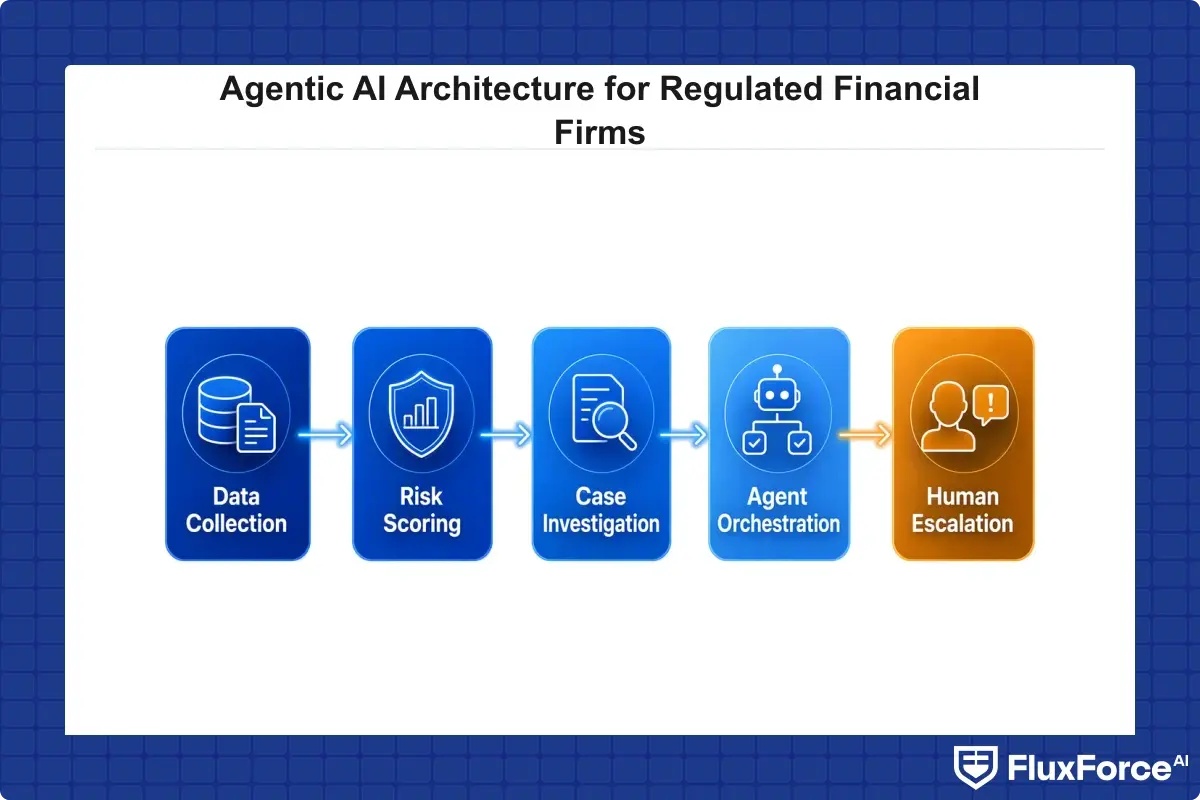
Agentic AI architecture is a system of coordinated, semi-autonomous AI agents that each own a specific task in a workflow, such as gathering evidence, scoring risk, or drafting a suspicious activity report, and hand off to a human or another agent at defined checkpoints. That is different from a single machine learning model bolted onto your existing transaction monitoring software.
A traditional model gives you a score. An agentic system gives you a score plus the reasoning trail: which accounts it checked, what patterns it matched, and why it escalated one case over another. That trail is what makes agentic AI usable in regulated environments where examiners want to see the "why," not just the "what."
How does AI detect fraud in an agentic system?
An agent pulls transaction data, device fingerprints, and behavioral history, then compares them against learned patterns of normal activity for that customer segment. When it finds a deviation, it does not just flag it, it spins up a sub-task: check for linked accounts, verify against sanctions lists, pull recent customer service interactions. That is the core mechanic behind ai fraud detection explained in plain terms: agents chain small decisions into one investigative narrative instead of a lone number on a dashboard.
AI fraud detection explained for compliance teams
Compliance officers care about defensibility. An agentic workflow logs every step an agent took, which makes it easier to demonstrate to an examiner that a decision was consistent and explainable. We have found that firms piloting this get through their first regulatory review of the system faster when the agent logs are structured from day one, not bolted on after a finding.
The 4 Phases of Agentic AI Architecture Rollout
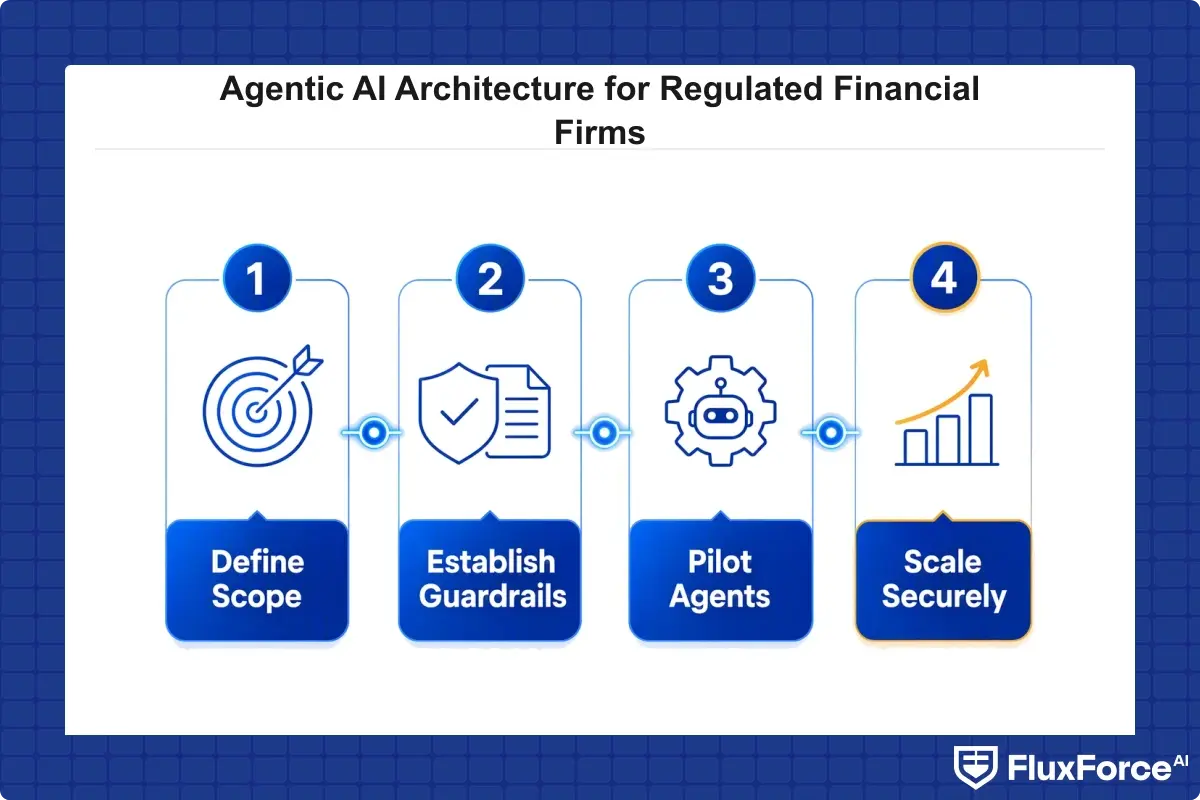
We recommend a phased rollout because regulated firms cannot afford a system that fails silently. Each phase hands the agents more autonomy only after the previous phase proves itself in production, not in a demo.
1. Phase 1 (Now): Augmented Review
Agents assist human analysts by pre-gathering evidence and summarizing a case before the analyst opens it. No autonomous decisions are made. This is where most banks and insurers sit today, and it is the right place to start if you have never run an agent in production. Expect this phase to run 60 to 90 days in our client engagements before moving on.
2. Phase 2: Supervised Autonomy
Agents can close low-risk, high-confidence cases automatically (clear false positives) but every escalation still requires a human sign-off. This is where fraud alert fatigue starts to visibly drop, because analysts stop wading through obvious non-events.
3. Phase 3: Conditional Autonomy
Agents handle full investigation-to-resolution for defined case types (say, card-not-present fraud under a dollar threshold) without human review, but a human audits a sample weekly. Firms in regulated industries typically require a documented model risk management sign-off before entering this phase.
4. Phase 4: Full Agentic Orchestration
Multiple agents coordinate across fraud, AML, and sanctions screening simultaneously, escalating to humans only for genuinely ambiguous or high-value cases. Very few firms are here today, and we do not recommend rushing to it. The firms that get burned are the ones that skip Phase 2 and Phase 3 entirely.
Skipping straight from a legacy rules engine to Phase 4 autonomy is the single most common reason agentic AI pilots get shut down by internal audit. The phases exist because trust has to be earned in production, not assumed from a vendor demo.
Why Fraud Alert Fatigue Breaks Legacy Transaction Monitoring Software
Most transaction monitoring software was built to generate alerts, not to resolve them. That design choice made sense a decade ago when volumes were lower. Today it means analysts spend most of their shift clearing noise instead of catching real fraud.
The false positive cost fraud teams underestimate
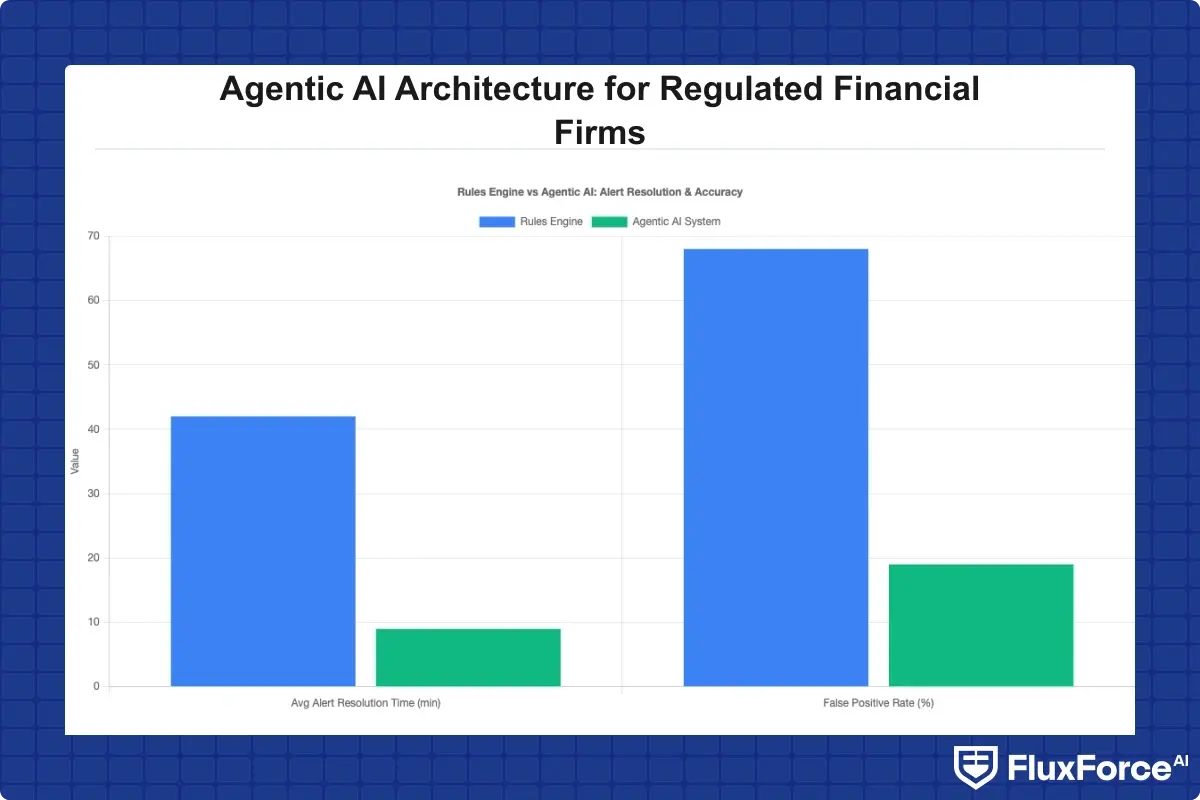
Every false positive costs analyst time, and analyst time is the scarcest resource in most compliance departments. In our engagements, teams running legacy rules engines report spending 3 to 5 minutes per alert even when the case turns out to be nothing, and a mid-size bank can generate thousands of those alerts a week. That is the false positive cost fraud programs rarely put a number on until they try to hire their way out of it.
The knock-on effect is worse: when analysts see mostly false positives, they start rubber-stamping cases faster, which is exactly how real fraud slips through. FluxForce's breakdown of how agentic AI fraud agents cut false positives by 80% walks through the mechanics of how agent-based triage reduces that noise without loosening detection thresholds.
How to reduce false positives in AML programs
The fix is not a stricter threshold, which just trades false positives for false negatives. The practical approach to reduce false positives transaction monitoring teams can start this quarter:
- Add behavioral baselines per customer segment instead of one static rule for everyone
- Layer an agent on top of existing rules to re-score alerts before they hit an analyst queue
- Feed investigation outcomes back into the model so it learns what your team actually calls fraud
- Track false positive rate fraud detection metrics weekly, not quarterly, so drift gets caught early
Firms wanting a structured path can review FluxForce's guide to rolling out regulatory compliance agents in 90 days, which maps directly onto the Phase 1 to Phase 2 transition described above.
How Does AI Fraud Detection Actually Work?
AI fraud detection works by training models on historical transaction patterns, then scoring new transactions against those learned patterns in real time, flagging deviations for review or automated action. The mechanics differ sharply from the if-this-then-that logic of legacy rules engines.
Machine learning fraud detection vs rules engines
A rules engine says "flag any transaction over $10,000 from a new device." Machine learning fraud detection instead learns that a specific customer's spending pattern, device history, and location make a $10,000 transaction from a new device completely normal for them, while it would be suspicious for someone else. That contextual scoring is why ai fraud detection in banking has moved past static thresholds over the past several years.
Real time fraud detection for banks
Real time fraud detection banks rely on has to score a transaction in under 200 milliseconds to avoid slowing down checkout or payment authorization. Agentic systems handle this by separating the fast, automated first-pass score from the slower, deeper investigation an agent runs only on flagged cases, so the customer experience never waits on the deep dive. FluxForce's comparison of AI versus traditional fraud detection covers the latency and accuracy tradeoffs risk officers should weigh before switching vendors.
Rule-Based vs Agentic AI Architecture: What's the Real Difference?
The honest answer is that most firms will run both for years, not one or the other. Rules stay useful for hard compliance requirements (sanctions list matches, for example) where you want deterministic, explainable logic. Agentic AI earns its place on the judgment calls in between.
Rule-Based vs Agentic AI
| Factor | Rule-Based Systems | Agentic AI Architecture |
|---|---|---|
| Decision logic | Static thresholds, manually tuned | Learns patterns, adapts over time |
| False positive rate | High, grows as fraud tactics shift | Lower, self-corrects with feedback |
| Explainability | Fully deterministic, easy to audit | Requires structured agent logs for audit |
| Analyst workload | Heavy, most alerts are noise | Reduced, agents pre-triage cases |
| Setup effort | Fast to deploy, slow to maintain | Slower initial setup, less ongoing tuning |
| Best fit | Hard compliance rules (sanctions, KYC gates) | Judgment-heavy fraud and AML cases |
FluxForce's deeper look at rule-based systems versus AI for false positive reduction is worth reading if your team is deciding whether to retire a rules engine entirely or run it alongside agents.
The firms that succeed with agentic AI architecture do not throw out their rules engine, they demote it to a first-pass filter and let agents handle the ambiguous middle ground that rules were never good at.
AI Fraud Detection in Banking, Insurance, and Supply Chain
Agentic AI architecture is not a banking-only story. The pattern repeats across every regulated industry FluxForce works with, though the specific fraud vectors differ.
AI fraud detection in banking
Card-not-present fraud, account takeover, and synthetic identity fraud dominate. Ai fraud detection in banking increasingly pairs transaction scoring with device and behavioral biometrics, which is where FluxForce's own fraud detection software fits into a bank's existing stack as an overlay rather than a replacement.
Insurance claims fraud
Agents cross-reference claim details against policy history, adjuster notes, and prior claims across carriers. FluxForce's guide on AI-powered suspicious claim strategy for underwriting managers shows how this plays out in a claims workflow specifically.
Supply chain and trade finance
Document fraud and shell-company invoicing are the recurring problem. Agentic systems here verify trade documents against shipping and customs data automatically, a workflow covered in FluxForce's piece on AI-driven trade document verification.
Choosing AI Fraud Detection Software: 5 Evaluation Criteria
Vendor demos look impressive across the board. These are the criteria that actually predict whether ai fraud detection software holds up in your production environment.
1. Audit trail depth
Can the vendor show you the exact reasoning chain an agent followed for a specific case, not just a confidence score? If the answer involves a black-box model with no log, walk away.
2. Integration with existing transaction monitoring software
Most regulated firms cannot rip out their core monitoring platform. Ask whether the agentic layer sits on top of your current system or requires a full migration.
3. False positive rate under your own data
Demo numbers are trained on the vendor's dataset, not yours. Insist on a pilot against your real transaction history before committing to a false positive rate fraud detection benchmark.
4. Model governance and explainability
Ask how the vendor handles model drift monitoring and whether their approach aligns with recognized frameworks like the NIST AI Risk Management Framework, which examiners increasingly reference when reviewing AI-driven compliance tools.
5. Rollout support for the phased approach
A vendor that pushes you straight to full autonomy without a Phase 1 and Phase 2 on-ramp is optimizing for their sales cycle, not your risk tolerance.
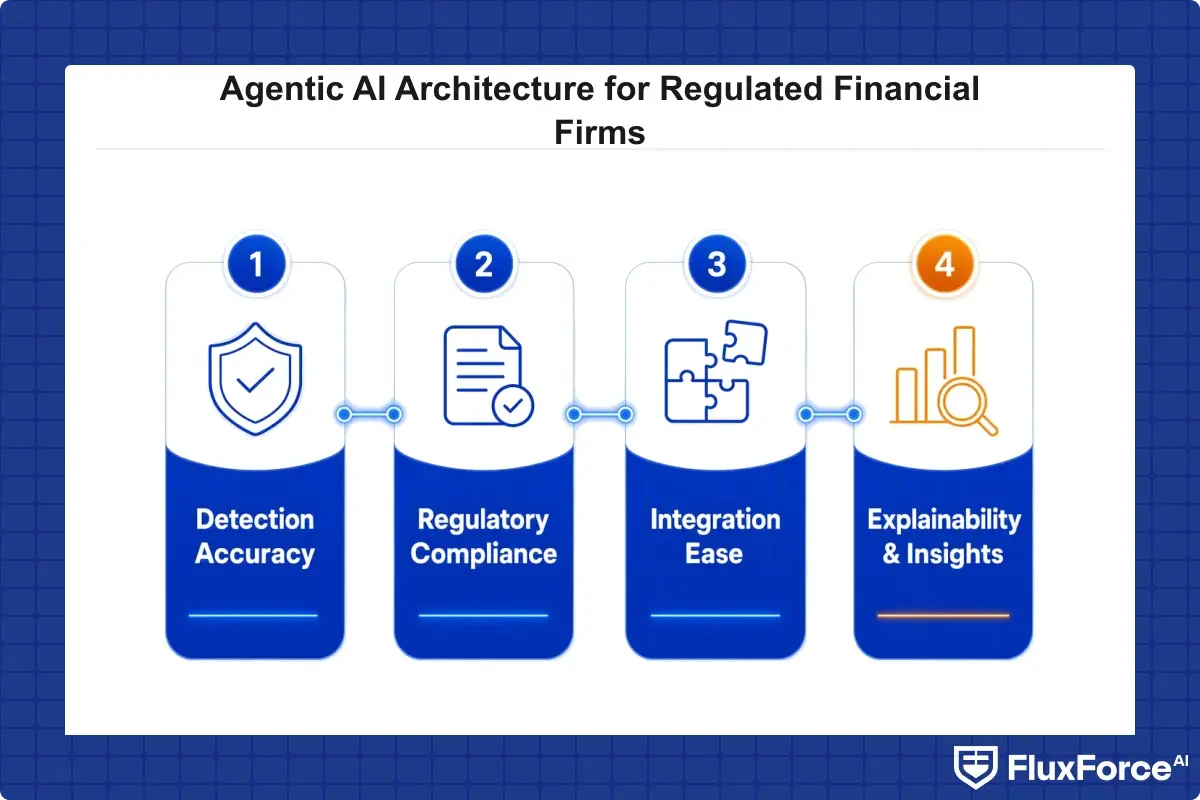
- Agentic AI architecture layers coordinated, task-specific agents on top of existing transaction monitoring software rather than replacing it outright.
- A 4-phase rollout, from augmented review to full orchestration, keeps regulated firms compliant while building trust in the system.
- Fraud alert fatigue carries a real, measurable false positive cost that most compliance budgets never itemize.
- Machine learning fraud detection beats static rules by scoring transactions against a customer's own behavioral baseline.
- Rule-based systems and agentic AI work best together, with rules handling deterministic compliance gates and agents handling judgment calls.
- Vendor evaluation should center on audit trail depth and integration effort, not just headline false positive numbers.
Onboard Customers in Seconds
Conclusion
Agentic AI architecture is not a single product decision, it is a multi-year operating shift for how banks, insurers, and supply chain firms handle fraud and compliance. The core problem it solves is concrete: teams buried in false positives from legacy transaction monitoring software, with fraud alert fatigue eroding both analyst retention and detection quality over time.
The fix runs through a phased agentic rollout, behavioral machine learning scoring layered on top of existing rules, and audit-ready agent logs that satisfy examiners instead of alarming them. None of this requires abandoning your current rules engine on day one.
In practice, adopting this looks like starting in Phase 1 with augmented review, proving the agents out on real cases for a quarter, and only then handing them supervised autonomy over the clearest false positives, the kind of change that can realistically cut analyst time spent on dead-end alerts within the first 90 days. Start by auditing where your current false positive rate actually sits, then map that number against the phase that fits your risk appetite.
If you are ready to move past Phase 1, talk to your compliance and risk teams about piloting a supervised-autonomy phase on your lowest-risk case type this quarter.
Share this article