.webp)







Listen To Our Podcast🎧
Introduction
AI governance tools are becoming the deciding factor between banks that catch fraud early and banks that drown their analysts in false alarms. Every risk team we talk to describes the same problem: transaction volumes are rising, fraud rings are using generative AI of their own, and the old rule-based stack cannot keep pace without burying compliance staff in noise.
This matters because the fix isn't just "buy an AI fraud detection tool." It's choosing governance tooling that gives you visibility into model decisions, a documented rollout plan, and a way to prove to regulators and auditors that the model is doing what you think it's doing. Banks, fintechs, and insurers that skip this step end up with a fast fraud model they can't explain and can't defend.
We wrote this guide from the vantage point of teams who have actually rolled these systems out, not from a vendor slide deck. Below is what to look for, phase by phase, and the specific traps that turn a promising pilot into a shelved project.
- What AI governance tools actually do inside a bank's fraud and compliance stack
- How does AI detect fraud, in plain terms, without the marketing jargon
- The 4-phase rollout banks use to go from pilot to full production
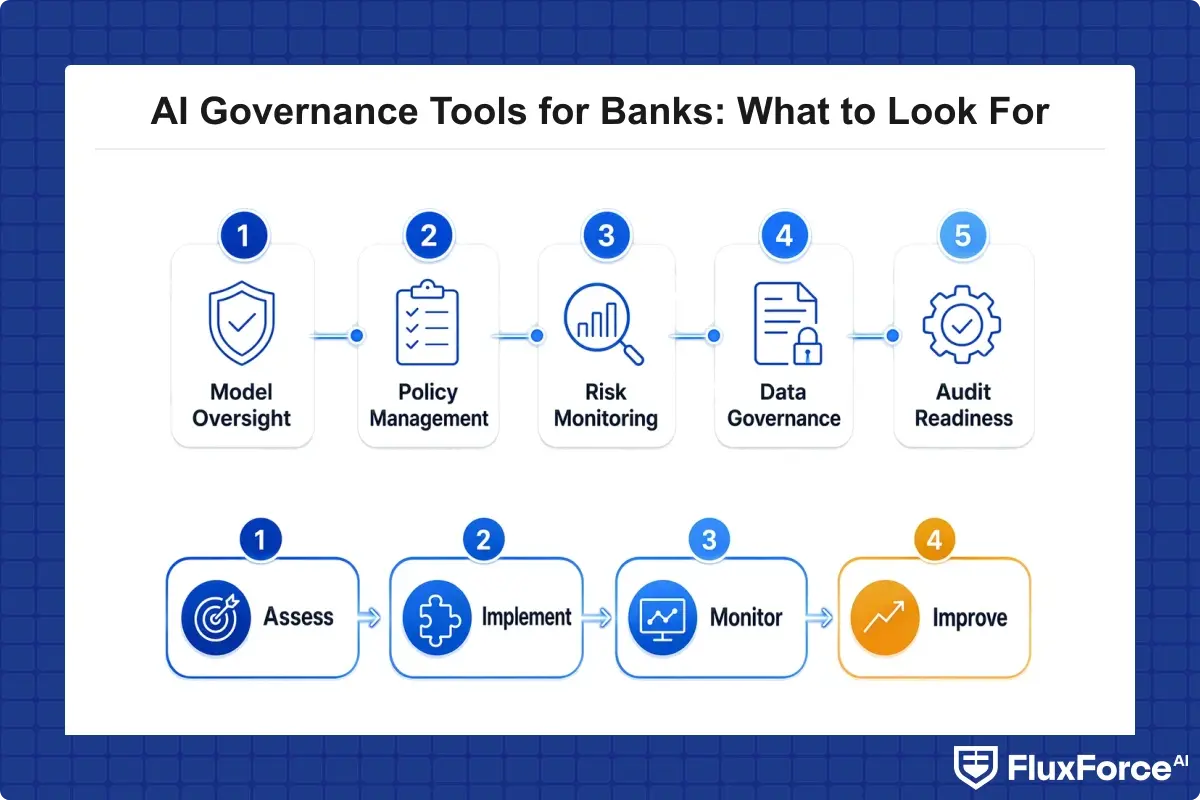
- The 5 specific features to demand from any vendor before you sign
- Why fraud alert fatigue is a budget problem, not just a morale problem
- A concrete way to reduce false positives in transaction monitoring without adding headcount
Onboard Customers in Seconds

What Are AI Governance Tools and Why Banks Need Them Now
AI governance tools are the systems that monitor, document, and control how a bank's AI models make decisions, especially models used for fraud detection, AML screening, and credit risk. They sit alongside your fraud detection models, not inside them, tracking drift, logging decisions, and flagging when a model starts behaving in ways nobody approved.
Banks need this now because AI fraud detection in banking has moved from an experimental add-on to the primary detection layer at most mid-size and large institutions. Regulators have noticed. The NIST AI Risk Management Framework is now the reference point examiners cite when they ask a bank how it validates and monitors an AI model, and FinCEN has flagged AI-enabled fraud typologies in its advisory guidance on identity-related fraud.
AI Fraud Detection Explained in Plain Terms
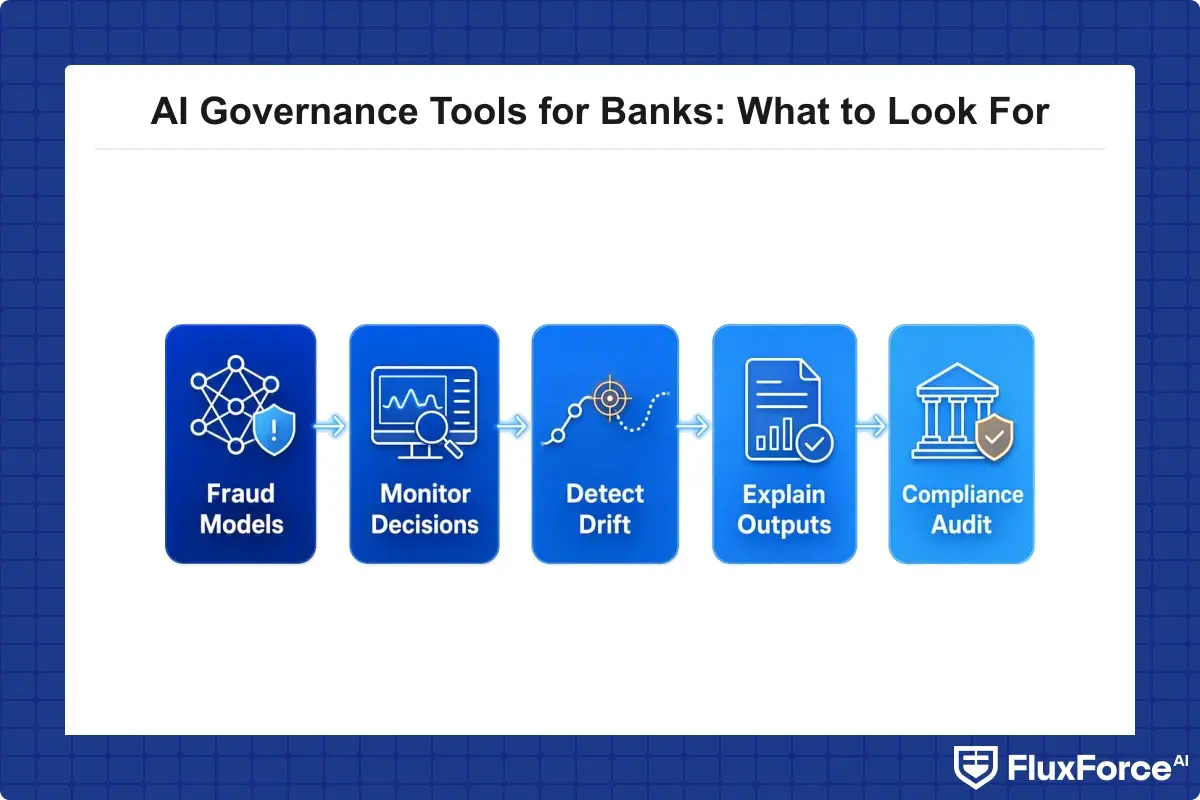
At its simplest, ai fraud detection explained means teaching a model what normal transaction behavior looks like for a customer, a merchant, or a channel, then scoring anything that deviates from that baseline. The governance layer is what tells you why the model flagged a transaction, whether that reasoning has changed over the last quarter, and whether the flag rate is creeping up in a way that suggests the model is drifting off its training data.
A fraud model without a governance layer is a black box making financial decisions at scale. The model can be 95% accurate and still get your bank a matter requiring attention from examiners if nobody can explain a single flagged decision.
How Does AI Detect Fraud? Inside Modern AI Fraud Detection Systems
AI detects fraud by scoring transactions against learned behavioral patterns in real time, rather than checking them against a fixed list of rules. That's the core shift from legacy systems, and it's why the question "how does ai detect fraud" keeps coming up in board meetings: the answer changes what your compliance team needs to monitor.
Machine Learning Fraud Detection vs Static Rules
Machine learning fraud detection builds a model from millions of historical transactions, learning the subtle combinations of time, location, merchant category, and device that separate legitimate activity from fraud. A static rule engine, by contrast, flags anything over $10,000 sent to a new payee within 24 hours of a password reset, regardless of whether that pattern is normal for a given customer.
We've reviewed fraud programs at several client banks, and the pattern is consistent: rule engines catch the fraud patterns from two years ago, and machine learning catches the ones happening this quarter. Neither replaces the other entirely, which is exactly why governance tooling matters, someone has to arbitrate when the two disagree.
Real-Time Fraud Detection Banks Actually Use in Production
Real time fraud detection banks deploy today typically scores a transaction in under 300 milliseconds, before the payment authorizes. For real time fraud detection banks to trust this speed, the governance layer needs a kill switch: a documented, tested way to roll back to the previous model version if the new one starts misbehaving in production. If your vendor can't show you that rollback process in a demo, that's a real gap, not a minor one.
Our guide on AI-powered fraud detection strategy for risk heads walks through how one card issuer structured this exact kill-switch process.
The 4 Phases of Rolling Out AI Governance Tools
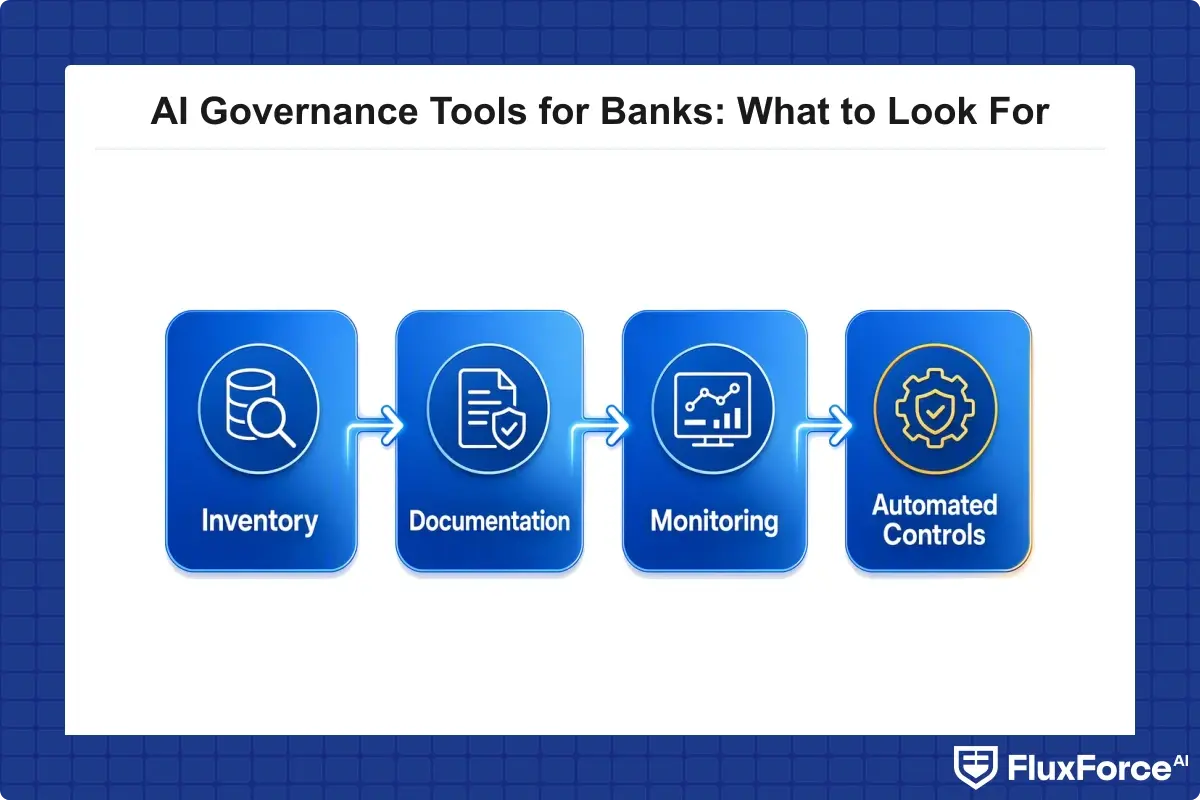
Banks that roll out AI governance tools successfully treat it as a phased program, not a single procurement decision. Here are the 4 phases we see work in practice.
1. Phase 1 (Now): Inventory and Baseline
Phase 1 (Now) is about knowing what you already have. Most banks are surprised to find 6 to 12 AI or ML models already running in production, fraud scoring, credit decisioning, chatbot triage, with no central inventory. This phase means cataloging every model, who owns it, what data feeds it, and what decisions it influences.
2. Phase 2: Explainability and Documentation
Phase 2 adds the paper trail. Every model gets a model card: training data source, known limitations, last validation date, and an explainability method (SHAP values are common) that lets an analyst see why a specific transaction was flagged. Skipping this phase is the single most common reason audits stall.
3. Phase 3: Continuous Monitoring
Phase 3 is where the governance tool starts earning its keep day to day. It tracks model drift, watches for shifts in the false positive rate, and alerts your team before a model quietly degrades. This is also where you start measuring fraud alert fatigue as a real metric instead of an anecdote from your analysts.
4. Phase 4: Automated Controls and Escalation
Phase 4 closes the loop. The governance tool can automatically throttle a model's authority (require human review above a risk score, for example) if drift crosses a threshold, and it routes high-risk decisions to a human reviewer without anyone having to notice the problem manually first.
5 Features to Look For in AI Governance Tools
Not every vendor pitching "AI governance" has built the same product. Here are the 5 features that separate a real governance platform from a dashboard with a nice logo.
1. Model Inventory and Lineage Tracking
The tool should automatically discover models running against your data, not rely on someone remembering to register them manually.
2. Explainability at the Transaction Level
An analyst should be able to click into any flagged transaction and see the top 3-5 factors that drove the score, in language a non-technical auditor can follow.
3. Drift and Performance Alerting
The platform should flag when a model's false positive rate or detection rate moves outside its normal range, ideally before your fraud alert fatigue metrics spike.
4. Audit-Ready Reporting
Examiner-facing reports should generate on demand, not require a data science team to assemble manually the week before an exam.
5. Integration With Existing Transaction Monitoring Software
The governance layer needs to plug into your existing transaction monitoring software and case management system rather than forcing a rip-and-replace. When we evaluate vendors for clients, this is usually the feature that eliminates half the shortlist. A mature platform for fraud detection software should connect to your current stack within weeks, not quarters.
Why Fraud Alert Fatigue Is Costing Banks More Than They Think
Fraud alert fatigue happens when analysts get so many low-quality alerts that they start clearing queues faster than they review them, which is exactly when real fraud slips through. Organizations lose a median of 5% of annual revenue to fraud according to the ACFE's Report to the Nations, and a meaningful share of that loss traces back to alerts that were technically generated but never properly investigated.
The Real Cost of a High False Positive Rate
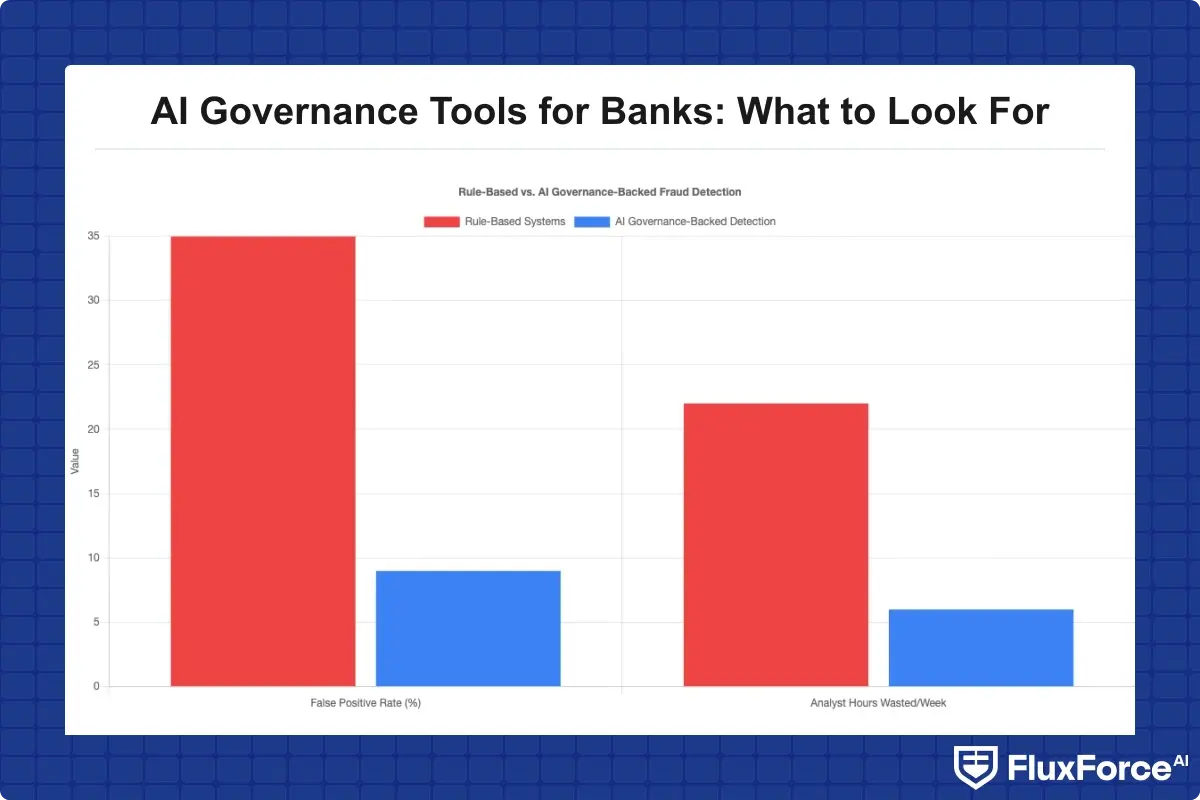
A false positive cost fraud teams rarely calculate directly: every hour an analyst spends clearing a false alarm is an hour not spent on the transaction that was actually fraudulent. In our engagements, teams running legacy rule-based systems commonly see 90%+ of alerts turn out to be false positives, which means only a sliver of analyst time touches real fraud.
Fraud alert fatigue isn't a staffing problem you fix by hiring more analysts. It's a signal-to-noise problem, and hiring more people to review noise just makes the noise more expensive.
Our post on how legacy fraud detection fails without agentic AI goes deeper into why static rule engines age so poorly against evolving fraud patterns.
Reducing False Positives: A Core Job of AI Governance Tools
False positives fraud detection systems generate aren't just an annoyance, they're the metric that determines whether your AI investment pays for itself. A governance layer that tracks this number over time is doing more for your ROI than almost any other feature on the list.
How to Reduce False Positives in AML Screening
Teams asking how to reduce false positives in aml screening usually get the fastest wins from three changes:
- Retrain on recent data so the model reflects current customer behavior instead of a two-year-old baseline
- Add entity resolution so the same customer across multiple accounts isn't flagged repeatedly for the same pattern
- Tier alerts by risk score so low-confidence flags route to automated review while high-confidence ones go straight to an analyst
Reduce False Positives in Transaction Monitoring Without Losing Coverage
The honest answer on how to reduce false positives transaction monitoring generates is that it's a tuning exercise, not a one-time fix. Banks that treat their false positive rate as a metric reviewed quarterly, alongside detection rate, tend to hold both numbers steady even as fraud patterns shift. Banks that set the model once and walk away watch their false positive rate creep upward every quarter.
Our rule-based vs AI transaction monitoring comparison breaks down the specific tuning levers that moved the needle most for banking clients.
Rule-Based Systems vs AI Governance Tools
| Factor | Rule-Based Systems | AI Governance Tools |
|---|---|---|
| False positive rate | Typically 90%+ of alerts are false | Meaningfully lower, with continuous tuning |
| Adaptation to new fraud | Requires manual rule updates | Learns from new transaction patterns automatically |
| Explainability | Simple, rule is the explanation | Requires dedicated explainability tooling |
| Regulatory defensibility | Well understood by examiners | Depends entirely on governance documentation |
| Analyst workload | High, most alerts need manual triage | Lower, once tuned and monitored |
- AI governance tools exist to make fraud models explainable, auditable, and safe to run at scale, not just accurate.
- A 4-phase rollout, inventory, documentation, monitoring, automated controls, beats a big-bang deployment every time.
- Fraud alert fatigue is a cost problem before it's a morale problem; every false positive eats analyst hours that should go to real fraud.
- The 5 must-have features are model inventory, transaction-level explainability, drift alerting, audit-ready reporting, and integration with existing transaction monitoring software.
- Reducing false positives is a continuous tuning exercise, not a setting you configure once and forget.
Onboard Customers in Seconds
Conclusion
AI governance tools solve a problem that's only getting more expensive to ignore: fraud models making high-stakes decisions with no one able to explain why. Across the phases we outlined, inventory, documentation, monitoring, and automated controls, the goal is the same, a fraud detection program your compliance team can actually defend in an exam.
The fix isn't complicated, but it does require explainability at the transaction level, continuous drift monitoring, and a documented rollout plan that doesn't treat governance as an afterthought bolted onto an existing fraud model. Adopting this approach realistically means a multi-quarter rollout, not a weekend project, but banks that follow the 4-phase path we described typically see their false positive rate drop meaningfully within two quarters of completing Phase 3.
Start with Phase 1: pull together the actual list of AI models running in your fraud and compliance stack this week, before you evaluate a single vendor.
Share this article