.webp)







Listen To Our Podcast🎧
Introduction
Sanctions screening tools are the systems that check every customer, transaction, and counterparty against government watchlists before money moves anywhere near the wrong hands. For banks, fintechs, insurers, and supply chain companies, picking the wrong one is not a minor technical decision. It shows up months later as a regulatory finding, a backlog of unresolved alerts, or a wire that should never have cleared.
Most vendor comparisons focus on marketing language: "AI-powered," "real-time," "industry-leading match rates." None of that tells a compliance officer whether the tool will actually reduce false positives, integrate with the core banking stack, or hold up during an examination. This post gives you a concrete framework for comparing sanctions screening tools on the criteria that matter for aml compliance, not the ones that sound good in a demo.
We will also connect screening to the parts of the compliance program it touches directly: kyc automation, sar filing, and the ctr filing rules examiners check first. If you are evaluating tools for a community bank, a fintech with a five-person compliance team, or a supply chain company managing high-risk suppliers, the same evaluation logic applies.
- The 6 criteria that actually separate strong sanctions screening tools from weak ones
- Why manual list checking breaks down once transaction volume grows past a few hundred a day
- How kyc automation and enhanced due diligence connect to screening accuracy
- What examiners expect to see in your sar filing and suspicious activity report documentation
- A practical bsa aml compliance checklist you can adapt for a community bank or a small fintech team
- What is actually changing in anti money laundering technology heading into 2026
Onboard Customers in Seconds

What Are Sanctions Screening Tools and Why Do They Matter for AML Compliance?
Sanctions screening tools are software systems that match customer and transaction data against government-maintained watchlists such as OFAC's Specially Designated Nationals list, UN Security Council sanctions, and EU consolidated lists, then flag or block anything that matches. They sit inside a broader aml compliance program alongside transaction monitoring, kyc automation, and case management.
The stakes are not abstract. A missed match can mean processing a payment for a sanctioned entity, which regulators treat as a strict-liability violation regardless of intent. A tool that is too aggressive creates the opposite problem: a flood of false positives that bury the two or three real hits your team actually needs to catch.
How sanctions lists work and why manual checks fail at scale
Watchlists update constantly. OFAC alone adds and removes entries throughout the year, and names come with inconsistent spellings, transliterations, and aliases. A manual process, someone checking a spreadsheet or a static PDF against a customer list, cannot keep pace once you are onboarding more than a handful of customers a week.
This is where anti money laundering technology earns its keep. Fuzzy matching, phonetic algorithms, and structured data feeds catch variant spellings a human reviewer would miss on a Friday afternoon. For fintechs scaling customer acquisition, this is often the first compliance control that breaks under growth, which is why our KYC/AML & identity verification strategy for CISOs piece treats screening as a scaling problem, not just a checkbox.
A sanctions screening tool that cannot explain why it flagged a name is not a compliance asset, it is a liability waiting for an examiner to ask the question you cannot answer.
6 Criteria for Evaluating Sanctions Screening Tools
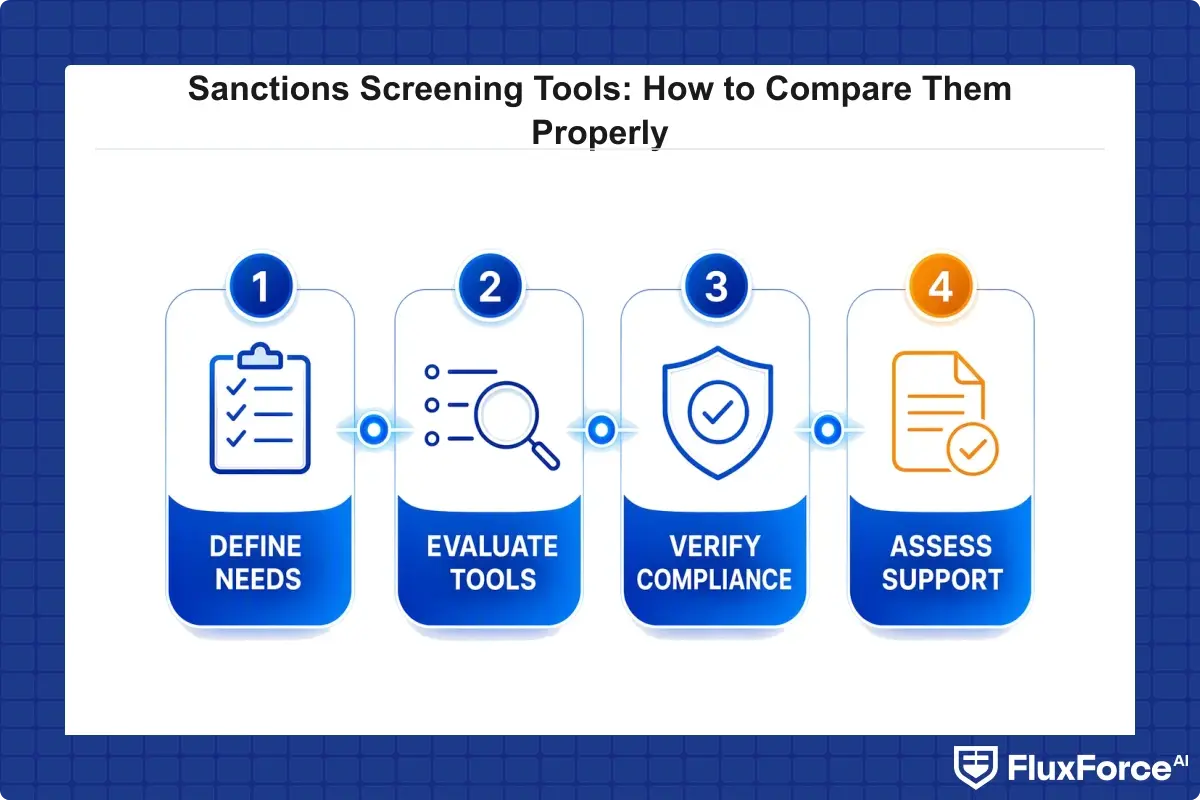
Most RFPs ask vendors the wrong questions. Here are the six that predict whether a tool will actually work in production, not just in a sales demo.
1. Match accuracy and fuzzy-matching logic
Ask the vendor to run your actual customer file, not their curated demo dataset, against a current watchlist. Look at both the true positive rate and the ratio of alerts per thousand transactions. A tool that generates ten alerts for every real hit is not accurate, it is expensive.
2. Real-time list updates
Watchlist changes should reach your screening engine within hours, not through a weekly batch job. Ask specifically how OFAC, UN, and EU updates are ingested and how long the lag is between a list change and it being live in your system.
3. Integration with core banking and payment rails
A screening tool that requires manual file exports to check transactions is a workaround, not a solution. It needs to sit inline with your payment processing or core banking platform, which is the same integration challenge covered in our regulatory compliance reporting strategy for payments risk officers.
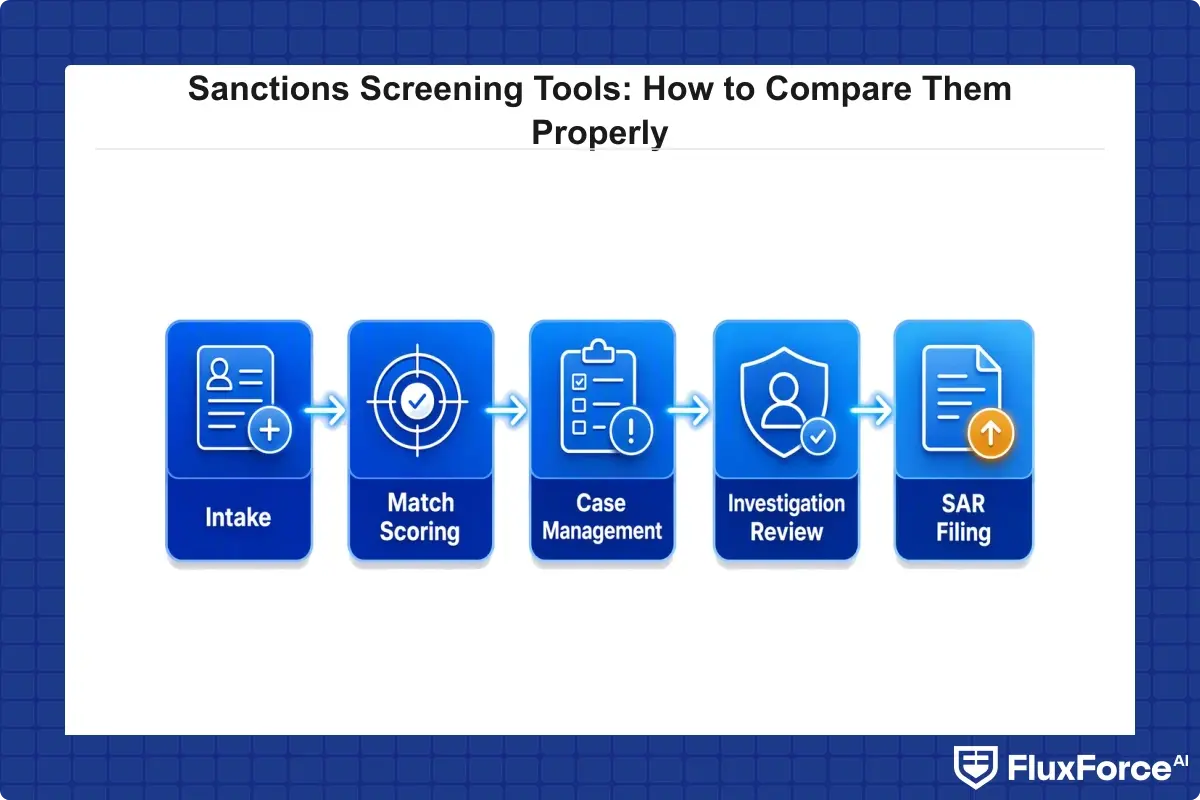
4. Case management and audit trail
Every alert disposition, cleared or escalated, needs a documented reason, a timestamp, and an analyst identity attached to it. This is the record an examiner will pull first, so the tool's case management module matters as much as its matching engine.
5. Explainability and false-positive tuning
You need to see why a specific name scored above your threshold, and you need the ability to tune thresholds by customer segment without opening a support ticket with the vendor. Tools built on opaque scoring models make this nearly impossible, a problem we cover in more depth in rule-based systems vs AI for false positives.
6. Total cost of ownership
Per-transaction pricing looks cheap until volume scales. Factor in implementation time, the analyst hours needed to clear false positives, and the cost of a missed hit. A tool priced 20% higher that cuts your false-positive queue in half is usually the cheaper option within a year.
Sanctions Screening Automation vs Manual List Checking
Some smaller institutions still lean on manual or semi-manual processes for lower transaction volumes. It is worth being honest about when that still works and when it stops.
Sanctions screening tools vs manual list checking
| Factor | Manual List Checking | Automated Screening Tool |
|---|---|---|
| Volume it handles well | Under a few hundred transactions/month | Thousands to millions per day |
| List freshness | Depends on staff remembering to check | Near real-time ingestion |
| Fuzzy/alias matching | Relies on reviewer judgment | Algorithmic, consistent |
| Audit trail | Manual notes, easy to lose | Structured, timestamped, searchable |
| Cost driver | Labor hours | License fee plus tuning effort |
| Examiner confidence | Often flagged as a finding | Generally accepted if documented |
Manual checking is not automatically wrong for a very small institution with a handful of customers. It becomes a liability the moment volume outpaces the compliance team's ability to review every name by hand, which for most growing fintechs happens faster than leadership expects.
Enhanced due diligence guide: when a hit needs escalation
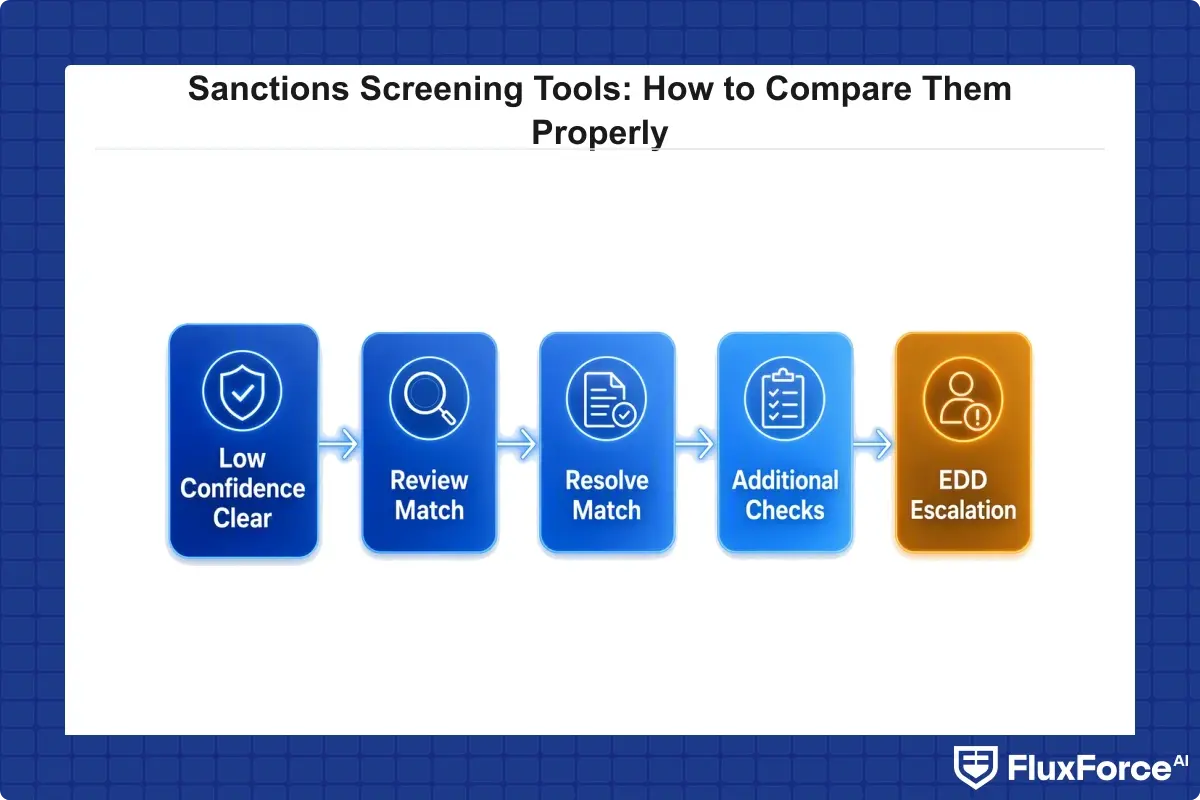
Not every match should trigger the same response. A low-confidence match on a common name might warrant a quick secondary check. A high-confidence match on a customer flagged for other risk factors should trigger full enhanced due diligence, additional identity verification, source-of-funds documentation, and senior compliance sign-off before the account proceeds. Building this escalation logic into the tool's workflow, rather than handling it ad hoc in email threads, is what turns a screening alert into a defensible decision.
How KYC Automation Is Reshaping Customer Due Diligence Heading Into 2026
Kyc automation 2026 is less about replacing analysts and more about routing the easy 80% of cases to automated approval so analysts spend their time on the 20% that actually need judgment. Sanctions screening is one input into that risk score, alongside identity verification and transaction behavior.
KYC CDD requirements banks must document
Regulators expect documented evidence that a bank collected, verified, and assessed customer information proportional to risk, not just that a screening check ran and came back clean. Kyc cdd requirements banks operate under typically include identity verification, beneficial ownership disclosure for entities, and ongoing monitoring, all of which should feed back into the sanctions screening cadence rather than existing as a separate silo.
AML risk assessment guide: scoring customer risk
A solid aml risk assessment guide for internal use should score customers on geography, product usage, transaction volume, and industry, then set the screening frequency and due diligence depth accordingly. High-risk supply chain or insurance intermediary relationships, for instance, warrant more frequent re-screening than a low-volume retail customer, a distinction covered further in our KYC/AML strategy for high-risk supply chain CISOs.
A screening tool that treats every customer with the same rescreening frequency is optimizing for compliance theater, not risk. Segment by risk tier and the alert queue gets smaller and more meaningful, not just smaller.
Why Sanctions Screening Data Feeds Directly Into SAR and CTR Filing
A sanctions hit that gets escalated and confirmed does not stay inside the screening tool. It typically becomes part of the evidence supporting a sar filing, and the underlying transaction data still needs to satisfy standard ctr filing rules if it crosses the $10,000 currency threshold regardless of the sanctions outcome. Treating these as separate systems that do not talk to each other is one of the most common gaps examiners flag.
SAR filing best practices for flagged sanctions hits
Sar filing best practices start with narrative quality: examiners want to see the specific facts that made the transaction suspicious, not a template paragraph copied across every filing. When a sanctions match contributes to the suspicion, the narrative should reference the match details, the list source, and the disposition decision, which is far easier when your screening tool's case notes export directly into the filing workflow. Building this connection is exactly the kind of workflow gap addressed by regulatory compliance automation, which links screening alerts, case documentation, and filing preparation into one auditable chain instead of three disconnected systems.
Suspicious activity report guide: what examiners expect
A working suspicious activity report guide for staff should cover filing deadlines (generally 30 calendar days from initial detection, per FinCEN's filing guidance), required narrative elements, and how sanctions-related SARs differ from those triggered by transaction monitoring alone. Sar filing requirements 2026 have not fundamentally changed the deadline structure, but examiners are paying closer attention to whether SAR narratives reference specific screening data rather than generic language, a trend worth building into your sar filing efficiency metrics now rather than after your next exam.
A BSA/AML Compliance Checklist for Community Banks and Small Fintech Teams
Smaller institutions often try to run the same compliance program as a top-20 bank with a fraction of the staff. That does not work, but a scaled-down program still needs to cover the fundamentals.
BSA AML compliance checklist for community banks
A workable bsa aml compliance checklist for a bsa aml compliance community banks program should include, at minimum:
- Documented risk assessment covering customer, product, and geographic risk
- Sanctions screening at onboarding and on an ongoing rescreening cadence
- Transaction monitoring rules tuned to your actual customer base, not vendor defaults
- SAR and CTR filing procedures with clear internal escalation paths
- Independent testing on a regular cycle, per the FFIEC BSA/AML Examination Manual
- Training records for frontline and compliance staff, updated annually
Fintech BSA AML small team: doing more with less
A fintech bsa aml small team usually cannot afford a large analyst bench, which makes tool selection matter more, not less. The honest answer here is that a five-person compliance team at a growing fintech needs a screening tool with strong out-of-box tuning and low false-positive rates far more than a large bank does, because there is no headroom to absorb a bad alert queue. Outsourcing initial tuning to the vendor, then bringing thresholds in-house once volume patterns are understood, is a pragmatic middle ground we have seen work.
What's Next for Anti-Money Laundering Technology in 2026
The direction of travel in anti money laundering technology is toward tighter integration between screening, monitoring, and case management, plus growing regulatory attention on how AI-driven decisions get explained and audited.
Anti money laundering technology 2026: what's actually new
Anti money laundering technology 2026 trends center on explainability requirements, not just better matching algorithms. Regulators and auditors increasingly want to see why a model scored a transaction the way it did, which pushes vendors toward interpretable models over pure black-box scoring. This mirrors the shift already underway in fraud detection, covered in how agentic AI fraud agents cut false positives.
EU AI Act financial services: compliance implications
For institutions operating in or serving EU customers, eu ai act financial services provisions classify many AML and fraud-detection AI systems as high-risk, which brings documentation, human oversight, and risk-management obligations under the EU's AI Act regulatory framework. If your sanctions screening tool uses machine learning for match scoring, this is worth reviewing with legal counsel before your next EU-facing product launch, not after.
- Sanctions screening tools should be judged on match accuracy, list freshness, integration, case management, explainability, and total cost, not marketing claims.
- Manual list checking works only at very low transaction volumes and breaks down fast as customer growth accelerates.
- Kyc automation and enhanced due diligence decisions should feed directly into screening frequency and thresholds.
- Sanctions hits that get escalated need to flow cleanly into SAR narratives and satisfy CTR filing rules without manual re-entry.
- Community banks and small fintechs need tools with strong default tuning since they lack the analyst bench to absorb a bad alert queue.
- The EU AI Act and rising explainability expectations are reshaping which AML technology vendors will hold up under 2026-era scrutiny.
Onboard Customers in Seconds
Conclusion
Choosing among sanctions screening tools comes down to one real question: will this system catch the handful of true hits in a sea of transactions without burying your team in false positives, and will it produce records that hold up when an examiner asks why a case was closed the way it was. The six evaluation criteria in this piece, from match accuracy to total cost of ownership, give you a way to answer that before you sign a contract.
The institutions that get this right combine strong fuzzy-matching engines, tight integration with case management and SAR workflows, and risk-based rescreening tied to kyc automation, rather than treating screening as an isolated checkbox. That combination is what turns a compliance cost center into a program that can scale with transaction volume instead of falling behind it.
Adopting this approach in practice means auditing your current tool against the six criteria here, mapping where sanctions data currently breaks its connection to SAR and CTR filing, and fixing that link first, since it is the gap examiners find most often. A mid-size bank that closed this gap in our experience typically cut SAR narrative drafting time noticeably within a quarter simply by connecting the two systems.
Start by running your own customer file through your current screening vendor and counting how many alerts per thousand transactions come back. That single number will tell you more about whether it is time to switch than any vendor pitch deck.
Share this article