.webp)







Listen To Our Podcast🎧
Introduction
AML sanctions screening gets treated as one program with two names inside a lot of compliance shops, and that mistake costs real money. AML compliance covers the broad job of spotting money laundering: watching transaction patterns, filing reports, knowing your customer. Sanctions screening is narrower: matching names against government watchlists before money ever moves. They share data, staff, and technology, but they run on different clocks and different failure modes.
This matters more in 2026 because regulators expect both programs to work together without duplicating effort. Community banks and fintechs with lean compliance teams cannot afford two disconnected systems, two alert queues, and two sets of manual reviews. Understanding exactly where AML compliance and sanctions screening overlap, and where they genuinely diverge, is what separates an efficient program from a costly one.
- Where AML compliance and sanctions screening genuinely overlap versus where they need separate controls
- How KYC automation cuts duplicate alerts across both programs at once
- A practical BSA AML compliance checklist sized for community banks and small fintech teams
- The real difference between SAR filing and CTR filing triggers, deadlines, and thresholds
- Five concrete ways anti money laundering technology reduces false positives in 2026
- Why the EU AI Act is starting to matter for US financial institutions' sanctions screening tools
Onboard Customers in Seconds

What Is AML Sanctions Screening and How Does It Overlap with Transaction Monitoring?
AML sanctions screening is the practice of checking customers and transactions against government watchlists, such as OFAC's Specially Designated Nationals list, as part of a broader anti-money-laundering program. It sits inside AML compliance but answers a narrower question: is this person, company, or country on a list that legally blocks the transaction.
Transaction monitoring, by contrast, looks for patterns, structuring, layering, unusual velocity, that suggest laundering even when no name matches a list. A customer can pass sanctions screening cleanly and still trigger a transaction monitoring alert a week later. The two feed the same investigation team but start from different triggers.
How AML Sanctions Screening Differs from Transaction Monitoring
Sanctions screening runs in real time, before or during a transaction, because a match legally blocks the transfer. Transaction monitoring runs after the fact, usually in batch cycles, because it is looking for behavioral patterns over days or weeks. Treating them as the same control means either sanctions checks run too slowly or monitoring rules get tuned so tight they miss real activity.
A Quick AML Risk Assessment Guide for New Programs
Start any AML risk assessment guide with three inputs: customer risk (geography, industry, ownership structure), product risk (wire transfers carry more exposure than a savings account), and channel risk (in-person onboarding versus a fully digital fintech signup). Score each customer on all three before deciding how often to rescreen them against sanctions lists.
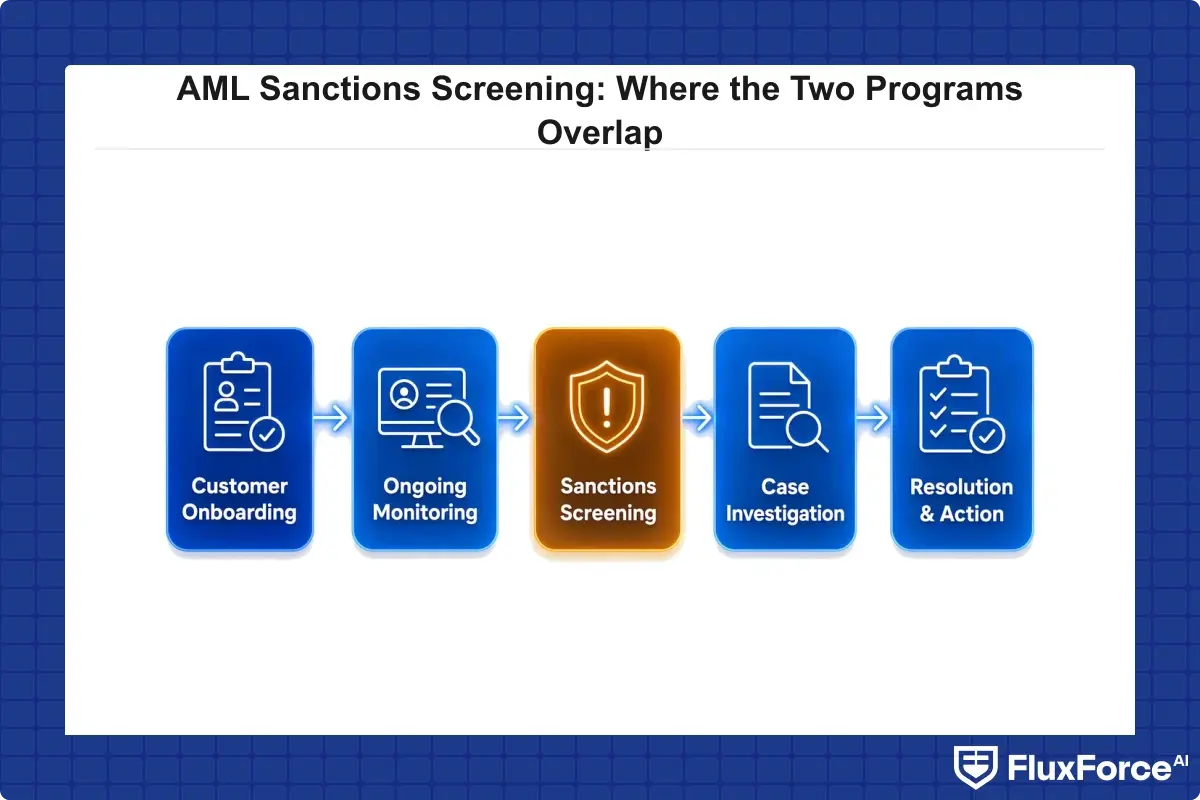
4 Places Where AML Compliance and Sanctions Screening Programs Overlap
Most institutions run these as separate workstreams even though the same data and the same analysts touch both. Here is where they actually intersect.
1. Customer Onboarding and KYC
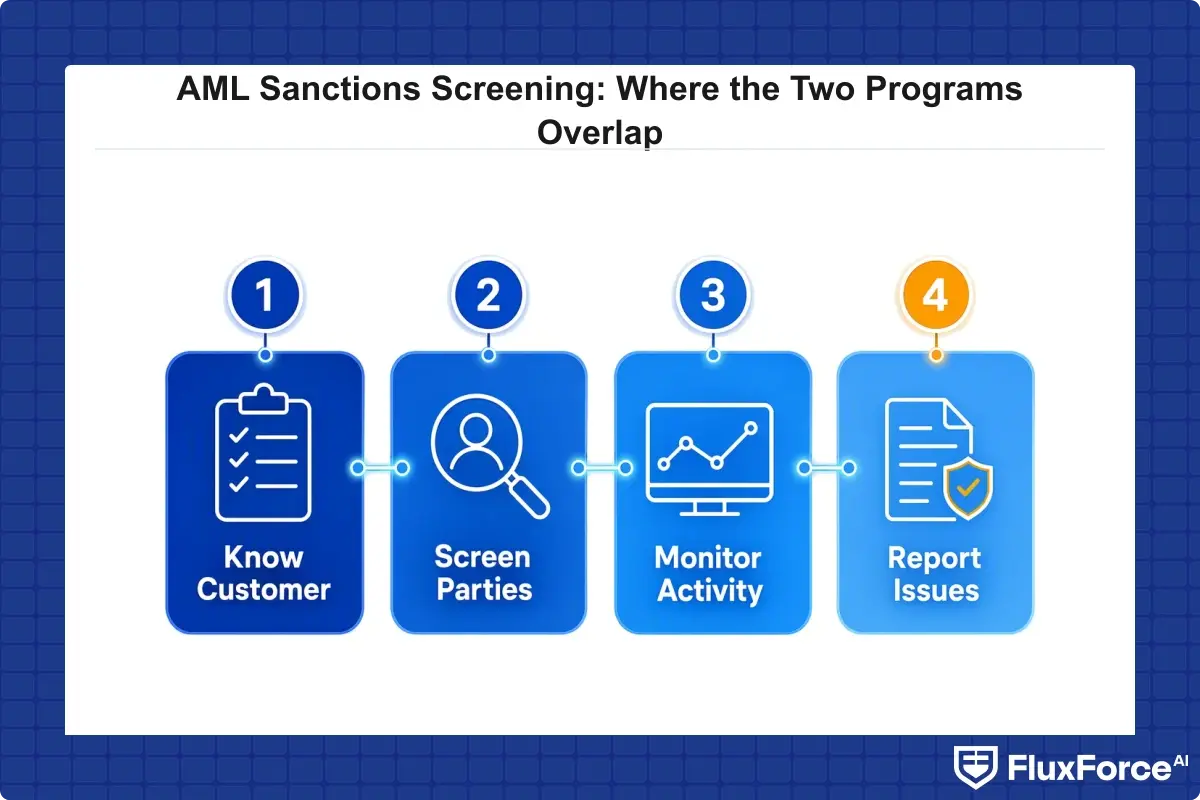
Every new customer needs both a KYC profile and a sanctions check before the account opens. Running these as one workflow instead of two separate queues is the single biggest efficiency win available to a small aml compliance software rollout.
2. Ongoing Transaction Monitoring
Sanctioned parties change addresses and shell companies constantly, so real-time sanctions screening has to sit inside the same transaction stream that feeds AML monitoring rules, not bolted on as a separate batch job.
3. List Management and Watchlist Updates
OFAC, the EU, and the UN update their lists on no fixed schedule. A single list-management process, not two competing ones, keeps both the AML alert engine and the sanctions engine working from the same source of truth.
4. Investigations and Case Management
When an alert fires, whether it started as a sanctions hit or an AML pattern, it usually lands with the same investigator. Case management systems that keep both alert types in one queue cut duplicate work and give examiners a full picture of the customer.
A $10,000 cash transaction triggers a mandatory Currency Transaction Report under the Bank Secrecy Act, but sanctions screening has no dollar floor at all. A single $50 wire to a blocked entity is still a reportable violation.
How KYC Automation Strengthens Your AML Sanctions Screening Program
KYC automation reduces AML sanctions screening errors by standardizing how customer identity, risk scoring, and watchlist checks get triggered, instead of leaving those decisions to manual review. Kyc automation 2026 tools increasingly run identity verification, risk scoring, and sanctions matching as one pipeline rather than three separate handoffs.
For a fintech onboarding thousands of users a month, that consolidation is not optional. Manual review queues that separate KYC from sanctions checks create gaps where a flagged customer slips through before the sanctions team catches up. Our AML screening and monitoring guide for payments risk officers covers how to wire these steps together without adding headcount.
KYC CDD Requirements Banks Must Automate First
The baseline kyc cdd requirements banks must meet include verified identity documents, beneficial ownership disclosure for entities, and a documented risk rating. Automating the document capture and beneficial ownership lookup removes the slowest manual steps first, since those are also the steps most likely to delay a sanctions check.
Enhanced Due Diligence Guide for High-Risk Customers
Any enhanced due diligence guide worth following starts with a trigger list: politically exposed persons, cash-intensive businesses, correspondent banking relationships, and customers from high-risk jurisdictions. These customers need more frequent sanctions rescreening, not just a one-time check at onboarding, because their risk profile changes faster than the average account.
A BSA AML Compliance Checklist for Community Banks and Fintech Teams
A working bsa aml compliance checklist for community banks does not need to be exhaustive to be effective. It needs to cover the handful of controls examiners actually test.
- Written AML policy approved by the board and reviewed annually
- Designated BSA officer with clear authority to escalate
- Customer identification program covering both individuals and entities
- Ongoing sanctions screening against OFAC and relevant international lists
- Independent testing of the program, typically annual for most community banks
- Employee training documented and refreshed at least yearly
- SAR and CTR filing procedures with defined internal deadlines ahead of the regulatory ones
This is the same checklist we walk through in our piece on regulatory compliance automation strategy for logistics security officers, adapted here for banking and fintech.
Why Fintech BSA AML Small Team Structures Need Automation
A fintech bsa aml small team, often two or three people covering compliance, fraud, and sanctions together, cannot manually review every alert a growing user base generates. Automating the checklist above through regulatory compliance automation turns a checklist that would take a full-time analyst weeks to maintain into a system that runs continuously in the background, with the analyst reviewing exceptions instead of every case.
SAR Filing vs CTR Filing: Where Reporting Duties Meet Sanctions Screening
SAR filing and CTR filing get confused constantly, and the confusion slows both processes down. They serve different purposes and have different triggers.
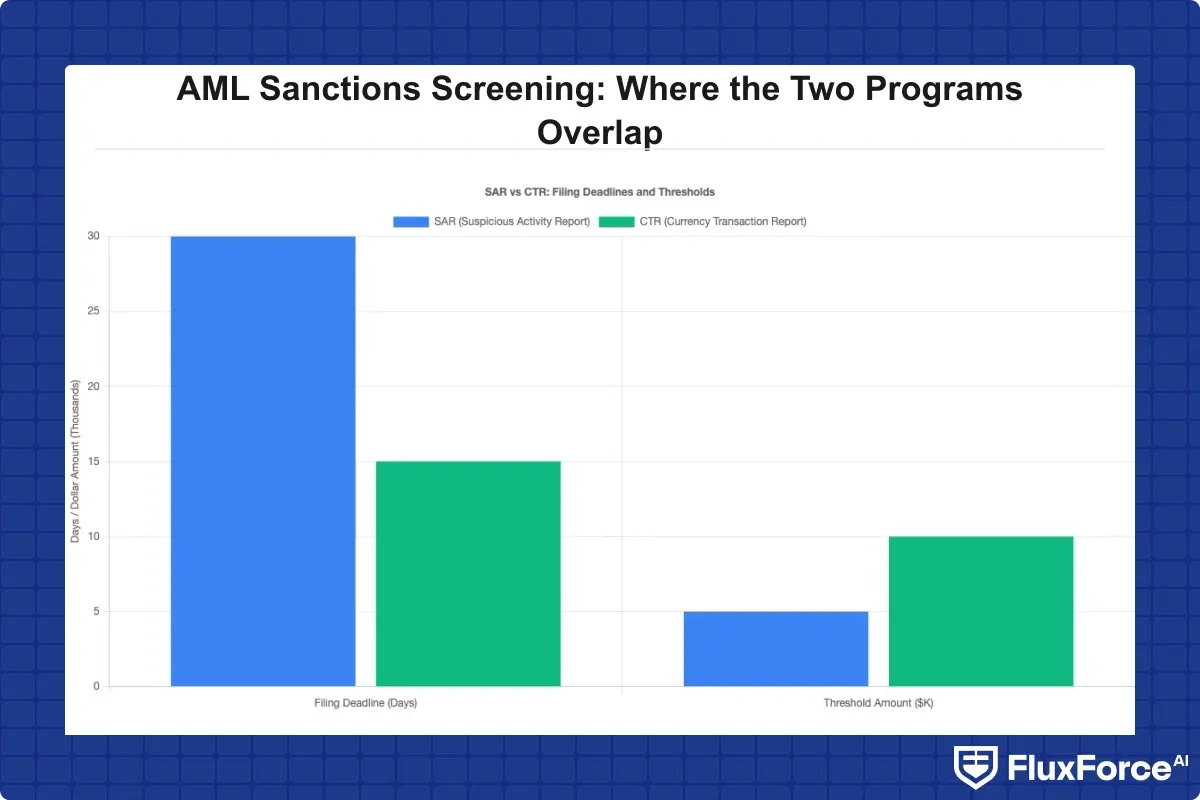
| Factor | SAR Filing | CTR Filing |
|---|---|---|
| Trigger | Suspicious activity, any dollar amount | Cash transactions over $10,000 |
| Deadline | 30 days from detection (60 if no suspect identified) | 15 days from the transaction |
| Confidentiality | Filing must stay confidential from the customer | Not confidential; routine reporting |
| Sanctions link | Often filed alongside a sanctions hit investigation | Rarely connected to sanctions screening |
SAR Filing Requirements 2026: What Changed
Sar filing requirements 2026 have not changed the core 30-day window, but FinCEN continues to push institutions toward electronic filing through the BSA E-Filing system and faster internal escalation timelines. The regulatory text and current filing guidance are maintained directly by FinCEN.
SAR Filing Best Practices for Faster Case Closure
The sar filing best practices that actually move the needle are narrow: pre-populate narrative templates, route sanctions-related alerts to a specialist rather than a generalist, and track sar filing efficiency as a metric your BSA officer reviews monthly, not just at exam time. Teams that treat SAR narrative writing as a bottleneck usually find the bottleneck is really unclear escalation ownership.
Suspicious Activity Report Guide: From Alert to Filing
A useful suspicious activity report guide walks the alert through four stages: detection, investigation, decision, and filing. Sanctions-linked alerts should skip straight to a senior investigator, since a confirmed sanctions match carries legal blocking obligations that a routine AML alert does not.
5 Ways Anti Money Laundering Technology Cuts False Positives in 2026
Anti money laundering technology 2026 platforms are finally addressing the false-positive problem that has plagued screening teams for years. Here are the five approaches doing the most work right now.
1. Risk-Based Scoring Replaces Static Rules
Static rules flag every fuzzy name match with equal weight. Risk-based scoring weighs the match against customer risk, transaction size, and geography, so a low-risk domestic customer with a common name does not generate the same alert volume as a high-risk international transfer.
2. Entity Resolution Cuts Duplicate Alerts
Many false positives come from the same customer appearing under slightly different name spellings across systems. Entity resolution merges those records before screening runs, which alone can eliminate a meaningful share of repeat alerts on returning customers.
3. Real-Time List Updates Reduce Screening Lag
Batch nightly syncs against sanctions lists create a window where a newly listed entity slips through. Real-time or near-real-time list ingestion closes that gap, which matters more than most teams assume.
4. Machine Learning Models Adapt to New Typologies
Rule-based systems need a human to write a new rule every time a laundering pattern shifts. Our breakdown of rule-based systems vs AI for false positive reduction covers how adaptive models catch pattern drift without a manual rule rewrite every quarter.
5. Case Management Automation Speeds SAR Filing
Once a true positive is confirmed, automated case management pre-fills SAR narrative fields from the investigation record, cutting the time between decision and filing.
In our work with community bank compliance teams, the biggest driver of alert fatigue is not rule count. It is sanctions list update lag: nightly batch syncs against the OFAC list routinely run half a day behind, long enough for a flagged transaction to clear before the alert even fires.
Why the EU AI Act Matters for Financial Services Sanctions Screening
The EU AI Act classifies certain AI systems used in financial risk assessment as high-risk, which means AML compliance software with EU customers or EU-domiciled subsidiaries needs documented risk management and human oversight controls. US institutions without European exposure are not directly bound by it, but the direction of travel matters.
Eu ai act financial services provisions push vendors toward explainable models and documented testing before deployment. Institutions buying aml compliance software from a vendor that already meets those standards are buying a safer, more auditable tool regardless of which regulator eventually asks for proof.
EU AI Act Financial Services Compliance Timeline
The regulation phases in obligations over several years following its entry into force, with high-risk system requirements arriving later than the general-purpose AI provisions. The full text and implementation timeline are published by the European Union.
What US Institutions Should Do Now
Any US bank or fintech evaluating new screening vendors should ask directly whether the vendor's model documentation would satisfy EU AI Act high-risk requirements. If the answer is no, that is a signal the tool may also fall short of what US examiners increasingly expect around model governance. Our guide on DORA compliance automation strategy for digital banks covers a parallel example of a European rule reshaping US vendor expectations.
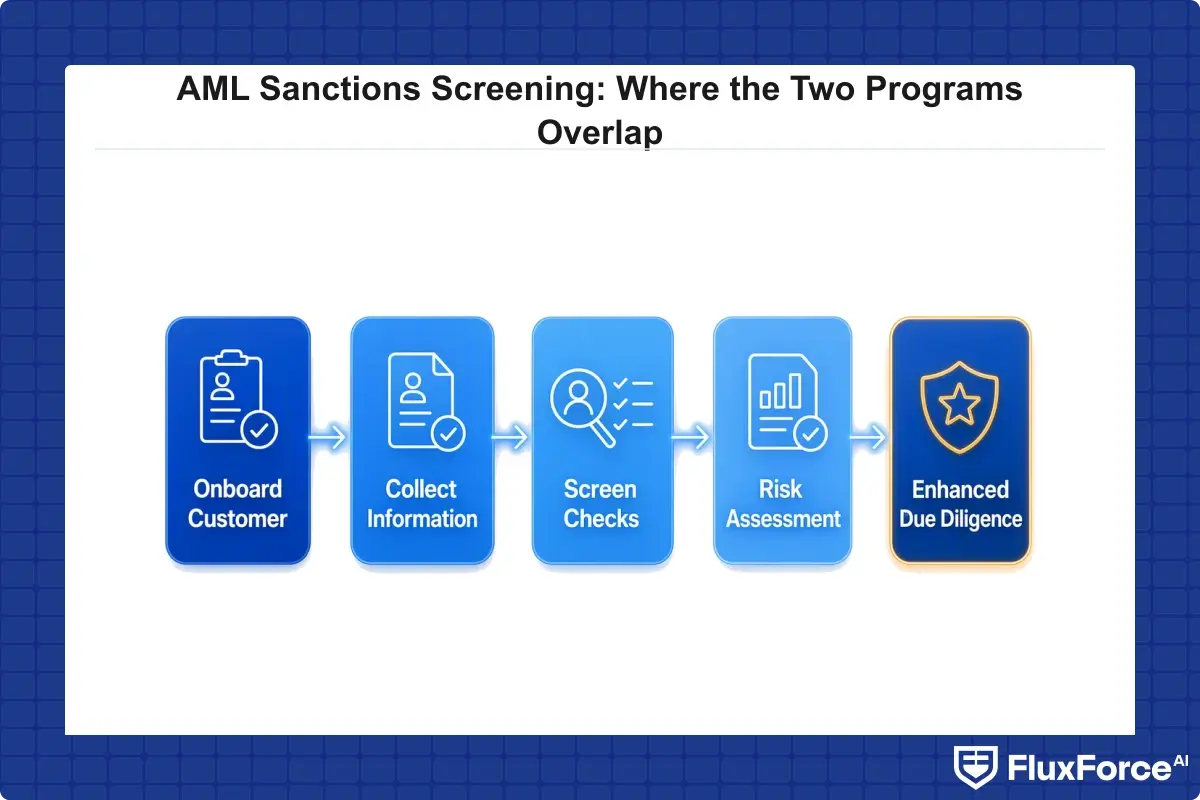
- AML sanctions screening is a subset of AML compliance, not a synonym for it, and treating them identically creates gaps.
- Onboarding, transaction monitoring, list management, and case investigations are the four points where the two programs must share data.
- KYC automation and enhanced due diligence cut duplicate work across both AML and sanctions workflows at once.
- SAR filing and CTR filing have different triggers, deadlines, and confidentiality rules, and sanctions hits usually route through the SAR path.
- Risk-based scoring, entity resolution, and real-time list updates are the three technology changes cutting false positives fastest in 2026.
- The EU AI Act is starting to shape vendor expectations for aml compliance software even for institutions without direct EU exposure.
Onboard Customers in Seconds
Conclusion
AML sanctions screening fails most often not because the rules are unclear, but because institutions run it as a separate system from their broader AML compliance program instead of one connected pipeline. A twelve-to-twenty-four-hour lag on a nightly list sync, or a SAR narrative that takes a week longer than it should, both trace back to the same root cause: disconnected workflows.
The fix is not more headcount. It is KYC automation that feeds both KYC and sanctions checks from one profile, a BSA AML compliance checklist built for the size of team you actually have, and anti money laundering technology that updates sanctions lists in near real time instead of overnight.
For a community bank or fintech with a two-person compliance team, adopting these changes typically means fewer duplicate alerts and a shorter path from detection to a filed SAR, not a bigger department. Start by mapping where your onboarding, monitoring, and sanctions checks currently run as separate steps, then consolidate the ones that touch the same customer data.
If your team is still running sanctions screening and AML monitoring as two disconnected systems, that is the first gap worth closing this quarter.
Share this article