.webp)







Introduction
Ecommerce fraud detection has become a moving target for payment service providers in 2026, because fraud rings now automate their attacks as fast as PSPs automate their defenses. A single compromised card list can be tested against a checkout page in minutes, and a synthetic identity built from a stolen Social Security number and a fabricated name can pass a weak identity check on the first try.
For CISOs, compliance officers, and fraud operations teams inside banks, fintechs, and payment platforms, the stakes are not abstract: chargebacks, regulatory fines, and reputational damage all trace back to how well the monitoring stack catches bad transactions without burying analysts in noise.
This guide breaks down what actually works for ecommerce fraud detection at PSP scale in 2026, from the mechanics of ai fraud detection to the real cost of false positives and how two well known platforms, Sardine and Unit21, stack up against each other.
- How does ai detect fraud, explained without the vendor marketing language
- Why fraud alert fatigue quietly costs PSPs more than the fraud itself
- What separates rule-based transaction monitoring software from machine learning fraud detection
- A practical breakdown of sardine vs unit21 for teams evaluating a platform switch
- How to reduce false positives in transaction monitoring without loosening your risk appetite
- What real time fraud detection actually requires at payment-processing volume
Onboard Customers in Seconds

Why Ecommerce Fraud Detection Gets Harder Every Year
Ecommerce fraud detection used to mean matching a transaction against a blacklist of stolen card numbers. That model still catches the easy cases, but the fraud costing PSPs the most money today is harder to fingerprint. Fraudsters blend real and fabricated data into synthetic identities, open accounts that pass a soft check, then let them age for months before running a bust-out.
Synthetic Identity Fraud Is Outpacing Stolen-Card Fraud
The Financial Crimes Enforcement Network has warned that synthetic identity fraud schemes are hard to detect because they are built to look like legitimate, thin-file consumers rather than obviously stolen identities (FinCEN Advisory FIN-2021-A003). That warning still describes the core problem accurately in 2026: a synthetic identity does not trip a stolen-identity alert because, technically, no single person's full identity was stolen. Our deep dive on detecting synthetic identity fraud in real time covers the account-aging pattern in more detail.
A synthetic identity is built to pass every individual check, the SSN is real, the name is fake, and the combination has no fraud history anywhere, so it beats detection systems tuned to catch stolen identities rather than fabricated ones.
Where PSPs Carry More Risk Than Merchants
A PSP sits between thousands of merchants and their acquiring banks, so a single weak merchant integration can expose the whole processing relationship to card testing attacks. The PSP absorbs the chargeback liability and the regulatory scrutiny even when the fraud originated on a merchant's site. This is why payment fraud prevention at the PSP layer has to be broader and faster than anything a single merchant would build for itself.
How Does AI Detect Fraud? A Practical Breakdown
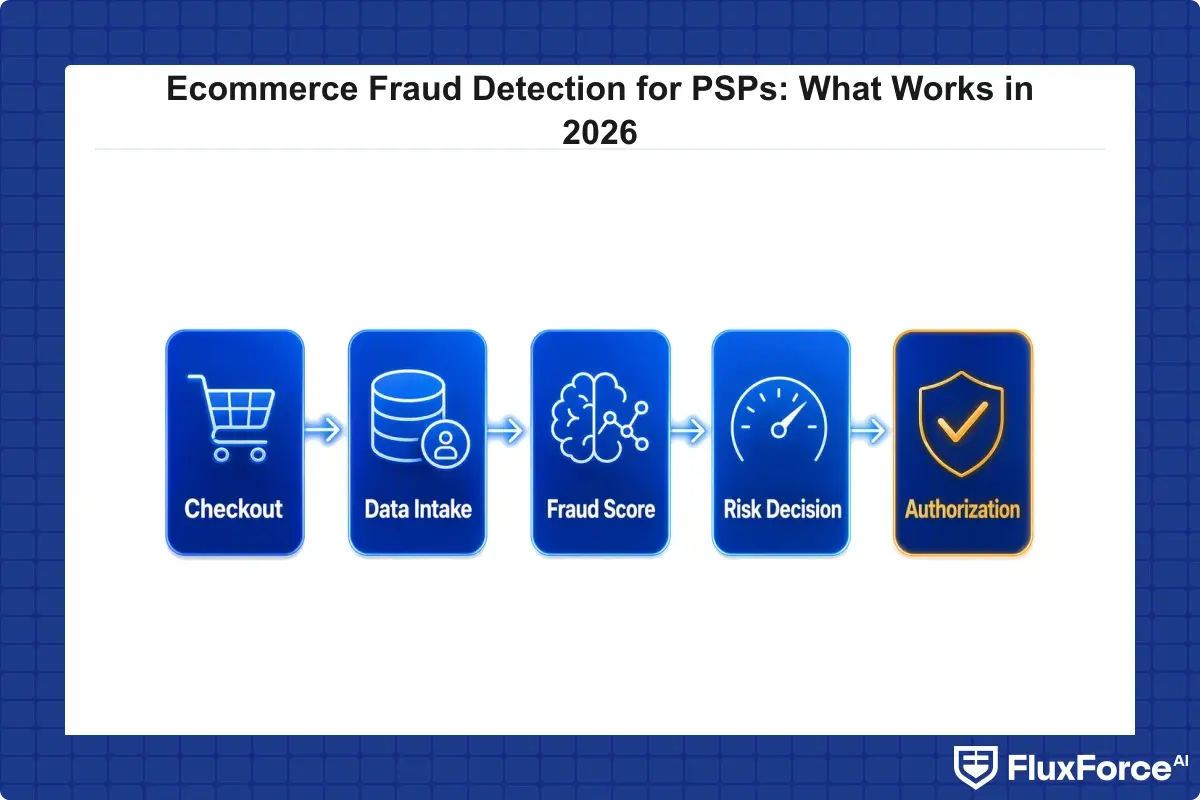
How does ai detect fraud in an ecommerce context? An ai fraud detection system scores each transaction against patterns learned from millions of past transactions, then flags anything that deviates from a customer's normal behavior or matches a known fraud pattern, before the payment authorizes.
Ai Fraud Detection Explained in Three Layers
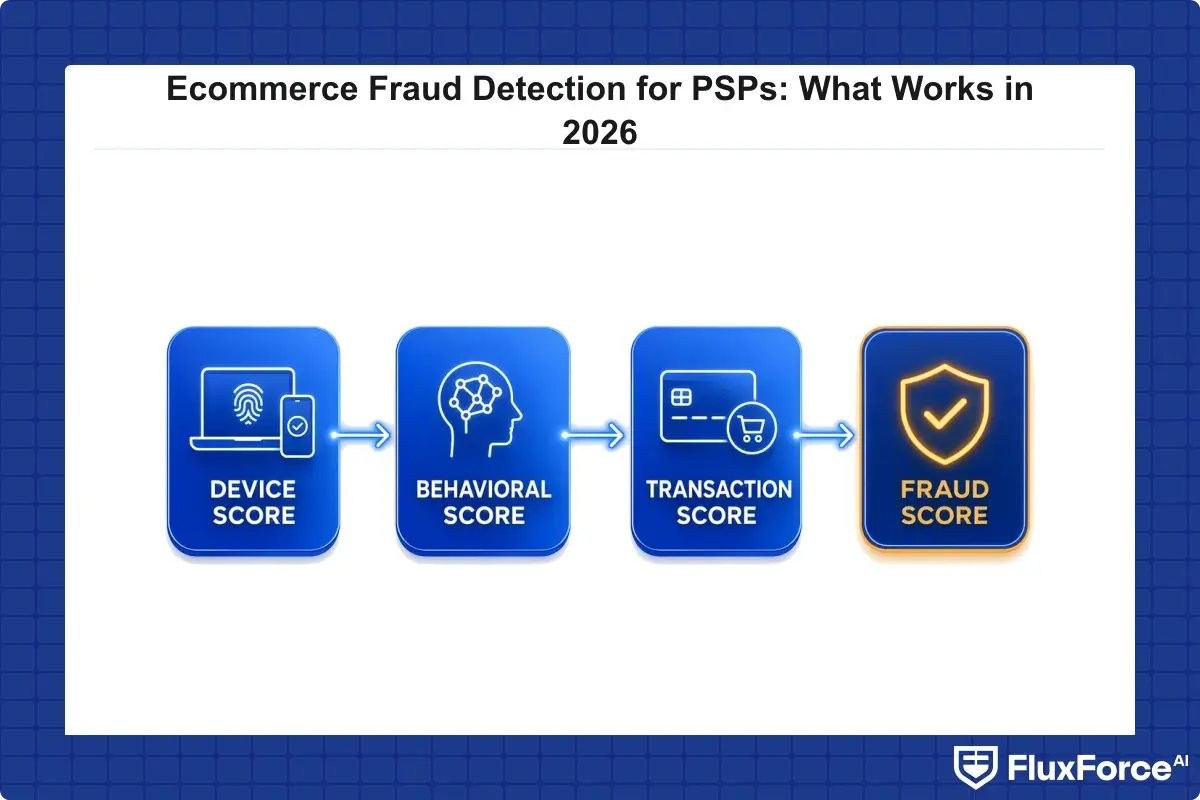
Ai fraud detection explained simply: it is not one model, it is a stack. The first layer scores device and network signals, is this a known device, is the IP tied to a proxy. The second layer scores behavioral signals like typing cadence and navigation pattern. The third layer scores the transaction itself: amount, merchant category, velocity against the account's history. A transaction only needs one bad signal combined with a few borderline ones to cross the alert threshold.
AI Fraud Detection in Banking vs Ecommerce
Ai fraud detection in banking usually has more historical data to train on, since account relationships span years, while ecommerce checkout fraud has to make a call on a first-time customer in under a second. That asymmetry is why ecommerce fraud detection leans harder on device fingerprinting and network reputation than banking fraud detection does. Our breakdown of card fraud analytics and AI-powered detection scoring goes deeper into how risk teams weight these signals differently by channel.
Machine Learning Fraud Detection: Supervised vs Unsupervised
Machine learning fraud detection typically combines two approaches. Supervised models train on labeled past fraud cases to recognize known patterns, while unsupervised models look for anomalies with no fraud label at all, which is how they catch patterns nobody has seen before. Most production systems run both, because supervised models decay as fraud tactics shift and unsupervised models alone throw too many low-value alerts.
5 Hidden Costs of Fraud Alert Fatigue in Ecommerce Fraud Detection
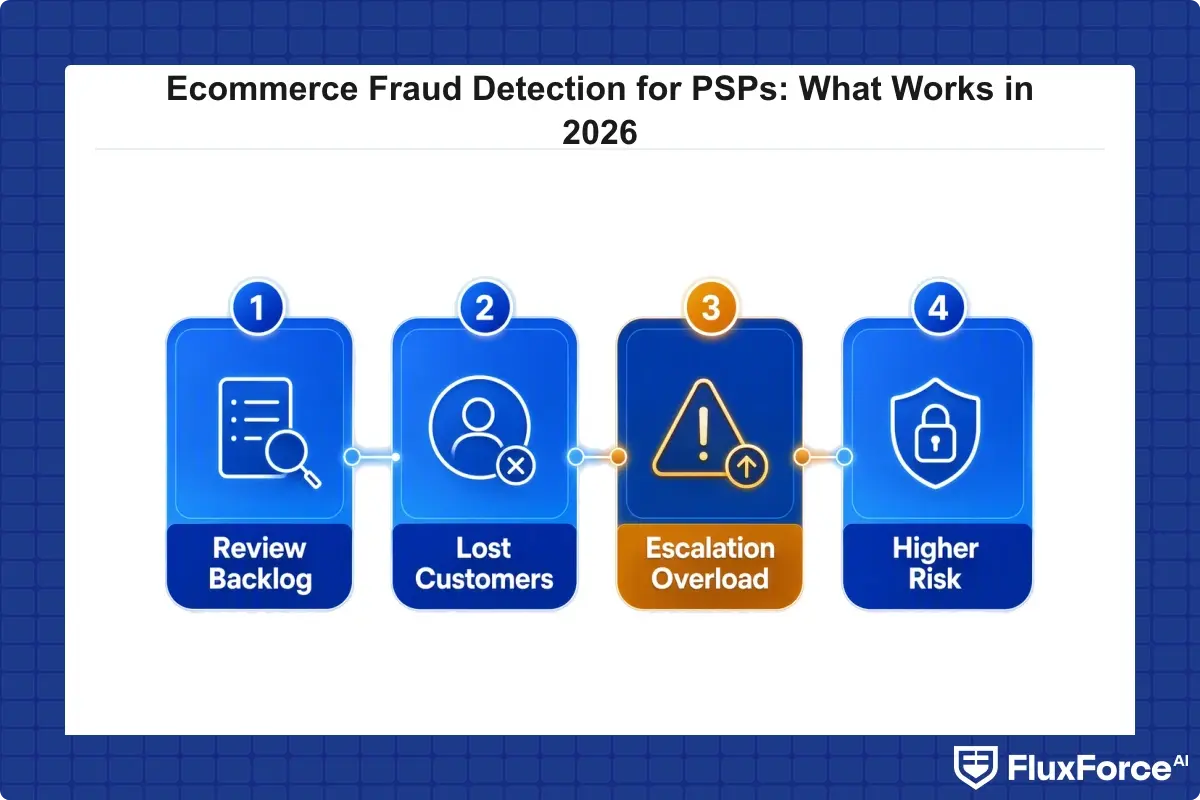
Fraud alert fatigue sets in when the volume of flagged transactions outpaces the analyst team's capacity to review them carefully, and it quietly costs more than most fraud budgets account for.
1. Analyst Burnout and Turnover
Reviewing hundreds of low-value alerts a day is exhausting work. Fraud teams with high false-positive rates see faster analyst turnover, which means more onboarding cost and more institutional knowledge walking out the door.
2. Missed Genuine Fraud
When analysts are buried in noise, the handful of alerts that represent real fraud get the same rushed glance as everything around them. Fraud alert fatigue does not just waste time, it increases the odds that real fraud slips through.
3. Customer Friction and Abandoned Carts
Every step-up challenge or manual review triggered by a false positive adds friction at checkout, and a share of those customers simply abandon the cart rather than wait. Payment fraud prevention that is too aggressive becomes a revenue problem, not just a security one.
4. Inflated Transaction Monitoring Cost
Transaction monitoring cost scales with alert volume more than with transaction volume, since every alert needs a human review, a case note, and often a follow-up. A platform that halves the false-positive rate can cut review headcount needs by a similar margin.
5. Slower Time to Detect New Fraud Patterns
When the queue is full of low-value alerts, a genuinely new fraud pattern has to compete for attention with routine noise, which delays the moment a team notices it and builds a rule or model update to stop it.
Choosing Transaction Monitoring Software for Ecommerce Fraud Detection
Every PSP eventually asks whether to build transaction monitoring software in-house, buy a vendor platform, or blend both. Automated transaction monitoring did not replace rules, it added a scoring layer on top of them, and the strongest programs still keep both.
Rule-Based vs AI Transaction Monitoring
| Approach | Rule-Based Monitoring | AI Transaction Monitoring |
|---|---|---|
| Detection logic | Fixed if-then thresholds set by analysts | Learned patterns updated as new fraud data arrives |
| New fraud patterns | Requires a manual rule change to catch | Adapts faster, though still needs retraining |
| False positive rate | Typically higher, since rules can't weigh context | Lower when tuned, since it scores multiple signals together |
| Transparency | Easy to explain to auditors and regulators | Needs explainability tooling to satisfy compliance review |
| Best for | Known, well-defined fraud typologies | Novel or evolving fraud patterns |
Neither column wins outright, which is why most PSPs run rules as a floor that blocks obviously fraudulent transactions instantly, then layer AI scoring on top of whatever the rules didn't catch. Platforms built specifically as fraud detection software are usually designed around exactly that blend rather than forcing a PSP to choose one model over the other.
What Automated Transaction Monitoring Adds
Automated transaction monitoring is not just about speed, it is about consistency. A model scores every transaction the same way regardless of analyst fatigue, time of day, or caseload, which a rules-based system relying on manual escalation cannot guarantee. For teams weighing card data obligations alongside fraud scoring, the PCI Security Standards Council publishes the baseline controls that any monitoring stack still has to satisfy regardless of how much AI sits on top of it.
Sardine vs Unit21: Comparing Two Transaction Monitoring Approaches
The sardine vs unit21 question comes up constantly in PSP fraud team evaluations, because both are established transaction monitoring software vendors, but they solve slightly different problems.
Where Sardine Focuses
Sardine built its platform around device and behavioral signals captured at the point of onboarding and checkout, which makes it a strong fit for PSPs that need real time fraud detection at the exact moment a payment or account opening happens.
Where Unit21 Focuses
Unit21 leans more toward case management and rule orchestration, which suits compliance teams that need flexible rule building and detailed audit trails for AML and fraud investigations side by side.
| Factor | Sardine | Unit21 |
|---|---|---|
| Primary strength | Real-time device and behavioral scoring at checkout | Rule orchestration and investigator case management |
| Best fit | PSPs prioritizing point-of-transaction decisioning | Compliance teams needing flexible AML and fraud workflows |
| Onboarding fraud coverage | Strong, built for account opening signals | Moderate, depends on integrated data sources |
| Pricing model | Usage-based, quote on request | Usage-based, quote on request |
Neither platform is a drop-in replacement for the other. The honest answer for most PSPs is that the choice comes down to whether the bigger pain point is decisioning speed at checkout or investigation workflow across a compliance team, since both areas ultimately lean on the same kind of ai fraud detection in banking style verification underneath.
How to Reduce False Positives in Transaction Monitoring
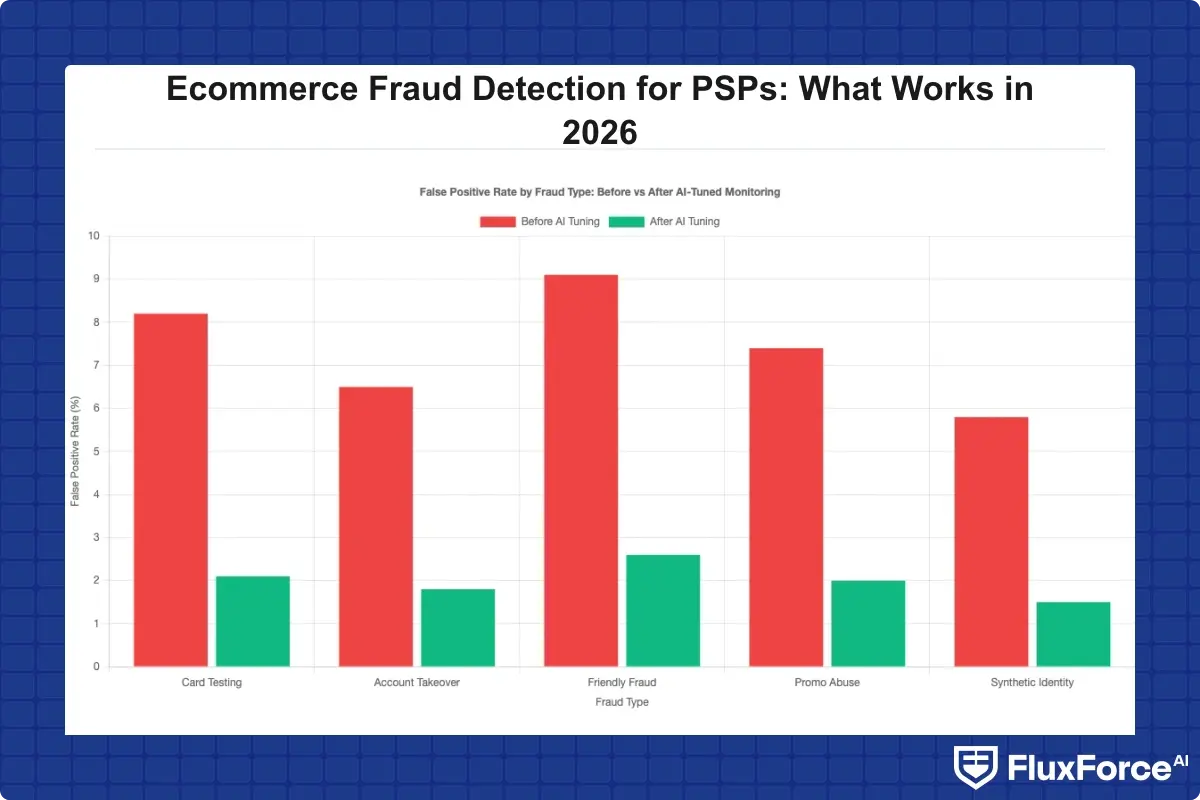
Reducing false positives in transaction monitoring starts with feeding the model actual investigation outcomes, not just raw alerts, so it learns which flagged patterns were real fraud and which were false alarms.
The false positive cost of fraud detection is easy to underestimate because it hides inside labor cost and lost revenue rather than showing up as a single line item. A high false positive rate for fraud detection also erodes trust in the system itself, since analysts start ignoring alerts they've learned to distrust.
Practical steps that move the needle:
- Feed confirmed outcomes back into the model. Every closed case, true fraud or false alarm, should retrain the scoring model, not just sit closed in a ticket.
- Segment thresholds by risk tier. A first-time $15 purchase and a first-time $1,500 purchase should not share the same alert threshold.
- Tune rules before adding more models. A rule that has not been reviewed in a year is often the single biggest source of low-value alerts, and fixing it costs nothing.
- Set a review cadence for the false positive rate itself. Treat it as a KPI the fraud team owns, not a side effect nobody tracks.
Our post on reducing false positives with agentic AI covers how automated feedback loops cut alert volume without loosening the underlying risk appetite, and the rule-based vs AI transaction monitoring comparison breaks down how to reduce false positives in AML programs specifically, where regulatory reporting adds another layer of review.
A false positive is not a free pass, it still costs a full review cycle in analyst time, so cutting a monitoring program's false positive rate in half often saves more than any single rule tightening ever will.
What Real-Time Fraud Detection Requires at PSP Scale
Real time fraud detection at PSP scale requires a scoring decision inside the payment authorization window, typically well under a second, without adding noticeable latency to checkout.
Real Time Fraud Detection Banks Rely On
The real time fraud detection banks depend on was largely built for card-present transactions with decades of network-level fraud data behind it. Ecommerce PSPs have to replicate that speed with far less historical signal per merchant, which is why device and behavioral data matter more in the ecommerce context than they do in traditional card-network scoring.
Latency Budgets for AI Fraud Detection Software
Ai fraud detection software aimed at checkout has to fit its entire scoring pipeline, device check, behavioral check, transaction check, inside a latency budget the payment processor sets. The National Institute of Standards and Technology's AI Risk Management Framework is a useful reference here, since it lays out how to validate a model's reliability under real operating conditions rather than just its accuracy in a lab test, which matters when a scoring model has to make a call in a fraction of a second.
For PSPs also rethinking identity checks beyond the transaction itself, Zero Trust + Agentic AI: The New Normal for Banking Security covers how continuous verification pairs with real-time transaction scoring rather than treating login as the only checkpoint.
- Ecommerce fraud detection in 2026 has to catch synthetic identities, not just stolen cards, because synthetic identities are built to pass individual checks.
- Ai fraud detection scores device, behavioral, and transaction signals together, and works best combined with rule-based floors rather than replacing them.
- Fraud alert fatigue carries five real costs: burnout, missed fraud, checkout friction, inflated transaction monitoring cost, and slower detection of new patterns.
- Sardine and Unit21 solve different halves of the fraud stack, real-time decisioning versus investigation workflow.
- Reducing false positives comes down to feeding confirmed outcomes back into the model and tuning thresholds by risk tier, not just adding more monitoring tools.
- Real-time fraud detection at PSP scale means fitting the entire scoring pipeline inside a latency budget measured in milliseconds.
Onboard Customers in Seconds
Conclusion
Ecommerce fraud detection in 2026 is no longer a single system, it is a layered decision made in a fraction of a second against fraud rings that automate their attacks just as aggressively as PSPs automate their defenses. The core problem here is that legacy rule-only systems catch known patterns but drown teams in false positives, while synthetic identities and account-aging fraud slip past checks built for a different era.
The fix is not one tool. Layered AI scoring, disciplined false-positive tuning, and a monitoring stack that fits inside a checkout's latency budget are the three things that separate PSPs still fighting fires from PSPs that catch fraud before it authorizes.
Adopting this in practice usually means auditing your current rule set first, since cutting a bloated ruleset alone can shave a meaningful share of your alert volume before a single model gets involved, often the fastest of the five hidden costs above to fix.
Start by pulling your last quarter's false-positive rate and deciding whether your current stack, or a dedicated fraud detection platform, can actually move it.


Share this article