.webp)







Listen To Our Podcast🎧
Introduction
AI agentic workflows are changing how banks catch fraud, because a single autonomous system can now investigate an alert the way a junior analyst would, but in seconds instead of hours. Most fraud teams are still running last decade's playbook: static rules, a growing alert queue, and analysts drowning in cases that turn out to be nothing. Fraud alert fatigue is real, and it costs banks both money and good customers who get declined by mistake.
This piece is not about theory. We walk through how agentic AI actually runs inside a bank, what changes at each rollout phase, and why the fix for false positives isn't a bigger rulebook, it's a system that reasons.
- What an AI agentic workflow actually does, step by step, when a suspicious transaction fires
- How ai fraud detection explained in plain terms differs from a rules engine
- The 4 phases banks move through when adopting agentic AI, from pilot to full autonomy
- Why fraud alert fatigue keeps growing even as transaction monitoring software gets more advanced
- 3 concrete ways agentic AI cuts false positives without missing real fraud
- What compliance and security leaders should ask a vendor before buying
Onboard Customers in Seconds

What Are AI Agentic Workflows in Banking?
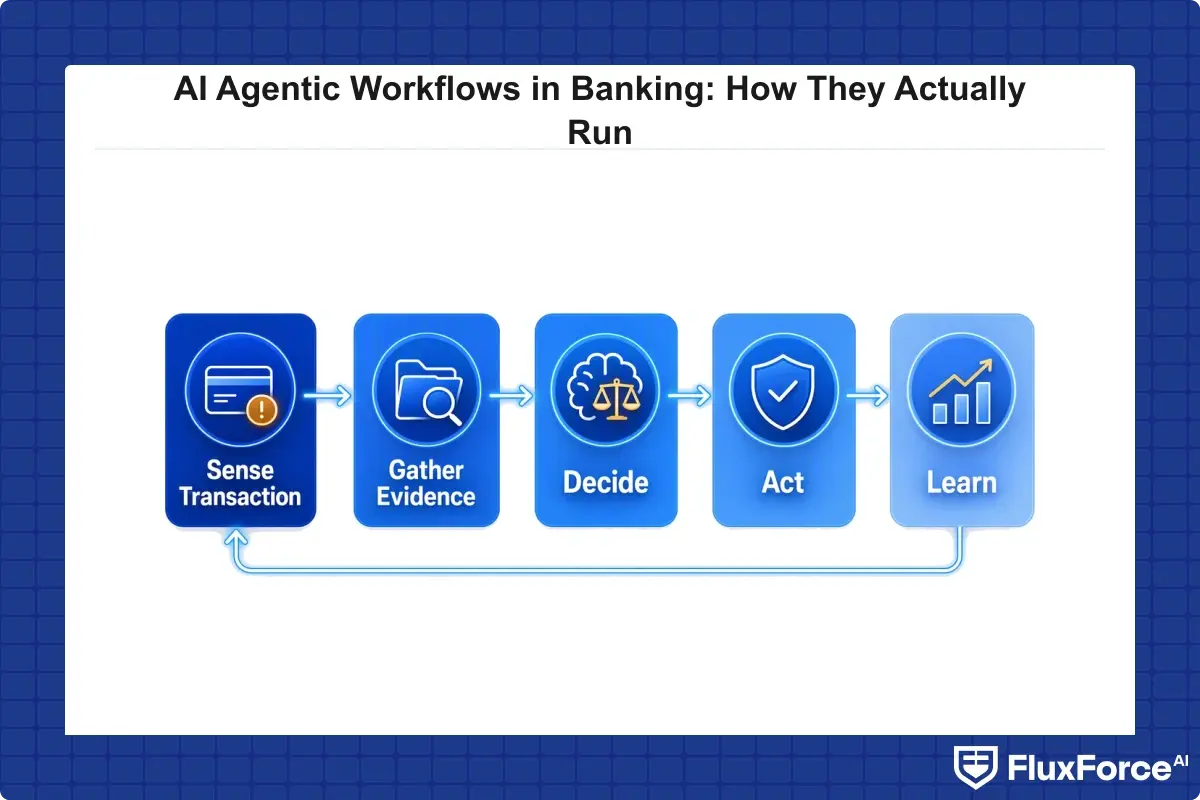
An AI agentic workflow is a chain of autonomous steps where an AI agent gathers evidence, makes a decision, and takes action on a case, with a human reviewing only the outcome, not every step. That's the core difference from older automation: it doesn't just flag, it investigates.
AI Fraud Detection Explained in Plain Terms
Traditional transaction monitoring software fires an alert when a transaction crosses a threshold, say a wire transfer over $10,000 from a new payee. That alert lands in a queue. A human analyst then has to pull account history, check device fingerprints, look at prior disputes, and decide.
An agentic system does that pulling and checking itself. It queries the core banking system, checks device and geolocation history, cross-references the payee against watchlists, and writes a case summary before a human ever opens the ticket. That's ai fraud detection in banking working as intended: less time spent gathering facts, more time spent judging them.
How Does AI Detect Fraud Differently From Rules?
Rules ask "did this cross a line." Machine learning fraud detection asks "does this look like the thousands of confirmed fraud patterns we've seen before, adjusted for this specific customer's normal behavior." That's a probabilistic judgment, not a fixed threshold, and it's why AI fraud detection in banking catches fraud that never crosses a static rule at all, like an account takeover that stays under every dollar threshold.
A rules engine can only catch fraud patterns someone already coded for. An agentic system builds a behavioral baseline per customer, so it catches the first occurrence of a new fraud pattern, not just the second.
Real Time Fraud Detection: What Changes When Agents Act Instantly
Real time fraud detection used to mean "flag it before settlement." Real time fraud detection banks need today means something faster: stop the transaction, gather the evidence, and either release or freeze it, in under two seconds, before the customer's app even finishes loading the confirmation screen.
This matters more since the Federal Reserve's FedNow instant payment rail went live, because instant payments also mean instant, irreversible fraud. A wire that clears in twenty seconds gives an analyst zero time to review it manually. Agentic workflows are the only practical way to keep a human in the loop on payment rails that fast, because the agent does the pre-work and only escalates the fraction of cases that actually need judgment.
The 4 Phases of Agentic AI Adoption in Banking
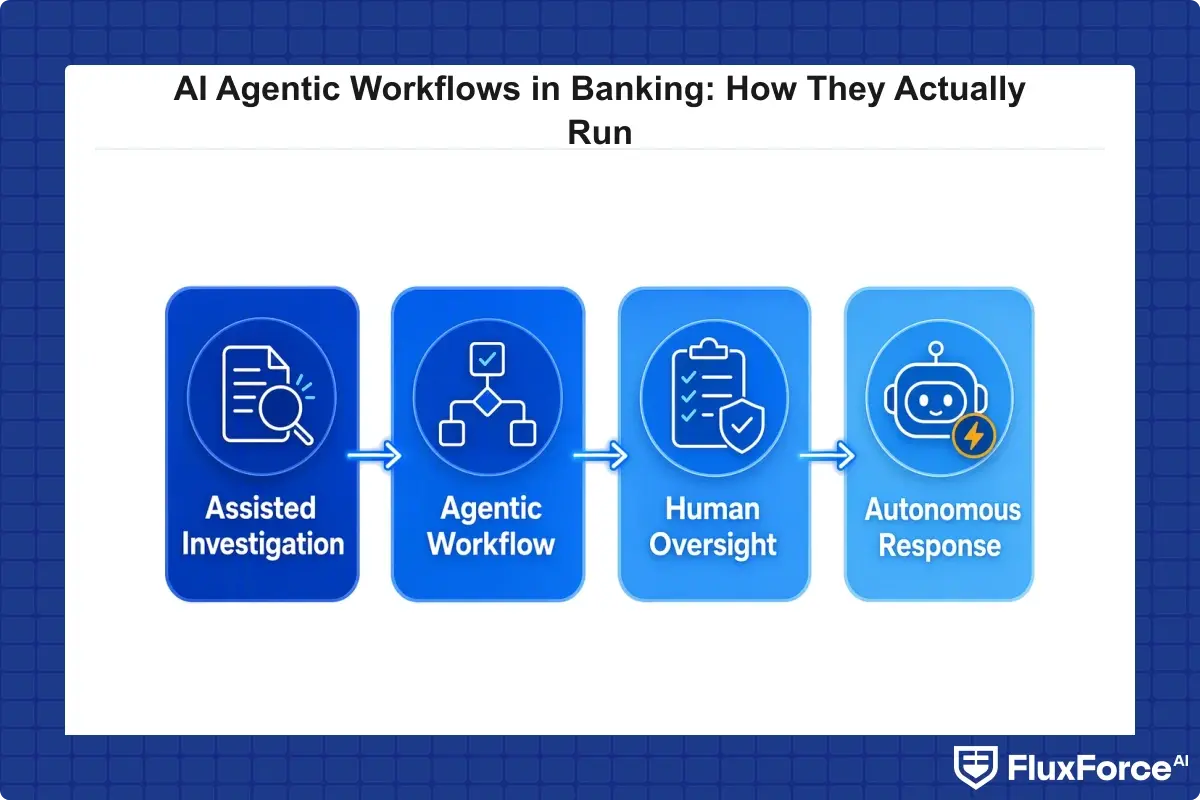
Every bank we've worked with moves through the same four stages, whether they admit it or not. Skipping a stage is the single biggest reason agentic AI pilots stall.
1. Phase 1 (Now): Assisted Investigation
In Phase 1 (Now), the agent does the research but a human makes every decision. It pulls transaction history, flags the top risk factors, and drafts a recommendation. Nothing gets auto-closed or auto-blocked without sign-off. Most regulated banks are here today, and it's the right place to start: it builds an audit trail that proves the agent's judgment before anyone trusts it with authority.
2. Phase 2: Supervised Autonomy
In Phase 2, the agent auto-closes the clearly-legitimate cases, usually 30 to 50 percent of the queue, and routes only ambiguous or high-risk cases to a human. This is where fraud alert fatigue actually starts to drop, because analysts stop reviewing cases the agent has already confirmed as low-risk with high confidence.
3. Phase 3: Conditional Autonomy
Phase 3 lets the agent act on medium-risk cases directly, like temporarily holding a transaction pending a customer callback, without waiting for a human to approve the hold first. A human still reviews every action after the fact, but the agent isn't waiting on a queue to act.
4. Phase 4: Full Autonomous Response
In Phase 4, the agent handles the full lifecycle for defined risk categories: investigate, decide, act, and document, with human review reserved for edge cases and periodic audit sampling. Very few banks are fully here yet, and honestly, most shouldn't rush it. Regulators want to see two or three years of clean Phase 2 and Phase 3 performance data first.
Why Fraud Alert Fatigue Is Breaking Transaction Monitoring Software
Fraud alert fatigue isn't a training problem, it's a math problem. When an analyst reviews 200 alerts a day and most turn out to be nothing, attention naturally drops on alert 150. That's when real fraud slips through, not because the analyst is careless, but because the system handed them an impossible workload.
Legacy transaction monitoring software was built for lower transaction volume and a simpler threat model. It wasn't designed for synthetic identities, real-time payment rails, or fraud rings that test stolen cards across hundreds of merchants in minutes. Bolting more rules onto that system just produces more alerts, not better ones.
Rule-Based vs Agentic AI for Fraud Detection
Good ai fraud detection software should reduce false positives transaction monitoring teams flag every day, and the fastest way to see the difference is side by side.
Rule-Based Systems vs Agentic AI Workflows
| Factor | Rule-Based System | Agentic AI Workflow |
|---|---|---|
| Decision basis | Fixed thresholds set by analysts | Behavioral baseline per customer, updated continuously |
| New fraud patterns | Missed until someone writes a new rule | Detected from deviation, no rule update needed |
| Analyst workload | Reviews every triggered alert | Reviews only ambiguous or high-risk cases |
| Speed | Fast to flag, slow to investigate | Fast to flag and pre-investigate |
| Maintenance | Grows more complex every quarter | Retrains on new confirmed fraud and legitimate cases |
| False positive rate | Typically high and rising with volume | Lower, and improves as the model sees more cases |
For a deeper breakdown of what changes operationally, see our comparison of rule-based systems vs AI transaction monitoring.
3 Ways Agentic AI Reduces False Positives in Fraud Detection
The false positive cost fraud teams absorb isn't just analyst time. Every wrongly declined transaction risks losing a customer, and every wrongly frozen account generates a support call. When banks talk about false positives fraud detection performance, they usually mean the ratio of alerts closed as legitimate versus alerts that turned out to matter. Here's how agentic workflows bring that number down.
1. Building a Behavioral Baseline Instead of a Static Threshold
Static thresholds treat every customer the same. An agent learns that customer A always travels for work and customer B never leaves their home city, so the same $2,000 international charge means something completely different for each of them.
2. How to Reduce False Positives in AML Without Adding Headcount
Instead of hiring more analysts, agentic workflows automate the evidence-gathering step that consumes most of an analyst's time. One of our banking clients found that roughly 40 percent of their AML alert queue closed automatically once the agent could pull KYC records, prior SARs, and transaction context on its own, work that used to take an analyst 15 to 20 minutes per case.
3. Continuous Feedback Loops That Retrain the Model
Every time a human overturns the agent's recommendation, that decision feeds back into the model. The false positive rate fraud detection systems report should trend down month over month, not stay flat, and if it isn't improving, that's a sign the feedback loop isn't wired up correctly.
A transaction monitoring system that isn't getting measurably better every quarter isn't learning, it's just running the same rules with an AI label on it.
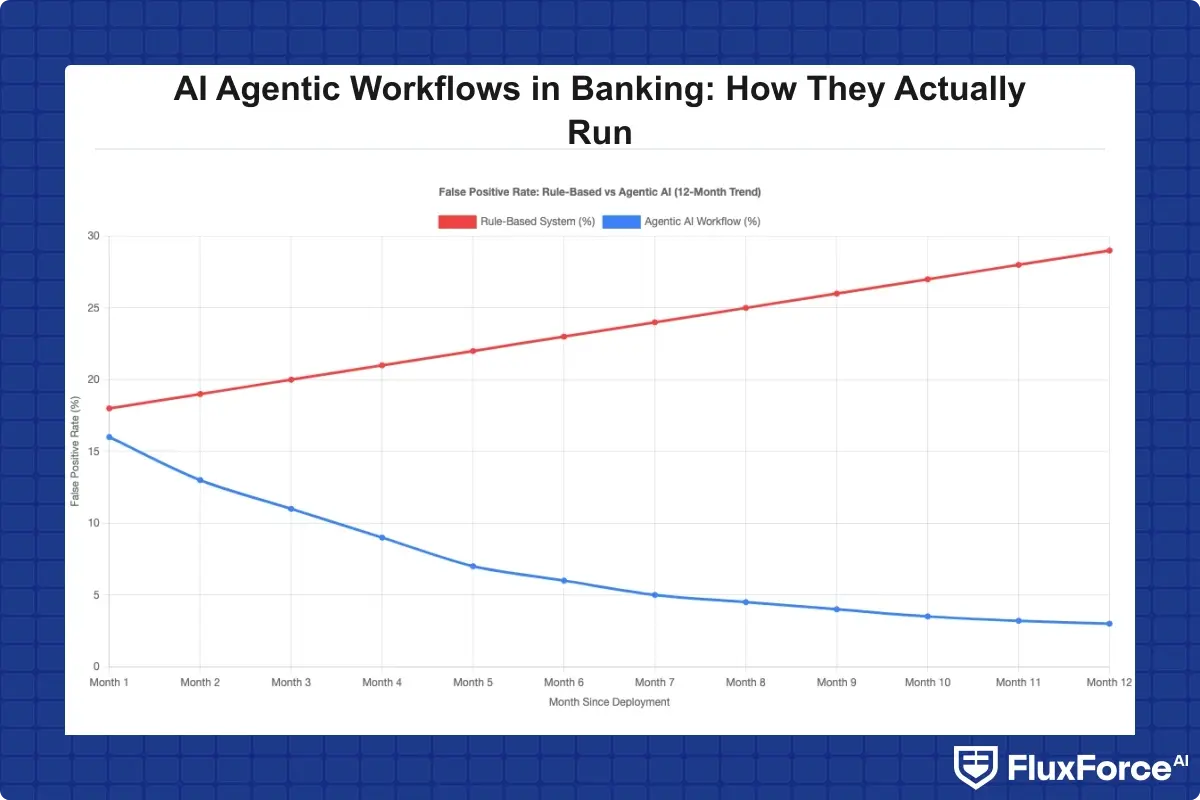
Well-built fraud detection software treats false positive reduction as a measurable KPI, not a marketing claim, and tracks it the same way it tracks catch rate. If a vendor can't show you a false-positive trend line, that's worth asking about before signing.
What Should Compliance Teams Verify Before Rolling Out Agentic AI?
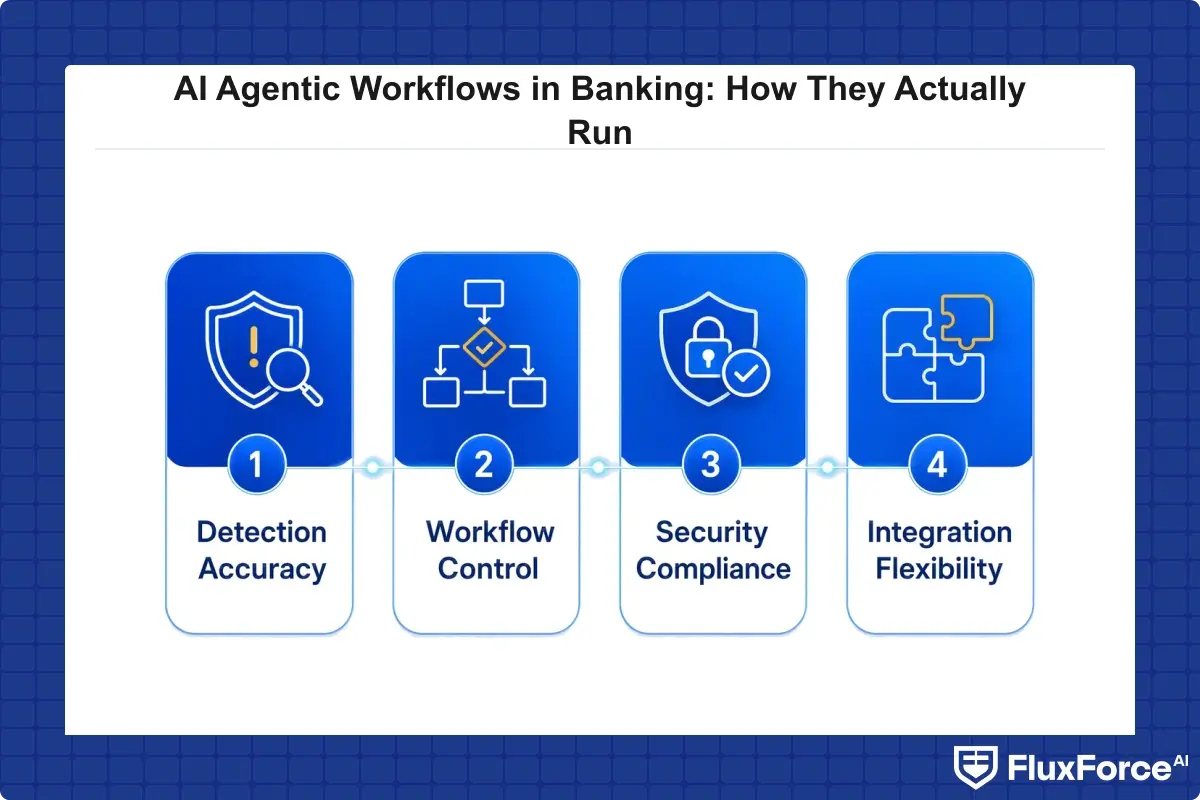
Compliance teams should verify that every agent decision is logged, explainable, and reversible before it touches a live transaction. That means checking the audit trail format, confirming the model documentation aligns with NIST's AI Risk Management Framework, and mapping every autonomous action back to the FFIEC BSA/AML examination manual requirements your examiners already use.
This isn't paperwork for its own sake. Occupational fraud, per the Association of Certified Fraud Examiners' Report to the Nations, costs organizations a median of 5% of annual revenue, and banking fraud moves through payment rails in seconds rather than months. An examiner needs to reconstruct exactly why an agent released or froze a transaction, months after the fact, which is why the audit log matters as much as the catch rate.
For teams building a broader security posture around this, our guide on zero trust and agentic AI covers how access controls need to change once agents, not just humans, are taking action on live accounts.
- AI agentic workflows investigate a case before a human sees it, they don't just flag transactions like older systems.
- Most banks are in Phase 1 (Now) or Phase 2 today; Phase 4 full autonomy is rare and shouldn't be rushed.
- Fraud alert fatigue is a volume problem, not a training problem, and it gets worse every year transaction volume grows.
- Agentic AI reduces false positives through behavioral baselines, automated evidence-gathering, and continuous retraining, not through more rules.
- Compliance sign-off depends on explainability and a documented audit trail, not just a lower false positive rate.
Onboard Customers in Seconds
Conclusion
AI agentic workflows solve a problem that rule-based transaction monitoring never could: catching new fraud patterns while cutting the false positive load that burns out analysts. The four-phase path from assisted investigation to full autonomy gives banks a way to build trust in the system gradually, instead of betting the whole fraud program on day one.
The real fix combines three things: a behavioral baseline that replaces static thresholds, an automated evidence-gathering step that removes the busywork from every case, and a continuous feedback loop that makes the false positive rate improve over time instead of staying flat.
Adopting this in practice means starting in Phase 1, proving the audit trail holds up, and only expanding autonomy once the false-positive trend line is moving the right direction. The same 40 percent reduction in manual review time we've seen other AML teams achieve is a realistic early target. If your fraud queue is still growing faster than your headcount, pilot an agentic workflow on your lowest-risk case category first and measure the results before you scale it further.
Share this article