.webp)







Listen To Our Podcast🎧
Introduction
AML regulatory compliance is no longer a back-office checkbox exercise. It is the difference between a bank that keeps its charter and one that ends up in a consent order. Examiners are moving faster, penalties are bigger, and the definition of "reasonable" controls keeps shifting as criminals adopt faster payment rails and synthetic identities.
We work with compliance officers and CISOs at banks, fintechs, and insurers who are stuck between two bad options: keep throwing analysts at a growing alert queue, or bet on automation they don't fully trust yet. Neither is a strategy.
This guide breaks down exactly what AML regulatory compliance requires today, where BSA AML compliance checklist obligations create the most audit risk, and how AML compliance software is changing what a lean team can realistically cover. We'll also flag where the rules are still moving, including how the EU AI Act touches financial services compliance tools.
- The five core obligations examiners check first during a BSA AML exam
- Where SAR filing and CTR filing rules actually diverge, and why mixing them up gets institutions in trouble
- How KYC automation changes customer due diligence without removing human judgment
- What a realistic AML risk assessment actually covers, in plain terms
- Why community banks and small fintech teams face a different BSA AML compliance checklist reality than the top 25 banks
- How the EU AI Act intersects with anti money laundering technology decisions in 2026
Onboard Customers in Seconds

What Is AML Regulatory Compliance and Why Does It Matter in 2026?
AML regulatory compliance is the set of laws, rules, and internal controls that require financial institutions to detect, prevent, and report money laundering and terrorist financing activity. In the United States, it centers on the Bank Secrecy Act (BSA), enforced primarily by FinCEN, with parallel obligations from the OCC, FDIC, and state regulators depending on charter type.
AML Regulatory Compliance Definition in Plain English
Strip away the acronyms and it comes down to three questions every institution must be able to answer for any customer, at any time: Who is this person or entity, is their activity consistent with what we expect from them, and have we told the government about anything that isn't? The Bank Secrecy Act, first enacted in 1970, created this framework and has been amended repeatedly to keep pace with new payment methods and laundering typologies.
Key US and Global Regulatory Bodies Involved
- FinCEN sets BSA rules and collects Suspicious Activity Reports and Currency Transaction Reports
- OCC and FDIC examine national banks and state non-member banks for BSA/AML program adequacy
- FATF sets the global standard through its 40 Recommendations, which most national AML laws are modeled on
- European Commission now layers AI governance on top of existing AML law through the EU AI Act's regulatory framework
Why AML Compliance Fintech Programs Look Different
A fintech built on a sponsor-bank model inherits BSA obligations through its partner but often owns the actual monitoring and SAR filing work in practice. That split accountability is exactly what examiners scrutinize hardest, because it's where gaps hide. AML compliance fintech programs also tend to process higher transaction volumes per compliance headcount than traditional banks, which raises the stakes on automation.
The Bank Secrecy Act has been amended more than a dozen times since 1970, and every major amendment followed a laundering scandal that regulators say existing rules should have caught.
The Core Pillars of AML Regulatory Compliance for Banks and Fintechs
Every adequate AML compliance program rests on four pillars, and examiners check all four independently. Missing one, even with strong performance elsewhere, is enough to trigger a matter requiring attention.
Governance and a Risk-Based Program
A board-approved AML program has to name a compliance officer, define risk appetite, and document how risk drives everything downstream. This is where an aml risk assessment guide becomes central: it scores customers, products, and geographies so the institution can put more scrutiny where the actual risk sits instead of spreading effort evenly and thinly.
Internal Controls and Independent Testing
Controls only count if someone who didn't build them tests them. Independent testing, whether internal audit or a third party, has to happen on a regular cadence and actually challenge the model's assumptions, not just confirm the alerts fired.
AML Compliance Software as the Connective Layer
AML compliance software is what ties governance, controls, and reporting together in practice. Without it, a bank is reconstructing customer risk profiles from spreadsheets during every exam, which is slow, error-prone, and exactly the finding examiners love to write up. Teams evaluating vendors should treat regulatory compliance automation as infrastructure, not a nice-to-have layered on top of manual review.
5 Obligations Every Bank Must Meet Under AML Regulatory Compliance Rules
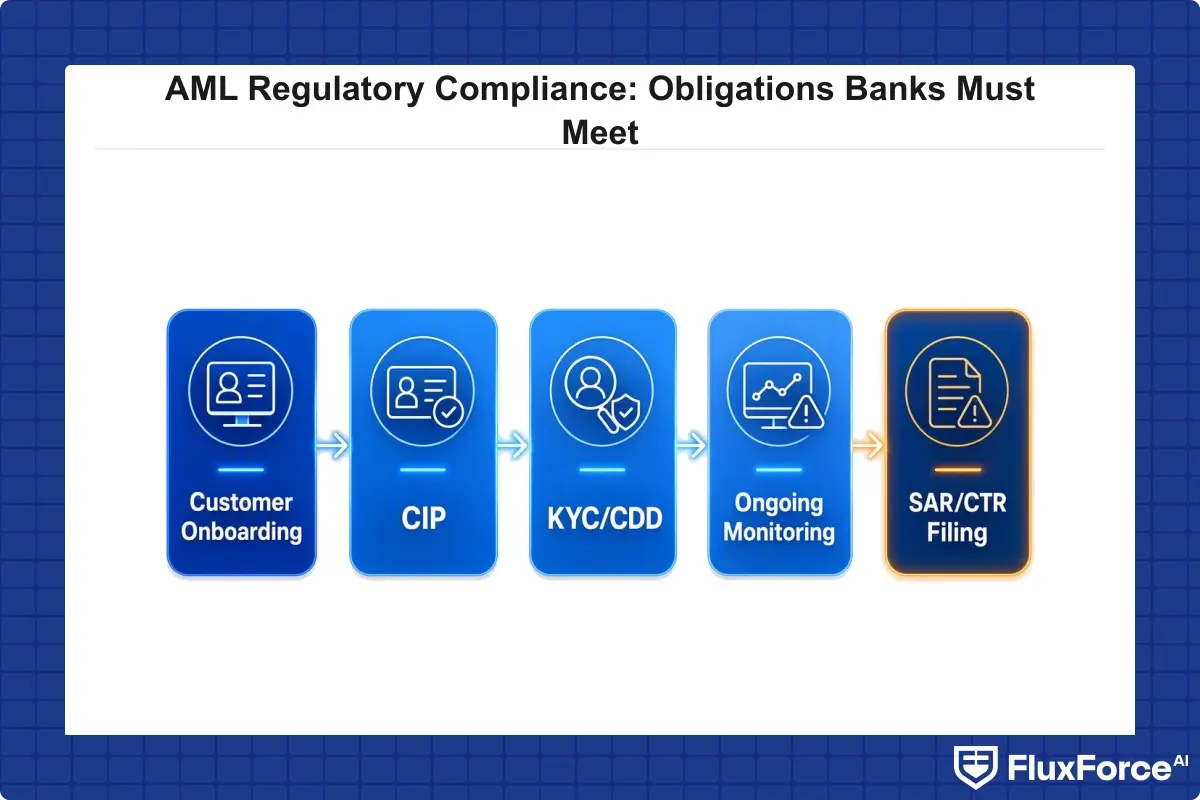
This is the checklist examiners actually run through. Miss any one of these five and the exam finding writes itself.
1. Customer Identification Program (CIP)
Banks must verify identity at account opening using name, date of birth, address, and identification number, at minimum. This is the foundation everything else builds on. Weak CIP data quietly breaks KYC and monitoring downstream, since bad identity data means bad risk scoring.
2. KYC and Customer Due Diligence (CDD)
Beyond identity, institutions must understand the nature and purpose of the customer relationship. The 2018 CDD Rule added a requirement to identify beneficial owners of legal entity customers holding 25% or more ownership. Meeting kyc cdd requirements banks face today means documenting expected activity for every customer segment, not just collecting a form once.
3. Ongoing Transaction Monitoring
Static onboarding data goes stale fast. Institutions need continuous monitoring that flags activity inconsistent with the customer's expected profile, whether that's a sudden spike in wire volume or a pattern of structuring below reporting thresholds.
4. SAR and CTR Filing Obligations
When monitoring surfaces something suspicious, institutions must file the right report within the right window. We cover the mechanics of SAR filing and CTR filing rules in detail below, since this is where a surprising number of otherwise strong programs stumble.
5. Recordkeeping and Independent Audits
BSA records, including SARs and supporting documentation, generally must be retained for five years. Independent audits close the loop by verifying the first four obligations are actually working, not just documented.
How KYC Automation and CDD Requirements Strengthen AML Programs
KYC automation replaces manual document review and static risk scoring with continuous, data-driven identity verification and customer risk monitoring. It doesn't remove the compliance officer's judgment call; it removes the grunt work that used to eat the hours they needed for that judgment call.
What KYC Automation Actually Automates
- Document verification: OCR and liveness checks replace manual ID review
- Sanctions and PEP screening: Automated list matching against OFAC, UN, and EU sanctions lists on onboarding and on an ongoing basis, similar to the approach we cover in our sanctions screening automation strategy
- Risk scoring: Dynamic models that recalculate customer risk as new data arrives instead of only at onboarding
- Periodic review triggers: Automatic flags when a high-risk customer is due for re-verification
Enhanced Due Diligence Guide for High-Risk Customers
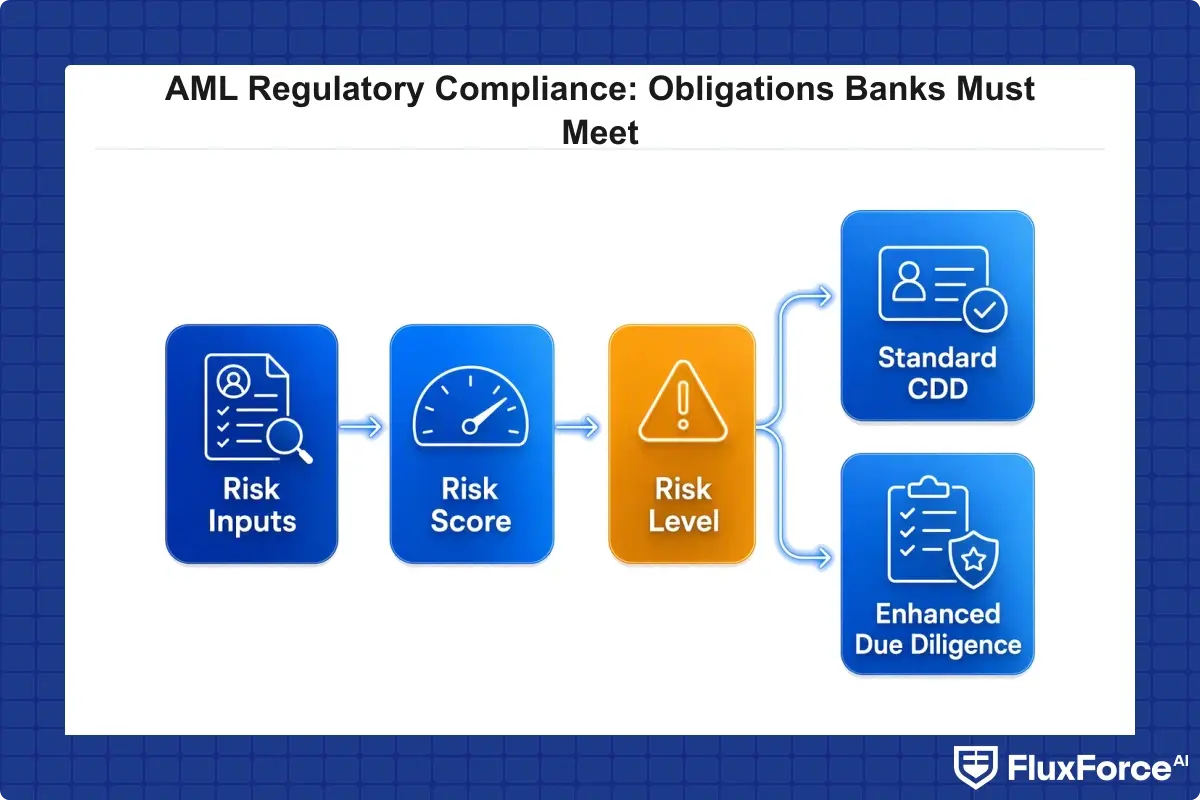
Standard CDD is not enough for customers flagged as higher risk: politically exposed persons, cash-intensive businesses, or accounts in high-risk jurisdictions. An enhanced due diligence guide for these relationships typically requires source-of-funds documentation, senior management sign-off, and shorter review cycles, often quarterly instead of annually.
KYC Automation 2026: What's Changed
KYC automation 2026 deployments increasingly combine identity verification with behavioral biometrics to catch synthetic identity fraud, which static document checks alone tend to miss. In our client engagements, teams moving from manual to automated KYC typically cut onboarding review time from days to minutes for straightforward cases, freeing analysts to focus on the genuinely ambiguous ones.
SAR Filing and CTR Filing Rules: What Compliance Teams Get Wrong
These two reports get confused constantly, and the confusion causes real filing errors.
SAR Filing Requirements 2026: Deadlines and Thresholds
A Suspicious Activity Report must generally be filed within 30 calendar days of detecting facts that may constitute a basis for filing, with a possible 30-day extension if no suspect is identified. Sar filing requirements 2026 haven't changed the core deadline, but examiners are pushing harder on documentation quality: a SAR narrative that just says "unusual activity" without specifics is treated as a near-miss on the obligation, not a completed one.
CTR Filing Rules and the $10,000 Threshold
A Currency Transaction Report is required for any cash transaction exceeding $10,000 in a single business day, whether it's one transaction or several that add up. Unlike a SAR, a CTR isn't optional or judgment-based. If the cash threshold is crossed, the CTR gets filed, full stop.
Suspicious Activity Report Guide: Common Filing Mistakes
- Filing too late: Missing the 30-day clock because the alert sat in a queue
- Vague narratives: Not naming specific red flags, dates, and amounts
- Structuring blindness: Missing patterns of transactions deliberately kept under $10,000 to dodge CTR filing
- Tipping off: Referencing the SAR filing to the customer, which is itself a violation
A CTR is a mechanical, threshold-based filing with no judgment call involved. A SAR is a judgment call with a hard deadline. Treating either one like the other is the single most common exam finding in BSA reviews.
Following sar filing best practices, meaning consistent narrative templates, clear escalation paths, and documented decision rationale even when a team decides not to file, is what turns SAR filing efficiency from a bottleneck into a predictable process. Programs with weak SAR filing efficiency tend to show it in growing alert backlogs long before an exam catches it, which is the same pattern we've seen play out in rule-based transaction monitoring systems that generate too many low-value alerts.
Why Anti Money Laundering Technology Is the 2026 Turning Point
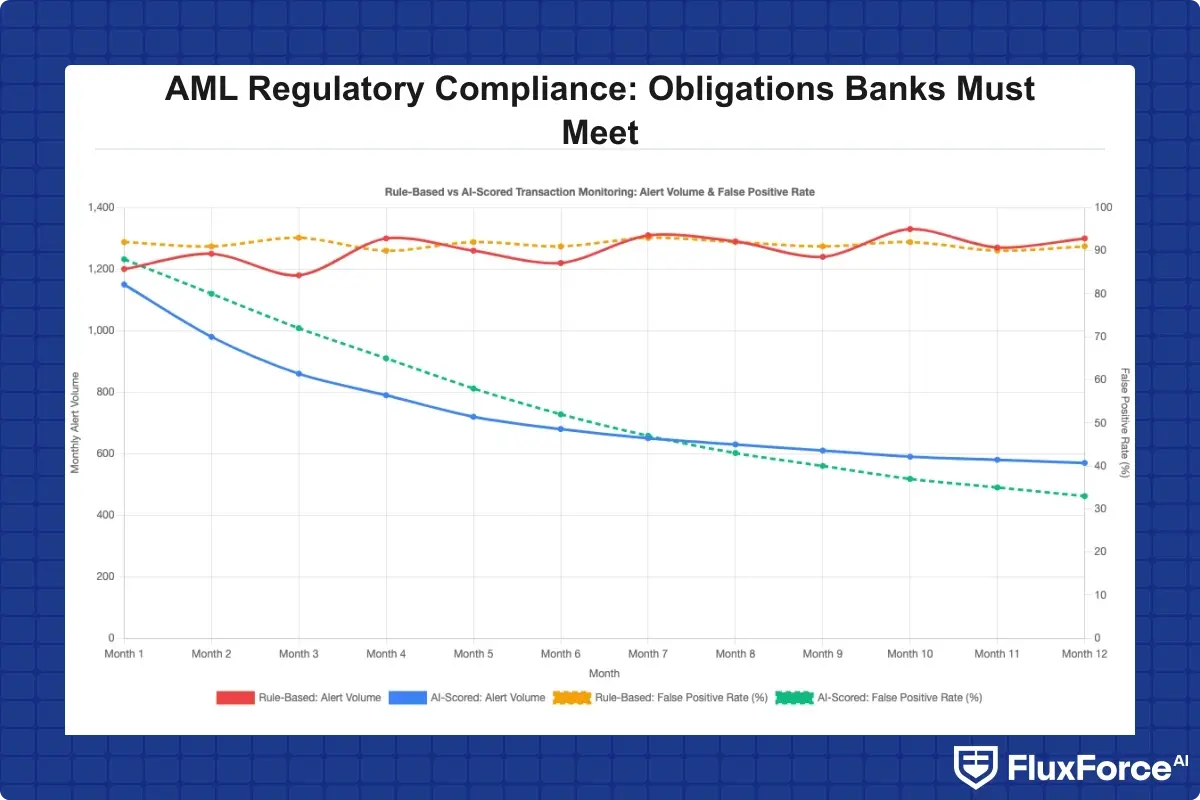
Anti money laundering technology has moved past simple rules engines. Static if-then rules catch known patterns but miss novel ones, and they generate enough false positives to bury a review team.
Rule-Based vs AI-Powered AML Technology
| Factor | Rule-Based Monitoring | AI-Powered AML Technology |
|---|---|---|
| Alert accuracy | High false-positive rate on static thresholds | Learns customer-specific baselines, fewer false positives |
| Novel typologies | Only catches patterns explicitly coded | Can flag statistically anomalous behavior it wasn't told to look for |
| Analyst workload | Grows linearly with transaction volume | Prioritizes alerts by risk score, reducing queue time |
| Explainability | Simple, easy to document for exams | Requires model governance documentation for examiners |
| Tuning cost | Manual rule updates after every miss | Continuous retraining, but needs monitoring for drift |
Anti money laundering technology 2026 deployments increasingly pair AI-driven alert scoring with rule-based guardrails, since examiners still want to see explainable logic behind every filed or dismissed alert. Pure black-box scoring without documentation is a compliance risk of its own.
EU AI Act and Financial Services AML Tools
For institutions operating in or serving EU customers, the EU AI Act financial services provisions classify certain AML and credit-scoring AI systems as "high-risk," which triggers documentation, human oversight, and bias-testing obligations on top of existing AML law. US institutions with EU exposure should treat this as a parallel compliance track, not an afterthought, when selecting or building anti money laundering technology.
AML Compliance for Fintechs and Community Banks: Closing the Resource Gap
A money-center bank can staff a 200-person BSA/AML department. A community bank or seed-stage fintech cannot, and pretending otherwise leads to burned-out compliance teams and missed deadlines.
BSA AML Compliance Checklist for Small Teams
Fintech BSA AML small team programs need to prioritize ruthlessly:
- Automate CIP and sanctions screening first, since these are the highest-volume, lowest-judgment tasks
- Outsource or automate CTR filing, given it's threshold-based and doesn't need much human review
- Reserve analyst time for SAR investigations, where judgment actually matters
- Document risk-based decisions, even simple ones, since examiners weight documentation heavily for smaller institutions
BSA AML Compliance for Community Banks: Budget Reality
Bsa aml compliance community banks face is straightforward: the exam standard doesn't scale down with headcount. A community bank is held to the same BSA framework as a regional bank, just with a fraction of the staff. That gap is exactly why AML compliance software adoption has grown fastest among smaller institutions, not the largest ones, over the past few years. It's also why programs like regulatory compliance automation for insurance risk officers and banking compliance reporting automation keep showing up across smaller, resource-constrained compliance teams.
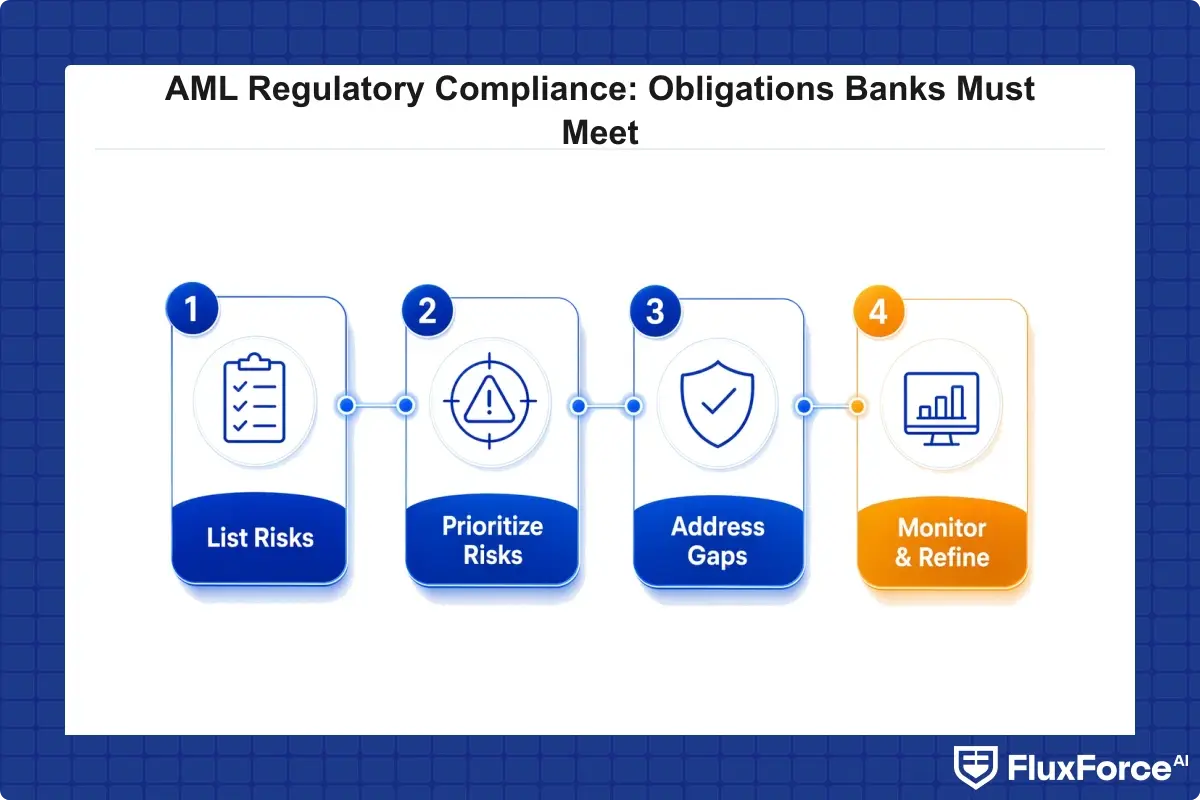
- AML regulatory compliance rests on four pillars: governance, controls, independent testing, and accurate reporting, and examiners check all four separately.
- CTRs are mechanical and threshold-based at $10,000 in cash; SARs require judgment and a 30-day filing clock.
- KYC automation and enhanced due diligence don't replace compliance judgment, they remove the manual work that was crowding it out.
- Anti money laundering technology built on AI scoring still needs explainable, documented logic to satisfy examiners.
- Community banks and small fintech teams face the same exam standard as large institutions with a fraction of the staff, making automation a necessity rather than an upgrade.
- The EU AI Act adds a parallel compliance track for any institution using AI-driven AML tools with EU customer exposure.
Onboard Customers in Seconds
Conclusion
AML regulatory compliance in 2026 is defined by a widening gap between what examiners expect and what manual processes can realistically deliver, especially once transaction volumes and identity fraud both keep climbing. A five-day SAR review backlog or a missed CTR threshold isn't a staffing problem anymore, it's a structural one.
Closing that gap comes down to three things: a genuinely risk-based AML program that puts scrutiny where it belongs, KYC automation that handles verification and screening at machine speed, and AML compliance software that keeps SAR and CTR filing accurate and on deadline. None of these replace a compliance officer's judgment. They protect the hours that judgment actually needs.
For most teams, adopting this stack means auditing where analyst time currently goes, automating the threshold-based and document-heavy work first, and reserving human review for the genuinely ambiguous cases, the same prioritization that turns a five-day SAR backlog into same-day review for a well-run team.
If your program is still running CIP, monitoring, and SAR investigation as three disconnected manual workflows, start by mapping which of the five core obligations covered here is consuming the most unplanned analyst time, and automate that one first.
Share this article