.webp)







Listen To Our Podcast🎧
Introduction
KYC tools decide how fast a legitimate customer gets an account and how quickly a fraud ring gets shut out, and most banks still run a stack that gets both calls wrong. We have watched compliance teams pick a vendor based on a demo and a pricing sheet, then spend eighteen months bolting on point solutions for deepfake detection or synthetic identity checks the original tool never covered.
This matters more in 2026 than it did three years ago. Generative AI has made fake driver's licenses and injected video attacks cheap to produce, and a KYC stack built for 2019-era document forgery will not catch a 2026-era deepfake. Picking the right combination of identity verification, biometric checks, and fraud signals now determines both your onboarding conversion rate and your regulatory exposure.
We wrote this comparison for the people who actually own that decision: CISOs weighing security architecture, compliance officers who answer to examiners, developers who have to integrate the identity verification API, and operations teams who get paged when onboarding queues back up.
- How to score KYC tools across the five criteria that actually predict onboarding failure
- Why biometric identity verification alone no longer stops synthetic identity fraud
- What liveness detection catches that a static selfie check misses
- How to benchmark kyc onboarding speed without sacrificing fraud detection accuracy
- Where a zero trust security framework changes how you architect the KYC layer
- A comparison table you can hand to procurement before the next vendor call
Onboard Customers in Seconds

What Are KYC Tools and Why Does Choosing the Right One Matter?
KYC tools are software systems that verify a customer's identity, screen them against watchlists, and assess fraud risk before an account opens. For a bank, the wrong choice shows up in two places: dropped applicants during onboarding and fraud losses that surface months later.
The stakes are higher than a typical software purchase because KYC sits at a regulatory choke point. A bank that under-verifies faces enforcement action; one that over-verifies loses applicants to a faster competitor. Getting this balance wrong is not a minor operational issue, it is a board-level risk.
The Real Cost of the Wrong KYC Stack
We have seen banks underestimate three specific costs when a KYC tool falls short:
- Manual review backlogs: Weak document verification pushes borderline cases to a human queue, which is where onboarding speed actually dies.
- Fraud that surfaces late: Synthetic identity fraud is built to pass initial checks and default 12-18 months later, long after the account is active.
- Regulatory findings: Examiners increasingly ask specifically about liveness detection and deepfake resilience, not just document capture.
A KYC stack that only checks document authenticity, without liveness detection or biometric matching, is built for a fraud pattern that peaked years ago. Deepfake-based application fraud requires a verification layer that assumes the video in front of the camera might not be real.
5 Criteria for Comparing KYC Tools
Most vendor comparisons focus on price and skip the criteria that actually determine whether the tool works for a bank's risk profile. Here are the five that matter.
1. Identity Verification API Design
A modern identity verification api needs to support document capture, database checks, and biometric verification through a single integration, not three separate contracts. Ask how many API calls a full verification requires and whether the vendor supports webhooks for asynchronous review, since synchronous-only APIs stall your onboarding flow whenever a case needs manual escalation.
2. Biometric Identity Verification Accuracy
Biometric identity verification compares a selfie or video against the photo on a government ID. The accuracy gap between vendors is real: some rely on 2D face matching that a printed photo can fool, while others require 3D depth mapping. If your applicant volume includes higher-risk geographies, this difference shows up directly in your fraud loss rate.
3. Liveness Detection Against Fraud
Liveness detection fraud prevention checks whether the person on camera is physically present, not a photo, video replay, or injected feed. The strongest implementations combine passive liveness (analyzing texture and depth from a single frame) with active liveness (prompting a head turn or blink). Passive-only liveness detection is now beatable by consumer-grade deepfake tools, which is why examiners are asking about it directly.
4. Synthetic Identity Fraud Detection
Synthetic identity fraud detection requires cross-referencing identity elements (SSN, name, date of birth) against bureau and device data to catch combinations that don't have a coherent history. This is the hardest capability to evaluate in a demo because synthetic identities are designed to pass a single-point check. Ask vendors for their false-negative rate specifically on synthetic identities, not overall fraud catch rate.
5. Onboarding Speed Under Load
Kyc onboarding speed benchmarks from a vendor's sales deck rarely reflect your actual applicant mix. A tool that verifies a US driver's license in four seconds may take twenty seconds on a passport from a country its model was undertrained on. Test with your real applicant geography mix before signing.
Rule-Based vs AI-Driven KYC Screening
| Criterion | Rule-Based Screening | AI-Driven Screening |
|---|---|---|
| Document forgery detection | Flags known template mismatches | Detects statistical anomalies in unseen forgery patterns |
| Liveness detection fraud resistance | Limited to basic blink/prompt checks | Combines passive and active signals, adapts to new deepfake methods |
| Synthetic identity fraud detection | High false-negative rate | Cross-references device, bureau, and behavioral signals |
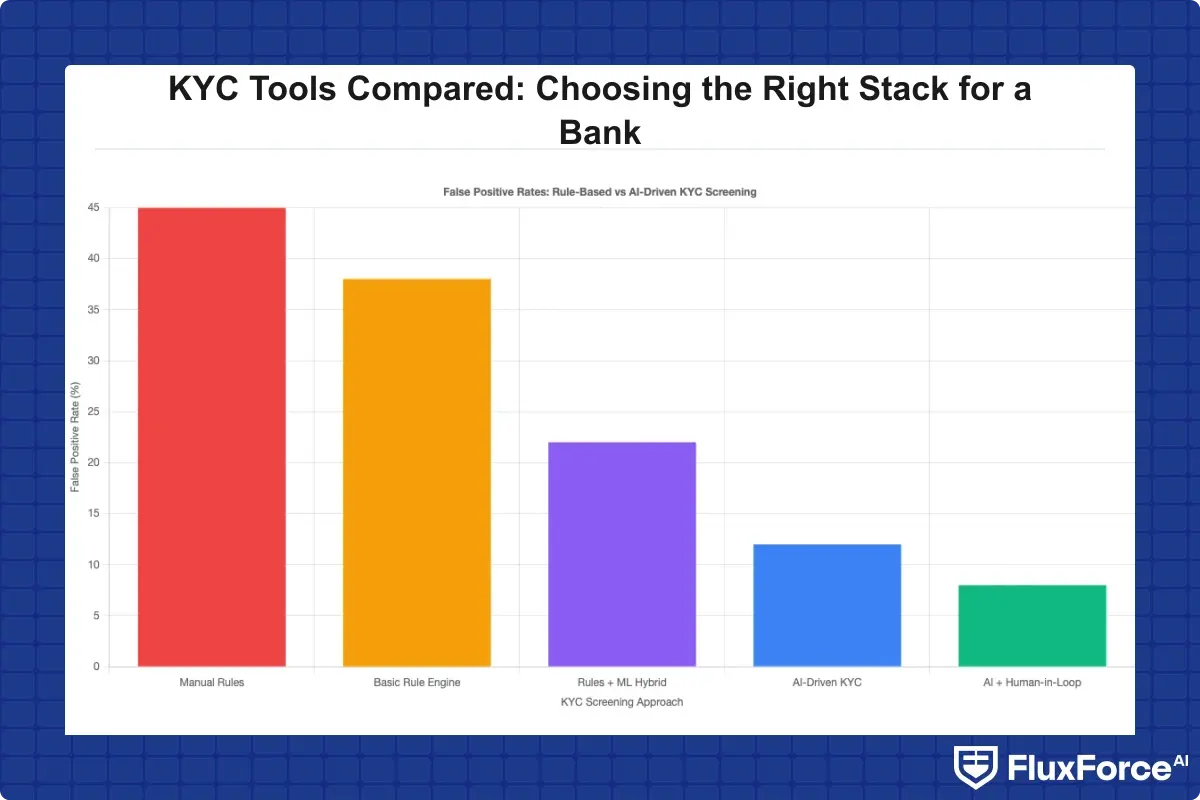
| False positive rate | Higher, more manual review | Lower with continuous model tuning |
| Time to adapt to new fraud patterns | Requires manual rule updates | Retrains on new fraud signals faster |
How Does Digital Identity Proofing Actually Work?
Digital identity proofing is the process of confirming a claimed identity belongs to the real person applying, using a combination of document verification, biometric matching, and data source checks. It is the foundation every other KYC capability builds on.
The Three Stages of Digital Identity Proofing
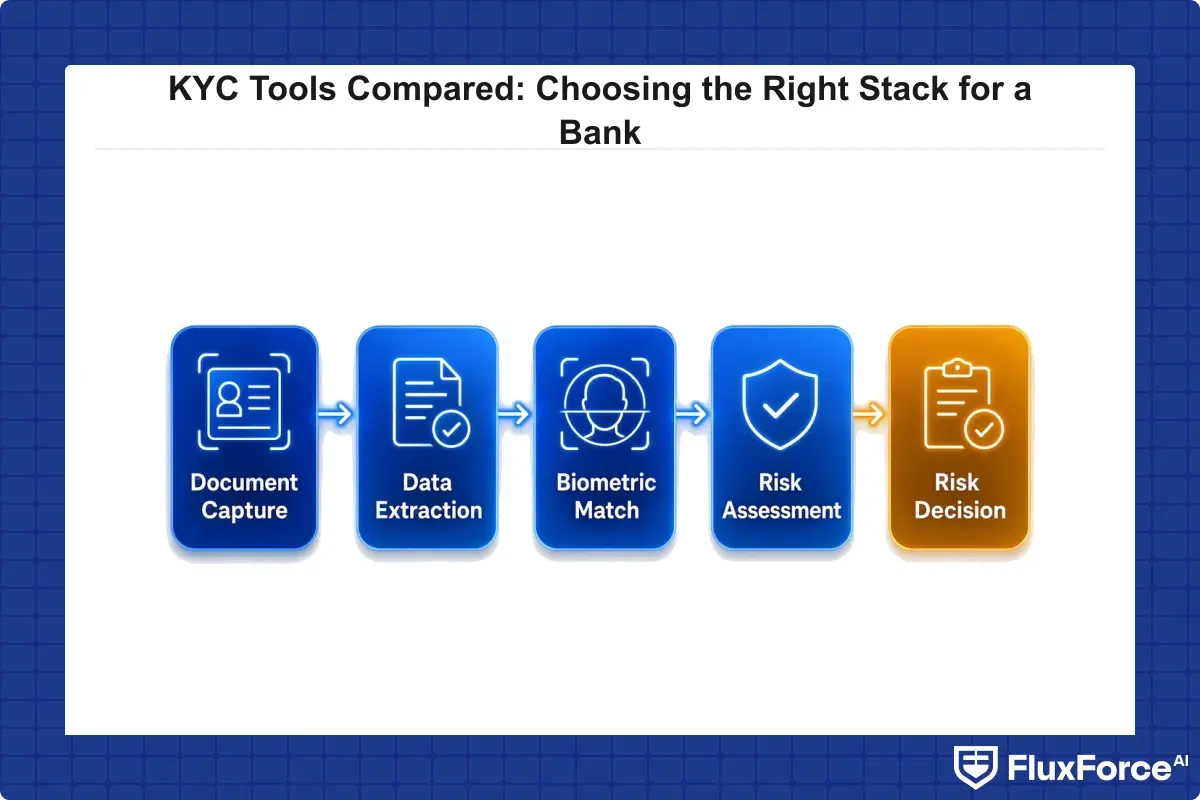
- Document capture and validation: OCR extracts data, and forensic checks look for tampering, font mismatches, or reused templates.
- Biometric matching: A live selfie or video is compared against the ID photo, with liveness detection running in parallel to confirm the applicant is physically present.
- Data corroboration: The extracted identity is checked against credit bureaus, device intelligence, and watchlists to confirm it has a real-world history.
Skipping stage three is exactly why many stacks miss synthetic identity fraud detection: a fabricated identity can pass document and biometric checks if there is no cross-reference to whether that identity has ever existed anywhere else. For a deeper look at how this plays out in supplier onboarding contexts, see our piece on KYC/AML and identity verification for high-risk supplier validation.
Why Is Deepfake Detection Banking's Newest KYC Priority?
Deepfake detection banking capability has moved from a nice-to-have to a core requirement because generative video tools now produce convincing injected-camera attacks. The Federal Trade Commission tracks the rise in AI-enabled identity fraud complaints as part of its identity theft resources for consumers and institutions.
What Deepfake Detection Actually Checks
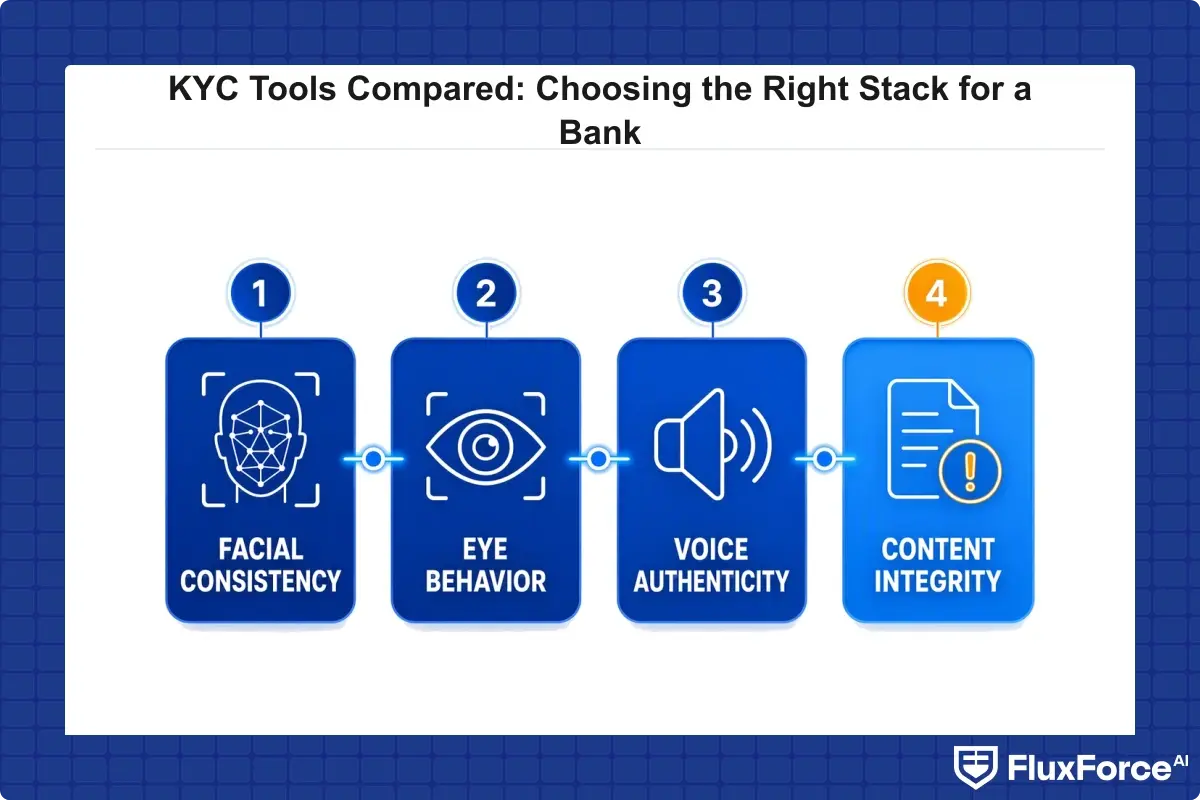
Deepfake detection banking tools look for artifacts that generative models still struggle to fake convincingly: inconsistent lighting reflections in the eyes, unnatural blink timing, and compression artifacts around the jawline during a live video prompt. None of this is visible to a human reviewer glancing at a video call, which is why it has to be automated.
How Often Should Banks Re-Verify Identity?
Most mid-size banks re-verify high-risk accounts every 12 months and re-run biometric checks immediately after any device or behavioral anomaly, rather than relying on a single point-in-time check at account opening.
How Does Zero Trust Change Your KYC Architecture?
A zero trust security framework treats every session, not just the initial onboarding moment, as something to verify. Applied to KYC, this means identity confidence is not a one-time gate, it is a continuous score that adjusts as new signals arrive.
Building Zero Trust Financial Services Around Identity
Zero trust financial services architecture pairs the KYC layer with ongoing device fingerprinting and behavioral biometrics, so a session that started as a verified user but later shows credential-sharing patterns gets re-challenged. We cover the access-control side of this model in our guide to zero trust security architecture for banking access controls, which pairs well with the identity layer discussed here.
This is also where the API layer matters again. A zero trust security framework only works if every service call, including the identity verification api itself, is authenticated and rate-limited, a topic we cover in more depth in our API security strategies for CISOs in banking.
Identity verification stops being a single gate and becomes a running score the moment you adopt a zero trust security framework. A customer verified at signup with a clean biometric match can still be re-challenged mid-session if device or behavioral signals shift.
What Should CISOs, Compliance Officers, and Developers Each Prioritize?
Each buyer role on the KYC decision weighs these criteria differently, and misalignment between them is the most common reason a KYC rollout stalls.
CISOs: Security Architecture and Deepfake Resilience
CISOs should prioritize how the vendor handles deepfake detection banking and whether the architecture supports a zero trust security framework, since a breach in the identity layer compromises every downstream control.
Compliance Officers: Audit Trail and Explainability
Compliance officers need a vendor that can produce a clear audit trail for every accept or decline decision. An AI model that cannot explain why it flagged a case is a liability during an examination, regardless of its accuracy.
Developers: Identity Verification API Reliability
Developers care about identity verification api uptime, documentation quality, and sandbox testing environments. A tool with excellent fraud detection but a poorly documented API will slow every future integration project, not just the first one.
Operations Teams: Manual Review Volume
Operations teams should model expected manual review volume before go-live, since that queue is what determines staffing costs and onboarding speed in practice, not the vendor's advertised automation rate.
Getting the KYC layer right is also foundational to broader AML programs; our overview of AML and identity verification strategy for CISOs walks through how the two connect. For teams evaluating a managed approach rather than building integrations piecemeal, kyc aml automation consolidates document verification, biometric matching, and ongoing monitoring into a single workflow instead of three separate vendor contracts.
How Do You Evaluate Identity Verification Fintech Vendors During a Pilot?
Run a side-by-side pilot with real applicant traffic, not vendor-provided test cases, and measure false positive rate, false negative rate, and average verification time separately.
4 Steps to a Fair KYC Vendor Pilot
- Route a fixed percentage of live traffic to each vendor for 30-60 days, matched by applicant geography and risk tier.
- Track both accepted and declined outcomes for 90 days after onboarding to catch synthetic identity fraud that surfaces later.
- Score liveness detection separately from document verification, since a vendor can be strong at one and weak at the other.
- Interview your operations team about review queue volume and false positive fatigue, since that qualitative signal predicts staffing costs the metrics alone will not show.
Identity verification fintech vendors will often quote accuracy numbers from their own benchmark set. The National Institute of Standards and Technology publishes independent face recognition vendor test results that are a more neutral starting point for biometric accuracy comparisons than vendor marketing.
- KYC tools must now defend against deepfakes and synthetic identities, not just document forgery.
- Biometric identity verification and liveness detection are separate capabilities and should be scored independently.
- A zero trust security framework turns identity verification into a continuous check rather than a one-time gate.
- Pilot vendors on live traffic with a 90-day outcome window to catch synthetic identity fraud that surfaces late.
- CISOs, compliance officers, developers, and operations teams each need different evidence before signing off on a KYC stack.
Onboard Customers in Seconds
Conclusion
Choosing among KYC tools comes down to whether the stack can catch the fraud patterns active right now, not the ones it was designed for five years ago. Deepfake-based application fraud and synthetic identities that default 12-18 months later are the two failure modes that a document-only verification approach cannot see.
The fix is not a single feature, it is a combination: strong biometric identity verification paired with real liveness detection, cross-referenced digital identity proofing that checks an identity's history rather than just its documents, and a zero trust security framework that keeps verifying after the account opens.
Adopting this combination usually means running a 30-60 day pilot against live traffic before switching vendors, and tracking outcomes for a full 90 days afterward to see the synthetic fraud your old stack was missing. That window is what actually reveals whether a vendor's onboarding speed claims hold up against real fraud pressure.
Start by pulling your last six months of manual review cases and sorting them by which of the five criteria above would have caught them earlier.
Share this article