.webp)







Listen To Our Podcast🎧
Introduction
An ai governance maturity model gives banks a way to answer a question their examiners keep asking: how do you actually know your AI is under control? Most banks did not plan their AI governance, they accumulated it. A fraud model here, a chatbot pilot there, a vendor tool nobody fully documented. That patchwork is why so many risk and compliance teams cannot say with confidence which phase of maturity they are actually in.
This matters most in fraud and transaction monitoring, where ai fraud detection decisions affect real customers and real dollars every minute. A bank running Phase 1 governance on a Phase 3 fraud detection system is carrying risk it cannot see. We wrote this guide after watching banks, fintechs, and insurers struggle with the same gap: strong technology, weak governance structure around it.
Below we walk through five concrete maturity levels, what fraud alert fatigue and false positive costs look like at each one, and how to move up without a two-year transformation project.
- The 5 distinct phases of an ai governance maturity model, from ad hoc to autonomous
- How does ai detect fraud differently at each maturity phase, and why that changes your risk exposure
- The real dollar and staffing cost of fraud alert fatigue at low-maturity institutions
- A side-by-side comparison of rule-based vs AI transaction monitoring software
- A practical path to reduce false positives in aml programs without ripping out existing systems
- What to evaluate before buying ai fraud detection software
Onboard Customers in Seconds

What Is an AI Governance Maturity Model?
An ai governance maturity model is a staged framework that describes how formally an organization manages the full lifecycle of its AI systems: model approval, monitoring, explainability, bias testing, and incident response. It is the AI-specific cousin of the model risk frameworks banks already know from Federal Reserve SR 11-7 guidance.
The NIST AI Risk Management Framework frames this as four functions: govern, map, measure, and manage. Our five-phase model translates those functions into something a compliance officer or CISO can actually locate their bank within, in an afternoon, not a quarter-long assessment.
Why maturity, not just compliance, is the right frame
Compliance checklists tell you what rules exist. A maturity model tells you whether those rules are followed consistently, monitored continuously, and improved over time. A bank can pass every audit item on paper and still be Phase 1 in practice, because nobody owns the process once the audit ends.
Why Banks Need an AI Governance Maturity Model Now
Regulatory attention on AI in financial services has moved past the theoretical stage. Examiners now ask specific questions about model explainability, drift monitoring, and vendor AI oversight during routine exams, not just during special reviews.
Meanwhile, the operational pressure is just as real. Fraud teams are drowning in alerts from transaction monitoring software that was tuned for a fraud pattern set that shifted years ago. Without a governance structure to require regular retuning, that gap keeps widening.
A bank cannot claim mature ai fraud detection if nobody can explain, in plain language, why a specific transaction was flagged. Explainability is the dividing line between Phase 2 and Phase 3 on the maturity model.
We cover the specific access-control side of this problem in our piece on zero trust security architecture for banking ops heads, which is a useful companion read since governance and access control tend to mature together.
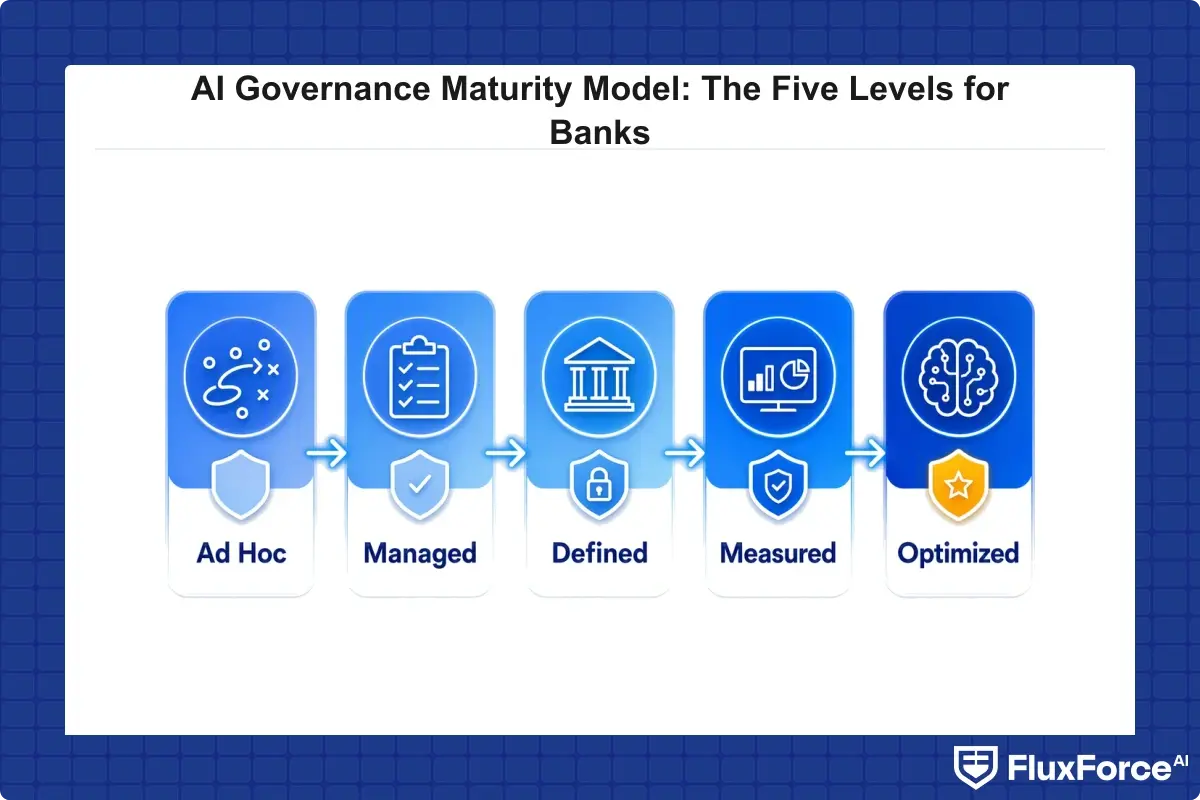
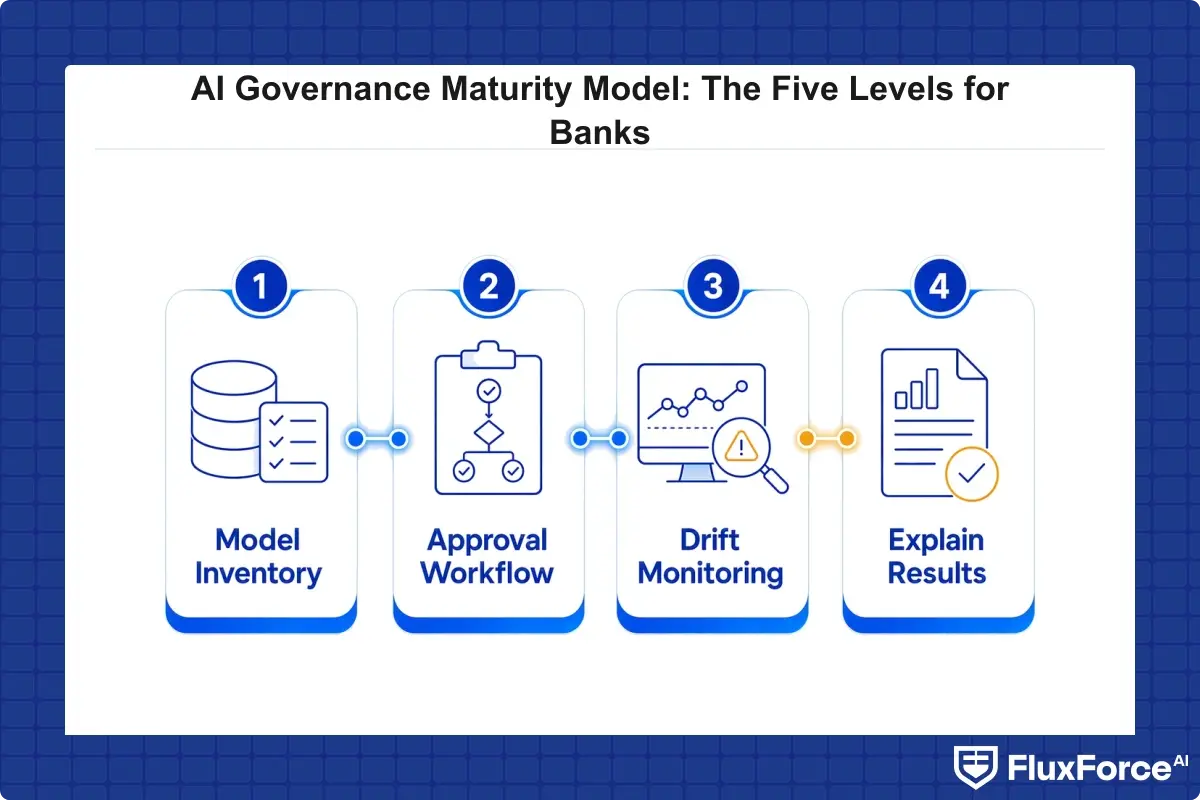
The 5 Levels of the AI Governance Maturity Model
Every bank we have assessed lands somewhere on this scale. Move through the phases in order. Skipping a phase usually means the skipped controls get built later, under pressure, after an incident.
1. Phase 0: Ad Hoc
AI and machine learning tools are deployed by individual teams with no central inventory. Nobody in risk or compliance can produce a complete list of which models are live, what data trains them, or who approved them. Fraud detection rules are hand-tuned by whoever inherited the system.
2. Phase 1 (Now): Reactive
This is where most mid-size banks and fintechs sit today. A model inventory exists, but it is updated manually and goes stale within months. Governance activity is triggered by incidents or exam findings rather than a schedule. Fraud alert fatigue is common because thresholds are rarely revisited unless a specific complaint forces the issue.
3. Phase 2: Managed
Model risk policies exist and are enforced for new deployments. There is a defined approval workflow, and someone owns model performance monitoring, even if it is still partly manual. This is the phase where institutions typically start asking how to reduce false positives in aml monitoring in a structured way rather than case by case.
4. Phase 3: Defined and Proactive
Governance runs on a schedule, not a trigger. Models are retrained and revalidated on a fixed cadence, drift is monitored automatically, and explainability reports are generated for every high-impact decision, including fraud alerts. Cross-functional committees, not single owners, sign off on model changes.
5. Phase 4: Optimized and Autonomous
Governance itself is partly automated. AI systems monitor other AI systems for drift and bias, flagging issues before they reach a human reviewer. Real time fraud detection banks operating at this level can adjust model thresholds dynamically based on live fraud pattern shifts, with governance guardrails baked into the automation rather than bolted on afterward.
How Does AI Detect Fraud at Each Maturity Phase?
AI fraud detection explained simply: it uses statistical patterns learned from historical transaction data to flag behavior that deviates from a customer's normal pattern, rather than relying only on fixed if-then rules. How that detection actually runs depends heavily on governance maturity.
At Phase 1, machine learning fraud detection models often run with limited monitoring after deployment. Nobody checks whether the model's accuracy has degraded until a fraud loss forces a review. At Phase 3 and 4, the same underlying ai fraud detection in banking approach runs inside a monitored loop: drift alerts fire automatically, and a human reviews any material change before it goes live.
The mechanics of machine learning fraud detection
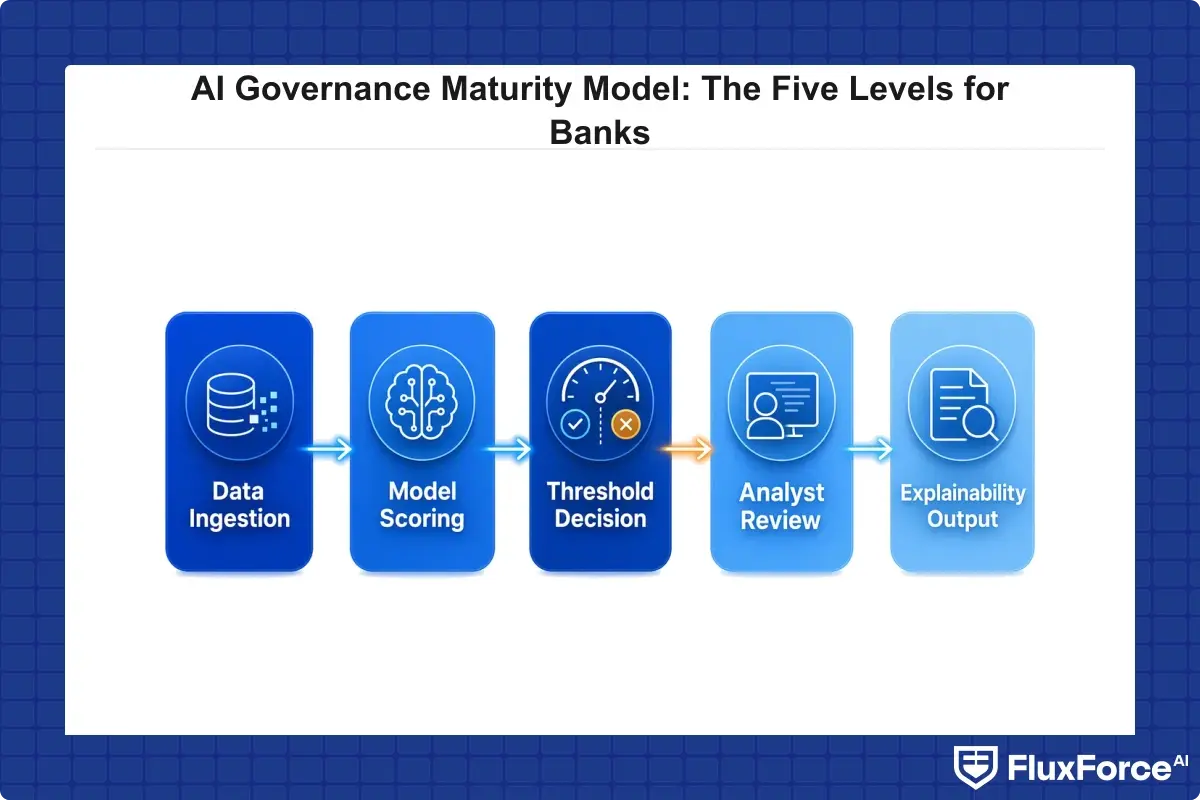
A typical model ingests transaction amount, location, device fingerprint, merchant category, and velocity (how many transactions in a short window). It scores each transaction against a learned baseline for that customer. Scores above a threshold trigger a review, ideally with a plain-language reason code attached so an analyst is not guessing why the system flagged it.
4 Hidden Costs of Alert Fatigue and False Positives
Fraud alert fatigue is not just an analyst morale problem. It has four distinct costs that compound as a bank stays stuck in low maturity phases.
- Analyst burnout and turnover. Reviewing hundreds of low-value alerts a day pushes experienced staff out the door, and replacements take months to ramp on institutional fraud patterns.
- Missed real fraud. When 90 percent or more of alerts are noise, analysts start pattern-matching for speed instead of accuracy, and genuine fraud gets waved through in the flood.
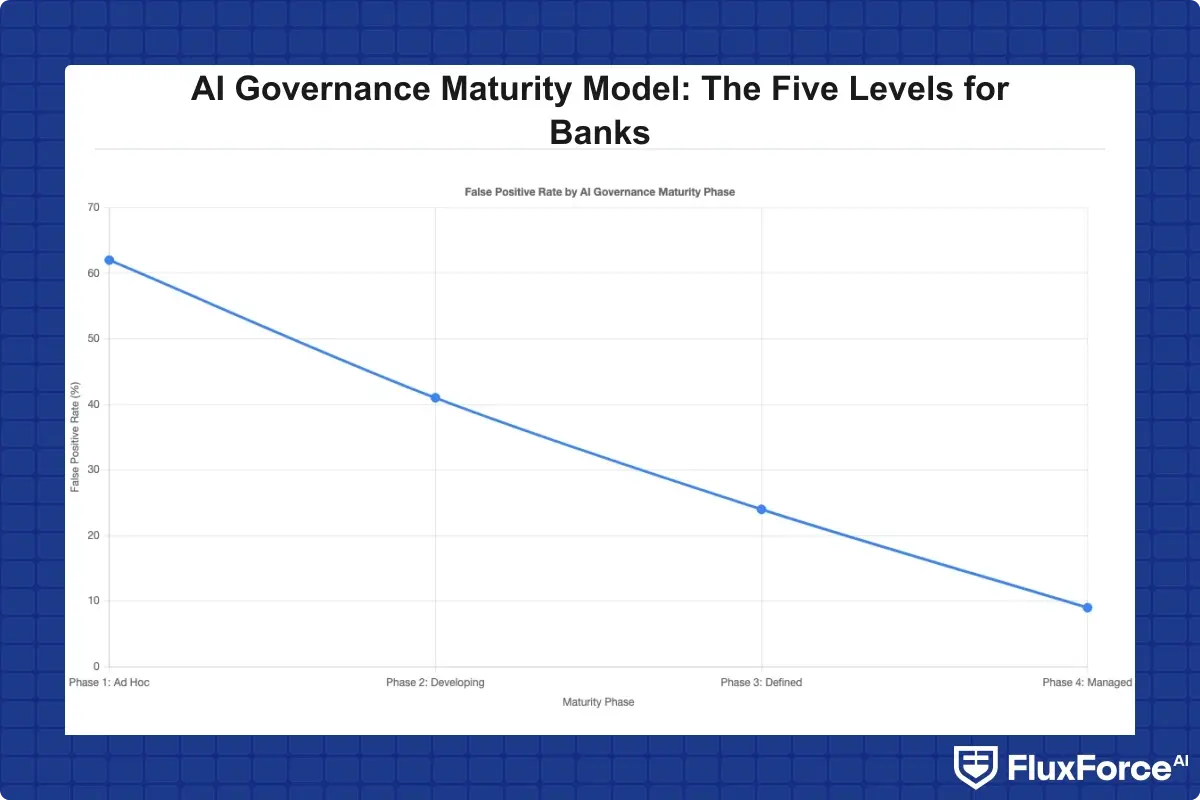
- Customer friction. A high false positive rate fraud detection system means legitimate customers get declined transactions or frozen cards, which drives complaints and churn.
- Compliance exposure. Examiners increasingly ask why false positive rates have not improved year over year. An unmanaged false positive cost fraud program signals exactly the Phase 1 governance gap we described above.
We go deeper on the analyst-side impact in how agentic AI fraud agents cut false positives by 80 percent, which pairs well with the governance framing here.
How to reduce false positives in aml programs without a rebuild
You do not need to replace your transaction monitoring software to make progress. Three moves work at almost any maturity phase:
- Segment thresholds by customer risk tier instead of one universal threshold across the whole portfolio
- Feed confirmed false positives back into the model on a monthly cadence, not annually
- Add a secondary explainability layer so analysts can dismiss low-risk alerts faster with documented reasoning
Rule-Based vs AI Transaction Monitoring
Rule-Based vs AI Transaction Monitoring Software
| Factor | Rule-Based Systems | AI-Based Transaction Monitoring |
|---|---|---|
| Adaptability | Fixed thresholds, manually updated | Learns evolving fraud patterns continuously |
| False positive rate | Typically high, static over time | Lower and improves as models retrain |
| Explainability | Simple, rule is the explanation | Requires dedicated explainability tooling |
| Governance burden | Lower initial burden, hidden drift risk | Higher upfront, but supports Phase 3-4 maturity |
| Real-time capability | Limited without heavy customization | Built for real time fraud detection banks need |
We compare these approaches in more depth in rule-based systems vs AI for false positive reduction and in our broader look at AI versus traditional fraud detection.
Most banks we work with do not choose one or the other. They run rules as a fast first pass and layer AI scoring on top for the transactions that need judgment. Getting that layering right is exactly what mature governance manages: which model gets final say, and how that decision gets documented.
Choosing AI Fraud Detection Software: What to Look For
Not every ai fraud detection software vendor is built for a regulated bank's governance needs. Before buying, evaluate against your current maturity phase, not just the vendor's feature list.
3 non-negotiables for regulated institutions
- Model explainability reports that satisfy an examiner, not just a data science team
- Audit trail for every threshold change, including who approved it and why
- A documented drift monitoring process the vendor runs, not one you have to build yourself
If your governance is still Phase 1, prioritize a vendor that helps you close that gap rather than one that only adds detection accuracy. A well-built fraud detection software platform should reduce your governance burden, not add a second inventory to track. Our own approach to this is covered in card fraud analytics for risk heads, which walks through the evaluation criteria in more detail.
- Most banks sit at Phase 1 (Now) on the ai governance maturity model, meaning governance is reactive rather than scheduled.
- Explainability is the line between Phase 2 and Phase 3, and examiners are asking about it directly.
- Fraud alert fatigue carries four compounding costs: burnout, missed fraud, customer friction, and compliance exposure.
- Rule-based and AI transaction monitoring are not mutually exclusive; the governance layer decides how they work together.
- Advancing one phase does not require a system rebuild, usually a documented process and a retuning cadence.
- Vendor selection for ai fraud detection software should match your governance phase, not just your detection accuracy needs.
Onboard Customers in Seconds
Conclusion
An ai governance maturity model is not an academic exercise. It is the difference between a bank that can explain a fraud decision to an examiner in five minutes and one that needs two weeks to reconstruct what happened. Most institutions we talk to are sitting at Phase 1, running real technology on reactive governance.
The path forward involves three things: a documented model inventory, a scheduled drift and retraining cadence, and explainability built into every fraud alert, not added after the fact. None of that requires abandoning your current transaction monitoring software.
In practice, moving from Phase 1 to Phase 2 typically takes a quarter, not a year, and the immediate payoff shows up in a measurably lower false positive rate within the first two review cycles. Start by inventorying every AI-driven decision system in your fraud and compliance stack this month, then assign an owner to each one before your next exam cycle begins.

Share this article