.webp)







Listen To Our Podcast🎧
Introduction
KYC screening is the process banks, fintechs, and insurers use to verify a customer's identity and assess their risk before letting them open an account or move money. Every regulated institution runs some version of it, yet most compliance officers can't tell you exactly what happens between the moment a customer uploads a driver's license and the moment a risk score lands in a queue. That gap matters because the checks inside KYC screening have changed more in the last three years than in the previous fifteen.
The old model, a document scan plus a sanctions list lookup, was built for a world without generative AI. Today's fraud rings use deepfake video, synthetic identities stitched together from real and fake data, and automated bots that can attempt thousands of onboarding sessions a day. A screening program that still treats identity verification as a one-time gate at signup is already behind.
This piece breaks down exactly what gets checked during KYC screening, why each layer exists, and where biometric identity verification and liveness detection fit into a modern program. We'll also cover the tradeoff every compliance officer feels daily: kyc onboarding speed versus screening depth.
- The four distinct checks that make up modern KYC screening, and what each one catches
- How biometric identity verification and liveness detection stop deepfake-based fraud attempts
- Why synthetic identity fraud slips past traditional document checks
- How to balance kyc onboarding speed against thorough digital identity proofing
- What a zero trust security framework adds to an existing KYC program
- Five warning signs that your current screening stack needs an upgrade
Onboard Customers in Seconds

What Is KYC Screening and Why Does It Matter Now?
KYC screening is the set of identity verification and risk-assessment checks a financial institution runs on a customer before and during a business relationship, covering identity proofing, sanctions and watchlist checks, and ongoing risk monitoring. It exists because regulators require it, but the deeper reason is that unverified accounts are the entry point for almost every downstream fraud and money laundering scheme.
The stakes have gone up. Generative AI tools now let a single fraud operator produce hundreds of synthetic faces and matching fabricated documents in an afternoon. That shift is why identity verification fintech vendors have moved so aggressively into biometrics and liveness detection over the past two years, and why regulators including FinCEN have pushed customer due diligence rules that assume institutions will keep verifying identity throughout the relationship, not just at signup (FinCEN Customer Due Diligence Rule).
Who KYC Screening Applies To
KYC obligations apply to banks, credit unions, money service businesses, insurers, and increasingly to fintechs that touch payments or lending. If your platform moves money or issues credit, some version of KYC screening is not optional. The scope of what counts as a covered entity has widened as embedded finance has spread beyond traditional banks.
How KYC Screening Works: 4 Layers of Identity Verification
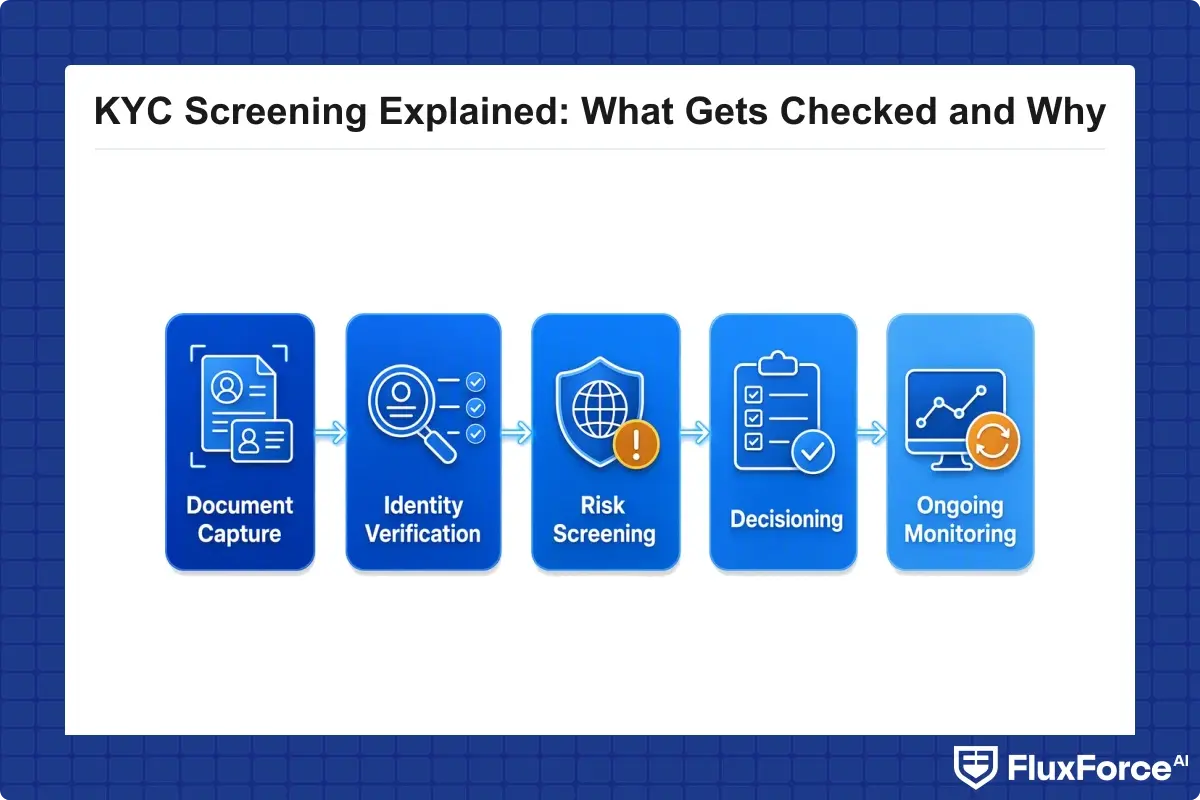
Modern KYC screening isn't one check, it's four layered checks that each catch a different kind of risk. Skipping any one layer leaves a specific gap that fraud rings know how to exploit.
1. Document Verification
The first layer confirms the government ID itself is genuine: checking security features, font kerning, hologram placement, and barcode data against known document templates. This catches crude forgeries but does nothing against a stolen but genuine document.
2. Biometric Identity Verification
Here the system matches a live selfie against the photo on the submitted ID. This is where biometric identity verification earns its keep: it confirms the person opening the account is the same person pictured on the document, not someone who obtained the document through theft or purchase on a fraud forum.
3. Liveness Detection
Liveness detection fraud checks answer a narrower question: is there a live human in front of the camera right now, or a photo, a video replay, or an AI-generated deepfake? This layer has become the front line against deepfake detection banking use cases, since static face-match alone can be fooled by a high-resolution printed photo or a looped video.
4. Sanctions and Watchlist Screening
The final layer checks the verified identity against OFAC, PEP, and adverse media lists. This is the layer most people picture when they hear "KYC," but it only works if the identity feeding into it was actually verified in the first three layers. For institutions running high volumes of automated screening, pairing this step with an identity verification api that handles document, biometric, and watchlist checks in a single call cuts the manual handoffs that slow down review teams. We'd recommend treating kyc aml automation as the default architecture rather than a bolt-on, since manual handoffs between these four layers are where errors and delays both concentrate.
A KYC program that verifies identity once at account opening and never again is checking the wrong moment, most synthetic identity fraud is designed specifically to pass a one-time document check and only surfaces during later behavioral screening.
Biometric Identity Verification and Liveness Detection: Stopping Deepfake Fraud
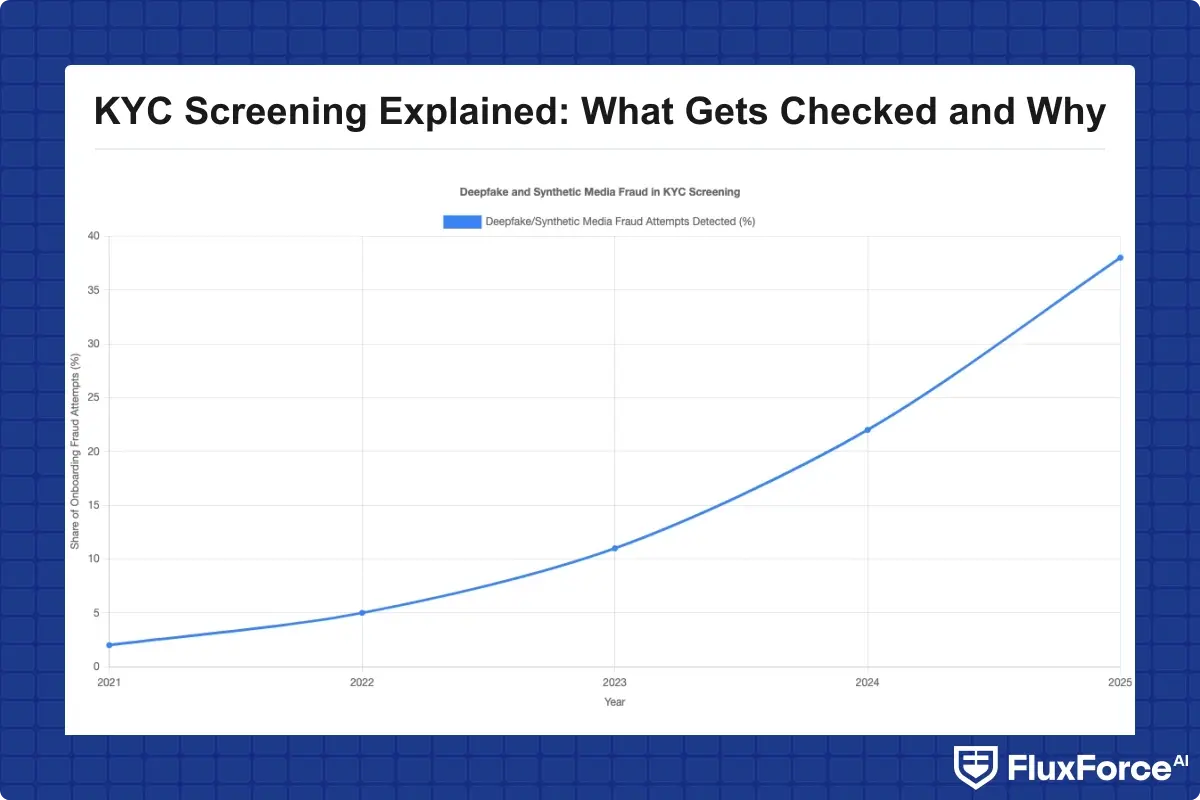
Deepfake tooling has gotten good enough that a face-match algorithm alone is no longer sufficient. We've seen fraud teams flag onboarding attempts where the submitted selfie was a real-time deepfake overlay, passing a static comparison but failing motion-based liveness checks within seconds.
How Liveness Detection Catches AI-Generated Faces
Active liveness detection asks the user to perform a randomized action, turn their head, blink, read a number aloud, so a pre-recorded or generated video can't respond correctly in real time. Passive liveness detection instead analyzes texture, depth, and micro-movement in a single frame to spot the tell-tale artifacts of synthetic video. Institutions serious about deepfake detection banking controls run both, since active checks catch replay attacks and passive checks catch injection attacks where a virtual camera feeds fabricated video directly into the verification pipeline.
Why Static Photo Matching Isn't Enough Anymore
A static photo match answers "does this face resemble the ID photo," which a sufficiently good deepfake can satisfy. It cannot answer "is a real person present right now," which is the actual question a bank needs answered before opening an account. That distinction is why digital identity proofing vendors have shifted budget from pure face-match accuracy toward liveness and injection-attack detection over the last two product cycles.
Why Synthetic Identity Fraud Is Breaking Traditional KYC Onboarding
Synthetic identity fraud combines a real Social Security number, often belonging to a child or someone who doesn't actively monitor credit, with a fabricated name, date of birth, and address. The resulting identity has no history to flag it as stolen, because nobody's identity was actually stolen. It was built from spare parts.
This is the fraud type that traditional document-and-database KYC screening struggles with most, because every individual data point can check out clean. Our work on synthetic identity fraud detection consistently shows the tell isn't in any single field, it's in the pattern: an identity with a thin or oddly assembled credit file, a phone number activated the same week as the application, and device fingerprints shared across dozens of otherwise unrelated applications.
Signals That Separate Synthetic Identities From Real Ones
- Credit file age: a real applicant usually has years of history; synthetic identities often show a file opened within the last 12-18 months
- Device and network overlap: the same device or IP submitting multiple applications under different names
- Velocity: identical documents or selfies reused across accounts, or applications submitted in rapid succession
- Address instability: an address tied to dozens of unrelated applicants in a short window
Our high-risk supply chain clients have run into a related version of this problem in supplier onboarding, which is covered in our KYC/AML and identity verification strategy for CISOs piece, where the same pattern-based detection logic applies to vendor identities instead of consumer ones.
KYC Onboarding Speed vs Screening Depth: Finding the Balance
Every compliance team faces the same pressure: sales wants a three-minute signup, risk wants five layers of verification. The honest answer is that kyc onboarding speed and screening depth aren't actually opposed, the friction comes from doing both layers manually instead of running them in parallel through automation.
Manual Review vs Automated Identity Verification API
| Manual Review | Automated Identity Verification API | |
|---|---|---|
| Typical decision time | Hours to days | Seconds to minutes |
| Consistency across reviewers | Varies by analyst judgment | Same rules applied every time |
| Deepfake/liveness detection | Limited, relies on visual inspection | Built-in active and passive checks |
| Scalability during volume spikes | Requires hiring more analysts | Scales with infrastructure, not headcount |
| Audit trail | Depends on documentation habits | Logged automatically at every step |
| Best fit | Complex edge cases, high-risk exceptions | Standard onboarding, high volume |
The realistic model most mature programs land on: automate the first three layers of KYC screening so 90%+ of applicants clear in minutes, and route only the flagged minority to human analysts. That's what actually protects onboarding speed without gutting screening depth. It gets tricky when your risk appetite varies by product line, a digital lending platform and a private wealth account shouldn't share the same auto-approval threshold, so the automation has to be tunable, not one-size-fits-all.
How Does Zero Trust Strengthen KYC Screening?
A zero trust security framework applies the same "verify, never assume" logic banks use at onboarding to every session and transaction afterward, so a compromised account can't quietly bypass the KYC checks that gated it at signup. Traditional KYC treats identity as verified-once; zero trust treats it as continuously re-earned.
Continuous Verification Beyond the Onboarding Moment
A zero trust financial services model reverifies identity signals at high-risk moments, a new device, an unusual login location, a large transfer, rather than trusting a session indefinitely once onboarding is complete. This closes the gap that account takeover fraud exploits: the attacker doesn't need to beat KYC screening if they can just hijack an already-verified session. Our zero trust security architecture strategy for banking ops heads covers how this gets implemented at the access-control layer, and it pairs directly with the identity layer discussed here.
Why Regulators Are Pushing Institutions This Direction
NIST's digital identity guidelines now explicitly recommend risk-based, continuous authentication rather than a single verification event, reflecting the same shift (NIST SP 800-63-3 Digital Identity Guidelines). FATF's guidance on digital identity systems similarly frames strong onboarding verification as one input into an ongoing risk model, not the final word (FATF Guidance on Digital Identity).
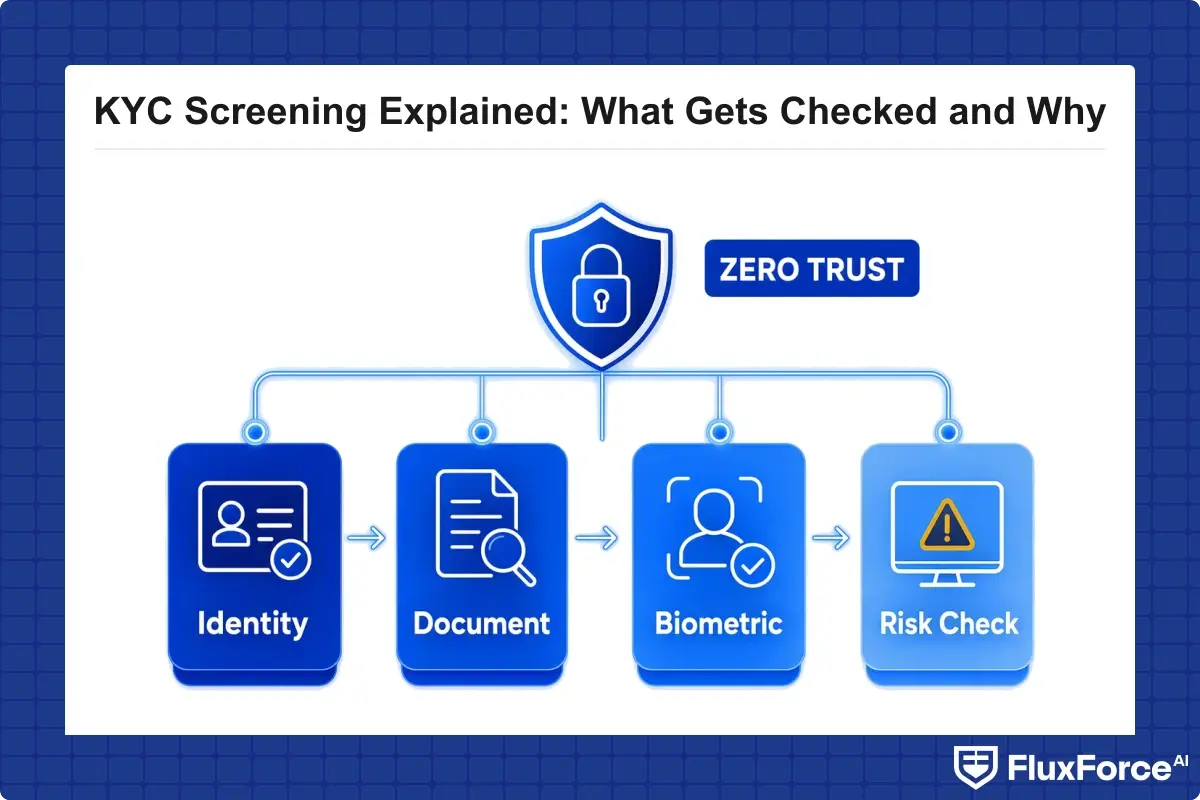
Zero trust and KYC screening solve different halves of the same problem, one verifies who someone is at the door, the other keeps checking that the person who walked through is still the one acting.
5 Signs Your KYC Screening Program Needs an Upgrade
Most compliance teams don't decide to overhaul KYC screening proactively, they get forced into it after an incident or an audit finding. Here are the signals worth acting on before that happens.
1. Manual Review Queues Keep Growing
If your analyst queue backlog is trending up month over month despite steady application volume, your automated layers aren't catching enough, pushing too much into manual review.
2. You Have No Liveness Detection Layer
If your onboarding flow still relies on a static selfie match without an active or passive liveness check, you have an open door for deepfake-based fraud attempts, regardless of how good your document verification is.
3. Synthetic Identity Cases Surface Only After Losses
If synthetic identity fraud is discovered through chargebacks or credit losses rather than flagged at onboarding, your program is detecting fraud after the money's gone instead of before the account opens.
4. Onboarding Abandonment Is Rising
A screening process that takes too long pushes legitimate customers to a competitor mid-application. Rising drop-off rates during identity verification steps usually mean the depth-versus-speed balance has tipped too far toward friction.
5. There's No Continuous Monitoring After Onboarding
If your KYC program stops checking identity signals the moment an account is approved, you're relying entirely on onboarding-day verification to hold for the life of the account, which is exactly the assumption zero trust models exist to remove.
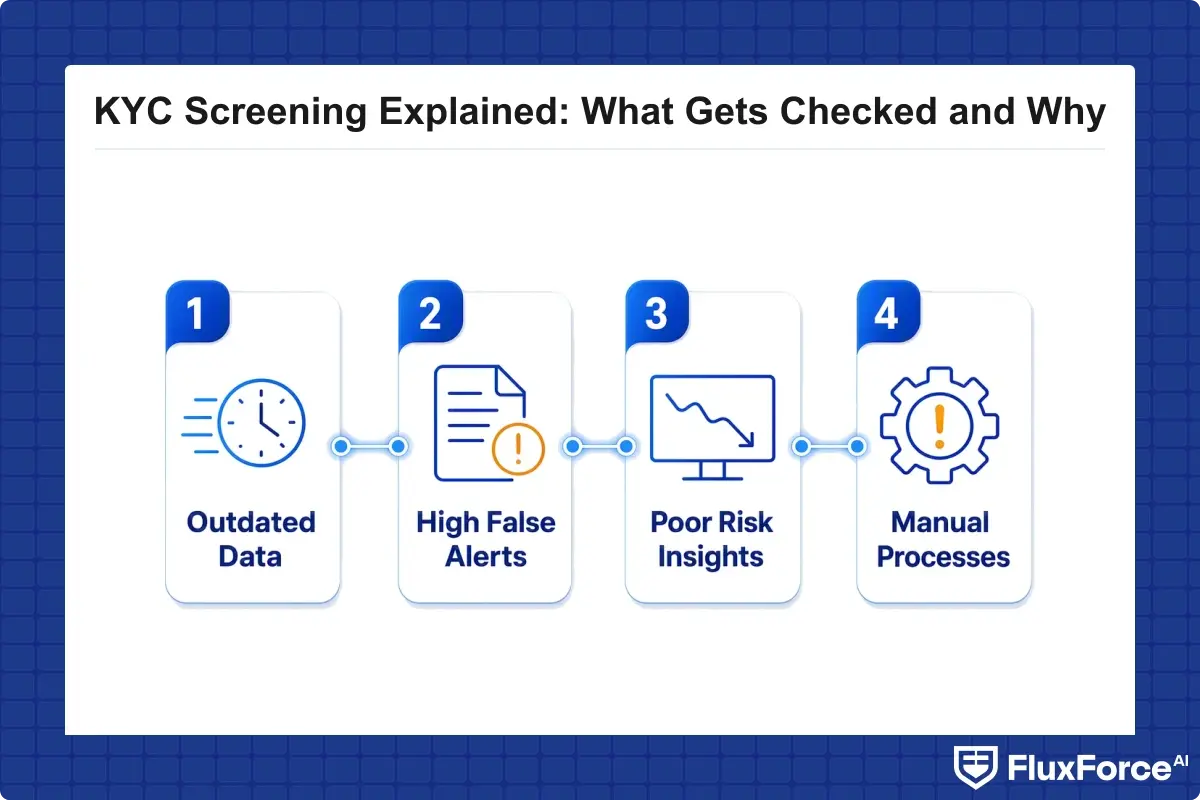
- KYC screening works in four layers: document verification, biometric identity verification, liveness detection, and sanctions screening, and skipping any one leaves a specific fraud gap open.
- Liveness detection, not static photo matching, is the layer that actually stops deepfake-based onboarding fraud.
- Synthetic identity fraud passes individual field checks because no single data point is stolen, the fraud is in the assembled pattern.
- Kyc onboarding speed and screening depth aren't opposed once the first three layers run through automation instead of manual review.
- A zero trust security framework extends verification past the onboarding moment, closing the account-takeover gap that one-time KYC checks leave open.
Onboard Customers in Seconds
Conclusion
KYC screening in 2026 has to do more than confirm a government ID looks real. Between deepfake tooling and synthetic identity fraud built from real fragments of stolen data, the four-layer approach covered here, document checks, biometric identity verification, liveness detection, and sanctions screening, is the minimum bar, not the finish line.
The institutions handling this well combine automated identity verification, continuous liveness detection, and a zero trust security framework that keeps checking identity after the account opens, not just at signup. That combination is what lets a team hit sub-minute onboarding decisions for the vast majority of applicants while still catching the synthetic and deepfake cases that a static, one-time check would miss.
Getting there in practice means auditing which of the four layers your current stack actually runs automatically versus manually, and closing whichever gap you find first. Start by pulling your last quarter of manual review cases and checking how many would have cleared automatically with a liveness detection layer in place.
Share this article