.webp)







Listen To Our Podcast🎧
Introduction
AML fraud detection used to mean two separate desks, two separate case queues, and two teams that rarely spoke. That is changing fast, and if you run compliance or fraud operations at a bank, fintech, or insurer, you have probably already felt the pressure to merge them.
The split made sense in a slower era. Fraud teams watched for stolen cards and account takeover in real time. AML teams filed suspicious activity reports on a delay, working through rules-based alerts that piled up faster than anyone could clear them. Today the same bad actor who opens a synthetic identity fraud account to launder money is often the one running the card-testing attack an hour later. Splitting detection across two teams just means the fraudster gets two blind spots instead of one.
This piece walks through why the convergence is happening now, how AI fraud detection actually works under the hood, and what it costs (in dollars and analyst sanity) to keep running rule-based transaction monitoring software in 2026.
- Why AML and fraud teams are merging into one detection function, and what's forcing the change
- How does AI detect fraud, in plain terms, without the vendor jargon
- The 5 hidden costs of fraud alert fatigue that never show up in a line-item budget
- A side-by-side look at rule-based transaction monitoring software vs AI-driven monitoring
- 4 concrete ways to reduce false positives in transaction monitoring without loosening controls
- How Sardine and Unit21 approach AML fraud detection differently, and which fits which team
Onboard Customers in Seconds

What Is AML Fraud Detection, and Why Are AML and Fraud Teams Merging?
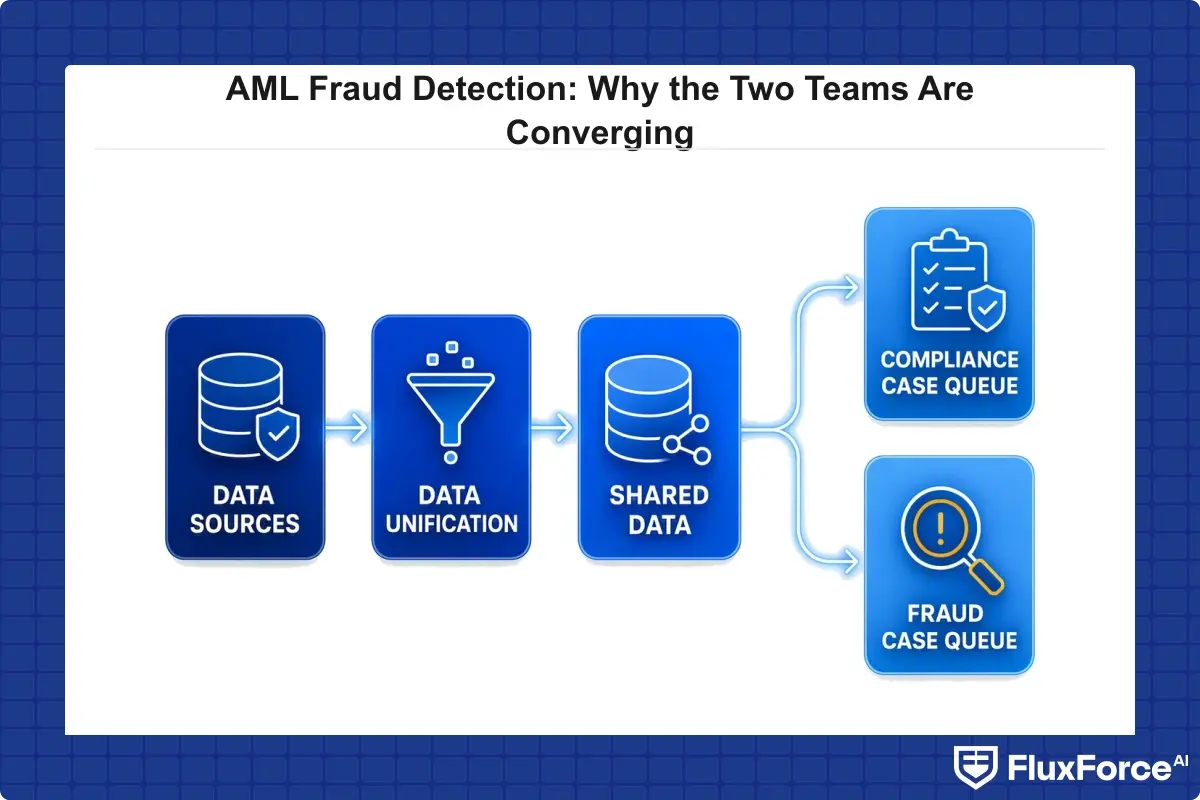
AML fraud detection is the practice of identifying money laundering activity and fraudulent transactions using a shared set of signals, models, and case management, instead of two separate systems working from different data. For most of the last two decades, that shared approach didn't exist. AML ran on rules tied to regulatory thresholds. Fraud ran on velocity checks and device fingerprinting. Neither team saw the other's alerts.
The Traditional Split: AML Compliance vs Fraud Ops
AML compliance answers to regulators. Its job is to document a defensible process, file SARs on time, and survive an exam. Fraud operations answers to the P&L. Its job is to stop the loss before it happens, in seconds, not days.
Those different mandates built different tooling, different KPIs, and often different reporting lines. A transaction that triggers a fraud hold at 2:14 PM might not reach an AML analyst's queue until the next monitoring cycle, sometimes days later.
Why Regulators and Boards Are Pushing Convergence
FinCEN's own 2018 joint statement with the federal banking agencies encouraged banks to pilot innovative approaches, including artificial intelligence and machine learning, for BSA/AML compliance rather than sticking to legacy rule sets. That statement is nearly a decade old now, and the case has only gotten stronger. Fraud rings that launder proceeds through synthetic identity fraud accounts don't respect the org chart. If your fraud engine flags the account for unusual velocity and your AML engine independently flags it for structuring, you have two disconnected alerts describing the same criminal instead of one high-confidence case.
We've seen this play out directly in engagements where a card fraud analytics program started catching AML-relevant patterns purely because the fraud model had richer behavioral data than the AML rules engine did.
How Does AI Detect Fraud? A Look Inside Modern AML Fraud Detection
AI fraud detection explained simply: instead of checking a transaction against a fixed list of rules, a model scores it against patterns learned from millions of prior transactions, both fraudulent and legitimate. That score updates continuously as new fraud patterns emerge, which is the part static rules can't do.
Machine Learning Fraud Detection: Pattern Recognition at Scale
Machine learning fraud detection works by feeding a model historical transaction data labeled as fraud or not-fraud, then letting it find the combinations of features (device, geography, transaction size, time of day, account age, counterparty history) that actually predict risk. A rules engine might flag every wire over $10,000 to a new counterparty. A trained model can tell the difference between a legitimate payroll wire and a laundering attempt that happens to be $10,000, because it's weighing dozens of contextual signals at once, not one threshold.
AI Fraud Detection in Banking: A Real-Time Example
Picture a customer who logs in from a new device, immediately adds a new payee, and initiates a transfer close to their daily limit within 90 seconds. Individually, none of those actions triggers a rule. Together, scored in real time, they push a risk score high enough to hold the transaction for review. That's real time fraud detection doing what a nightly batch job never could: acting before the money leaves the bank.
A transaction scored and held in under a second stops a loss before it happens; the same transaction caught in a next-day batch review only documents one after the fact.
This is also where synthetic identity fraud gets caught. Synthetic identities combine real and fake data (a real Social Security number paired with a fabricated name and date of birth, for example) specifically to pass static identity checks. A model trained on behavioral patterns, not just static identity fields, is far better positioned to catch the account before it's used to launder funds. If you're evaluating options here, a purpose-built fraud detection software platform that unifies AML and fraud signals into one model tends to outperform bolting AI onto a legacy rules engine.
5 Hidden Costs of Fraud Alert Fatigue
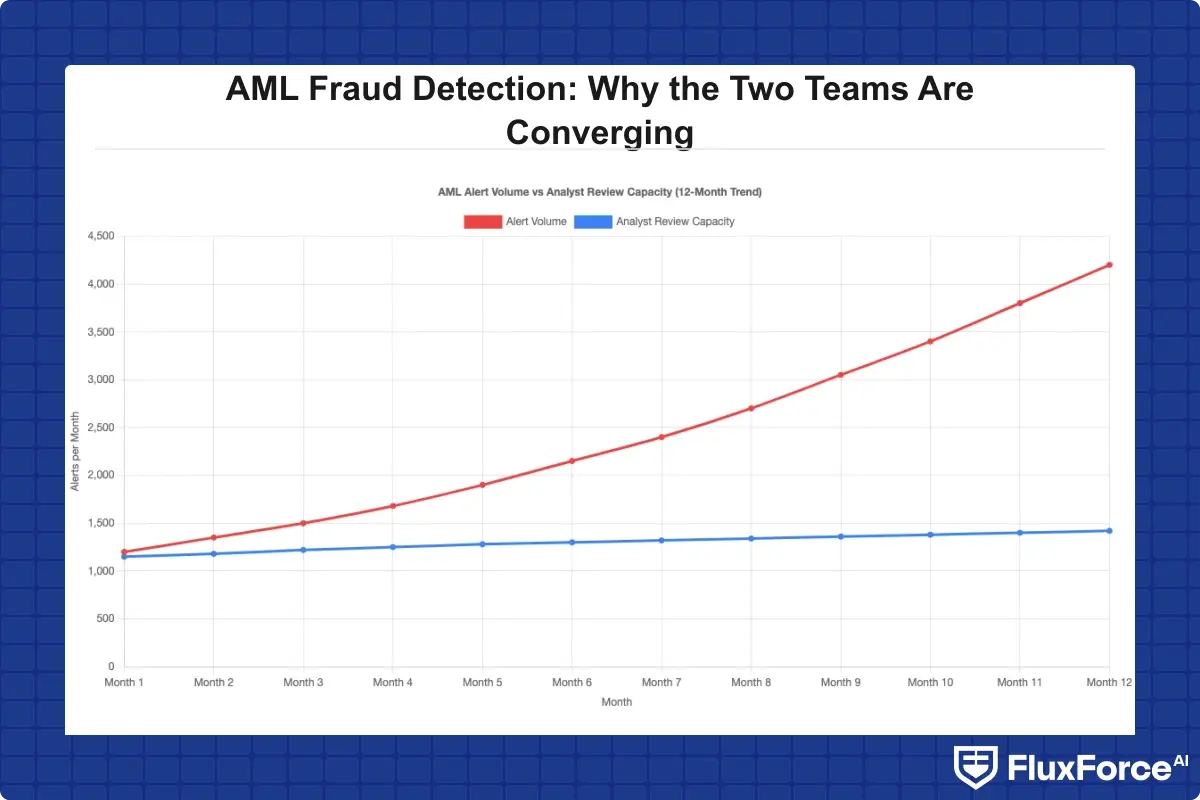
Every compliance leader knows the visible cost of alert volume: more analysts, more overtime, more outsourced review. The hidden costs are the ones that erode the program from the inside.
1. Analyst Burnout and Turnover
Analysts who spend their day closing alerts that turn out to be nothing don't stay long. Recruiting and training a replacement AML analyst takes months, and during that ramp-up window, review quality drops across the whole team.
2. The False Positive Cost Nobody Puts in the Budget
The false positive cost isn't just the analyst hours spent closing the alert. It's the case management overhead, the QA review of that closure, and the audit trail that has to be maintained for years in case a regulator asks why it was dismissed. None of that shows up as a single line item, which is exactly why it's easy to underestimate.
3. Missed Real Fraud Buried in Noise
A queue with a high false positive rate trains analysts, consciously or not, to move fast and assume most alerts are noise. That's how a genuinely suspicious transaction gets a five-second glance instead of the scrutiny it deserves.
4. Customer Friction From Over-Blocking
Legitimate customers who get their card declined or their transfer held for review don't usually complain to compliance. They complain to the call center, or they switch banks. Over-blocking is a retention problem wearing a risk-management costume.
5. Compliance Backlogs That Invite Regulatory Scrutiny
A growing backlog of unreviewed alerts is itself a finding waiting to happen. Examiners don't just look at whether you caught the bad actor; they look at whether your process could have.
Rule-Based AML Fraud Detection vs AI Transaction Monitoring Software
The honest answer on rules vs AI is that most mature programs end up running both, with AI layered on top of a rules baseline rather than replacing it outright. Pure rules are transparent but blunt. Pure AI is adaptive but harder to explain to an examiner without good model governance. The table below is a fair comparison of where each one actually wins.
Rule-Based Monitoring vs AI Transaction Monitoring Software
| Factor | Rule-Based Monitoring | AI Transaction Monitoring Software |
|---|---|---|
| Alert precision | Fixed thresholds catch known patterns, miss novel ones | Learns evolving patterns, adapts as fraud tactics shift |
| False positive rate | Typically high, since rules can't weigh context | Materially lower when properly tuned and monitored |
| Explainability | Simple to explain to auditors: "transaction exceeded $X" | Requires model documentation and governance to satisfy examiners |
| Setup effort | Faster initial deployment, fewer data requirements | Needs clean historical data and ongoing model tuning |
| Synthetic identity fraud detection | Weak; static checks are exactly what synthetic identities are built to pass | Stronger; behavioral scoring catches patterns static checks miss |
| Real-time fraud detection banks need | Possible for simple thresholds, but shallow | Native fit for scoring complex, multi-signal risk in milliseconds |
Transaction Monitoring Cost: What Changes When You Automate
Transaction monitoring cost isn't just software licensing. It's headcount, false-positive remediation, and the opportunity cost of analysts reviewing noise instead of real cases. Automated transaction monitoring shifts that cost curve: the upfront model-build and data-integration work is real, but the ongoing marginal cost per alert reviewed drops once behavioral scoring is doing the first pass. Our rule-based vs AI transaction monitoring analysis goes deeper into how that cost curve plays out over a typical 18-month program.
4 Ways to Reduce False Positives in Transaction Monitoring
How to reduce false positives in AML without weakening controls is the question every risk head eventually asks. Here are the four approaches we've seen actually move the number.
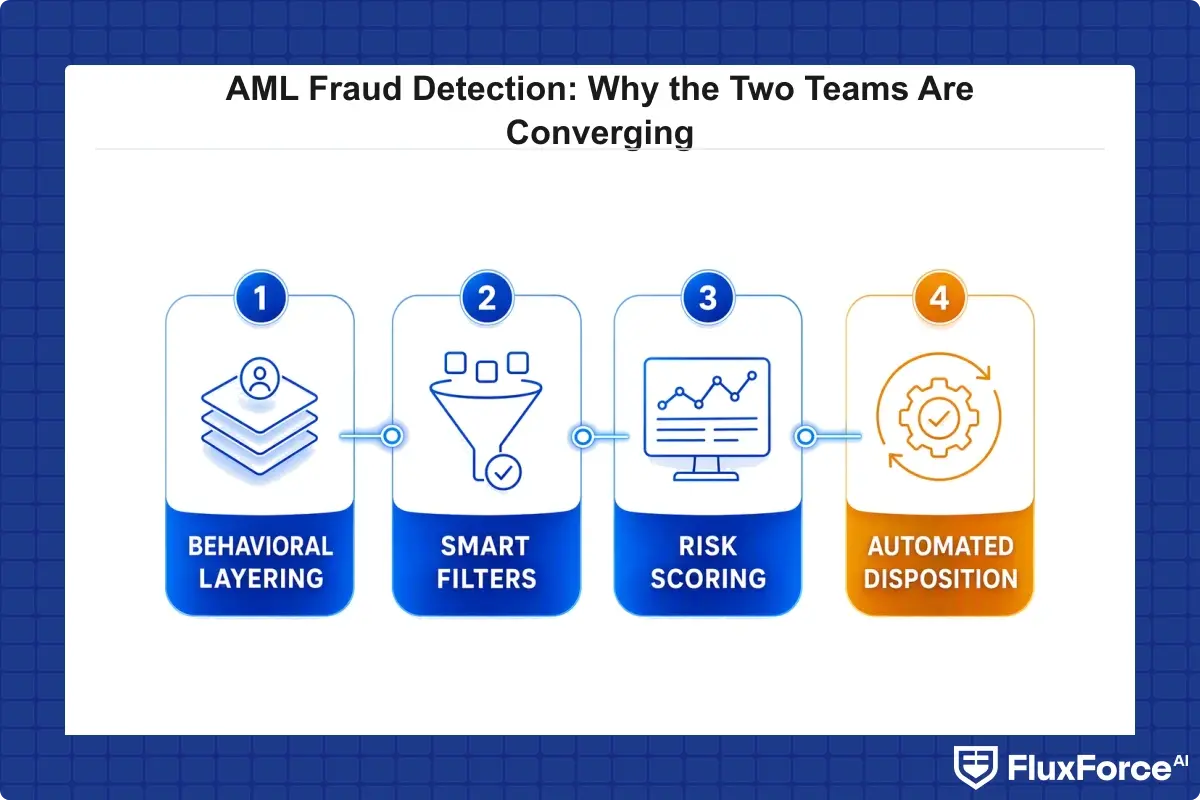
1. Layer Behavioral Analytics Onto Rules
Don't rip out your rules engine. Instead, feed rule-triggered alerts through a behavioral scoring layer that ranks them by actual risk before an analyst ever opens the case. Low-confidence alerts get batched for lighter review; high-confidence ones get escalated immediately.
2. Tune Thresholds With Real Feedback Loops
Most rules were set once, at launch, and never revisited. Feed analyst disposition data (confirmed fraud vs false positive) back into threshold tuning on a quarterly cycle at minimum. Static rules decay; the fraud patterns they were built for don't stay still.
3. Automate Case Enrichment for Analysts
A huge share of review time goes to pulling context: prior alerts on the account, device history, counterparty risk. Automating that enrichment so it's sitting in front of the analyst when the case opens cuts review time without touching the detection logic at all.
4. Route Low-Risk Alerts Through Automated Disposition
Not every alert needs a human. Alerts scored below a defined confidence threshold, with a clean account history and no prior flags, can be auto-closed with a documented rationale and periodic sampling for QA. This is the single biggest lever for false positive rate reduction, because it removes volume rather than just speeding up review.
We've documented this in more depth in how agentic AI fraud agents cut false positives by up to 80% in production environments, which is worth reading if your backlog is the main blocker to hitting SLA.
Real-Time Fraud Detection in Banking: What Changes When Teams Converge
Real-time fraud detection banks actually run in production looks different from the batch-based AML monitoring most institutions still rely on. The Federal Reserve's FedNow instant payment service is a good illustration of the pressure point: once payments settle in seconds, a detection process that runs overnight is reviewing money that's already gone.
Real-Time Fraud Detection Banks Actually Use in Production
In practice, real-time detection means scoring happens inline with the transaction, before authorization completes, not after. That requires the AML and fraud models to share infrastructure, because running two separate real-time scoring pipelines against the same transaction doubles latency and infrastructure cost for no real benefit.
Automated Transaction Monitoring and the Payment Fraud Prevention Overlap
Payment fraud prevention and AML monitoring increasingly draw on the same underlying signals: device fingerprint, behavioral biometrics, counterparty network analysis. Automated transaction monitoring that treats these as one data pipeline, feeding both a fraud score and an AML risk score from the same event, is what makes real-time review possible at all. Our work on synthetic identity fraud detection in real time covers the technical side of this in more detail.
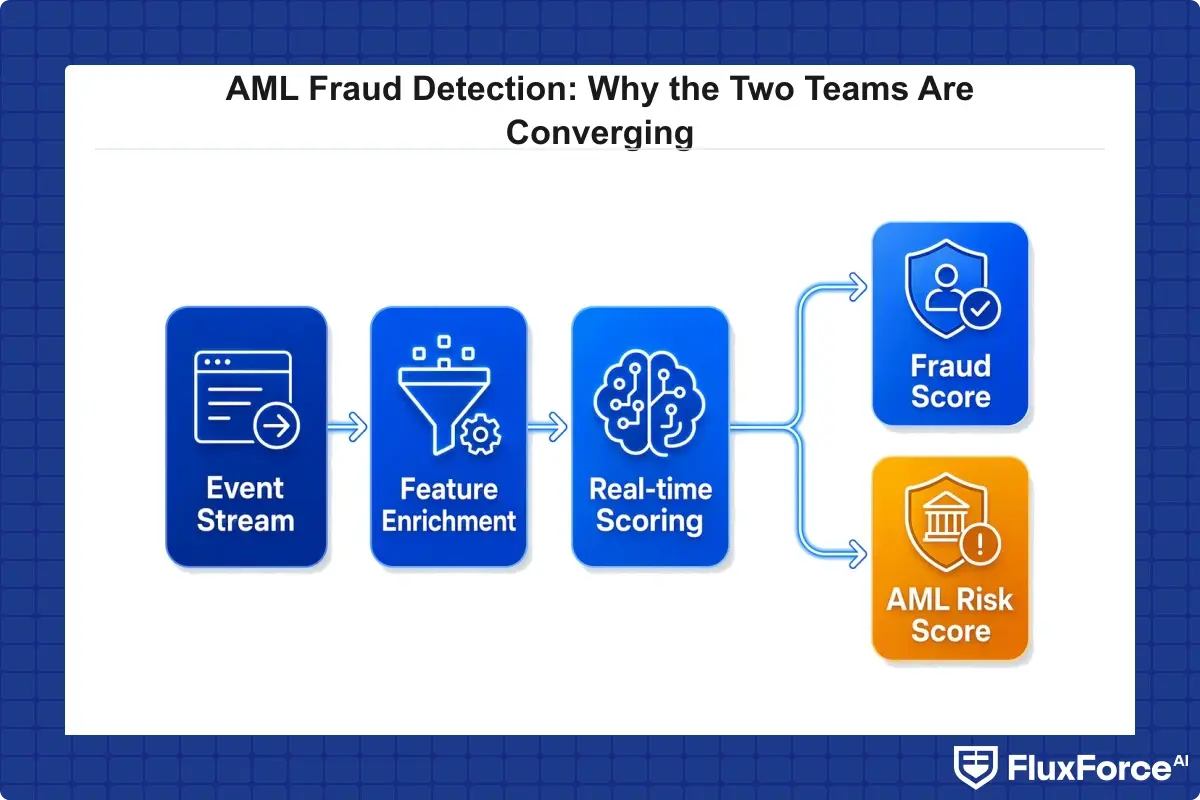
Once payments settle in seconds instead of days, a detection process that only runs overnight isn't reviewing risk anymore, it's reviewing history.
Sardine vs Unit21: Choosing AML Fraud Detection Software
The Sardine vs Unit21 question comes up constantly once a team decides to consolidate AML and fraud detection into one platform, so it's worth addressing directly rather than dodging it.
Sardine leans heavily on device and behavioral intelligence gathered at the point of transaction, which makes it strong for fintechs and neobanks focused on onboarding fraud and account takeover, with AML case management built around that same behavioral core. Unit21 takes a more workflow-first approach: a rules and case management layer designed to sit over whatever data sources you already have, with strong customization for teams that need to define their own risk logic rather than accept a vendor's model as-is.
The honest tradeoff: Sardine's behavioral-first model is faster to value for high-volume digital onboarding, but teams with complex, jurisdiction-specific AML rule requirements often find Unit21's configurability easier to defend to examiners. Neither is a universal answer; the right pick depends on whether your bigger pain point is onboarding fraud or AML rule complexity. Our comparison of AI fraud detection in banking vs traditional fraud detection is a useful next read if you're still scoping requirements before a vendor evaluation.
- AML fraud detection works best as one converged function, because the same bad actor triggers both AML and fraud signals.
- AI fraud detection scores transactions on behavioral context in real time, catching what static rule thresholds miss.
- Fraud alert fatigue has five hidden costs beyond headcount: burnout, false positive overhead, missed real fraud, customer friction, and regulatory exposure.
- Reducing false positives in transaction monitoring takes behavioral layering, threshold tuning, case enrichment, and automated disposition together, not any single fix.
- Real-time fraud detection requires AML and fraud models to share one scoring pipeline, not two separate systems reviewing the same transaction twice.
- Sardine and Unit21 solve different problems: behavioral-first onboarding fraud versus configurable AML workflow, so the right choice depends on which pain point is bigger.
Onboard Customers in Seconds
Conclusion
AML fraud detection is converging because the old split, AML on a days-long review cycle and fraud on real-time holds, no longer matches how money actually moves once instant payments are the norm. The five hidden costs of alert fatigue, from analyst burnout to the compliance backlogs examiners flag, all trace back to the same root problem: two disconnected systems generating noise instead of one system generating signal.
The fix isn't a single tool. It's behavioral scoring layered on existing rules, real-time processing shared across AML and fraud pipelines, and automated disposition that removes low-risk volume before it ever reaches an analyst. Together, those three changes are what took false positive rates from a permanent budget drain to a manageable operating cost in the programs we've worked on.
Adopting this doesn't mean ripping out your current stack overnight. It means starting with the alerts driving the most analyst hours, running behavioral scoring alongside your existing rules for a quarter, and measuring the reduction before you commit further, the kind of phased rollout that got one team we worked with to an 80% cut in reviewed false positives within two quarters. If your backlog is already past the point your team can defend in an exam, that's the place to start looking today.


Share this article