.webp)







Listen To Our Podcast🎧
Introduction
Sanctions screening software is the control that stands between your institution and a six-figure or eight-figure OFAC penalty. Banks, fintechs, and insurers are all screening the same watchlists, but the tools they use to do it vary wildly in accuracy, speed, and audit readiness. Pick the wrong platform and you inherit false positive rates that bury your operations team, or worse, miss a true match because the fuzzy-matching logic is weak.
We've sat in enough vendor demos to know the glossy feature list rarely maps to what happens in production. A screening engine that looked airtight in a sales call can choke the moment your transaction volume triples or a regulator asks for six years of decisioning logs.
This checklist walks through the exact criteria we use when a bank, fintech, or supply chain company asks us to evaluate sanctions screening software, so you can run the same evaluation before you sign a contract.
- The 7 non-negotiable capabilities any sanctions screening software must have before you sign
- How to calculate the real cost of false positives on your compliance team's time
- Why kyc automation and sanctions screening need to sit on the same data layer
- What SAR filing efficiency actually depends on (it's not the software alone)
- The 5 questions to ask a vendor that separate real AML compliance software from a rebranded rules engine
- How the EU AI Act changes vendor due diligence for financial services in 2026
Onboard Customers in Seconds

What Is Sanctions Screening Software and Why Does It Matter Now
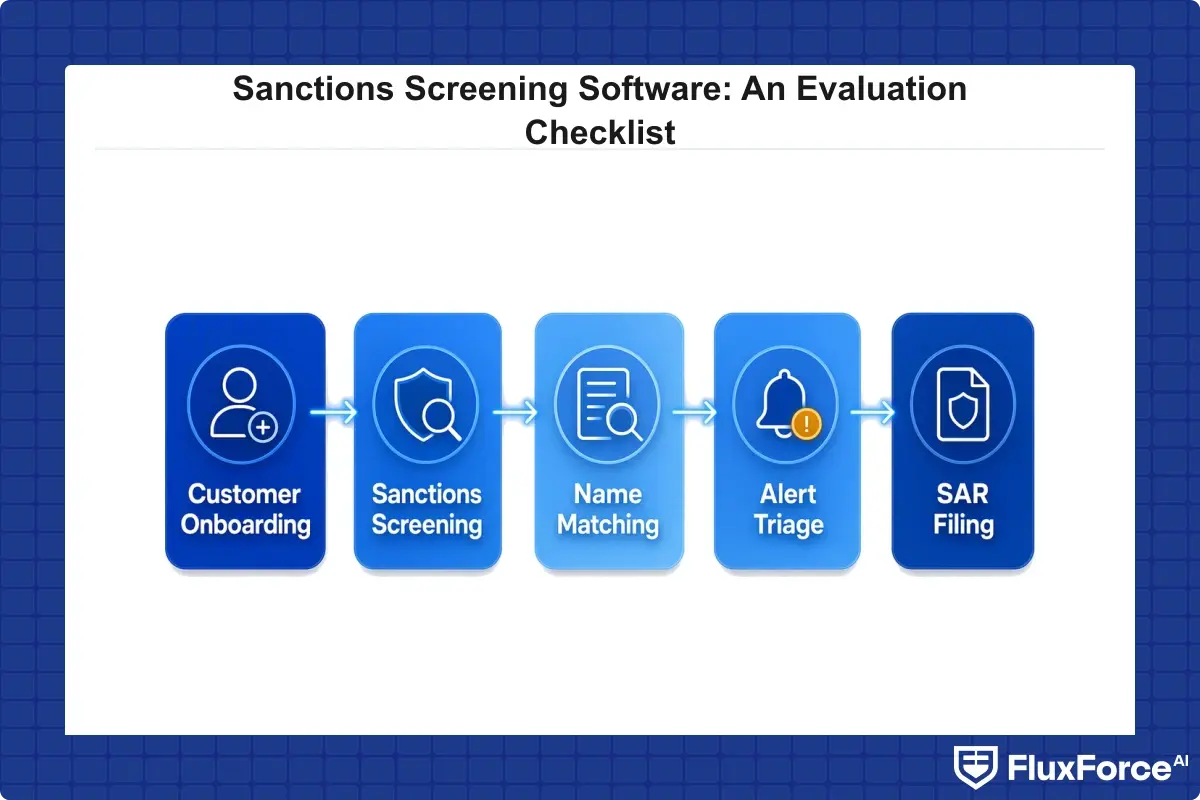
Sanctions screening software is a compliance layer that checks customers, transactions, and counterparties against government and international watchlists in real time. It matters more in 2026 than it did five years ago because sanctions lists change weekly, not annually. OFAC, OFSI, and the EU consolidated list have all increased update frequency since 2022, and a static rules engine cannot keep pace.
The pressure is compounding. Regulators expect BSA/AML program effectiveness to scale with transaction volume, not lag behind it. A fintech onboarding 5,000 new accounts a month cannot run the same manual review process a community bank used in 2015.
A screening list that updates daily is worthless if your matching engine only ingests updates weekly. Ask every vendor for their list refresh SLA in writing, not in the sales deck.
How does sanctions screening differ from transaction monitoring?
Sanctions screening checks identity and counterparty data against static watchlists at onboarding and at transaction time. Transaction monitoring looks at behavioral patterns over time to flag suspicious activity that feeds into sar filing decisions. They're complementary, not interchangeable, and a lot of vendors blur the line in their marketing.
7 Capabilities Your Sanctions Screening Software Must Have
We've narrowed this down from dozens of vendor evaluations to the seven that actually predict whether a platform holds up under real transaction volume.
1. Fuzzy name matching with tunable thresholds
Exact-match screening misses transliterated names, nicknames, and deliberate misspellings. The engine needs phonetic and fuzzy matching (Levenshtein, Soundex, or a proprietary equivalent) with thresholds your team can tune per risk segment, not a fixed global setting.
2. Real-time list ingestion
Watchlist updates should apply within hours, not during a nightly batch job. A same-day gap between an OFAC designation and your screening logic is a gap a bad actor can exploit.
3. Explainable alert scoring
Every alert needs a visible reason code: which list, which match algorithm, what confidence score. Black-box scoring fails audits and slows down analyst review because nobody can explain why an alert fired.
4. API-first architecture for kyc automation 2026 workflows
Screening can't be a bolt-on batch process anymore. It needs to plug into your onboarding pipeline via API so identity verification and sanctions checks happen in the same flow, which is the direction kyc automation is heading across the industry in 2026.
5. Case management with full audit trail
Every alert disposition, every analyst note, every escalation needs a timestamped record. Examiners will ask for this during a BSA/AML exam, and reconstructing it after the fact from spreadsheets is a nightmare we've watched clients live through.
6. Configurable risk-based screening frequency
High-risk customers should screen more often than low-risk ones. If the software forces one screening cadence across your entire book, you're either over-screening low-risk accounts or under-screening high-risk ones.
7. Native reporting for regulators and auditors
The platform should generate exam-ready reports without a data export and reformat exercise. If your team spends two days before every exam building spreadsheets from raw exports, the software has already failed this test.
| Capability | Legacy Rules Engine | Modern AML Compliance Software |
|---|---|---|
| List updates | Batch, often weekly | Near real-time, hours |
| Name matching | Exact or basic fuzzy | Phonetic + ML-tuned thresholds |
| Alert explainability | Limited or none | Full reason codes per alert |
| Integration | Manual export/import | API-first, embedded in onboarding |
| Audit trail | Spreadsheet-based | Native, timestamped, exam-ready |
| Screening cadence | Fixed, one-size-fits-all | Risk-based, configurable |
How Do You Build a BSA/AML Compliance Checklist for Community Banks?
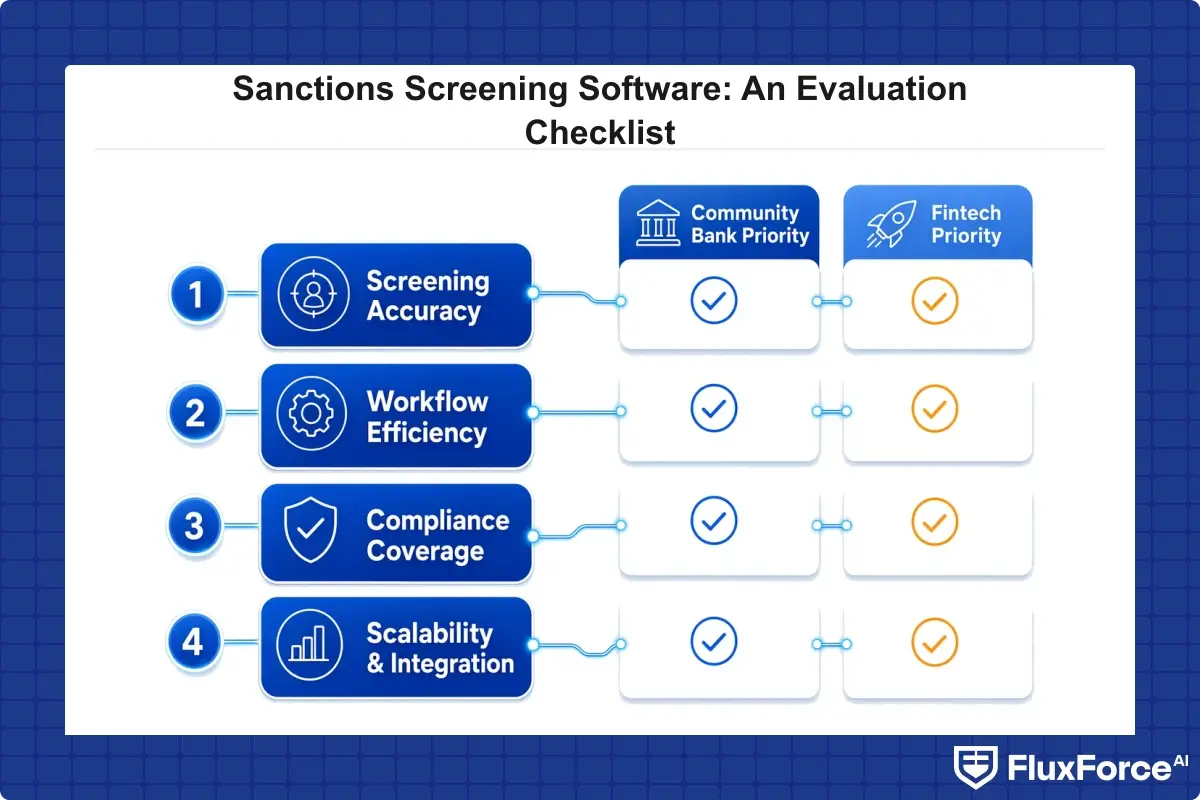
Community banks face a specific tension: examiner expectations are the same as a national bank's, but the compliance team is a fraction of the size. A bsa aml compliance checklist for community banks has to account for that staffing reality, not just regulatory theory.
What line items belong in a community bank AML checklist?
Start with these, in order of examiner priority:
- Written AML program approved by the board, reviewed annually
- Independent testing of the sanctions screening and transaction monitoring systems, not just a vendor self-attestation
- BSA officer with sufficient authority and time allocation, not a title bolted onto another role
- Ongoing employee training, documented and role-specific
- CTR filing rules compliance check, confirming your software correctly aggregates transactions across accounts to catch structuring attempts under the $10,000 threshold
We've seen community banks pass an exam on paper and still get hit with a matter requiring attention (MRA) because their screening software couldn't demonstrate independent testing results. The software has to produce evidence, not just perform the function.
Anti Money Laundering Technology 2026: What's Actually Changed
Anti money laundering technology in 2026 looks different from even two years ago, mostly because of two forces: AI-driven false positive reduction and new regulatory scrutiny of AI itself.
Why does false positive reduction matter for SAR filing efficiency?
Reducing false positives directly improves sar filing efficiency because analyst time freed from chasing noise gets redirected to genuine investigations. Rule-based systems that flag every fuzzy name match without contextual scoring can produce alert queues where the overwhelming majority are dismissed after review. Teams we've worked with have cut review time substantially after moving to context-aware scoring, based on our own client engagement experience rather than any third-party study.
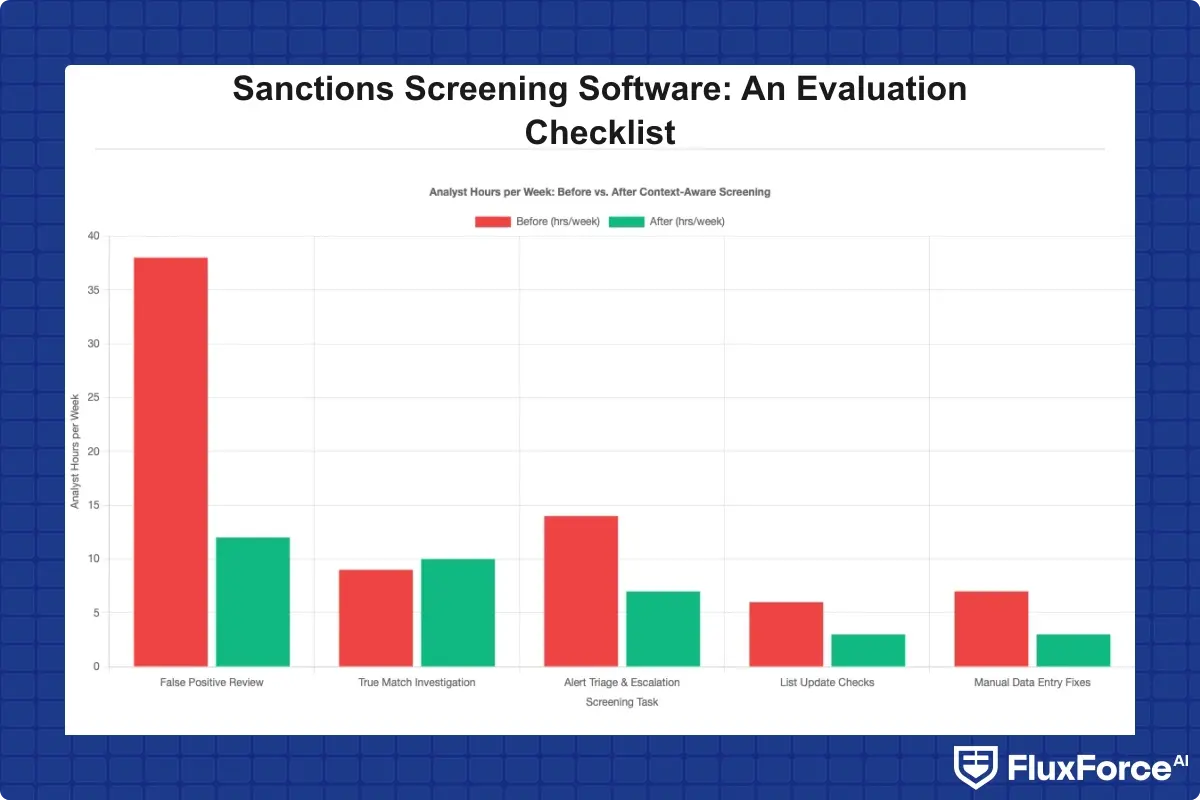
This is where regulatory compliance automation earns its keep: instead of an analyst manually clearing hundreds of low-risk alerts a week, an automation layer applies consistent risk logic across the queue and surfaces only the alerts that need a human judgment call. If you're still running screening as a standalone tool disconnected from your broader compliance stack, this is the gap worth closing first, and it's worth reading how rule-based systems compare to AI-driven false positive reduction before you commit to a vendor.
How does the EU AI Act affect financial services vendors?
The EU AI Act classifies certain AI systems used in creditworthiness and risk scoring as high-risk, which pulls sanctions screening tools with ML-based matching into scope for institutions doing business in the EU. Vendors now need to document training data provenance, bias testing, and human oversight mechanisms as part of standard due diligence, not as a special request.
If your sanctions screening vendor can't answer basic questions about how their matching model was trained or validated, that's now a compliance risk in EU markets, not just a technical curiosity.
AML Risk Assessment Guide: Where Screening Software Fits
An AML risk assessment guide typically separates institutional risk into customer, product, geographic, and delivery channel categories. Sanctions screening software should map directly onto this framework rather than treating every customer identically.
How should risk tiers change your screening configuration?
- High-risk customers (correspondent banking, MSBs, cash-intensive businesses): screen at onboarding, ongoing, and at every transaction above a low threshold
- Medium-risk customers: screen at onboarding and periodically, plus transaction-triggered rescreening
- Low-risk customers: screen at onboarding and on a fixed periodic cycle, without transaction-level rescreening unless a red flag appears
A platform that can't differentiate configuration by tier forces you into a single global setting, which either over-screens 80% of your book or leaves your highest-risk relationships under-monitored.
Enhanced Due Diligence and SAR Filing: The Software's Role
Enhanced due diligence kicks in when a customer or transaction crosses a risk threshold, and this is where screening software and case management need to work as one system, not two disconnected tools.
What does an enhanced due diligence guide require from the software?
An enhanced due diligence guide, whether internal or examiner-issued, typically requires documented source of funds, beneficial ownership verification, and ongoing enhanced monitoring. The software needs to flag when a customer's risk score crosses into EDD territory automatically, not rely on an analyst remembering to escalate manually.
SAR filing best practices your software should support
Sar filing best practices include timely filing (within 30 days of detection under standard FinCEN guidance), narrative quality, and consistent decisioning across similar cases. Good software supports this with:
- Pre-populated SAR narratives drawn from case management notes
- Consistency checks flagging when similar alert patterns received different dispositions
- Direct e-filing integration with FinCEN's BSA E-Filing system
Sar filing requirements for 2026 haven't changed structurally, but examiner tolerance for late or thin filings has tightened, particularly for institutions that have had prior MRAs.
KYC/CDD Requirements for Banks and How KYC Automation Changes the Equation
KYC/CDD requirements for banks require identity verification, beneficial ownership collection, and risk profiling at account opening, all of which should feed the same data layer your sanctions screening tool queries.
Why should sanctions screening and kyc automation share infrastructure?
When kyc automation and sanctions screening run on separate systems, you end up re-verifying the same identity data twice and reconciling discrepancies manually. A unified platform screens the customer against sanctions lists using the same verified identity record collected during onboarding, which cuts duplicate work and reduces the chance of a mismatch slipping through. This is a pattern we've discussed in more depth around KYC and identity verification strategy for high-risk sectors.
Every duplicate identity check between your KYC vendor and your sanctions screening vendor is a reconciliation task someone on your team does manually, usually without realizing it's avoidable.
AML Compliance Fintech: A Different Set of Constraints
AML compliance for a fintech looks different from a traditional bank because most fintechs run lean compliance teams and rely heavily on a banking partner or sponsor bank relationship.
What does fintech BSA AML for a small team actually require?
Fintech BSA AML for a small team means the screening software has to do more of the heavy lifting because there's no ten-person compliance department to backstop gaps. That means:
- Low-code alert configuration so a compliance lead, not an engineer, can adjust thresholds
- Pre-built regulatory reporting templates since there's no dedicated reporting analyst
- Vendor-managed list updates rather than in-house watchlist maintenance
Sponsor banks increasingly audit their fintech partners' compliance software stack directly, so the choice of sanctions screening tool isn't just an internal decision anymore. If your sponsor bank's exam team can't get straight answers about your screening vendor's matching logic, that's a relationship risk, not just a compliance one. Our piece on API security strategies for CISOs in banking covers the adjacent integration risks worth reviewing alongside this.
5 Questions to Ask Every Sanctions Screening Vendor
Before signing anything, put these five questions to the vendor directly and insist on specific answers, not marketing language.
- What is your watchlist refresh SLA, and is it contractual?
- How do you validate and document your matching algorithm's accuracy?
- Can we export the full audit trail in a format our examiners accept?
- How does your platform handle EU AI Act documentation requirements for high-risk AI systems?
- What is the average false positive rate across your client base, and how is it measured?
A vendor that hedges on all five is telling you something. A vendor that answers all five with specifics and documentation is the one worth a pilot.
- Sanctions screening software must ingest watchlist updates in near real-time, not on a weekly batch cycle.
- False positive reduction is the single biggest lever for improving sar filing efficiency and analyst capacity.
- Community banks need a bsa aml compliance checklist that produces evidence for examiners, not just internal policy documents.
- Kyc automation and sanctions screening should share a single identity data layer to avoid duplicate verification work.
- The EU AI Act now requires documentation of AI-based matching models for any vendor serving EU financial institutions.
- Fintechs with small compliance teams need vendor-managed screening infrastructure, since sponsor banks now audit the underlying software stack.
Onboard Customers in Seconds
Conclusion
Choosing sanctions screening software is a decision with regulatory consequences that show up years after you sign the contract, not weeks. The seven-capability checklist above, from real-time list ingestion to exam-ready audit trails, is the bar we hold every vendor to before recommending them to a client.
The fix isn't one tool, it's three things working together: explainable alert scoring, risk-tiered screening configuration, and shared identity infrastructure between KYC and sanctions checks. None of these are exotic asks, but plenty of legacy platforms still can't deliver all three.
Adopting this approach in practice means running a structured vendor evaluation against the checklist above rather than a feature-by-feature demo comparison, and it typically surfaces which vendors are still running rules engines dressed up as AI. In our own engagements, teams that made this switch cut their false positive review time meaningfully within the first quarter.
Pull your current screening vendor's list refresh SLA and false positive rate today, and compare them against the benchmarks in this checklist before your next contract renewal.
Share this article