.webp)







Listen To Our Podcast🎧
Introduction
Agentic AI companies are no longer a niche research topic for banks, insurers, and supply chain finance teams. By late 2026, they are the vendor category that compliance, fraud, and operations leaders evaluate first when a legacy system falls short. The shift is not cosmetic: instead of a model that scores a transaction and hands a queue to a human analyst, agentic systems investigate, gather evidence, and recommend or execute a decision on their own.
That matters because the old approach is buckling under its own weight. Rule-based transaction monitoring software throws off so many low-value alerts that analysts burn out, real fraud slips through the noise, and compliance officers spend more time closing tickets than catching criminals. We have watched this play out across banking, insurance, and cross-border trade clients, and the pattern repeats: teams do not need more alerts, they need fewer, better ones.
This guide breaks down where agentic AI companies actually stand today, what a realistic adoption roadmap looks like, and how to separate genuine fraud-fighting capability from a rebadged rules engine.
- What separates true agentic AI companies from vendors that just added a chatbot on top of old rules
- The 4-phase roadmap financial institutions are actually following, from Phase 1 (Now) through Phase 4
- Why fraud alert fatigue persists even at banks that already bought "AI" fraud tools
- How does AI detect fraud in banking, explained without the marketing gloss
- A practical way to reduce false positives in AML transaction monitoring without adding headcount
- What to check before signing with any ai fraud detection software vendor
Onboard Customers in Seconds

What Are Agentic AI Companies Bringing to Financial Services in 2026?
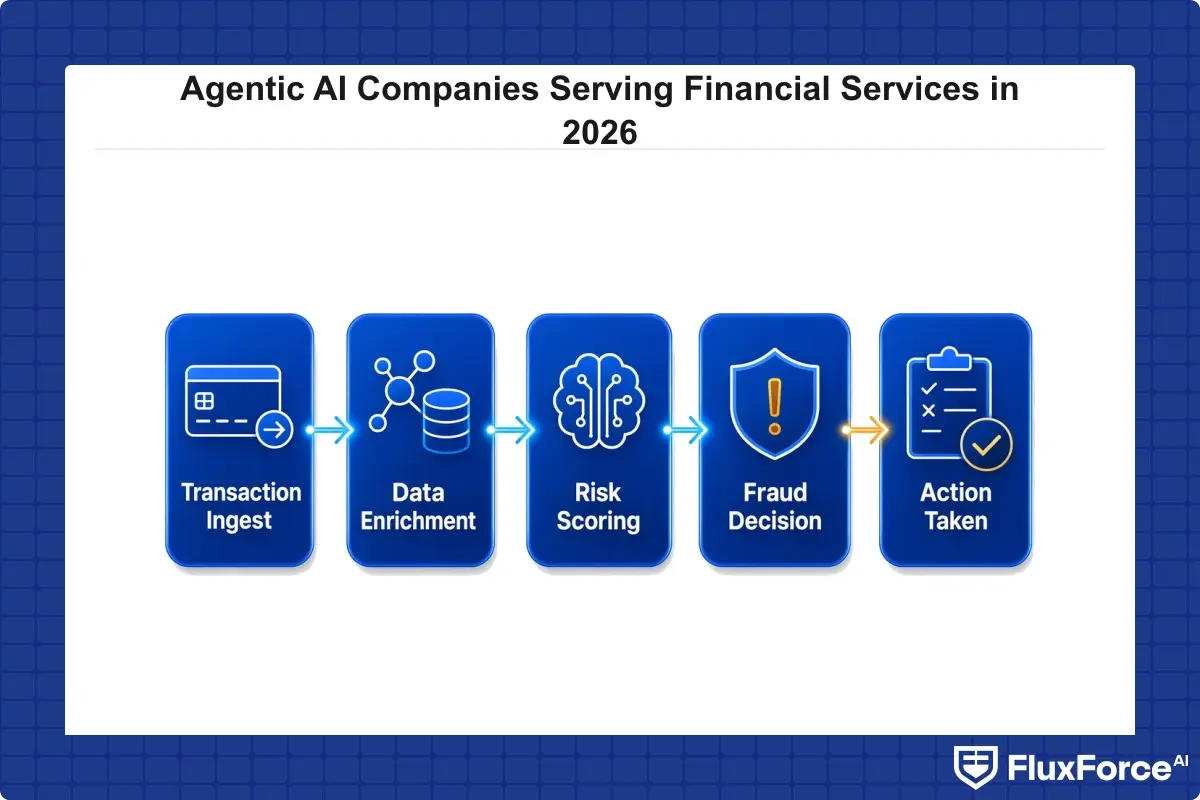
Agentic AI companies build systems that plan and act across multiple steps, not just score a single transaction. A conventional fraud model outputs a risk number; an agentic system pulls transaction history, checks device and identity signals, cross-references sanctions lists, and drafts (or files) a suspicious activity report, all without a human triggering each step.
That difference sounds incremental until you look at the workload it removes. In our client engagements, a mid-size bank's fraud team spends roughly 60-70% of analyst hours on investigations that end in "no action needed." Agentic AI companies target exactly that layer of work.
How Does AI Detect Fraud? A Quick Primer
At a technical level, AI fraud detection combines supervised models (trained on labeled fraud/not-fraud data), unsupervised anomaly detection, and increasingly, large language model agents that reason over unstructured evidence like chat logs, invoices, or KYC documents. The agentic layer is the orchestration on top: it decides which model to call, what data to pull next, and when a case needs a human.
AI Fraud Detection Explained in One Sentence
AI fraud detection explained simply: software that learns what normal customer behavior looks like, then investigates and explains deviations faster than a human analyst could. The "agentic" part is the software doing the investigating, not just the flagging.
The gap between a fraud model and an agentic AI company is not accuracy, it's autonomy. A model tells you something is suspicious; an agent tells you why, gathers the proof, and drafts the next action.
The 4 Phases of Agentic AI Adoption in Financial Services
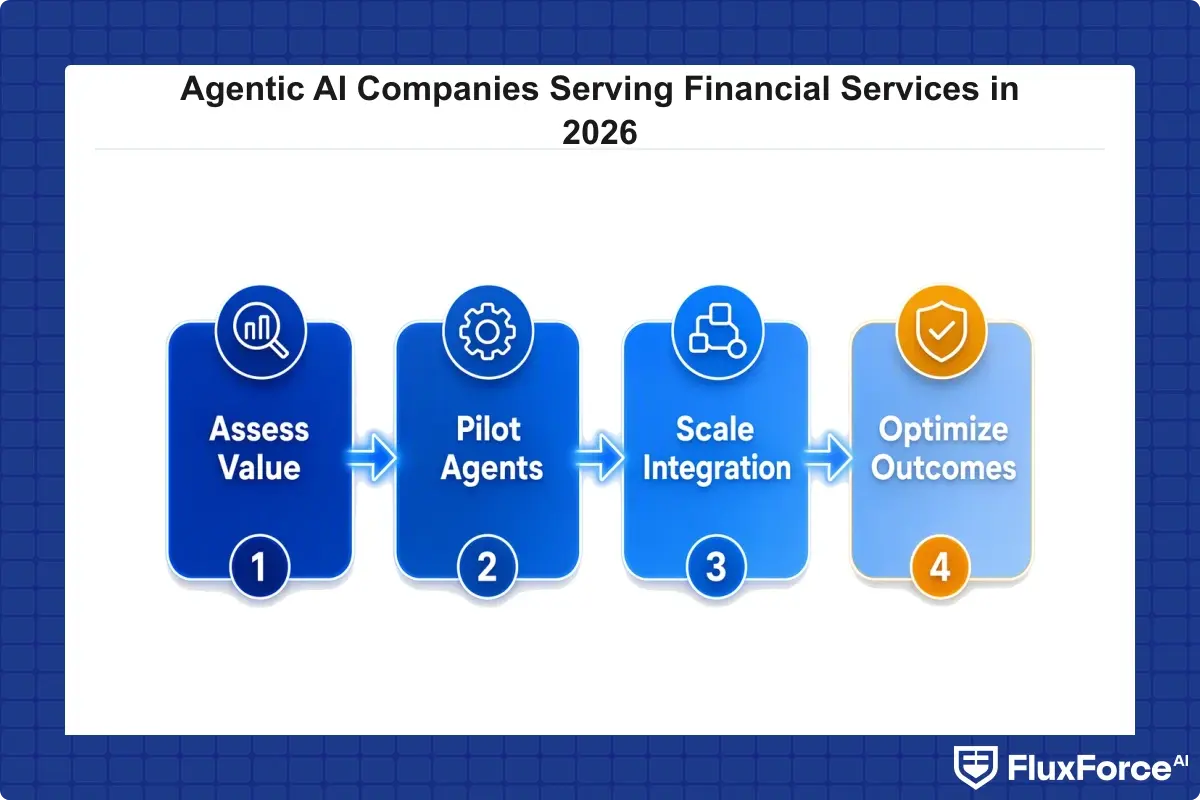
Most institutions we talk to are somewhere on a four-phase curve, whether they've named it that way or not. Here is what each phase actually involves.
1. Phase 1 (Now): Augmented Alert Triage
Phase 1 (Now) is where the majority of banks and insurers sit in 2026. Agentic AI companies plug into the existing transaction monitoring software and pre-investigate alerts, attaching evidence and a recommendation, but a human still clicks "approve" or "escalate." This phase alone typically cuts analyst review time per case by half, because the agent has already assembled the case file.
2. Phase 2: Supervised Autonomous Action
In Phase 2, low-risk, high-confidence decisions (blocking a card on a confirmed compromised-merchant pattern, for example) are executed automatically, with a mandatory audit trail and same-day human spot-checks. This is where compliance officers start trusting the system enough to shrink the review queue instead of just speeding it up.
3. Phase 3: Cross-Functional Orchestration
Phase 3 connects fraud agents to adjacent workflows: KYC/AML onboarding, sanctions screening, and claims review. An agent investigating a suspicious payment can pull the customer's onboarding history and prior claims without a human routing the request between departments. Our KYC/AML identity verification work with insurance claims teams shows this cross-functional step is usually where the real ROI shows up, not in Phase 1.
4. Phase 4: Full Regulatory Co-Pilot
Phase 4 is still mostly aspirational for regulated institutions: agents that file regulatory reports, manage sanctions list updates, and adjust monitoring thresholds in response to new typologies, with human oversight limited to periodic audits rather than case-by-case review. A small number of digital-first banks are piloting this now; see our breakdown of rolling out regulatory compliance agents in 90 days for what that pilot actually looks like.
Why Transaction Monitoring Software Still Triggers Fraud Alert Fatigue
Fraud alert fatigue happens when analysts are shown so many false alarms that they start treating every alert as noise, including the real ones. Most transaction monitoring software still runs on static, if-then rules written years ago, and rules don't adapt when fraud patterns shift.
The False Positive Cost of Fraud Detection
The false positive cost of fraud detection is rarely just analyst time. Every wrongly blocked transaction risks a frustrated, possibly departing customer. Fraud costs organizations an estimated 5% of annual revenue according to the Association of Certified Fraud Examiners, and a meaningful share of that loss traces back to real fraud missed while teams chase false positives.
False Positive Rate Fraud Detection Benchmarks
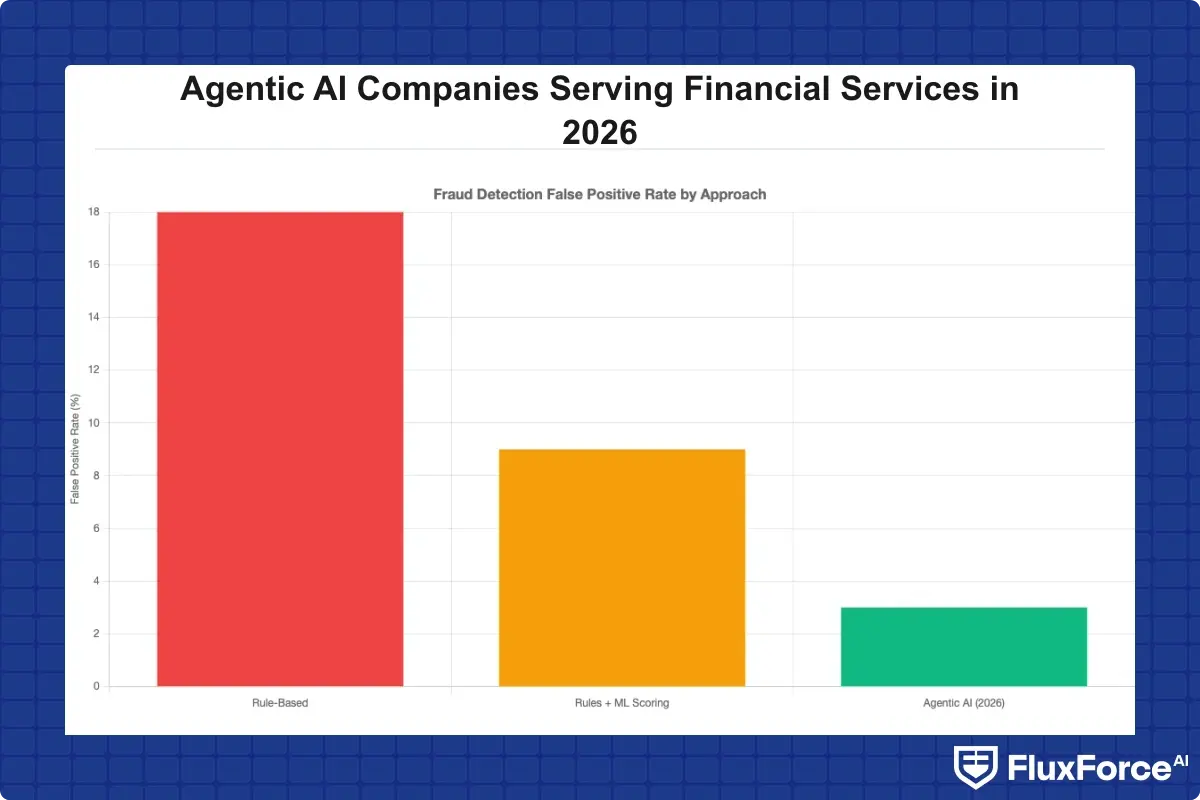
Rule-based transaction monitoring software commonly runs false positive rates above 90%, meaning fewer than 1 in 10 alerts represents genuine fraud. We've documented how agentic AI fraud agents cut false positives by roughly 80% in production deployments by learning from analyst dispositions instead of static thresholds.
A false positive rate above 90% is not a fraud detection problem, it's an attention allocation problem. Agentic AI companies win by deciding what deserves a human's attention, not by catching more fraud outright.
How Does AI Detect Fraud in Banking?
AI fraud detection in banking works by scoring every transaction against a behavioral baseline built from that customer's history, then escalating anomalies through an investigation layer. The technology stack has moved well past static rules.
Real Time Fraud Detection for Banks
Real time fraud detection banks now deploy typically scores a payment in under 200 milliseconds, fast enough to block or hold a transaction before settlement rather than clawing back funds afterward. That speed requirement is why agentic orchestration matters: a slow investigation defeats the purpose of a real-time block.
Machine Learning Fraud Detection vs Rule Engines
Machine learning fraud detection adapts as fraud patterns shift; rule engines only change when someone rewrites the rule. If you're weighing a move, our comparison of rule-based systems vs AI for false positive reduction walks through the tradeoffs in more depth than we can cover here.
Rule-Based vs Agentic AI Fraud Detection
| Capability | Rule-Based Monitoring | Agentic AI Fraud Detection |
|---|---|---|
| Adapts to new fraud patterns | Only when a rule is manually rewritten | Continuously, from labeled outcomes |
| False positive rate | Commonly 90%+ | Meaningfully lower after tuning |
| Investigation effort per alert | Fully manual | Pre-investigated, evidence attached |
| Speed to decision | Minutes to hours | Sub-second to a few seconds |
| Regulatory explainability | Simple (if-then logic) | Requires documented model governance |
For a deeper look at how this plays out for compliance teams specifically, our piece on AI vs. traditional fraud detection covers the regulatory explainability tradeoff in the table above. Teams evaluating a switch should also look at purpose-built fraud detection software rather than trying to bolt agentic behavior onto a legacy rules engine, since the underlying data pipelines are usually built for very different assumptions.
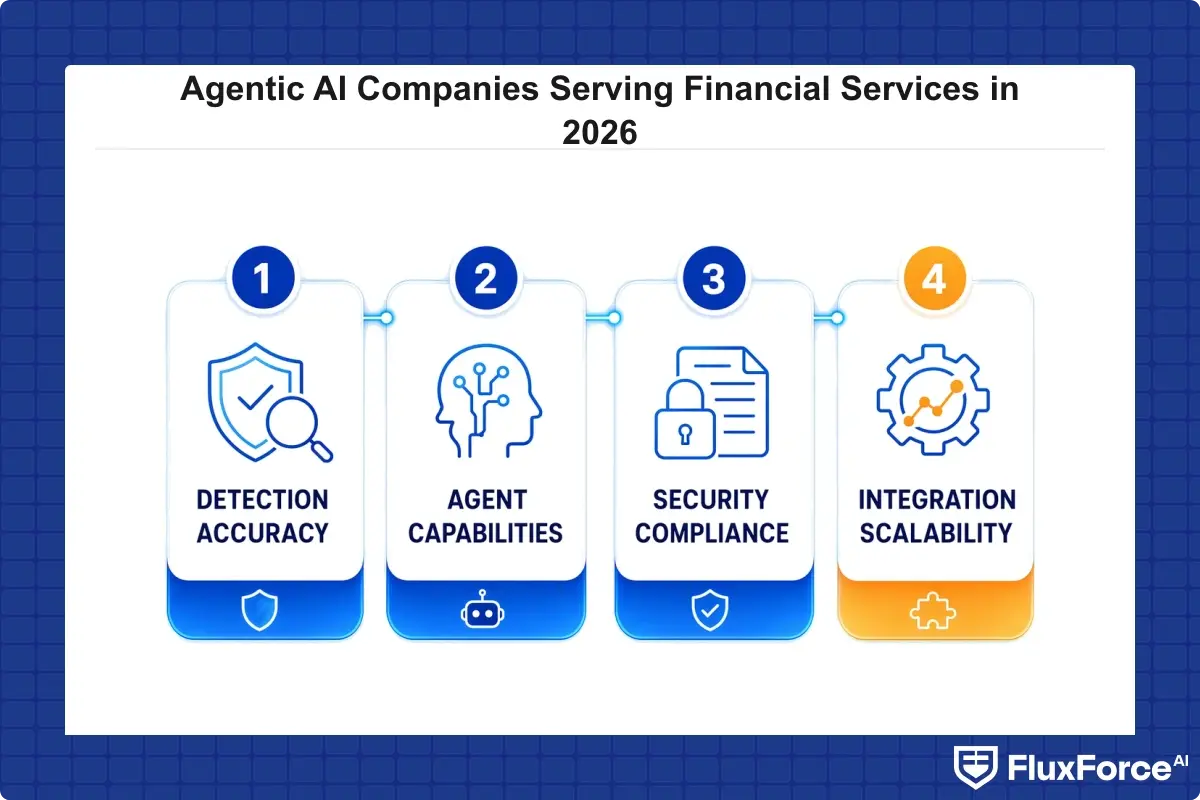
5 Agentic AI Companies Financial Institutions Are Evaluating in 2026
Vendor names shift fast in this category, so instead of a fixed leaderboard, here are the five types of agentic AI companies actually showing up in bank and insurer RFPs this year.
1. Fraud Detection Specialists
These vendors focus exclusively on transaction-level fraud, offering agentic case investigation on top of real-time scoring. They integrate directly with card networks and payment rails and tend to be the fastest to deploy.
2. AML and Transaction Monitoring Platforms
This group extends agentic investigation into anti-money laundering, automatically building the narrative for a suspicious activity report instead of leaving that to an analyst starting from a blank page.
3. Identity and KYC Agentic Platforms
These companies apply agentic reasoning to onboarding: verifying documents, cross-checking sanctions and PEP lists, and flagging synthetic identity patterns. Our writeup on detecting synthetic identity fraud in real time covers this category's core use case.
4. Core Banking Orchestration Vendors
Rather than a single point tool, these vendors embed agentic workflows across core banking modernization projects, coordinating fraud, compliance, and customer service agents through one orchestration layer.
5. Enterprise Agentic AI Platforms (Cross-Industry)
General-purpose enterprise AI platforms with financial-services-specific modules round out the field. They offer broader flexibility but usually need more configuration to meet banking-grade audit and explainability requirements, something the NIST AI Risk Management Framework is increasingly used as the baseline for evaluating.
How to Reduce False Positives in AML Transaction Monitoring
Cutting false positives in AML transaction monitoring is less about buying new software and more about disciplined rollout. Here is the sequence that has worked in our engagements.
AI Fraud Detection Software Checklist
Before signing with any ai fraud detection software vendor, confirm:
- Training data lineage: can the vendor show which historical dispositions trained the model
- Explainability output: does every decision come with a human-readable rationale for auditors
- Integration depth: does it read from your core banking and case management systems, or just sit beside them
- Threshold tuning cadence: how often does the model retrain against your institution's actual fraud patterns
- Fallback behavior: what happens when the agent is not confident enough to act alone
AI Fraud Detection in Banking: What to Measure First
Don't start by measuring fraud caught. Start by measuring alert volume reduction and analyst time per case over the first 90 days. Fraud capture rate takes longer to validate honestly, and teams that chase it too early tend to over-tune for recall and reintroduce the alert fatigue they were trying to fix. Institutions moving toward zero trust architecture alongside agentic AI tend to see the cleanest rollouts, because access controls and fraud monitoring end up sharing the same identity signals.
- Agentic AI companies differ from traditional fraud vendors by investigating and acting, not just scoring transactions.
- Most financial institutions are in Phase 1 (Now): AI pre-investigates alerts while a human still approves the final call.
- Fraud alert fatigue persists because most transaction monitoring software still runs on static rules with false positive rates above 90%.
- Real time fraud detection banks deploy today can score and block a transaction in under 200 milliseconds.
- Reducing false positives starts with measuring alert volume and analyst time, not fraud capture rate, in the first 90 days.
- Vendor evaluation should center on training data lineage, explainability, and integration depth, not marketing claims of "agentic" AI.
Onboard Customers in Seconds
Conclusion
Agentic AI companies are rewriting what financial institutions can expect from fraud and compliance software, but the shift is a roadmap, not a light switch. Most banks and insurers are still in Phase 1 (Now), where agents pre-investigate alerts and false positive rates above 90% remain the norm without intervention.
What actually closes that gap is agentic case investigation, cross-functional orchestration connecting fraud, KYC, and claims data, and a disciplined 90-day measurement plan that tracks analyst time before chasing fraud capture numbers. None of that requires ripping out your core banking stack on day one.
A realistic path forward starts small: pick one alert queue, add agentic pre-investigation, and measure the drop in analyst hours before expanding further. Teams that follow this sequence typically see the workload drop in the first quarter, well before Phase 2 automation is even on the table.
If your team is still triaging alerts manually, the next step is a straightforward vendor evaluation against the checklist above, not a full platform overhaul.

Share this article