.webp)







Listen To Our Podcast🎧
Introduction
Transaction monitoring rules are the backbone of every bank secrecy act program, and most of them are wrong in one direction or another. Set the thresholds too tight and your compliance team drowns in alerts that go nowhere. Set them too loose and a real suspicious pattern slides through untouched. Either way, the rule engine is generating noise instead of signal.
We've sat with compliance officers at community banks and fintechs who spend more time closing false alerts than investigating real ones. That's not a staffing problem. It's a tuning problem. The rules themselves, the thresholds, the scenarios, the exclusion logic, are set once during implementation and rarely touched again, even as transaction patterns, customer mix, and regulatory guidance shift underneath them.
This article walks through why transaction monitoring rules go stale, what it costs when they do, and a practical path to tuning them without opening a compliance gap. If you run AML for a bank, fintech, or insurer, this is the operational fix most teams skip.
- Why static transaction monitoring rules quietly inflate your false positive rate
- The 5 hidden costs of noisy monitoring rules, beyond analyst headcount
- A practical process for tuning rules without loosening your actual risk coverage
- How SAR filing and CTR filing accuracy improve when rules are tuned correctly
- What a modern BSA/AML compliance checklist for 2026 actually includes
- Where KYC automation fits into the rule-tuning conversation
Onboard Customers in Seconds

What Are Transaction Monitoring Rules?
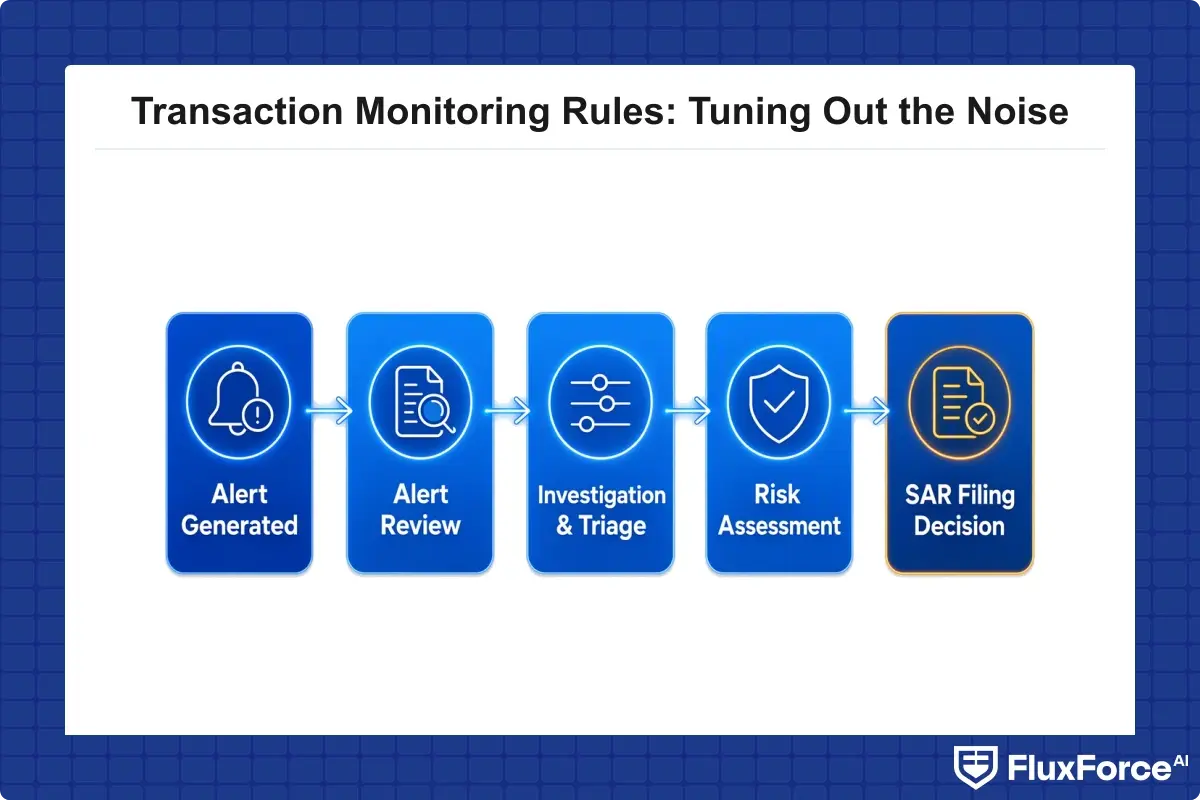
Transaction monitoring rules are the conditional logic, thresholds, and scenarios that a bank secrecy act system uses to flag transactions for review. A rule might say: flag any cash deposit over $9,000 followed by a wire out within 48 hours, or flag any account with more than five transactions just under the CTR filing rules threshold in a 30-day window.
Each rule produces alerts. Each alert requires a human or a system to decide: escalate to a suspicious activity report, or close as a false positive. The ratio between those two outcomes is the real measure of whether your transaction monitoring rules are doing their job.
Why most rule sets are built once and never revisited
Most core banking and AML compliance software ships with a starter rule library from the vendor. Teams tune it lightly during implementation to pass the validation exam, then move on. Two years later, the customer base has changed, transaction volume has tripled, and nobody has gone back to ask whether rule #14 still makes sense.
A rule set tuned once at go-live and never revisited is not a control, it's a snapshot of risk conditions that no longer exist.
The difference between a rule and a scenario
A rule is a single condition. A scenario chains multiple rules together to model a known typology, like structuring or layering. Confusing the two is a common cause of over-alerting: teams write one broad rule to try to catch a complex pattern, instead of building a scenario with tighter individual conditions.
Why AML Compliance Fintech Teams Struggle with Rule Sprawl
Fintechs inherit a specific version of this problem. A fintech bsa aml small team often runs the same rule library as a regional bank ten times its size, because the core monitoring vendor doesn't offer a lighter tier. The result is an alert queue sized for an institution with a much bigger compliance staff.
We've seen three-person compliance teams at digital lenders and payment platforms managing the same rule count as a 500-employee bank. That's not sustainable, and it's why aml compliance fintech programs lean so heavily on automation to survive an exam.
Rule sprawl compounds over time
Every new product line, every new payment rail, every new state license tends to add rules rather than replace them. Nobody wants to be the person who deletes a rule right before an exam. So the library only grows, and alert volume grows with it, even when the underlying risk hasn't changed.
- New product launch: adds 3-8 rules on average, rarely removes any
- Regulator feedback: adds targeted rules after an exam finding
- Vendor updates: ships new scenario templates that get turned on by default
- Staff turnover: incoming compliance officers often add rules they trust rather than trusting the legacy set
This is where regulatory compliance automation earns its keep. Instead of a static rule library, an automated layer can continuously reweight scenarios based on actual alert-to-SAR conversion rates, so the rule set adapts instead of just accumulating.
5 Hidden Costs of Noisy Transaction Monitoring Rules
Alert fatigue gets discussed as an analyst productivity problem. It's bigger than that.
1. Analyst burnout and turnover
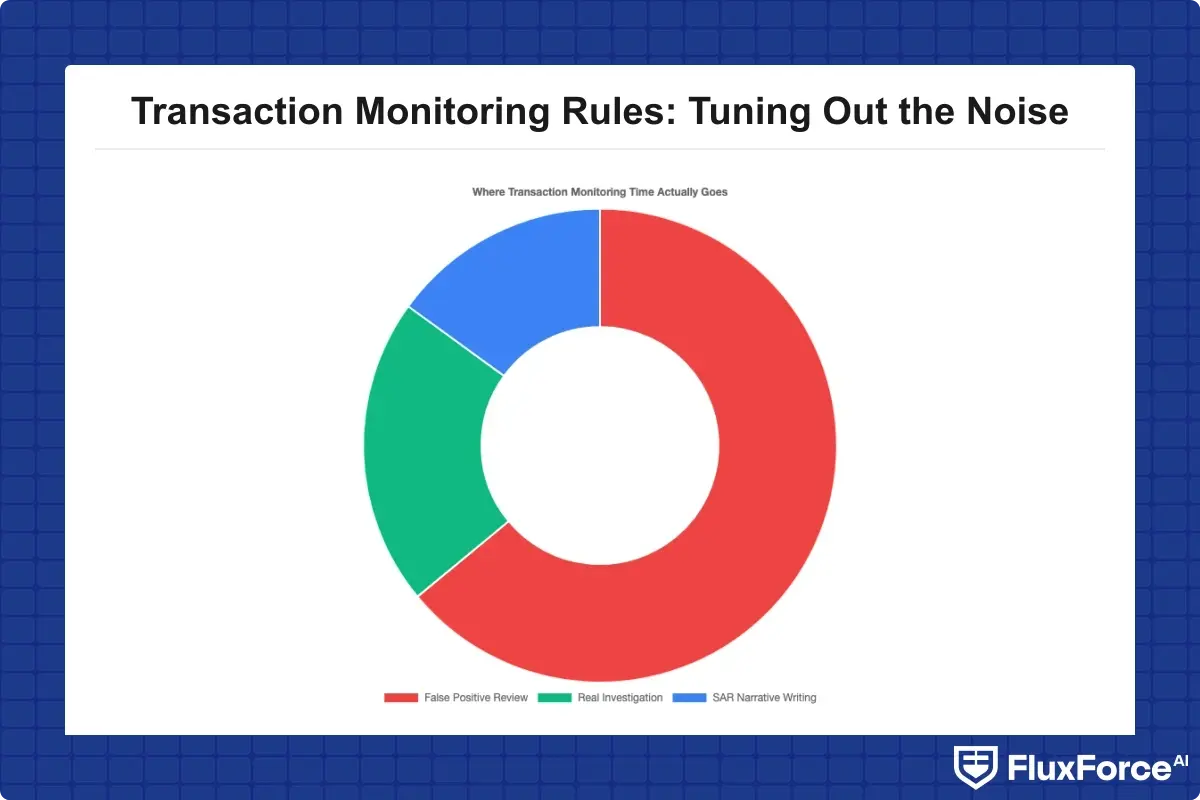
AML analyst roles have some of the highest turnover in financial services compliance, and a queue full of low-value alerts is a big driver. Training a replacement takes months, during which the backlog grows.
2. Delayed detection of real activity
When 95% of alerts are noise, the analyst reviewing alert #400 that day is fatigued and moving fast. The genuinely suspicious pattern buried in that queue gets the same 90 seconds of attention as the false positive before it.
3. Examiner findings on program effectiveness
Examiners increasingly ask not just whether you have rules, but whether you can demonstrate they're tuned to actual risk. A rule set that generates a 98% false positive rate with no documented tuning cadence is itself a finding, independent of whether any SARs were missed.
4. SAR filing efficiency losses
When analysts are buried in low-value alerts, the SARs that do get filed are often rushed, thinner on narrative detail, and filed closer to the 30-day statutory deadline than they should be. That's a direct hit to sar filing efficiency.
5. Budget spent on headcount instead of detection quality
The default response to alert volume is to hire more analysts. That's the most expensive way to solve a tuning problem, and it doesn't actually improve detection, it just processes more noise faster.
Most AML programs treat alert volume as a staffing problem when it's really a tuning problem, and tuning is dramatically cheaper than hiring.
How to Tune Transaction Monitoring Rules Without Blowing Up Compliance
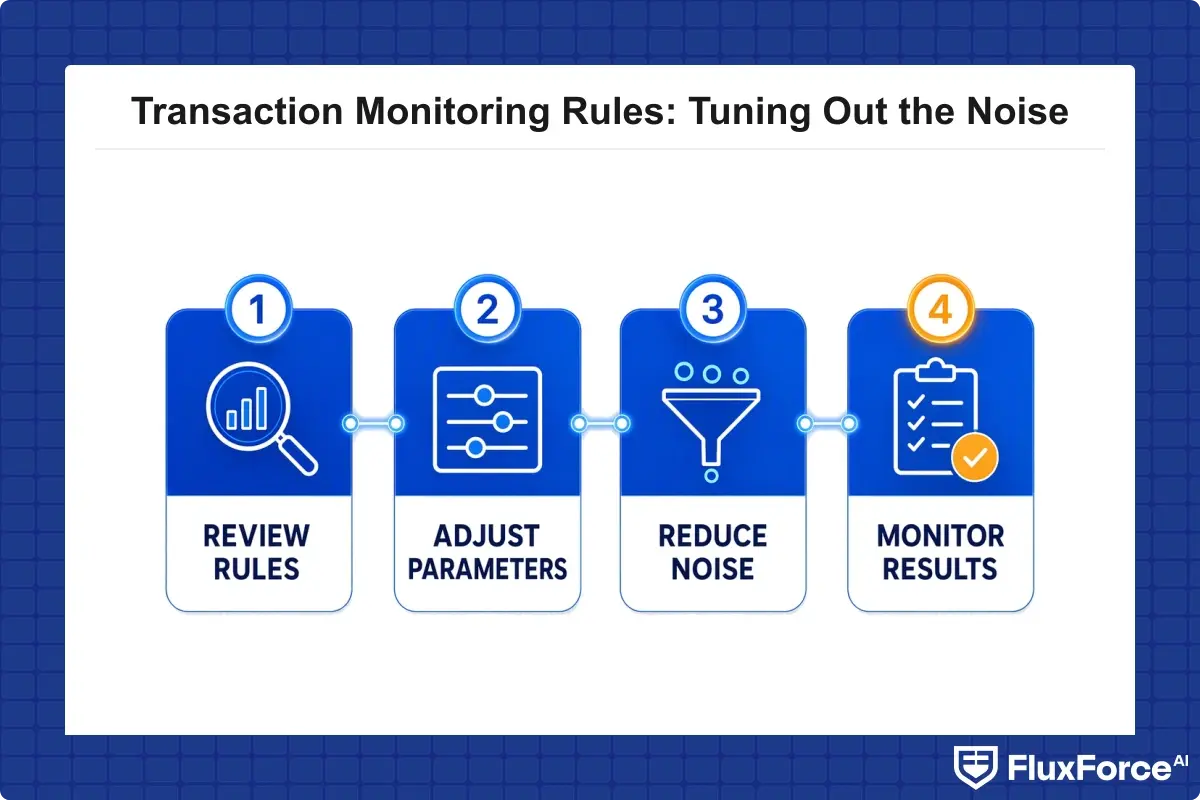
Tuning transaction monitoring rules means adjusting thresholds and scenario logic based on actual alert outcomes, without weakening coverage of your institution's real risk profile. The goal is fewer alerts that matter more, not just fewer alerts.
Start with an aml risk assessment guide, not a spreadsheet of thresholds
Jumping straight to threshold math skips the step that actually justifies the change to an examiner. A proper aml risk assessment guide approach starts with your institution's actual customer, product, and geographic risk factors, then maps rules back to those factors. If a rule doesn't tie to a documented risk, it's a candidate for removal or narrowing.
Run above-the-line and below-the-line testing
Before changing a threshold, test it against 12 months of historical data. Above-the-line testing shows what you'd still catch at the new threshold. Below-the-line testing shows what you'd have missed. Document both, because that documentation is what an examiner will want to see.
Segment rules by customer risk tier
A single global threshold across all customers is the single biggest source of over-alerting. A cash-intensive business customer and a low-risk retail depositor shouldn't trigger the same $10,000 threshold rule. Segmenting thresholds by risk tier, informed by KYC data, is usually the single highest-impact change a team can make.
Document every change with a before-and-after alert count
Regulators don't object to tuning. They object to undocumented tuning. Every threshold change needs a change log entry: what changed, why, what the alert volume was before and after, and who approved it.
Rule-Based vs Risk-Scored Monitoring
| Approach | How it works | Where it breaks down |
|---|---|---|
| Static rule-based | Fixed thresholds trigger a binary alert or no-alert | High false positive rate as customer base and volume grow |
| Segmented rule-based | Thresholds vary by customer risk tier from KYC/CDD data | Still requires manual review cycles to stay current |
| Risk-scored / AI-assisted | Continuous scoring blends multiple signals into a single alert priority | Needs model governance and explainability documentation for examiners |
We've written before about how rule-based systems compare to AI-assisted transaction monitoring for false positive reduction specifically, and the pattern holds here too: the honest answer is most institutions need a hybrid, not a wholesale replacement. Pure AI scoring without documented rule logic is its own examiner problem.
SAR Filing and CTR Filing: Where Tuning Pays Off
Tuning isn't just about analyst workload. It directly changes what shows up in your suspicious activity reports and currency transaction reports.
SAR filing best practices start with alert quality
Sar filing best practices put alert quality ahead of alert volume. A tuned rule set produces fewer alerts, but each one has a materially higher chance of representing genuine suspicious activity, which means analysts spend their time writing stronger narratives instead of triaging noise. FinCEN's own guidance on SAR filing requirements is explicit that the narrative quality, not just the filing itself, is what makes a report useful to law enforcement.
A suspicious activity report guide for 2026 filings
Under current sar filing requirements 2026, the 30-day filing clock from initial detection hasn't changed, but examiner expectations around narrative specificity have tightened. A working suspicious activity report guide for this cycle means: cite the specific rule or scenario that triggered the alert, describe the pattern in plain language, and reference any prior related filings on the same subject.
CTR filing rules still trip up growing institutions
Ctr filing rules require a report for any single or aggregated cash transaction over $10,000 in a business day, and the aggregation logic is where most gaps happen. Tuned transaction monitoring rules that correctly aggregate related transactions across accounts catch structuring attempts designed to stay just under that line. Our AML screening strategy for payments risk officers covers the aggregation logic gap in more depth if your team handles high transaction volume across linked accounts.
KYC Automation and the BSA/AML Compliance Checklist for 2026
Rule tuning and KYC data quality are two sides of the same problem. Thresholds segmented by customer risk tier are only as good as the KYC and customer due diligence data feeding them.
KYC CDD requirements banks need to keep current
Kyc cdd requirements banks must satisfy under FFIEC guidance include verified identity, beneficial ownership, expected account activity, and ongoing monitoring for material changes. The FFIEC BSA/AML Examination Manual is the authoritative reference here, and it's worth a direct read rather than relying on a vendor's summary of it.
Enhanced due diligence guide for higher-risk customers
An enhanced due diligence guide for higher-risk customers (cash-intensive businesses, correspondent banking relationships, politically exposed persons) should specify enhanced monitoring thresholds distinct from the standard customer tier. This is exactly the segmentation point from the tuning section above, applied at onboarding instead of after the fact.
Kyc automation 2026 and the BSA AML compliance checklist community banks actually use
Kyc automation 2026 deployments increasingly tie CDD refresh triggers directly into transaction monitoring rule segmentation, so a customer's risk tier updates automatically instead of waiting for an annual review. A working bsa aml compliance checklist for this cycle covers: documented risk assessment, segmented monitoring thresholds, KYC/CDD refresh cadence, SAR/CTR filing timeliness tracking, and an annual independent testing review. For a bsa aml compliance checklist community banks with lean compliance staff can realistically execute, automation isn't optional anymore, it's what makes the checklist achievable without adding headcount. Our guide on rolling out regulatory compliance agents in 90 days walks through a phased implementation for teams starting from a manual baseline.
Where the EU AI Act intersects AML tooling
Institutions operating in or serving EU customers should also track how the EU AI Act classifies AI-driven compliance tools used in financial services. Eu ai act financial services provisions treat certain credit and risk-scoring systems as high-risk, which brings documentation and explainability obligations that overlap directly with the change-log discipline described in the tuning section above. If your anti money laundering technology roadmap includes AI-assisted scoring and you serve EU customers, this isn't a future concern, it's a current one. General anti money laundering technology 2026 procurement decisions should factor this in before signing a multi-year vendor contract.
Reducing false positive volume through better rule logic and AI-assisted scoring is also the subject of how agentic AI fraud agents cut false positives, which is worth reading alongside this piece if you're evaluating vendors.
- Static transaction monitoring rules set once at go-live degrade in accuracy as customer mix and volume change.
- Alert fatigue is a tuning problem first and a staffing problem second, and tuning is the cheaper fix.
- Segmenting thresholds by customer risk tier, informed by KYC/CDD data, is usually the highest-impact single change.
- Every tuning change needs a documented before-and-after alert count to survive examiner scrutiny.
- SAR filing efficiency and CTR aggregation accuracy both improve directly when rule tuning gets prioritized.
- KYC automation and transaction monitoring rule segmentation should be linked, not managed as separate workstreams.
Onboard Customers in Seconds
Conclusion
Noisy transaction monitoring rules cost more than analyst hours. A rule set that hasn't been retuned since implementation is quietly generating a false positive rate that buries real suspicious activity reports under low-value alerts, and it's the kind of gap an examiner will flag even before a missed SAR does.
The fix isn't a rip-and-replace of your AML compliance software. It's risk-tiered thresholds built from your actual customer risk assessment, documented tuning changes with before-and-after alert counts, and automated KYC refresh cycles that keep segmentation current instead of stale. Institutions that adopt this approach typically see their alert-to-SAR conversion rate improve within one or two tuning cycles, which is the clearest signal that transaction monitoring rules are doing their actual job again.
Getting there in practice means starting with the risk assessment, not the threshold spreadsheet, and treating regulatory compliance automation as the layer that keeps tuning continuous instead of an annual scramble. Pull your last 90 days of alert-to-SAR conversion data this week and see where your rule set actually stands.
Share this article