.webp)







Listen To Our Podcast🎧
Introduction
Fraud detection and prevention are two halves of one defense, yet most teams budget for them as if they were the same thing. Prevention blocks a bad payment or a fake account before money moves. Detection finds what slipped through and sends it to an analyst or an automated action.
The split matters because each half fails in its own way. Weak prevention produces fraud losses. Weak detection produces analyst backlogs and missed cases.
This guide explains what each one covers, where AI fits, and how to combine them without burying your team in alerts.
- How fraud detection and fraud prevention differ in timing, tools, and ownership
- 4 prevention controls that stop payment fraud before a transaction settles
- How AI detects fraud, and where machine learning beats static rules
- Why false positives quietly consume analyst capacity, with a simple way to size the cost
- A 3-step plan to connect prevention and detection in one workflow
- What drives transaction monitoring cost, and what to ask vendors
Onboard Customers in Seconds

What Is the Difference Between Fraud Detection and Prevention?
Fraud prevention stops fraud before it happens by adding friction or blocking access. Fraud detection identifies suspicious activity that is already underway or has just occurred, then triggers a response. Prevention is a gate. Detection is a smoke alarm.
Neither works alone. A gate with no alarm cannot see what a stolen credential does once inside. An alarm with no gate makes you chase every incident after the loss.
What fraud detection covers
Detection covers everything that happens after a request is allowed to proceed. That includes transaction scoring, behavioral analysis, device and network signals, and case management.
- Scoring each payment or login against a risk model
- Spotting patterns across accounts, such as many accounts sharing one device
- Routing high-risk events to analysts with the evidence attached
- Feeding confirmed fraud back into the model
Fraud Detection vs Prevention: Side-by-Side Comparison
| Dimension | Fraud prevention | Fraud detection |
|---|---|---|
| When it acts | Before the event | During or after the event |
| Typical tools | MFA, identity checks, velocity limits, tokenization | Scoring models, anomaly detection, monitoring rules |
| Failure mode | Customer friction, abandoned sign-ups | Alert overload, missed patterns |
| Main owner | Security and product teams | Fraud operations and compliance |
| Output | Allow, challenge, or block | Alert, case, or suspicious activity report |
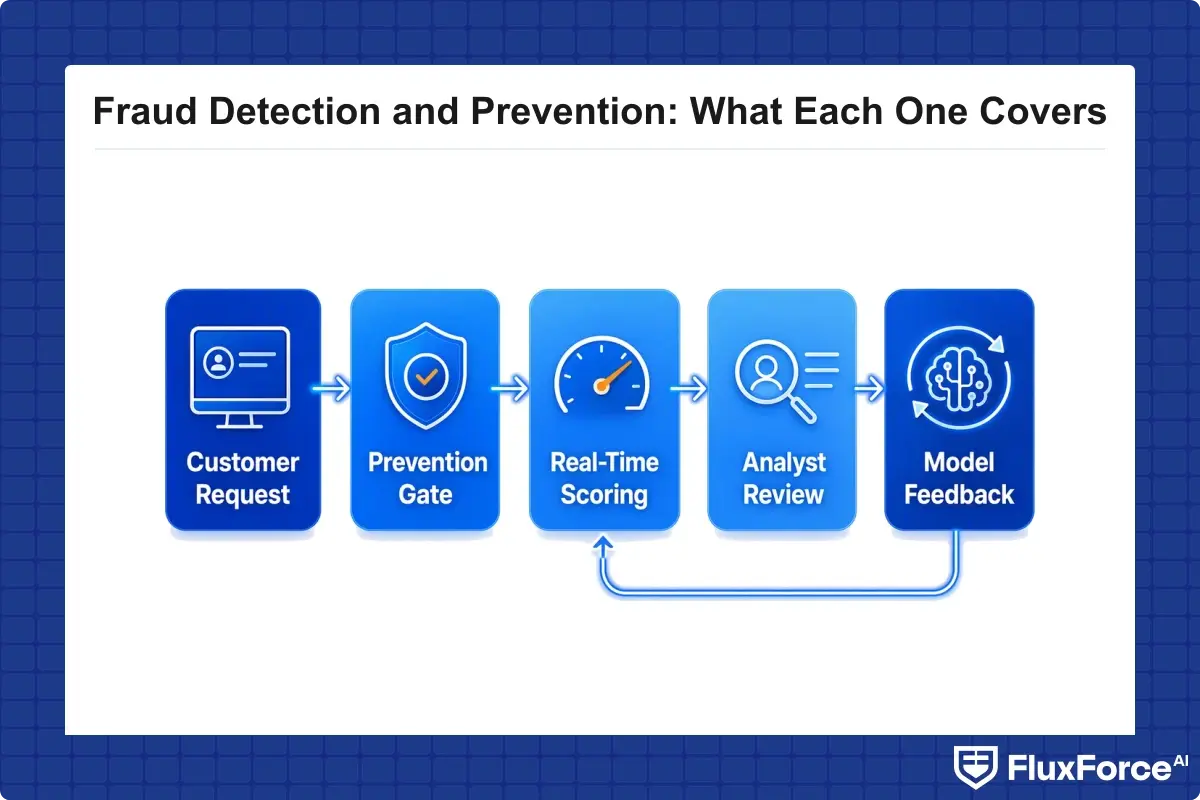
Prevention lowers how many bad events reach your systems. Detection determines how fast you catch the ones that do. Judge each on a different metric: blocked attempts for prevention, time to detect for detection.
4 Payment Fraud Prevention Controls That Stop Losses Early
Payment fraud prevention works best as layers, because each control catches what the previous one misses. These four cover most of the ground for banks and fintechs.
1. Strong Identity Verification at Onboarding
The cheapest fraud to stop is the account that never opens. Document checks, liveness tests, and data cross-matching filter fake applicants at the door. This is also your main defense against synthetic identity fraud, where real and invented data are stitched into a new persona. Our guide on detecting synthetic identity fraud in real time covers the signals that expose these profiles.
2. Step-Up Authentication
Apply extra verification only when risk is high, such as a new device paired with a large transfer. Uniform friction annoys good customers. Risk-based challenges keep it to the few who need it.
3. Velocity and Limit Controls
Cap how many payments, password attempts, or new payees an account can add in a given window. These simple limits stop many card-testing and account takeover attempts. They are blunt, so tune them by segment.
4. Payment Data Protection
Tokenization and encryption make stolen payment data useless to an attacker. For card and open banking flows, see how agentic AI supports PCI DSS and PSD2 requirements.
One honest tradeoff: every prevention control adds friction, and too much of it costs you legitimate customers. That is exactly why detection exists to cover the gaps you choose not to gate.
How Does AI Detect Fraud in Real Time?
AI fraud detection works by learning what normal behavior looks like for each customer and flagging deviations, then scoring each event within milliseconds. It combines many signals at once, such as amount, device, location, timing, and payee history, instead of checking one rule at a time.
AI fraud detection explained
AI fraud detection explained simply: a model is trained on labeled past transactions (confirmed fraud and confirmed good), learns which signal combinations predict fraud, and outputs a risk score for every new event. Analysts confirm or reject flagged cases, and that feedback retrains the model.
This is a form of machine learning applied to a classification problem, and it is why AI fraud detection in banking has moved from experiment to standard practice. For a direct comparison, read AI vs. traditional fraud detection for risk officers.
Machine learning fraud detection vs static rules
Machine learning fraud detection adapts to new patterns. Static rules only catch what someone already wrote down.
| Factor | Static rules | Machine learning |
|---|---|---|
| New fraud patterns | Missed until a rule is added | Can surface unusual clusters unprompted |
| Maintenance | Manual, grows brittle | Retraining on fresh labels |
| Explainability | Easy to read | Needs reason codes and review |
| Data needs | Low | Requires clean historical labels |
Models are not magic. They need quality labels, drift monitoring, and governance. The NIST AI Risk Management Framework is a practical reference for documenting and testing them.
Real-time fraud detection for banks
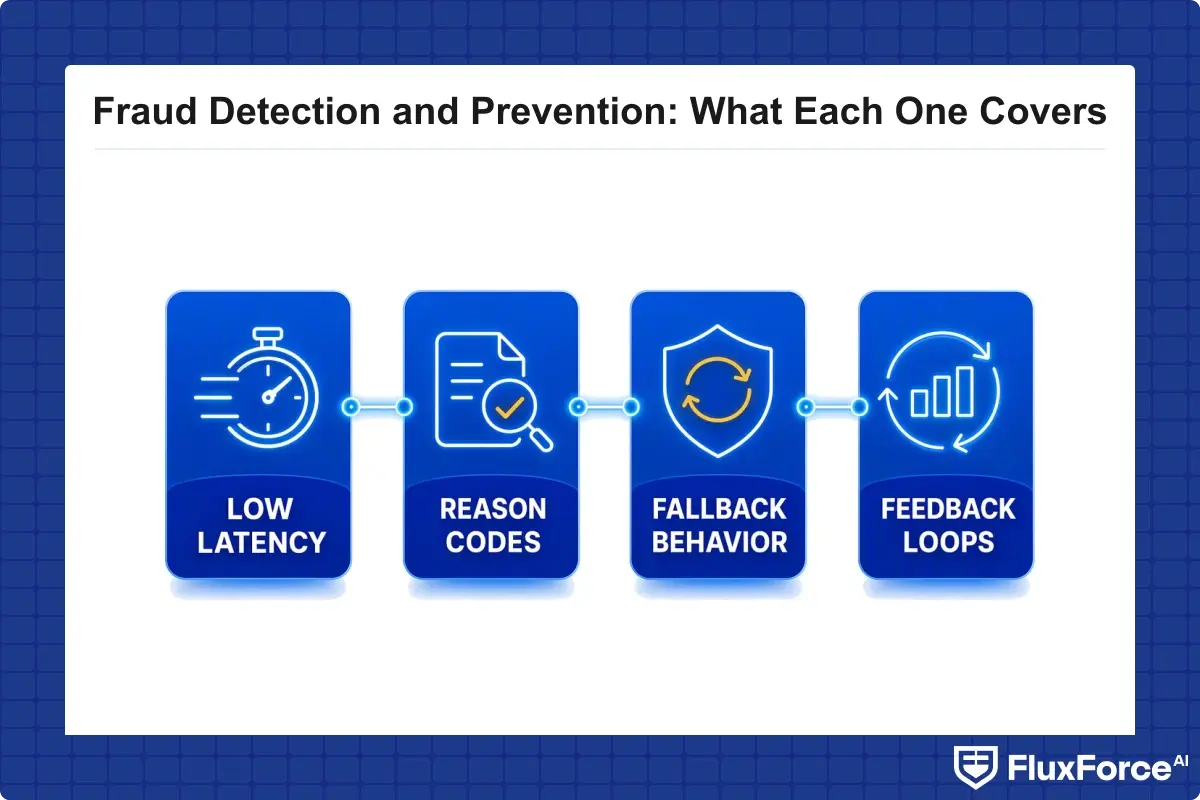
Real time fraud detection banks depend on is a latency problem as much as a modeling one. Instant payment rails leave no window to recall funds, so the decision must land before authorization completes. That means scoring in the payment path, not in a nightly batch. Teams evaluating fraud detection software should ask for p95 scoring latency and what happens when the model is unavailable.
For teams building this, AI-powered fraud detection software that scores in-line and returns reason codes is the practical starting point.
Why False Positives Undermine Transaction Monitoring
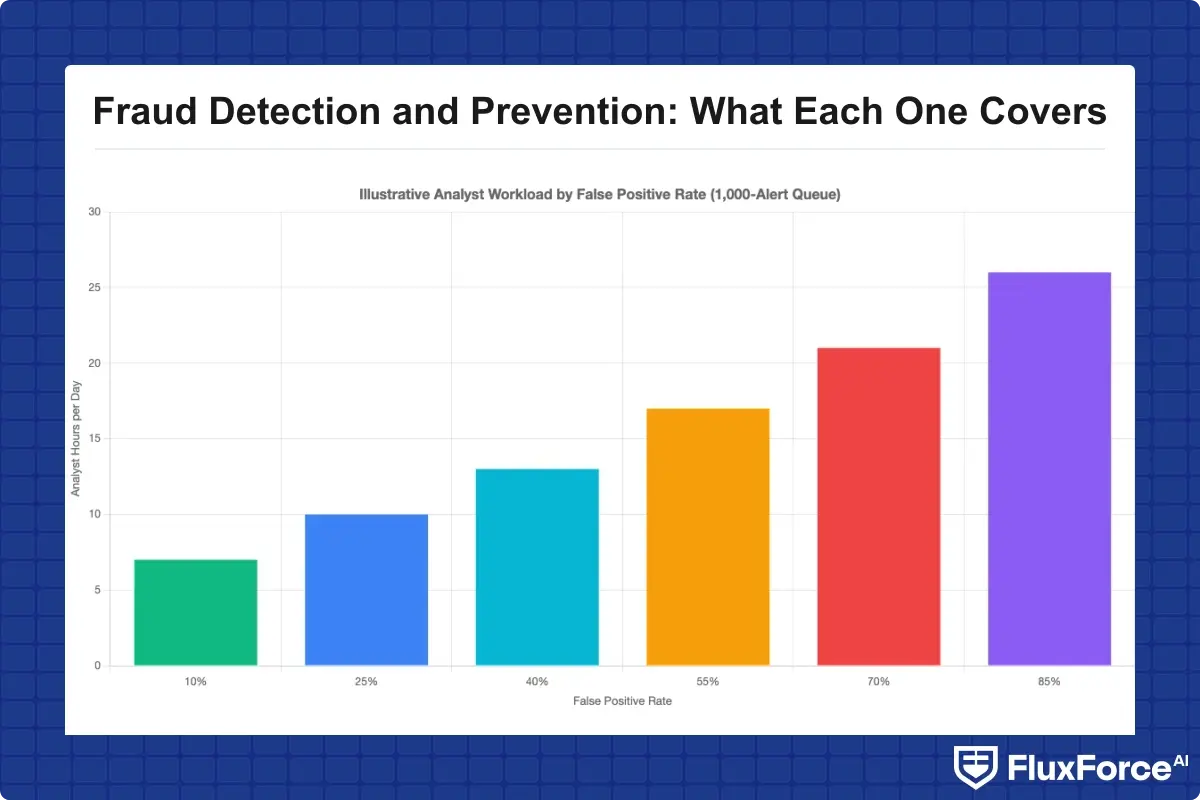
False positives fraud detection teams live with are alerts that turn out to be legitimate activity. Each one costs analyst time and, when it blocks a payment, customer goodwill. When most alerts are noise, real cases wait in the same queue.
What is the false positive cost of fraud alerts?
The false positive cost fraud teams carry is easy to size with your own numbers. Suppose you get 1,000 alerts a day and each takes 5 minutes to clear. That is about 83 analyst hours daily. Cut the false positive rate fraud detection produces by half and you free roughly 40 of those hours, before counting recovered customer transactions.
Alert volume times minutes per alert equals your real cost. A 1,000-alert queue at 5 minutes each burns about 83 analyst hours a day, so every point of false positive rate has a payroll price.
This is also where fraud alert fatigue sets in. Analysts who clear hundreds of low-value alerts start skimming, and skimming is how genuine fraud gets closed as noise.
How to reduce false positives in AML and fraud monitoring
How to reduce false positives in AML comes down to four practical moves:
- Segment your customers. A business account and a student account should not share one threshold.
- Add behavioral context. Compare each event to that customer's own history, not just a global rule.
- Tier alerts by risk. Auto-close the lowest tier with an audit trail and send the top tier to senior analysts.
- Measure the outcome. Track precision per rule and retire rules that rarely produce confirmed cases.
To reduce false positives transaction monitoring programs run today, compare rule-based systems and AI for false positives. For a case study of agentic approaches, see how agentic AI fraud agents cut false positives.
3 Steps to Combine Fraud Detection and Prevention
Combining them means treating detection findings as inputs to prevention rules. Otherwise you catch the same fraud pattern repeatedly and never stop it at the gate.
1. Map the Fraud Lifecycle
List where fraud enters: onboarding, login, payment initiation, payee changes, and claims. Mark which have a preventive control, which have detection, and which have neither. The gaps show up quickly.
2. Feed Confirmed Fraud Back Into Prevention
When analysts confirm a pattern, such as one device behind 40 new accounts, convert it into a preventive rule or a step-up trigger. Detection should shorten its own future workload.
3. Align Reporting With Regulators
Confirmed suspicious activity in the US may require a report to FinCEN. Review the FinCEN filing information so your case workflow captures the fields and deadlines you need.
What Should You Know About Transaction Monitoring Software Cost?
Transaction monitoring software cost is more than the license. The larger, less visible piece is the analyst time spent on alerts, plus tuning and integration effort. In our experience, a low-priced tool with a high false positive rate often ends up costing more than a pricier tool that cuts the queue.
What drives transaction monitoring cost?
When you calculate transaction monitoring cost, include these items:
- Licensing model: per transaction, per account, or flat platform fee
- Alert handling: analyst hours multiplied by alert volume
- Integration: data pipelines, core banking connectors, case tools
- Model upkeep: retraining, validation, and audit documentation
Automated transaction monitoring lowers the third and fourth items when it ships with pre-built connectors and model governance reports. Ask for a pilot on your own data before signing.
Comparing vendors: what a Sardine vs Unit21 search really asks
Buyers who search for Sardine vs Unit21 are usually asking three things: how quickly can it be deployed, how much of the rules logic can our team control, and how well does it reduce alert volume. We do not rank vendors here. Use those three questions, plus scoring latency and reason-code quality, as your scorecard for any shortlist.
- Fraud prevention blocks bad events before they happen, while fraud detection finds and responds to the ones that get through.
- Layered payment fraud prevention starts with identity verification and adds step-up checks, limits, and data protection.
- AI fraud detection scores events in milliseconds by comparing them to learned normal behavior, which beats static rules on new patterns.
- False positives have a payroll price: alert volume times minutes per alert.
- Feed confirmed fraud back into prevention so detection shortens its own workload.
- Judge transaction monitoring cost by total analyst effort, not license price alone.
Onboard Customers in Seconds
Conclusion
Fraud detection and prevention only work when they share data. A team clearing 1,000 alerts a day at 5 minutes each spends about 83 analyst hours on triage, and most of it is noise if prevention and detection run separately.
Three things fix that. Layered prevention controls stop the cheapest fraud at the gate. Real-time AI scoring catches what gets through in milliseconds. A feedback loop turns each confirmed case into a new preventive rule, which lowers false positives over time.
Adopting this does not require a rip-and-replace. Start by mapping your fraud lifecycle, pilot scoring on one payment channel, and measure the change in alert volume against your baseline. Map your gaps this week, then test a scoring pilot on your own transaction data.



Share this article